DEF 14A: Definitive proxy statements
Published on September 16, 2026
UNITED STATES
SECURITIES AND EXCHANGE COMMISSION
Washington, D.C. 20549
________________________________________
SCHEDULE 14A
(RULE 14a-101)
________________________________________
SCHEDULE 14A INFORMATION
Proxy Statement Pursuant to Section 14(a) of the Securities Exchange Act of 1934
|
Filed by the Registrant |
☒ |
|
|
Filed by a Party other than the Registrant |
☐ |
Check the appropriate box:
|
☐ |
Preliminary Proxy Statement |
|
|
☐ |
Confidential, For Use of the Commission Only (As Permitted by Rule 14a-6(e)(2)) |
|
|
☒ |
Definitive Proxy Statement |
|
|
☐ |
Definitive Additional Materials |
|
|
☐ |
Soliciting Material under Rule 14a-12 |
THE ELMET GROUP CO.
(Name of Registrant as Specified In Its Charter)
_________________________________________________________________
(Name of Person(s) Filing Proxy Statement, if other than the Registrant)
Payment of Filing Fee (Check the appropriate box):
|
☒ |
No fee required |
|
|
☐ |
Fee computed on table below per Exchange Act Rules 14a-6(i)(1) and 0-11. |
The Elmet Group Co.
280 Fore Street, Suite 301
Portland, Maine 04101
(207) 518-6791
September 16, 2026
Dear Fellow Stockholders:
You are cordially invited to attend The Elmet Group Co.’s 2026 Special Meeting of Stockholders (the “Special Meeting”) to be held on October 19, 2026 at 1:00 p.m. Eastern Time. The formal meeting notice and proxy statement for the Special Meeting are attached.
The Special Meeting will be a completely virtual meeting of stockholders, which will be conducted via live webcast. You will be able to attend the Special Meeting online and vote during the Special Meeting by registering for the Special Meeting at https://www.virtualshareholdermeeting.com/ELMT2026. The virtual meeting format allows attendance from any location in the world.
We have elected to provide our materials pursuant to the full set delivery option in connection with the Special Meeting. Under the full set delivery option, a company delivers all proxy materials to its stockholders. The approximate date on which the proxy materials are intended to be first sent or given to our stockholders is on or about September 17, 2026. These proxy materials include this letter, a formal meeting notice, the proxy statement and proxy card. These materials are available free of charge at https://virtualshareholdermeeting.com/ELMT2026.
Your vote is important to us. Please act as soon as possible to vote your shares. It is important that your shares be represented at the Special Meeting, whether or not you plan to attend the Special Meeting. Even if you are planning on attending the Special Meeting online, please promptly submit your proxy vote by Internet, or, if you received a printed form of proxy in the mail, by completing, dating, signing and returning the enclosed proxy, so your shares will be represented at the Special Meeting. Instructions on voting your shares are in the accompanying proxy statement you received for the Special Meeting. Internet voting facilities for stockholders of record will be available 24 hours a day and will close at 11:59 p.m. Eastern Time on October 18, 2026. If you attend the Special Meeting online and wish to vote at the Special Meeting, you will be able to do so even if you have previously returned your proxy card.
On behalf of our Board of Directors and management, it is my pleasure to express our appreciation for your continued support of The Elmet Group Co.
|
Sincerely, |
||
|
/s/ Peter V. Anania |
||
|
Peter V. Anania |
YOUR VOTE IS IMPORTANT
VOTING YOUR SHARES WILL ENSURE THE PRESENCE OF A QUORUM AT THE SPECIAL MEETING AND WILL SAVE US THE EXPENSE OF FURTHER SOLICITATION. PLEASE PROMPTLY VOTE YOUR SHARES BY FOLLOWING THE INSTRUCTIONS FOR VOTING DESCRIBED IN THE PROXY STATEMENT BY COMPLETING, SIGNING, DATING AND RETURNING YOUR PROXY CARD BY MAIL, EMAIL OR FAX AS DESCRIBED ON YOUR PROXY CARD. YOU MAY ALSO VOTE VIA THE INTERNET AS DESCRIBED HEREIN.
YOUR PROXY, GIVEN BY VOTING PRIOR TO THE SPECIAL MEETING, MAY BE REVOKED PRIOR TO ITS EXERCISE BY ENTERING A NEW VOTE OVER THE INTERNET, FILING WITH OUR SECRETARY PRIOR TO THE SPECIAL MEETING A WRITTEN NOTICE OF REVOCATION OR A DULY EXECUTED PROXY BEARING A LATER DATE, OR BY ATTENDING THE SPECIAL MEETING ONLINE AND VOTING ONLINE.
IF YOU HAVE ALREADY VOTED OR DELIVERED YOUR PROXY FOR THE SPECIAL MEETING, YOUR VOTE WILL BE COUNTED, AND YOU DO NOT HAVE TO VOTE YOUR SHARES AGAIN. IF YOU WISH TO CHANGE YOUR VOTE, YOU SHOULD REVOTE YOUR SHARES. ANY STOCKHOLDER ATTENDING THE SPECIAL MEETING ONLINE MAY VOTE EVEN IF HE OR SHE HAS RETURNED A PROXY.
The Elmet Group Co.
280 Fore Street, Suite 301
Portland, Maine 04101
(207) 518-6791
NOTICE OF VIRTUAL SPECIAL MEETING OF STOCKHOLDERS
TO BE HELD ON OCTOBER 19, 2026
1:00 P.M. EASTERN TIME
TO OUR STOCKHOLDERS:
NOTICE IS HEREBY GIVEN that the 2026 Special Meeting of Stockholders (the “Special Meeting”) of The Elmet Group Co., a Delaware corporation (“we,” “us,” “our” or the “Company”), will be held on October 19, 2026, at 1:00 p.m. Eastern Time, as a virtual meeting. You will be able to attend and vote your shares during the Special Meeting via a live webcast by registering for the Special Meeting at https://www.virtualshareholdermeeting.com/ELMT2026.
The Special Meeting will be held for the following purpose, as more fully described in the proxy statement accompanying this notice:
1. APPROVAL OF THE ELMET GROUP CO. 2026 EMPLOYEE STOCK PURCHASE PLAN. To approve the adoption of the Company’s proposed 2026 Employee Stock Purchase Plan (the “Proposal”).
In addition, at their discretion, the proxies if designated as such are authorized to vote upon such other business as may properly come before the Special Meeting or any continuation, postponement or adjournment thereof.
Our Board of Directors recommends that stockholders vote FOR the Proposal. Only stockholders of record at the close of business on August 28, 2026 (the “Record Date”) are entitled to receive notice of and to vote at the Special Meeting and any adjournments or postponements thereof. A complete list of stockholders of record entitled to vote at the Special Meeting will be available for ten days before the Special Meeting at our principal executive office for inspection by stockholders during ordinary business hours for any purpose germane to the Special Meeting. Our stock transfer books will remain open between the Record Date and the date of the Special Meeting.
The Special Meeting will be held as a virtual meeting via live webcast on the Internet on October 19, 2026, at 1:00 p.m. Eastern Time. Because the Special Meeting is completely virtual and being conducted via the Internet, stockholders will not be able to attend the Special Meeting in person. To assure your representation at the Special Meeting, please register for the Special Meeting at https://www.virtualshareholdermeeting.com/ELMT2026 and vote your proxy via the Internet at https://www.virtualshareholdermeeting.com/ELMT2026. You may revoke your proxy at any time prior to the Special Meeting. If you attend the Special Meeting online and vote, your proxy will be revoked automatically and only your vote at the Special Meeting will be counted. IF YOU RETURN YOUR PROXY CARD WITHOUT AN INDICATION OF HOW YOU WISH TO VOTE, YOUR SHARES WILL BE VOTED FOR THE PROPOSAL.
Please note: If you hold your shares in the name of a broker, bank or other nominee, your nominee may determine to vote your shares at its own discretion, absent instructions from you. However, due to voting rules that may prevent your bank or broker from voting your uninstructed shares on a discretionary basis in the election of directors and other non-routine matters, it is important that you cast your vote. Accordingly, we ask that you please complete your proxy or cast your vote at the Special Meeting to ensure your vote will count.
We will mail the proxy materials to our stockholders of record and beneficial owners, which provides instructions on how to vote online. These proxy materials are intended be first sent or distributed to our stockholders on or about September 17, 2026.
Instructions for voting on the matters presented at the Special Meeting are contained in the accompanying proxy statement (see “Voting and Related Matters”).
Your vote is very important to us. Whether or not you plan to attend the Special Meeting, we encourage you to vote promptly. You may vote by mailing a completed proxy card or by the Internet.
|
By order of the Board of Directors, |
||
|
/s/ Peter V. Anania |
||
|
Peter V. Anania |
||
|
Chief Executive Officer |
||
|
Portland, Maine |
||
|
September 16, 2026 |
The Elmet Group Co.
280 Fore Street, Suite 301
Portland, Maine 04101
(207) 518-6791
PROXY STATEMENT
The Board of Directors (the “Board” or “Board of Directors”) of The Elmet Group Co. (the “Company,” “our company,” “our,” “us” or “we”) solicits your proxy on our behalf for a special meeting of stockholders (the “Special Meeting”), to be held virtually at 1:00 p.m. Eastern Time on October 19, 2026, or at any adjournments or postponements thereof, for the purposes set forth in this proxy statement (the “Proxy Statement”), the accompanying notice, and the proxy card (collectively, the “proxy materials”).You will be able to attend the Special Meeting online and vote during the Special Meeting by registering for the Special Meeting at https://www.virtualshareholdermeeting.com/ELMT2026.
These proxy materials are being furnished by and on behalf of the Board. This notice of special meeting and the other proxy materials are available at https://www.virtualshareholdermeeting.com/ELMT2026.
We will mail the proxy materials to our stockholders of record and beneficial owners, which provides instructions on how to vote online. These proxy materials are intended be first sent or distributed to our stockholders on or about September 17, 2026.
These proxy solicitation materials are being provided to all stockholders entitled to vote at the Special Meeting. Stockholders who owned shares of common stock, par value $0.0001 per share, of the Company (the “Common Stock”) at the close of business on August 28, 2026 (the “Record Date”) are entitled to receive notice of, attend and vote at the Special Meeting.
On the Record Date, there were 30,459,498 shares of Common Stock outstanding and approximately 27 registered holders of our Common Stock. Each share of Common Stock entitles the holder to one vote.
i
QUESTIONS AND ANSWERS REGARDING OUR 2026 SPECIAL MEETING
Why am I receiving these proxy materials?
You are receiving this Proxy Statement and proxy card from the Company because, at the close of business on August 28, 2026, the Record Date, you were a holder of record of shares of Common Stock of the Company. This Proxy Statement describes the matters that will be presented for your consideration at the Special Meeting. It also gives you information concerning the matters to assist you in making an informed decision.
What is the purpose of the Special Meeting?
The purpose of the Special Meeting is to vote on the following item described in this Proxy Statement:
• Proposal: To approve The Elmet Group Co. 2026 Employee Stock Purchase Plan. This proposal is referred to as the “2026 ESPP Proposal.”
In addition, at their discretion, the proxies if designated as such are authorized to vote upon such other business as may properly come before the Special Meeting or any continuation, postponement or adjournment thereof.
What does it mean if I receive more than one set of proxy materials?
It means that your shares are held in more than one account at the transfer agent and/or with banks or brokers. Please vote all of your shares. To ensure that all of your shares are voted, for each set of proxy materials, please submit your proxy via the Internet, or by signing, dating and returning the enclosed proxy card in the enclosed envelope or via email.
Who is entitled to vote at the Special Meeting?
Holders of record of shares of our Common Stock as of the close of business on the Record Date will be entitled to notice of and to vote at the Special Meeting and any continuation, postponement or adjournment thereof. At the close of business on the Record Date, there were 30,459,498 shares of our Common Stock issued and outstanding and entitled to vote. Each share of our Common Stock is entitled to one vote on any matter presented to stockholders at the Special Meeting.
What is the difference between being a “record holder” and holding shares in “street name”?
A record holder (also called a “registered holder”) holds shares in his or her name. Shares held in “street name” means that shares are held in the name of a bank, broker or other nominee on the holder’s behalf.
What do I do if my shares are held in “street name”?
If your shares are held in a brokerage account or by a bank or other holder of record, you are considered the “beneficial owner” of shares held in “street name.” The proxy materials have been forwarded to you by your broker, bank or other nominee who is considered, with respect to those shares, the stockholder of record. As the beneficial owner, you have the right to direct your broker, bank or other holder of record on how to vote your shares by following their instructions for voting. Please refer to information from your bank, broker or other nominee on how to submit your voting instructions.
How many shares must be present to hold the Special Meeting?
A quorum must be present at the Special Meeting for any business to be conducted. The holders of one third (1/3) (33.34%) of the outstanding shares of Common Stock in voting power of our stock issued and outstanding and entitled to vote at the Special Meeting, present in person or represented by proxy, shall constitute a quorum. If you sign and return your paper proxy card via mail or email, or authorize a proxy to vote electronically, your shares will be counted to determine whether we have a quorum even if you abstain or fail to vote as indicated in the proxy materials.
Broker non-votes will also be considered present for the purpose of determining whether there is a quorum for the Special Meeting.
1
What are “broker non-votes”?
A “broker non-vote” occurs when shares held by a broker in “street name” for a beneficial owner are not voted with respect to a proposal because (1) the broker has not received voting instructions from the stockholder who beneficially owns the shares and (2) the broker lacks the authority to vote the shares at their discretion.
If you do not provide voting instructions to your broker and the broker has indicated that it does not have discretionary authority to vote on a particular proposal, your shares will be considered “broker non-votes” with regard to that matter. Broker non-votes will be considered as represented for purposes of determining a quorum but generally will not be considered as entitled to vote with respect to a particular proposal. Broker non-votes are not counted for purposes of determining the number of votes cast with respect to a particular proposal. Thus, a broker non-vote will make a quorum more readily obtainable, but the broker non-vote will not otherwise affect the outcome of the vote on a proposal that requires the affirmative vote of a majority of the shares present and entitled to vote.
Under the rules of various national and regional securities exchanges interpretations that govern broker non-votes, the Proposal is considered a non-routine matter, and a broker will lack the authority to vote uninstructed shares at their discretion on such Proposal.
What if a quorum is not present at the Special Meeting?
If a quorum is not present or represented at the scheduled time of the Special Meeting, (i) the chair of the Special Meeting (the “Chair”) or (ii) a majority in voting power of the stockholders entitled to vote at the Special Meeting, present in person or represented by proxy, may adjourn the Special Meeting until a quorum is present or represented.
How do I vote my shares without attending the Special Meeting?
We ask that stockholders vote by proxy even if they plan to attend the Special Meeting. If you are a stockholder of record, there are two ways to vote by proxy:
• by Internet — Following the instructions in the proxy materials, you can vote by Internet, prior to or at the Special Meeting before the polls close; or
• by Mail — You can vote by mail by signing, dating and mailing the proxy card using the return envelope, which you may have received by mail.
Internet voting facilities for stockholders of record will be available 24 hours a day and will close at 11:59 p.m., Eastern Time, on October 18, 2026.
If your shares are held in the name of a bank, broker or other holder of record, you will receive instructions on how to vote from the bank, broker or holder of record. You must follow the instructions of such bank, broker or holder of record in order for your shares to be voted.
How can I attend and vote at the Special Meeting?
The Special Meeting will be conducted virtually via live webcast by registering for the Special Meeting at https://www.virtualshareholdermeeting.com/ELMT2026. You are entitled to participate in the Special Meeting if you were a stockholder on August 28, 2026, which is the Record Date, or hold a valid proxy for the Special Meeting.
The Special Meeting will begin promptly at 1:00 p.m., Eastern Time, on October 19, 2026.
Will I be able to ask questions at the Special Meeting?
We will not have a segment for stockholder questions during the Special Meeting. Questions can only be submitted to us at https://www.virtualshareholdermeeting.com/ELMT2026 prior to the Special Meeting until October 18, 2026 at 11:59 p.m. Eastern Time.
2
To help ensure that we have a productive and efficient meeting, and in fairness to all stockholders in attendance, you will also find our rules of conduct for the Special Meeting posted when you log in prior to its start. These rules of conduct will include the following guidelines:
• Stockholders of record will not be able to ask questions online during the Special Meeting. You may submit questions and comments electronically through our website at https://virtualshareholdermeeting.com/ELMT2026 until October 18, 2026 at 11:59 p.m. Eastern Time.
• Only stockholders of record as of the Record Date for the Special Meeting and their proxy holders may submit questions or comments to us at https://www.virtualshareholdermeeting.com/ELMT2026 prior to the Special Meeting.
• Questions pertinent to the Special Meeting and related to our business may be answered during the webcast, subject to time constraints.
• Questions may be omitted if they are, among other things, irrelevant to our business, related to pending or threatened litigation, disorderly, repetitious of statements already made, or in furtherance of the speaker’s own personal, political or business interests.
• No audio or video recordings of the Special Meeting are permitted.
How does the Board of Directors recommend that I vote?
The Board of Directors recommends that you vote your shares of Common Stock FOR the Proposal. In addition, at their discretion, the proxies if designated as such are authorized to vote upon such other business as may properly come before the Special Meeting or any continuation, postponement or adjournment thereof.
How many votes are required to approve the Proposal?
The table below summarizes the Proposal that will be voted on, the votes required to approve each item, and how votes are counted:
|
Proposal |
Votes Required |
Voting |
Impact of |
Broker |
||||
|
Proposal: The 2026 ESPP Proposal |
The affirmative vote of the holders of a majority of the shares present in person or represented by proxy at the Special Meeting and entitled to vote on the matter. |
“FOR” |
“AGAINST”(1) |
No(2) |
____________
(1) A vote marked as “withhold” or “abstain” will have the same effect as votes against this Proposal.
(2) As this Proposal is not considered a discretionary matter, brokers lack authority to exercise their discretion to vote uninstructed shares on this Proposal. If you fail to provide your broker, nominee, fiduciary or other custodian, as applicable, with instructions on how to vote your shares, such broker, nominee, fiduciary or other custodian may not vote your shares in its/their discretion. Accordingly, such broker, nominee, fiduciary or other custodian shall not be entitled to vote, and broker non-votes will have no effect on the outcome of this Proposal.
What if I do not specify how my shares are to be voted?
If you submit a proxy but do not indicate any voting instructions, the persons named as proxies will vote in accordance with the recommendations of the Board. The Board’s recommendations are set forth above, as well as with the description of the Proposal in this Proxy Statement.
Who will count the votes?
The appointed inspector of election.
3
Can I revoke or change my vote after I submit my proxy?
Yes. Whether you have voted by the Internet or mail if you are a stockholder of record, you may change your vote and revoke your proxy by:
• voting again by Internet at a later time before the closing of those voting facilities at 11:59 p.m., Eastern Time, on October 18, 2026;
• attending the Special Meeting, virtually, and voting at the Special Meeting on October 19, 2026 (See instructions as set forth in “VOTING AND RELATED MATTERS — Methods of Voting — Voting at the Special Meeting” on page 5;
• submitting a properly signed proxy card with a later date that is received no later than October 18, 2026 at 11:59 p.m. Eastern Time; or
• if you hold shares in street name, you may submit new voting instructions by contacting your bank, broker or other nominee.
Your most recent proxy card or Internet proxy is the one that is counted. Your virtual attendance at the Special Meeting by itself will not revoke your proxy unless you give written notice of revocation to the Company before your proxy is voted or you vote at the Special Meeting.
Who will pay for the cost of this proxy solicitation?
We will pay the cost of soliciting proxies. Proxies may be solicited on our behalf by directors, officers or employees (for no additional compensation) in person or by telephone, electronic transmission and facsimile transmission. Brokers and other nominees will be requested to solicit proxies or authorizations from beneficial owners and will be reimbursed for their reasonable expenses.
Are there any rights of appraisal?
None of Delaware law, our Second Amended and Restated Certificate of Incorporation (“Amended and Restated Certificate of Incorporation”) or our Amended and Restated Bylaws (“Bylaws”), each as currently in effect, provides for appraisal or other similar rights for dissenting stockholders in connection with the Proposal to be voted upon at this Special Meeting. Accordingly, you will have no right to dissent and obtain payment for your shares.
Our Principal Executive Offices
Our principal executive offices are located at 280 Fore Street, Suite 301, Portland, Maine 04101. Our telephone number is (207) 518-6791.
4
Voting Procedures
As a stockholder of The Elmet Group Co., you have a right to vote on certain business matters affecting us. The Proposal that will be presented at the Special Meeting and upon which you are being asked to vote are discussed below in the “Proposal” section. Each share of our Common Stock you owned as of the Record Date entitles you to one vote on the Proposal presented at the Special Meeting.
Proxy Card
The proxy card enables you to appoint Peter V. Anania, our Chief Executive Officer and Chairman of the Board of Directors, and Michael Lee, our Chief Financial Officer, as your representatives at the Special Meeting. By completing and returning the proxy card or voting online as described herein, you are authorizing these individuals to vote your shares at the Special Meeting in accordance with your instructions on the proxy card. This way, your shares will be voted whether or not you attend the virtual Special Meeting. Even if you plan to attend the virtual Special Meeting, we think that it is a good idea to complete and return your proxy card before the Special Meeting date just in case your plans change. If a proposal comes up for vote at the Special Meeting that is not on the proxy card, the proxies will vote your shares, under your proxy, according to their best judgment. The form of proxy card is annexed to this Proxy Statement.
Methods of Voting
You may vote over the Internet, by mail or in person online at the Special Meeting. Please be aware that if you vote over the Internet, you may incur costs such as Internet access charges for which you will be responsible.
Voting over the Internet. The website address for Internet voting is provided on the accompanying proxy card. You will need to use the control number appearing on your proxy card to vote via the Internet. You can use the Internet to transmit your voting instructions up until 11:59 p.m. Eastern Time on October 18, 2026. Internet voting is available 24 hours a day. If you vote via the Internet, you do not need to return a proxy card. If you sign and return the proxy card or submit an electronic vote but do not give instructions on how to vote your shares, your shares will be voted as recommended by the Board.
Voting by Mail. You can vote by marking, dating and signing your proxy card and returning it in the postage-paid envelope provided. Please promptly mail your proxy card to ensure that it is received prior to the closing of the polls at the Special Meeting. If you received printed copies of the proxy materials by mail and are a beneficial holder, you may vote by proxy by filling out the vote instruction form and sending it back in the envelope provided by your brokerage firm, bank, broker-dealer or other similar organization that holds your shares.
Voting by Telephone. Using a touch-tone telephone, you may transmit your voting instructions to the number provided on your proxy card. Have your proxy card in hand as you will be prompted to enter your control number to create and submit a telephonic vote.
Voting at the Special Meeting. You may vote at the Meeting by following the instructions when you log-in for the Special Meeting. Have your proxy card in hand as you will be prompted to enter your control number to vote at the Special Meeting.
If you hold shares beneficially in “street name,” you will need to follow the voting instructions provided by your bank, brokerage or other nominee. If you hold your shares through a stockbroker, nominee, fiduciary or other custodian you may also be able to vote through a program provided through Broadridge that offers internet voting options. If your shares are held in an account at a brokerage firm or bank participating in the Broadridge program, you are offered the opportunity to elect to vote via the Internet. Votes submitted via the Internet through the Broadridge program must be received by 11:59 p.m. Eastern Time on the day before the Special Meeting.
5
Revoking Your Proxy
You may revoke your proxy at any time before it is voted at the Special Meeting. To do this, you must:
• enter a new vote over the Internet, or sign and return a replacement proxy card;
• provide written notice of the revocation to our Secretary at our principal executive office, 280 Fore Street, Suite 301, Portland, Maine 04101, which written notice must be received prior to the Special Meeting; or
• attend the virtual Special Meeting online and vote.
Quorum and Voting Requirements
Stockholders of record at the close of business on the Record Date are entitled to receive notice and vote at the Special Meeting. On the Record Date, there were 30,459,498 issued and outstanding shares of our Common Stock. Each holder of Common Stock (or restricted Common Stock) voting at the Special Meeting, either online or by proxy, may cast one vote per share of Common Stock held on the Record Date on all matters to be voted on at the Special Meeting. Stockholders may not cumulate votes in the election of directors.
The presence, in person, online or by proxy, of the holders of one third (1/3) (33.34%) of the outstanding shares of Common Stock entitled to vote constitutes a quorum for the transaction of business at the Special Meeting. Assuming that a quorum is present:
1. the adoption of The Elmet Group Co. 2026 Employee Stock Purchase Plan thereunder will be approved if approved by a majority of shares present in person, online, or represented by proxy at the Special Meeting and entitled to vote on the matter; and
Votes cast by proxy or online at the Special Meeting will be tabulated by the election inspector appointed for the Special Meeting who will also determine whether a quorum is present. The election inspector will treat abstentions and broker non-votes as shares that are present for purposes of determining the presence of a quorum. Broker non-votes occur on a matter when a broker is not permitted to vote on that matter without instructions from the beneficial owner and instructions are not given. These matters are referred to as “non-routine” matters. The 2026 ESPP Proposal is considered a “non-routine” matter. If you fail to provide your broker, nominee, fiduciary or other custodian, as applicable, with instructions on how to vote your shares, such broker, nominee, fiduciary or other custodian may not vote your shares in its/their discretion. Accordingly, such broker, nominee, fiduciary or other custodian shall not be entitled to vote, and broker non-votes will have no effect on the outcome of this Proposal. By contrast, votes marked “withheld” or “abstain” will have the same effect as votes against this Proposal.
Voting of Proxies
When a proxy is properly executed and returned, the shares it represents will be voted at the Special Meeting as directed. If no specification is indicated, the shares will be voted:
1. “FOR” the approval of The Elmet Group Co. 2026 Employee Stock Purchase Plan unless the authority to vote for such proposal is withheld.
Voting Results
Voting results will be announced at the Special Meeting and published in a Current Report on Form 8-K that will be filed with the SEC within four business days after the Special Meeting.
Holding of Stock
Most of our stockholders hold their shares in an account at a brokerage firm, bank or other nominee holder, rather than holding share certificates in their own name. As summarized below and described elsewhere herein, there are some distinctions between shares held of record and those owned beneficially.
6
Stockholder of Record
If, on the Record Date, your shares were registered directly in your name with our transfer agent, Continental Stock Transfer & Trust Company, you are a “stockholder of record” who may vote at the Special Meeting, and we will send to you these proxy materials. As the stockholder of record, you have the right to direct the voting of your shares by voting as described above. Whether or not you plan to attend the Special Meeting, please complete, date and sign the enclosed proxy card to ensure that your vote is counted.
Beneficial Owner
If, on the Record Date, your shares were held in an account at a brokerage firm or at a bank or other nominee holder, you are considered the beneficial owner of shares held “in street name,” and these proxy materials were forwarded to you by our transfer agent or by your broker or nominee who is considered the stockholder of record for purposes of voting at the Special Meeting. As the beneficial owner, you have the right to vote or to direct your broker on how to vote your shares and to attend online the Special Meeting. Whether or not you plan to attend the virtual Special Meeting, please complete, date and sign the proxy card to ensure that your vote is counted.
Proxy Solicitation
We are soliciting proxies solely on behalf of the Company and will bear the cost of this solicitation. In addition, we may reimburse brokerage firms and other persons representing beneficial owners of shares for reasonable expenses incurred in forwarding solicitation materials to such beneficial owners. Proxies also may be solicited by our directors, officers or employees, personally, by telephone, facsimile, Internet or other means, without additional compensation. We may retain a proxy solicitor to assist in the distribution of proxies and proxy solicitation materials, and in the solicitation of proxies. If we do elect to retain a proxy solicitor, we will pay the proxy solicitor reasonable and customary fees. Except as described above, we do not presently intend to solicit proxies other than by mail.
No Right of Appraisal
None of Delaware law, our Articles of Incorporation or our Bylaws provides for appraisal or other similar rights for dissenting stockholders in connection with the Proposal to be voted upon at this Special Meeting. Accordingly, our stockholders will have no right to dissent and obtain payment for their shares.
Who Can Answer Questions About Voting Your Shares
You can contact our Secretary at (207) 518-6791 or by sending a letter to our Secretary at our principal executive office, 280 Fore Street, Suite 301, Portland, Maine 04101, with any questions about the Proposal described in this Proxy Statement or how to execute your vote.
7
EXECUTIVE AND DIRECTOR COMPENSATION
This section sets forth the material components of the executive compensation program for our named executive officers for the years ended December 31, 2025 and 2024. Individuals we refer to as our “named executive officers” or “NEOs” include our CMC Division President, Chief Executive Officer and Chief Financial Officer.
Summary Compensation Table
The following table presents the compensation awarded to or earned by or paid to our named executive officers during the fiscal years ended December 31, 2025 and 2024.
|
Name and Principal Position |
Year |
Salary |
Bonus |
Stock |
Non-Equity |
Nonqualified |
All Other |
Total |
||||||||||||
|
Peter V. Anania |
2025 |
250,962 |
— |
|
— |
— |
— |
$ |
60,069 |
(9) |
$ |
311,031 |
||||||||
|
Chief Executive Officer and Chairman(4) |
2024 |
251,923 |
— |
|
— |
— |
— |
|
74,529 |
(10) |
|
326,452 |
||||||||
|
|
|
|
|
|||||||||||||||||
|
Derek Fox |
2025 |
323,635 |
— |
|
2,298,850 |
177,277 |
— |
|
93,075 |
(11) |
|
2,892,837 |
||||||||
|
President of our CMC Division(5) |
2024 |
284,964 |
788,527 |
(7) |
— |
185,009 |
— |
|
86,295 |
(12) |
|
1,344,795 |
||||||||
|
|
|
|
|
|||||||||||||||||
|
Michael Steven Lee(6) |
2025 |
240,000 |
40,000 |
(8) |
1,409,975 |
96,000 |
— |
|
5,885 |
(13) |
|
1,791,860 |
||||||||
|
Chief Financial Officer |
2024 |
— |
— |
|
— |
— |
— |
|
— |
|
|
— |
||||||||
____________
(1) Amounts reflect the base salary actually paid to each named executive officer in the fiscal years ended December 31, 2025 and 2024.
(2) Amounts reported represent the aggregate grant date fair value of restricted stock awards granted to our executive officers during 2025, under either our 2016 Plan or 2025 Plan computed in accordance with Financial Accounting Standards Board Accounting Standards Codification Topic 718, Compensation — Stock Compensation (“ASC Topic 718”), excluding the effect of estimated forfeitures. The assumptions used in calculating the grant date fair value of the restricted stock awards reported in these columns are set forth in the notes to our audited consolidated financial statements included elsewhere in this prospectus. These amounts will not reflect the actual economic value that may be realized by the named executive officers.
(3) Amount reflects annual performance-based incentive cash compensation that were earned by each named executive officer based on the Company’s performance during the fiscal years ended December 31, 2025 and December 31, 2024.
(4) Mr. Anania’s compensation received for 2025 and 2024 was in connection with his position as Chief Executive Officer of Anania & Associates (“A&A”) and Chief Executive Officer of Elmet Tech.
(5) Mr. Fox’s compensation received for 2025 was in connection with his position as President of our CMC division and for 2024 was in connection with his position as Chief Financial Officer of our CMC division (except for the bonus payment referenced in footnote 7 to this table).
(6) Mr. Lee was hired on March 17, 2025 and compensation received for 2025 was in connection with his position as Chief Financial Officer of A&A.
(7) Amount reflects the bonus paid to Mr. Fox in November 2024 for his promotion to President of our CMC division, which became effective as of March 2025.
(8) Mr. Lee received a sign-on bonus in connection with his commencement of employment.
(9) Amount in this column reflects an automobile allowance of $10,200, credit card points converted to cash of $27,508, personal credit card payments of $6,625 and personal expenses of Mr. Anania paid by the Company on his behalf of $15,736.
(10) Amount in this column reflects an automobile allowance of $10,200, credit card points converted to cash of $29,791, personal credit card payments of $13,700 and personal expenses of Mr. Anania paid by the Company on his behalf of $20,838.
(11) Amount reflects matching contributions to the 401(k) Plan (as defined below) of $14,000, board fees of $50,000, an automobile allowance of $10,800, company profit sharing contribution to the 401(k) Plan (as defined below) totaling $17,500, and personal expenses of Mr. Fox paid by the Company on his behalf of $775.
(12) Amount reflects matching contributions to the 401(k) Plan (as defined below) of $11,073, board fees of $50,000, an automobile allowance of $10,800, company profit sharing contribution to the 401(k) Plan (as defined below) totaling $13,841, and personal expenses of Mr. Fox paid by the Company on his behalf of $581.
(13) Amount reflects matching contributions to the A&A 401(k) plan of $5,885.
8
Narrative to Summary Compensation Table
2025 Salaries
The named executive officers receive a base salary to compensate them for services rendered to our Company. The base salary payable to each named executive officer is intended to provide a fixed component of compensation reflecting the executive’s skill set, experience, role and responsibilities. The base salaries for Mr. Anania, Mr. Fox and Mr. Lee for 2025 were $250,962, $323,635 and $240,000, respectively.
2025 Bonuses
In March of 2025, Mr. Lee joined the company as CFO of A&A. As part of the hiring, Mr. Lee received a one-time discretionary bonus of $40,000.
2025 Non-Equity Incentive Plan Compensation
For 2025, Mr. Anania, being the primary shareholder of A&A, did not have a structured incentive compensation plan.
For 2025, Mr. Fox’s target bonus was 50% of his annual base salary. Eligibility was based upon the achievement of pre-determined performance goals of Elmet Tech for 2025, including goals related to successfully succeeding Mr. Anania as President of Elmet Tech, as well as financial goals of adjusted EBITDA and cash flow. Under the 2025 bonus program, participants were eligible to receive up to 170% of the participant’s target bonus opportunity. Based upon the attainment of applicable performance measures, his 2025 annual bonus was determined to be earned at approximately 110% of target.
For 2025, Mr. Lee’s target bonus was 40% of his annual base salary. Eligibility was based upon the achievement of pre-determined performance goals associated with preparation for our initial public offering, as well as financial goals of adjusted EBITDA. Based upon the attainment of applicable performance measures, his 2025 annual bonus was determined to be earned at approximately 100% of target.
2025 All Other Compensation
The named executive officers were eligible for certain other benefits as part of their employment during 2025, including matching 401(k) plan contributions paid by the Company, automobile allowances, payment of certain personal expenses, and profit sharing.
Equity Compensation
Equity Compensation Plans
Prior to the initial public offering, Elmet Tech maintained the 2016 Plan Unit Appreciation Rights Plan (the “2016 Plan”), and Elmet maintained the 2025 Equity Incentive Plan (the “2025 Plan”), each in order to provide our service providers the opportunity to acquire a proprietary interest in our success. For additional information about the 2016 and 2025 Plans, please see “— Equity Incentive Plans” below. No further awards will be granted under either the 2016 Plan or the 2025 Plan.
We have adopted a 2026 Equity Incentive Plan (the “2026 Plan”) in order to facilitate the grant of cash and equity incentives to directors, employees (including our named executive officers) and consultants of our Company and certain of our affiliates and to enable us to obtain and retain the services of these individuals, which is essential to our long-term success. For additional information about the 2026 Plan, please see “— 2026 Equity Incentive Plan” below.
9
2025 Equity Grants
The following table sets forth the stock awards granted to our named executive officers in the 2025 fiscal year.
|
Named Executive Officer |
Type of Award |
# Granted |
|||
|
Peter V. Anania |
N/A |
— |
|
||
|
Derek Fox |
Restricted Stock |
328,390 |
(1) |
||
|
Michael Steven Lee |
Restricted Stock |
122,500 |
(2) |
||
____________
(1) Mr. Fox was granted 14,546 unvested restricted membership units of Elmet Technologies LLC (“Elmet Tech”) under our 2016 Plan on April 1, 2025, which were subsequently converted to 328,390 unvested shares of restricted stock of the Company upon the upon our corporate reorganization on January 2, 2026 (the “Reorganization”). All 328,390 shares of restricted stock vest on October 20, 2026, subject to continued employment. Until vested, the restricted stock may not be sold, assigned, transferred, pledged, hypothecated or otherwise disposed of, is subject to the risk of forfeiture, may not be voted, and shall accrue, but not receive, dividends.
(2) Mr. Lee was granted 98,000 shares of restricted stock under our 2025 Plan on September 1, 2025, and 24,500 shares of restricted stock under our 2025 Plan on October 15, 2025. The 122,500 shares of restricted stock vest according to the following schedule: 73,500 shares vested upon the consummation of our initial public offering, 24,500 shares vest on March 17, 2027, and 24,500 shares vest on March 17, 2028, in each case subject to continued employment. Until vested, the restricted stock may not be sold, assigned, transferred, pledged, hypothecated or otherwise disposed of, is subject to the risk of forfeiture, may not be voted, and shall accrue, but not receive, dividends.
Other Elements of Compensation
Retirement Plans
We currently maintain two 401(k) retirement savings plans (each, a “401(k) Plan”) for our employees, including our named executive officers, who satisfy certain eligibility requirements. Our named executive officers are eligible to participate in a 401(k) Plan on the same terms as other full-time employees who are eligible for each 401(k) Plan. The Internal Revenue Code of 1986 (the “Code”) allows eligible employees to defer a portion of their compensation, within prescribed limits, on a pre-tax basis through contributions to a 401(k) Plan. Currently, one of our 401(k) Plans provides for discretionary matching contributions that vest over five years, and one provides for matching contributions of 100% of the first 3% of a participant’s compensation contributed to the 401(k) Plan and 50% of the next 2% contributed, in addition to discretionary matching contributions, and non-elective profit sharing contributions. We believe that providing a vehicle for tax-deferred retirement savings though our 401(k) Plans adds to the overall desirability of our executive compensation package and further incentivizes our employees, including our named executive officers, in accordance with our compensation policies.
Employee Benefits
All of our full-time employees, including our named executive officers, are eligible to participate in our health and welfare plans, including:
• medical, dental and vision benefits;
• medical and dependent care flexible spending accounts;
• short-term and long-term disability insurance and accidental death and dismemberment insurance; and
• life insurance.
No Tax Gross-Ups
We generally have not made gross-up payments to cover our named executive officers’ personal income taxes that may pertain to any of the compensation paid or provided by our Company.
10
Outstanding Equity Awards at Fiscal Year-End
The following table summarizes the number of shares of common stock underlying outstanding equity incentive plan awards for each named executive officer as of December 31, 2025. Each equity award listed in the following table was granted under either the 2016 Plan or the 2025 Plan (each as defined below).
|
Option Awards |
||||||||||
|
Name |
Grant Date |
Number of |
Number of |
Option |
Option |
|||||
|
Peter V. Anania |
— |
— |
— |
— |
— |
|||||
|
Derek Fox(1) |
April 1, 2022 |
— |
310,420 |
0.91 |
December 31, 2027 |
|||||
|
Michael Steven Lee |
— |
— |
— |
— |
— |
|||||
____________
(1) As of December 31, 2025, Mr. Fox held 13,750 unit appreciation rights in Elmet Tech granted under the 2016 Plan with a base price of $20.50 per unit because the Reorganization had not yet occurred. All unit appreciation rights held by Mr. Fox were converted into stock appreciation rights (“SARs”) in The Elmet Group Co. with a base price of $0.91 upon the Reorganization. The numbers shown in this table represent what Mr. Fox would have held had the Reorganization happened prior to or on December 31, 2025 and Mr. Fox’s unit appreciation rights had been converted into stock appreciation rights of the Company. Mr. Fox’s stock appreciation award vests upon either (i) an initial public offering of the Company prior to December 31, 2026 or (ii) the sale of the Company for a purchase price in excess of $17,371,560, in each case subject to his continued employment. Mr. Fox’s award vested and settled in cash in connection with the closing of the Company’s initial public offering.
|
Stock Awards |
||||||||||
|
Name |
Number of |
Market value of |
Equity incentive |
Equity incentive |
||||||
|
Peter V. Anania |
— |
|
— |
|
— |
— |
||||
|
Derek Fox |
328,390 |
(1) |
2,298,850 |
(3) |
— |
— |
||||
|
Michael Steven Lee |
122,500 |
(2) |
1,409,975 |
(3) |
— |
— |
||||
____________
(1) Mr. Fox was granted 14,546 unvested restricted membership units of Elmet Tech on April 1, 2025, which were subsequently converted to 328,390 unvested shares of restricted stock of the Company upon the Reorganization. All 328,390 shares of restricted stock vest on October 20, 2026, subject to continued employment. Until vested, the restricted stock may not be sold, assigned, transferred, pledged, hypothecated or otherwise disposed of, is subject to the risk of forfeiture, may not be voted, and shall accrue, but not receive, dividends.
(2) Mr. Lee was granted 98,000 shares of restricted stock on September 1, 2025, and 24,500 shares of restricted stock on October 15, 2025. The 122,500 shares of restricted stock vest according to the following schedule: 73,500 shares vested upon the consummation of the Company’s initial public offering, 24,500 shares vest on March 17, 2027, and 24,500 shares vest on March 17, 2028, in each case subject to continued employment. Until vested, the restricted stock may not be sold, assigned, transferred, pledged, hypothecated or otherwise disposed of, is subject to the risk of forfeiture, may not be voted, and shall accrue, but not receive, dividends.
(3) Amounts reported represent the aggregate grant date fair value of restricted stock awards granted to our executive officers during 2025, under either our 2016 Plan or 2025 Plan computed in accordance with ASC Topic 718, excluding the effect of estimated forfeitures. The assumptions used in calculating the grant date fair value of the restricted stock awards reported in these columns are set forth in the notes to our audited consolidated financial statements included elsewhere in this prospectus. These amounts will not reflect the actual economic value that may be realized by the named executive officers.
11
Executive Compensation Arrangements
Existing Agreements
Peter V. Anania
As of December 31, 2025, Mr. Anania was not employed pursuant to an employment arrangement.
Derek Fox
As of December 31, 2025, Mr. Fox was not employed pursuant to an employment arrangement.
Michael Steven Lee
Mr. Lee is employed pursuant to an employment arrangement, effective January 13, 2025, with A&A, which became a subsidiary of the Company upon the consummation of the Reorganization (the “Lee Agreement”). Under the terms of the Lee Agreement, Mr. Lee commenced employment as A&A’s Chief Financial Officer on or about March 17, 2025, and the initial term of the Lee Agreement extends for 36 months, with the possibility of renewal for additional 12-month periods upon mutual agreement; otherwise, Mr. Lee’s employment would continue on an at-will basis. In connection with our initial public offering, the Lee Agreement was superseded and replaced by an Employment Letter with the Company, as described below.
Pursuant to the Lee Agreement, A&A pays Mr. Lee: (i) a base salary of $300,000 per annum, effective January 1, 2025, paid according to the company’s normal payroll schedule and subject to annual review by the President, (ii) an employment bonus of $40,000, payable within 30 days of commencement of the Lee Agreement, (iii) an annual bonus of up to 40% of his base salary, contingent on achieving company-set goals, which are not guaranteed, and (iv) a restricted stock grant in the expected amount of approximately 1% of the equity interests in the Company post-conversion, with the shares vesting: one-half on the earlier of an IPO or the third anniversary of employment (if still employed), one-fourth on the second anniversary of Mr. Lee’s employment commencement, and one-fourth on the third anniversary of Mr. Lee’s employment commencement, with full vesting upon a change of control. Mr. Lee is also eligible for additional long-term incentives.
If Mr. Lee is terminated without cause, dies, or becomes permanently disabled during the term (each an “Eligible Termination”), Mr. Lee is entitled to receive severance pay which is contingent on a release of claims. Mr. Lee will be entitled to receive six months’ base salary if his Eligible Termination occurs within the first 18 months of the term, or three months’ base salary thereafter, in each case in addition to continued contributions toward the costs of Mr. Lee’s health insurance premiums (as if he were an active employee) and payment of the premiums for life and disability insurance and other benefit programs that were in effect at the time of termination for the duration of the applicable base salary continuation period, and accrued obligations.
The Lee Agreement also includes post-termination, non-competition, non-solicitation, and confidentiality obligations that survive for 24 months post-termination (or indefinitely for confidentiality).
New Arrangements
General Description of New Employment Letters
The following is a general description of the employment letters (the “Employment Letters”) we entered into with certain of our executive officers, including our named executive officers, in connection with our initial public offering.
Mr. Anania will report to our board of directors and Mr. Fox and Mr. Lee will report to Mr. Anania. The Employment Letters specify each executive’s base salary and target bonus. Additionally, the employment letters specify that the executives will be eligible to (A) receive equity compensation awards, (B) participate in the Company’s executive severance policy, (C) participate in the Company’s executive change in control severance policy, and (D) participate in the Company’s employee benefit plans. The Employment Letters also require the executives to reaffirm any restrictive covenants that may be in effect.
12
Severance Plans
In connection with our initial public offering, we offered certain executive officers the ability to receive severance benefits under our Executive Severance Policy (the “Severance Policy”) or our Executive Change in Control Severance Policy (the “CIC Severance Policy” and together, the “Severance Policies”). The purpose of the Severance Policies is to provide a consistent framework for severance benefits for selected executives of the Company in the event of certain termination scenarios. The Severance Policies are expected to be “top hat plans” under the Employee Retirement Income Security Act of 1974, as amended.
Under the Severance Policies, executives with the title of “Director” and above who are selected by the Board of the Compensation Committee are eligible to participate. All benefits under the Severance Policies are subject to the covered executives’ execution and non-revocation of a release of claims.
Under the Severance Policy, upon a termination without “cause” (as defined in the Severance Policy), covered executives are entitled to the following:
|
Benefit Component |
CEO |
Other Executives |
||
|
Cash Severance |
1x Base Salary |
0.5x Base Salary |
||
|
Prorated Annual Bonus |
Actual performance |
|||
|
COBRA Continuation |
Up to 12 months |
Up to 6 months |
||
|
Equity Treatment |
Except as otherwise provided under the terms of an award agreement or equity plan: |
|||
|
• All unvested time-based equity awards will be forfeited as of the termination date; and |
||||
|
• Outstanding performance-based awards, including performance stock units, shall vest on a prorated basis and be paid based on actual performance, at the time determined under the applicable award agreement or plan. |
||||
The cash severance is payable in substantially equal installments over the applicable severance period in accordance with the Company’s regular payroll practices. Prorated bonuses are payable at the same time annual bonuses are otherwise paid to similarly situated executives for the applicable performance year. Additionally, under the Severance Policy, covered executives receive the following benefits upon a termination due to death, disability, and retirement:
|
Termination Event |
Equity Treatment |
|
|
Death |
Vesting of unvested equity awards as of the date of death, to the extent permitted under the applicable award agreement and equity plan |
|
|
Disability |
Continued vesting of time-based equity awards on the original schedule, to the extent provided under the applicable equity award agreement and equity plan |
|
|
Retirement |
Prorated vesting and payout of performance-based awards at the normal time of payout, based on actual performance, to the extent provided under the applicable award agreement and plan |
Under the CIC Severance Policy, upon a termination without “cause” (as defined in the Severance Policy) or a termination for “good reason” (as defined in the CIC Severance Policy), each within the period beginning on the date a change in control is consummated and ending on the first anniversary of such date, covered executives are entitled to the following:
|
Benefit Component |
All Covered Executives |
|
|
Cash Severance (Salary) |
1x Base Salary |
|
|
Cash Severance (Bonus) |
1x Target Bonus |
|
|
Prorated Annual Bonus |
Prorated annual bonus for the year of termination, based on actual performance |
|
|
COBRA Continuation |
Up to 12 months |
|
|
Time-Based Equity Awards |
Full acceleration |
|
|
Performance Awards/PSUs |
Vest and settle at target performance |
13
The cash severance is payable in a lump sum on the first administratively practicable date following the effective date of the covered executive’s release of claims, but in all events within 60 days following the termination. The prorated annual bonus is payable at the same time annual bonuses are otherwise paid to similarly situated executives for the applicable performance year.
The CIC Severance Policy also contains “best net” cutback language for purposes of Section 280G of the Code. The Severance Policies are administered by the Compensation Committee, and the Board or the Compensation Committee may amend, modify, suspend, or terminate the Severance Policies at any time. No covered executive is entitled to duplicate severance, bonus, benefits continuation, or equity treatment under the Severance Policies or any other plan or program maintained by the Company.
Director Compensation
During 2025, the directors of The Elmet Group Co. were Peter V. Anania, Scott Knoll and Christian T. Chandler. Mr. Anania’s compensation is set forth in the summary compensation table above, and the compensation paid to Mr. Knoll and Mr. Chandler during 2025 is set forth in the following table.
2025 Director Compensation
|
Name(1)(2) |
Fees Earned or |
Stock Awards |
Non-Equity |
All Other |
Total |
|||||
|
Scott W. Knoll |
— |
— |
50,000 |
265,950 |
315,950 |
|||||
|
Christian T. Chandler |
— |
— |
30,000 |
207,720 |
237,720 |
____________
(1) Mr. Anania also served as a director in 2025. His compensation is reported above in the summary compensation table.
(2) Mr. Knoll and Mr. Chandler are also employees of the Company. As such, they did not receive any compensation for their service on our board in 2025. Mr. Chandler resigned from our board in connection with our initial public offering.
(3) As of the end of 2025, Mr. Knoll held no outstanding option awards and no outstanding stock awards. As of the end of 2025, Mr. Chandler held no outstanding option awards and no outstanding stock awards.
(4) All other compensation is comprised of compensation paid for services as employees of the Company.
Director Compensation Agreements
Scott W. Knoll
Mr. Knoll is employed pursuant to an employment agreement effective January 1, 2017, with A&A, which became a subsidiary of the Company upon effectiveness of the Reorganization (the “Knoll Agreement”). The Knoll Agreement has a one-year term that automatically renews indefinitely unless either party gives the other at least sixty days prior written notice of nonrenewal. Pursuant to the Knoll Agreement, Mr. Knoll originally served as A&A’s Vice President of Corporate Development, and he now serves as Elmet’s Executive Vice President, Corporate Strategy and as a Director.
The Knoll Agreement entitles Mr. Knoll to receive an annual salary of $125,000 and the following bonuses: (i) a bonus of 38,877 shares of A&A’s common stock which was paid upon Mr. Knoll’s execution of the Knoll Agreement, (ii) a bonus of $50,000 paid in September 2017 for any and all deals transacted prior to the signing of the Knoll Agreement, (iii) a bonus of 2% of the acquisition price paid on any buy side transaction originated or led by Mr. Knoll which is completed and A&A is reimbursed for said bonus (a “Buy Side Bonus”), (iv) for buy side transactions upon which Mr. Knoll receives a Buy Side Bonus that are thereafter sold, a bonus of 3% of the proceeds received by AAI, minus the acquisition price, (v) if AAI’s portfolio company mWAVE Industries LLC (“mWAVE”) is sold prior to December 31, 2018, a bonus of 1% of the proceeds received by AAI, (vii) if Elmet Technologies LLC is sold, a bonus of 5% of the proceeds minus two times AAI’s investment in Elmet, (viii) for achievement by mWAVE during 2017 of operating net revenues in excess of $2,650,000 and EBITDA in excess of $350,000, a $10,000 bonus, (ix) starting in 2018, a bonus equal to $2,500 for each incremental 2.5% increase in the aggregate operating EBITDA of the portfolio companies owned by AAI for the entire twelve months of the calendar year, capped at $25,000 per year, provided that aggregate operating EBITDA is positive, and (x) also starting in 2018, Mr. Knoll has been eligible to receive a bonus equal to $2,500 for each incremental 2.5% increase in the aggregate operating net revenues of the portfolio companies
14
owned by AAI for the entire twelve months of the calendar year, capped at $25,000 per year, provided the aggregate operating EBITDA for the portfolio companies owned by AAI is positive for the year. Additionally, A&A is required to reimburse Mr. Knoll for all reasonable expenses in accordance with its policies.
Either A&A or Mr. Knoll may terminate the Knoll Agreement without “cause” (as defined in the Knoll Agreement) upon thirty days’ written notice of such termination, and Mr. Knoll will only be entitled to the compensation he has accrued through the termination date. The Knoll Agreement includes standard trade secret and confidentiality restrictive covenants. In connection with our initial public offering, the Knoll Agreement was terminated and Mr. Knoll entered into an Employment Letter substantially similar to the agreement described above for our named executive officers.
Christian T. Chandler
For his services to the Company as Executive Vice President, General Counsel, Mr. Chandler is entitled to receive an annual base salary of $175,000 and is eligible for an annual discretionary bonus. Additionally, Mr. Chandler is eligible to participate in the customary health, welfare and fringe benefit plans we provide to our employees and we pay 100% of Mr. Chandler’s health insurance premiums. Mr. Chandler did not receive compensation for his service as a member of our board of directors and is not employed pursuant to a formal written agreement. In connection with our initial public offering, Mr. Chandler entered into an Employment Letter substantially similar to the agreement described above for our named executive officers.
Post-IPO Director Compensation Program
In connection with our initial public offering, our board of directors adopted and our stockholders approved a nonemployee director compensation program (the “Director Compensation Program”), which became effective in connection with the completion of the initial public offering. The Director Compensation Program will provide for annual retainer fees and long-term equity awards for each of our non-employee directors (each, an “Eligible Director”). The material terms of the Director Compensation Program are summarized below.
The Director Compensation Program consists of the following components:
Cash Compensation
• Annual Retainer: $20,000
• Annual Chairman Retainer: $20,000
• Annual Vice Chairman Retainer: $10,000
• Annual Committee Chair Retainer:
• Audit: $12,000
• Compensation: $6,000
• Nominating and Governance: $6,000
• Annual Committee Member (Non-Chair) Retainer:
• Audit: $6,000
• Compensation: $3,000
• Nominating and Governance: $3,000
Annual cash retainers are paid in quarterly installments in arrears and are pro-rated for any partial calendar quarter of service.
15
Equity Compensation
• Annual Grant: An Eligible Director who is serving on the board of directors as of the date of the annual meeting of the Company’s stockholders each calendar year beginning with calendar year 2027 will be granted, on such annual meeting date, a RSU award with a value of approximately $20,000 (each, an “Annual Grant”) under our 2026 Plan. Each Annual Grant will vest immediately upon issuance.
• Initial Grant: Each Eligible Director who is serving on the board of directors at the effectiveness of the registration statement of which this prospectus forms a part or initially elected or appointed to serve on the board of directors after the effectiveness of the registration statement of which this prospectus forms a part will automatically be granted a RSU award with a value equal to $20,000 (each, an “Initial Grant”) under our 2026 Plan. The Initial Grants to directors serving at the effectiveness of the registration statement will vest on December 31, 2026, subject to continued service as a director of such date.
Compensation under our Director Compensation Program is subject to the annual limits on non-employee director compensation set forth in the 2026 Plan, as described below.
Incentive Plans
Amended and Restated 2016 Unit Appreciation Rights Plan
Our 2016 Plan was initially adopted by our subsidiary, Elmet Technologies LLC. We assumed the 2016 Plan in connection with the Reorganization and converted the outstanding awards to cover shares of our common stock. The material terms of the 2016 Plan (as amended and restated) are summarized below. This is a summary only and is qualified in its entirety by reference to the full terms and conditions of the 2016 Plan. In connection with our initial public offering, the Company terminated the 2016 Plan; however, all outstanding awards made under the 2016 Plan remained outstanding and subject to its terms.
Eligibility
Officers and key employees of the Company are eligible to SARs under the 2016 Plan.
Administration
The 2016 Plan will be administered by a committee appointed by the board of directors of the Company (the “Committee”). The Committee will have sole, full, and final authority in its discretion to (a) designate eligible officers and key employees to receive SARs, (b) determine the SARs to be granted, (c) determine the vesting schedule for SARs, (d) construe and interpret plan provisions and adopt, amend, and rescind rules and regulations for plan administration, (e) decide all questions of fact arising in the application of the plan, (f) require any additional provisions in letter agreements granting SARs (including noncompetition, nonsolicitation, and confidentiality provisions), (g) advise the Board with regard to the amount of the SAR pool, and (h) make all other determinations necessary or advisable for the administration of the 2016 Plan.
Share Reserve
As of the date of our initial public offering, 987,700 SARs had been issued under the 2016 Plan. The number of SARs that may be issued from the 2016 Plan was unlimited; however, the Company did not make additional grants under the 2016 Plan and terminated the 2016 Plan in connection with the initial public offering. All of the issued SARs were in the same class and had the same base SAR value.
The SARs may be subject to certain adjustments in the event of certain changes in the capitalization of the Company (see “— Equitable Adjustments” below).
16
Types of Awards
The 2016 Plan provides only for the grant of SARs. Except as otherwise determined by the Committee, each SAR has a base value that is equal to the fair market value of the Company on a per share basis when issued. The SARs may be subject to vesting, as determined by the Committee in an award letter effectuating the grant of the SARs; however, so long as a participant is an employee of the Company upon a payment event, all outstanding unvested SARs will fully accelerate and vest prior to or as of the closing of the payment event.
The SARs issuable under the 2016 Plan are nontraditional in that they do not have an exercise feature. Instead, they settle upon the occurrence of (1) a payment event, which generally means the earliest to occur of (a) a merger or consolidation of the Company or a sale of all or substantially all of the assets to any purchasers who are not shareholders of the Company at the 2016 Plan’s effective date, in which the outstanding shares of the Company are exchanged for securities, cash, or other property of any other corporation or business entity, (b) an underwritten public offering of the Company’s equity securities pursuant to an effective Registration Statement filed under the Securities Act, that is completed on or before December 31, 2026, or (c) the dissolution and winding up of the Company, or (2) the death of the participant. All the outstanding SARs under the 2016 Plan are expected to be settled in connection with this offering.
Upon the death of a participant, whether or not the participant is an employee at the time of his or her death, the Company will make cash payments with respect to the participant’s vested SARs within 75 days of the appointment of a personal representative. The cash payments will be made over a period of five years in equal monthly installments.
Upon the occurrence of a payment event, the Company will make a cash payment or, at the Company’s election, a participant with outstanding vested SARs may receive a number of shares, units, securities of, or interests in the business entity resulting from the payment event equal to the number of vested SARs held by the participant times either the aggregate net proceeds paid to stockholders as a result of the payment event or the fair market value of a share of Company stock, in each case less the aggregate base price. Payments will be made within 75 days of the closing of the payment event.
Equitable Adjustments
If the Company determines it necessary to alter the number of SARs hereunder due to a change in the capital structure of the Company, such modification will be made proportionately so that the aggregate base SAR value or initial calculation price after the modification is not less than the aggregate base SAR value or initial calculation price before the modification, in compliance with Code Section 409A and Treasury Regulation Section 1.409A-1(b)(5)(v).
Amendment and Termination
The Committee may amend or terminate the 2016 Plan at any time. All SARs granted under the 2016 Plan will be subject in all respects to the provisions of the 2016 Plan as amended from time to time; provided, however, that no such amendment or termination will materially and adversely affect any right of a participant with respect to any SAR, including an unvested SAR, granted before the date of such action without the consent of such participant. Any SAR which is outstanding at the termination of the 2016 Plan will survive any such termination in accordance with such SAR’s terms. The authorization of additional classes of SARs will not be deemed or considered an amendment of the 2016 Plan and the number of SARs which may be authorized under the 2016 Plan is unlimited. In connection with the initial public offering, the 2016 Plan was terminated.
2025 Equity Incentive Plan
We maintain the 2025 Plan, which was initially adopted on April 1, 2025. The material terms of the 2025 Plan (as amended and restated) are summarized below. In connection with the initial public offering, the 2025 Plan was terminated and following such termination, no further awards can be made thereunder.
Termination
The 2025 Plan is scheduled to expire on the tenth anniversary of its effective date; however, upon the effectiveness of the 2026 Plan, the 2025 Plan terminated. However, any outstanding awards granted under the 2025 Plan remained outstanding, subject to the terms of the 2025 Plan and applicable award agreements.
17
Eligibility and Administration
Our employees, board of directors, and consultants are eligible to receive grants of nonqualified stock options, or NSOs, restricted shares, and stock appreciation rights, or SARs. Only our employees may receive grants of incentive stock options, or ISOs. The 2025 Plan is administered by the Compensation Committee of our board of directors. Subject to the provisions of the 2025 Plan, our board of directors has the authority and discretion to take any actions it deems necessary or advisable for the administration of the 2025 Plan.
Limitation on Awards and Shares Available
An aggregate of 300,000 shares of our common stock were authorized for issuance under the 2025 Plan. Up to 20,000 of these shares were permitted to be issued as an ISO. In the event that (a) all or any portion of any award granted or offered under the 2025 Plan can no longer under any circumstances be exercised or (b) any shares are reacquired by us which were initially subject to an award agreement, the shares allocable to the unexercised portion of such award or the shares so reacquired would again be available for issuance under the 2025 Plan until the termination of the 2025 Plan, which occurred in connection with this offering.
Awards
The 2025 Plan provides for the grant of stock options, including ISOs and NSOs, restricted stock, and SARs. The terms of all awards under the 2025 Plan must be set forth in award agreements, which must detail all terms and conditions of the awards, including any applicable vesting and payment terms and post-termination exercise limitations. A brief description of each award type follows.
• Stock Options. Stock options provide for the purchase of shares of our common stock in the future at an exercise price set on the grant date. ISOs, by contrast to NSOs, may provide tax deferral beyond exercise and favorable capital gains tax treatment to their holders if certain holding period and other requirements of the Code are satisfied. The per share exercise price of a stock option may not be less than 100% of the fair market value of the underlying share on the date of grant (or 110% in the case of ISOs granted to a person who owns more than 10% of the total combined voting power of all classes of outstanding common stock of the Company, its parent, or any of its subsidiaries). The term of a stock option may not be longer than ten years (or five years in the case of ISOs granted to a person who owns more than 10% of the total combined voting power of all classes of outstanding shares of our common stock, its parent, or any of its subsidiaries).
• SARs. SARs entitle the recipient to shares, cash or a combination thereof, equal to the value of the appreciation in the company’s stock price over the exercise period, which will be at least equal to the fair market value of the underlying share on the grant date. The term of each SAR may not exceed ten years from the date of grant.
• Restricted Shares. Restricted shares are share awards that vest in accordance with terms and conditions established by the administrator. Restricted share grantees generally will have the rights and privileges of a stockholder as to such shares, including the right to vote and receive cash dividends. Restricted shares may or may not be subject to a purchase price. Restricted share purchase agreements may provide the Company with a repurchase right in the event of the grantee’s termination of service, which right expired immediately prior to our initial public offering.
Change in Control/IPO
The 2025 Plan provides that, unless otherwise provided in a particular award agreement, the vesting of all outstanding awards under the 2025 Plan will accelerate automatically, effective as of immediately prior to the consummation of a change in control or initial public offering of the Company’s stock, except in the case of a change in control if the outstanding awards are to be assumed by the acquiring or successor entity or new awards of comparable value are to be issued in exchange for awards granted under the 2025 Plan. As a result, the vesting of awards for approximately 173,500 shares that were issued under the 2025 Plan are expected to accelerate at or within six months following the closing of our initial public offering.
18
Plan Amendment and Termination
Our board of directors may amend, suspend, or terminate the 2025 Plan at any time. No amendment will be made which substantially affects or impairs the rights of any participant under an outstanding award agreement without such participant’s consent or will cause the 2025 Plan or any award granted under it to violate Code Section 409A. The 2025 Plan was terminated in connection with the closing of our initial public offering. Following such termination, no further awards can be made under the 2025 Plan.
2026 Equity Incentive Plan
As discussed above, in connection with our initial offering, we terminated the 2016 Plan and 2025 Plan and no further awards will be made under those plans. Also in connection with this offering, we adopted The Elmet Group Co. 2026 Equity Incentive Plan (the “2026 Plan”). The following is a summary only and is qualified in its entirety by reference to the full text of the 2026 Plan.
Eligibility
The Administrator of the 2026 Plan (as defined below) may grant awards to any director, employee or consultant of the Company or its subsidiaries. Only employees are eligible to receive incentive stock options.
Administration
The 2026 Plan is administered by the board of directors or one more committees or subcommittees of the board of directors, which will be comprised, unless otherwise determined by the board of directors, solely of not less than two members who will be non-employee directors (a “2026 Plan Committee”), or any officer that has been delegated administrative authority pursuant to the 2026 Plan for the duration such delegation is in effect (collectively, the “Administrator”). The Administrator, is initially the board of directors with respect to awards to non-employee directors and the Compensation Committee of our board of directors with respect to other participants. The Administrator will have the authority to make all determinations and interpretations under, prescribe all forms for use with, and adopt rules for the administration of the 2026 Plan, subject to the 2026 Plan’s express terms and conditions. The Administrator will also set the terms and conditions of all awards under the 2026 Plan, including any vesting and vesting acceleration conditions.
Share Reserve
The maximum aggregate number of shares of the Company’s common stock (the “2026 Plan Shares”) that may be issued under the 2026 Plan is the sum of (A) 3,461,717 shares of our common stock, or 12.0% of our issued and outstanding shares of common stock as of the consummation of our initial public offering, plus (B) an increase commencing on January 1, 2027, and continuing annually on each anniversary thereafter through and including January 1, 2036, equal to the lesser of (i) 3.0% of the 2026 Plan Shares outstanding on the last day of the immediately preceding calendar year and (ii) such smaller number of 2026 Plan Shares as determined by the board of directors or a 2026 Plan Committee.
The maximum aggregate number of 2026 Plan Shares that may be issued upon the exercise of incentive stock options is 3,461,717 shares of our common stock, or 12.0% of our issued and outstanding shares of common stock as of the consummation of our initial public offering.
2026 Plan Shares issuable under the 2026 Plan may be authorized, but unissued, or reacquired shares. 2026 Plan Shares underlying any awards under the 2026 Plan that are settled in cash, forfeited, canceled, repurchased, held back upon exercise of an option or settlement of an award to cover the exercise price or tax withholding satisfied without the issuance of stock or otherwise terminated (other than by exercise) will be added back to the shares available for issuance under the 2026 Plan, although shares shall not again become available for issuance as incentive stock options. Additionally, shares issued as “substitute awards” (as defined in the 2026 Plan) will not count against the 2026 Plan’s share limit, except substitute awards that are incentive stock options will count against the incentive stock option limit.
The 2026 Plan Share reserve described herein may be subject to certain adjustments in the event of certain changes in the capitalization of the Company (see “— Equitable Adjustments” below).
19
Annual Limitation on Awards to Non-Employee Directors
The 2026 Plan contains a limitation whereby the value of all awards under the 2026 Plan and all other cash compensation paid by the Company to any non-employee director may not exceed $1,000,000 for the first calendar year a non-employee director is initially appointed to the Board, and $750,000 in any other calendar year.
Types of Awards
The 2026 Plan provides for the grant of stock options, stock appreciation rights, restricted stock, restricted stock units, performance awards, dividend equivalent awards, and other stock- or cash-based awards (collectively, “awards”).
Stock Options. The 2026 Plan permits the granting of both options intended to qualify as incentive stock options under Section 422 of the Code and options that do not so qualify. Options granted under the 2026 Plan will be nonqualified options if they fail to qualify as incentive stock options or exceed the annual limit on incentive stock options. Incentive stock options may only be granted to employees of the Company and its subsidiaries. Nonqualified options may be granted to any persons eligible to receive awards under the 2026 Plan.
The exercise price of each option will be determined by the Administrator, but for each share subject to such option, the exercise price may not be less than 100% of the fair market value of one share of the Company’s common stock on the date of grant or, in the case of an incentive stock option granted to a 10% or greater stockholder, 110% of such share’s fair market value. The term of each option will be set by the Administrator and may not exceed ten (10) years from the date of grant (or five (5) years for an incentive stock option granted to a 10% or greater stockholder). The Administrator will determine at what time or times each option may be exercised, including the ability to accelerate the vesting of such options.
Stock Appreciation Rights. The Administrator may award stock appreciation rights subject to such conditions and restrictions as it may determine. Stock appreciation rights entitle the recipient to 2026 Plan Shares or cash, equal to the value of the appreciation in the Company’s stock price over the exercise price, as set by the Administrator and which for each share subject to a stock appreciation right will be at least equal to the fair market value of a share of the Company’s common stock on the grant date. The term of each stock appreciation right will be set by the Administrator and may not exceed ten years from the date of grant. The Administrator will determine at what time or times each stock appreciation right may be exercised, including the ability to accelerate the vesting of such stock appreciation rights.
Restricted Stock. A restricted stock award is an award of 2026 Plan Shares that vests in accordance with the terms and conditions established by the Administrator. The Administrator will determine the persons to whom grants of restricted stock awards are made, the number of restricted shares to be awarded, the price (if any) to be paid for the restricted shares, the time or times within which awards of restricted stock may be subject to forfeiture, the vesting schedule and rights to acceleration thereof, and all other terms and conditions of restricted stock awards. Unless otherwise provided in the applicable award agreement, a participant generally will have the rights and privileges of a stockholder as to such restricted shares, including without limitation the right to vote such restricted shares and the right to receive cash dividends, if applicable.
Restricted Stock Units. Restricted stock units are the right to receive 2026 Plan Shares at a future date in accordance with the terms of such grant upon the attainment of certain conditions specified by the Administrator. Restrictions or conditions could include, but are not limited to, the attainment of performance goals, continuous service with the Company or its subsidiaries, the passage of time or other restrictions or conditions. The Administrator determines the persons to whom grants of restricted stock units are made, the number of restricted stock units to be awarded, the time or times within which awards of restricted stock units may be subject to forfeiture, the vesting schedule, and rights to acceleration thereof, and all other terms and conditions of the restricted stock unit awards. The value of the restricted stock units may be paid in 2026 Plan Shares, cash, other securities, other property, or a combination of the foregoing, as determined by the Administrator.
The holders of restricted stock units will have no voting rights. Prior to settlement or forfeiture, restricted stock units awarded under the 2026 Plan may, at the Administrator’s discretion, provide for a right to dividend equivalents.
Performance Awards. The Administrator has the authority to grant stock options, stock appreciation rights, restricted stock, or restricted stock units as a performance award, which means that such awards vest at least in part upon the attainment of one or more specified performance criteria. For each performance period, the Administrator will have the sole authority to select the length of such performance period, the types of performance awards to be granted,
20
the performance criteria that will be used to establish the performance goals, and the level(s) of performance which shall result in a performance award being earned. At any time, the Administrator may adjust or modify the calculation of a performance goal for a performance period, to appropriately reflect any circumstance or event that occurs during a performance period and that in the Administrator’s sole discretion, warrants adjustment or modification. Depending on the type of performance award granted, the previously discussed terms and conditions will also apply to a performance award.
Performance criteria for a performance award may be based on the attainment of specific levels of performance of the Company (and/or one or more subsidiaries, divisions, business segments or operational units, or any combination of the foregoing) and may include, without limitation, any of the following: (i) net earnings or net income (before or after taxes); (ii) basic or diluted earnings per share (before or after taxes); (iii) revenue or revenue growth (measured on a net or gross basis); (iv) gross profit or gross profit growth; (v) operating profit (before or after taxes); (vi) return measures (including, but not limited to, return on assets, capital, invested capital, equity, or sales); (vii) cash flow (including, but not limited to, operating cash flow, free cash flow, net cash provided by operations and cash flow return on capital); (viii) financing and other capital raising transactions (including, but not limited to, sales of the Company’s equity or debt securities); (ix) earnings before or after taxes, interest, depreciation and/or amortization; (x) gross or operating margins; (xi) productivity ratios; (xii) share price (including, but not limited to, growth measures and total shareholder return); (xiii) expense targets; (xiv) margins; (xv) productivity and operating efficiencies; (xvi) customer satisfaction; (xvii) customer growth; (xviii) working capital targets; (xix) measures of economic value added; (xx) inventory control; (xxi) enterprise value; (xxii) sales; (xxiii) debt levels and net debt; (xxiv) combined ratio; (xxv) timely launch of new facilities; (xxvi) client retention; (xxvii) employee retention; (xxviii) timely completion of new product rollouts; (xxix) cost targets; (xxx) reductions and savings; (xxxi) productivity and efficiencies; (xxxii) strategic partnerships or transactions; and (xxxiii) personal targets, goals or completion of projects. Any one or more of the performance criteria may be used on an absolute or relative basis to measure the performance of the Company and/or one or more subsidiaries as a whole or any business unit(s) of the Company and/or one or more subsidiaries or any combination thereof, or any of the above performance criteria may be compared to the performance of a selected group of comparison or peer companies, or a published or special index that the Administrator deems appropriate, or as compared to various stock market indices.
Dividend Equivalents. An award of dividend equivalents entitles the holder to be credited with an amount equal to all dividends paid on one share of the Company’s common stock while the holder’s tandem award is outstanding. Dividend equivalents may be paid currently or credited to an account for the participant, settled in cash or 2026 Plan Shares, and subject to the same restriction on transferability and forfeitability as the award with respect to which the dividend equivalents are granted.
Other Stock- or Cash-Based Awards. Other stock-based awards may be granted either alone, in addition to, or in tandem with, other awards granted under the 2026 Plan and/or cash awards made outside of the 2026 Plan. The Administrator shall have authority to determine the service providers to whom and the time or times at which other stock-based awards shall be made, the amount of such other stock-based awards, and all other conditions of the other stock-based awards including any dividend and/or voting rights. The Administrator may grant cash awards in such amounts and subject to such performance or other vesting criteria and terms and conditions as the Administrator may determine.
Repricing
Notwithstanding anything to the contrary in the 2026 Plan, unless a repricing is approved by shareholders, in no case may the Administrator (i) amend an outstanding option or stock appreciation right to reduce the exercise price of the award, (ii) cancel, exchange, or surrender an outstanding option or stock appreciation right in exchange for cash or other awards for the purpose of repricing the award, or (iii) cancel, exchange, or surrender an outstanding option or stock appreciation right in exchange for an option or stock appreciation right with an exercise price that is less than the exercise price of the original award.
Equitable Adjustments
In the event of a merger, consolidation, recapitalization, stock split, reverse stock split, reorganization, split-up, spin-off, combination, repurchase or other change in corporate structure affecting the Shares, the Administrator will adjust (i) the number and class of shares which may be delivered under the 2026 Plan (or number and kind of other
21
securities or other property); (ii) the number, class and price (including the exercise or strike price of options and stock appreciation rights) of shares subject to outstanding awards, (iii) any applicable performance criteria, performance period, and other terms and conditions of outstanding performance awards, and (iv) the 2026 Plan’s numerical limits.
Change in Control
In the event of any change in control (as defined in the 2026 Plan), any outstanding award shall be treated in accordance with the applicable award agreement. If the applicable award agreement does not specify the treatment of the award in a change in control, the award shall be treated as determined by the Administrator in its sole discretion, and the Administrator shall not be obligated to treat all outstanding awards similarly.
Term
The 2026 Plan will become effective when approved by our shareholders, and, unless terminated earlier, the 2026 Plan will continue in effect for a term of ten (10) years.
Amendment and Termination
Our Board may amend, alter, suspend or terminate the 2026 Plan at any time. No amendment or termination of the 2026 Plan will materially impair the rights of any participant, unless mutually agreed otherwise between the participant and the Company. Approval of the stockholders shall be required for any amendment, where required by applicable law, as well as (i) to increase the number of shares available for issuance under the 2026 Plan and (ii) to change the persons or class of persons eligible to receive awards under the 2026 Plan.
Recoupment Policy
All awards granted under the 2026 Plan, all amounts paid under the 2026 Plan, and all 2026 Plan Shares issued under the 2026 Plan shall be subject to reduction, recoupment, clawback, or recovery by the Company in accordance with applicable laws and with Company policy.
Form S-8
The Company filed a registration statement on Form S-8 (File No. 295393) covering the 2026 Plan Shares issuable under the 2026 Plan.
Material United States Federal Income Tax Considerations
The following is a general summary under current law of the material U.S. federal income tax considerations related to awards and certain transactions under the 2026 Plan, based upon the current provisions of the Code and regulations promulgated thereunder. This summary deals with the general federal income tax principles that apply and is provided only for general information. It does not describe all federal tax consequences under the 2026 Plan, nor does it describe state, local, or foreign income tax consequences or federal employment tax consequences. The rules governing the tax treatment of such awards are quite technical, so the following discussion of tax consequences is necessarily general in nature and is not complete. In addition, statutory provisions are subject to change, as are their interpretations, and their application may vary in individual circumstances. This summary is not intended as tax advice to participants, who should consult their own tax advisors.
The 2026 Plan is not qualified under the provisions of Section 401(a) of the Code and is not subject to any of the provisions of the Employee Retirement Income Security Act of 1974, as amended. The Company’s ability to realize the benefit of any tax deductions described below depends on the Company’s generation of taxable income as well as the requirement of reasonableness and the satisfaction of the Company’s tax reporting obligations.
Incentive Stock Options. No taxable income is generally realized by the optionee upon the grant or exercise of an incentive stock option. If Shares issued to an optionee pursuant to the exercise of an incentive stock option are sold or transferred after two years from the date of grant and after one year from the date of exercise, then generally (i) upon sale of such shares, any amount realized in excess of the option exercise price (the amount paid for the shares) will be taxed to the optionee as a long-term capital gain, and any loss sustained will be a long-term capital loss, and (ii) neither
22
the Company nor its subsidiaries will be entitled to any deduction for federal income tax purposes; provided that such incentive stock option otherwise meets all of the technical requirements of an incentive stock option. The exercise of an incentive stock option will give rise to an item of tax preference that may result in alternative minimum tax liability for the optionee.
If the Shares acquired upon the exercise of an incentive stock option are disposed of prior to the expiration of the two-year and one-year holding periods described above (a “disqualifying disposition”), generally (i) the optionee will realize ordinary income in the year of disposition in an amount equal to the excess (if any) of the fair market value of the Shares at exercise (or, if less, the amount realized on a sale of such Shares) over the option exercise price thereof, and (ii) the Company or its subsidiaries will be entitled to deduct such amount. Special rules will apply where all or a portion of the exercise price of the incentive stock option is paid by tendering Shares.
If an incentive stock option is exercised at a time when it no longer qualifies for the tax treatment described above, the option is treated as a nonqualified option. Generally, an incentive stock option will not be eligible for the tax treatment described above if it is exercised more than three months following termination of employment (or one year in the case of termination of employment by reason of disability). In the case of termination of employment by reason of death, the three-month rule does not apply.
Nonqualified Options. No income is generally realized by the optionee at the time a nonqualified option is granted. Generally, (i) at exercise, ordinary income is realized by the optionee in an amount equal to the difference between the option exercise price and the fair market value of the Shares issued on the date of exercise, and the Company or its subsidiaries receive a tax deduction for the same amount, and (ii) at disposition, appreciation or depreciation after the date of exercise is treated as either short-term or long-term capital gain or loss depending on how long the Shares have been held. Special rules will apply where all or a portion of the exercise price of the nonqualified option is paid by tendering Shares. Upon exercise, the optionee will also be subject to Social Security taxes on the excess of the fair market value of the Shares over the exercise price of the option.
Stock Appreciation Rights, Restricted Stock, Restricted Stock Units, Dividend Equivalent Awards and Other Stock- and Cash-Based Awards. The current federal income tax consequences of other awards authorized under the 2026 Plan generally follow certain basic patterns: (i) stock appreciation rights are taxed and deductible in substantially the same manner as nonqualified options; (ii) nontransferable restricted stock subject to a substantial risk of forfeiture results in income recognition equal to the excess of the fair market value of the Shares over the price paid, if any, only at the time the restrictions lapse (unless the recipient elects to accelerate recognition as of the date of grant through a Section 83(b) election); and (iii) restricted stock units, dividend equivalents, and other stock- or cash-based awards are generally subject to tax at the time of payment. The Company or its subsidiaries generally should be entitled to a federal income tax deduction in an amount equal to the ordinary income recognized by the participant at the time the participant recognizes such income.
The participant’s basis for the determination of gain or loss upon the subsequent disposition of Shares acquired from a stock appreciation right, restricted stock, restricted stock unit, dividend equivalent award, or other stock-based award will be the amount paid for such Shares plus any ordinary income recognized when the Shares were originally delivered, and the participant’s capital gain holding period for those shares will begin on the day after they are transferred to the participant.
Performance Awards. The tax consequences of performance awards will generally mirror those of the underlying award type, each of which is discussed above.
Parachute Payments. The vesting of any portion of an award that is accelerated due to the occurrence of a change in control (such as a sale event) may cause all or a portion of the payments with respect to such accelerated awards to be treated as “parachute payments” as defined in the Code. Any such parachute payments may be non-deductible to either the Company or its subsidiaries, in whole or in part, and may subject the recipient to a non-deductible 20% federal excise tax on all or a portion of such payment (in addition to other taxes ordinarily payable).
23
Section 409A. The foregoing description assumes that Section 409A of the Code does not apply to an award under the 2026 Plan. In general, stock options and stock appreciation rights are exempt from Section 409A if the exercise price per share is at least equal to the fair market value per share of the underlying stock at the time the option or stock appreciation right was granted. Restricted stock awards are not generally subject to Section 409A. Restricted stock units are subject to Section 409A unless they are settled within two and one-half months after the end of the later of (1) the end of the Company’s fiscal year in which vesting occurs or (2) the end of the calendar year in which vesting occurs. If an award is subject to Section 409A and the provisions for the exercise or settlement of that award do not comply with Section 409A, then the participant would be required to recognize ordinary income whenever a portion of the award vested (regardless of whether it had been exercised or settled). This amount would also be subject to a 20% federal tax and premium interest in addition to the federal income tax at the participant’s usual marginal rate for ordinary income.
Policies and Practices Related to the Grant of Certain Equity Awards Close in Time to the Release of Material Nonpublic Information
We currently grant equity awards to our employees at the discretion of the board of directors. We do not have a written policy regarding the timing of the grant of equity awards, but we do not grant equity awards in anticipation of the release of material nonpublic information, nor do we time the release of material nonpublic information based on equity award grant dates.
24
SECURITY OWNERSHIP OF CERTAIN BENEFICIAL OWNERS
AND MANAGEMENT AND RELATED STOCKHOLDER MATTERS
The following table sets forth information about the beneficial ownership of our Common Stock as of the Record Date, for:
• each person known to us to be the beneficial owner of more than 5% of our Common Stock;
• each named executive officer;
• each of our directors; and
• all of our executive officers and directors as a group.
Unless otherwise noted below, the address for each beneficial owner listed on the table is in care of The Elmet Group Co., 280 Fore Street, Suite 301, Portland, Maine 04101. We have determined beneficial ownership in accordance with the rules of the SEC. We believe, based on the information furnished to us, that the persons and entities named in the tables below have sole voting and investment power with respect to all shares of Common Stock that they beneficially own, subject to applicable community property laws. We have based our calculation of the percentage of beneficial ownership on 30,459,498 shares of our Common Stock outstanding as of the Record Date.
In computing the number of shares of Common Stock beneficially owned by a person and the percentage ownership of that person, we deemed outstanding shares of Common Stock underlying convertible securities of our company held by that person that are currently exercisable or convertible or exercisable or convertible within 60 days of the Record Date. We did not deem these shares outstanding, however, for the purpose of computing the percentage ownership of any other person.
|
Name and Address of Beneficial Owner |
Shares of |
||||
|
Number |
Percentage |
||||
|
Directors and executive officers |
|
||||
|
Peter V. Anania, Chief Executive Officer and Chairman(1) |
10,803,122 |
35.47 |
% |
||
|
Michael Steven Lee, Chief Financial Officer(2) |
98,000 |
* |
% |
||
|
Scott W. Knoll, EVP, Corporate Strategy and Director(3) |
1,551,950 |
5.10 |
% |
||
|
Derek Fox, President of the CMC Division(4) |
784,064 |
2.55 |
% |
||
|
Kimberly Anania, Director(5) |
7,000 |
* |
% |
||
|
Kathie Leonard, Director(6) |
5,000 |
* |
% |
||
|
John Chandler, Director |
0 |
0 |
% |
||
|
Brian Deveaux, Director |
0 |
0 |
% |
||
|
Peter Woodward, Director |
0 |
0 |
% |
||
|
W. Jacob Homiller, Director(7) |
89,469 |
* |
% |
||
|
Mark Miklos, Director |
0 |
0 |
% |
||
|
All directors and executive officers as a group (14 persons) |
13,600,865 |
44.17 |
% |
||
|
|
|||||
|
5% or greater stockholders |
|
||||
|
Anania & Associates Investment Company, LLC(8) |
5,396,719 |
17.72 |
% |
||
|
George Schott |
5,100,009 |
16.74 |
% |
||
|
Needham Investment Management LLC(9) |
2,639,416 |
8.67 |
% |
||
|
The Anania Trust II(10) |
1,627,956 |
5.34 |
% |
||
____________
* Less than 1%.
(1) Mr. Anania’s beneficial holdings are comprised of 2,964,469 shares of common stock held directly, 813,978 shares of common stock held by The Anania Trust I, 1,627,956 shares of common stock held by The Anania Trust II, and 5,396,719 shares of common stock held by Anania & Associates Investment Company, LLC. Mr. Anania is the trust protector of The Anania Trust I and The Anania Trust II, with sole voting and dispositive power over the shares of our common stock held by each trust and is the president of Anania & Associates Investment Company, LLC in addition to controlling the majority of the equity voting power of the entity.
25
(2) Mr. Lee directly holds 98,000 shares of common stock. The number of shares beneficially held by Mr. Lee above does not include 24,500 shares of unvested restricted stock and 33,750 unvested restricted stock units.
(3) Mr. Knoll directly holds all 1,511,950 shares of common stock. The number of shares beneficially held by Mr. Knoll above does not include 33,357 unvested restricted stock units.
(4) Mr. Fox directly holds 455,674 shares of common stock and 328,390 shares of restricted stock that will vest on October 20, 2026. The number of shares beneficially held by Mr. Fox above does not include 50,584 unvested restricted stock units.
(5) Ms. Anania directly holds 7,000 shares of our common stock. The number of shares beneficially held by Ms. Anania above does not include 1,429 unvested restricted stock units.
(6) Ms. Leonard directly holds 5,000 shares of our common stock. The number of shares beneficially held by Ms. Leonard above does not include 1,429 unvested restricted stock units.
(7) Mr. Homiller directly holds 89,469 shares of common stock. The number of shares beneficially held by Mr. Homiller above does not include 1,429 unvested restricted stock units.
(8) Mr. Anania is the president of Anania & Associates Investment Company, LLC and controls the majority of the equity voting power of the entity.
(9) The information is based upon a Form 13G/A filed by Needham Investment Management L.L.C, Needham Asset Management, LLC, Needham Aggressive Growth Fund and George A. Needham. Each of Needham Investment Management L.L.C., Needham Asset Management, LLC and George A. Needham share voting and dispositive power with respect to 2,639,416 shares of common stock, while Needham Aggressive Growth Fund shares voting and dispositive power with respect to 2,044,400 shares of common stock.
(10) The Anania Trust II directly holds 1,627,956 shares of common stock. Mr. Anania is the trust protector of The Anania Trust II and possesses sole voting and dispositive power over the shares of common stock held by The Anania Trust II.
26
APPROVAL OF THE ELMET GROUP CO. 2026 EMPLOYEE STOCK PURCHASE PLAN
Overview
Our shareholders are being asked to approve The Elmet Group Co. 2026 Employee Stock Purchase Plan attached hereto as Annex A (the “2026 ESPP”). Our Board of Directors has approved the Employee Stock Purchase Plan Proposal, subject to shareholder approval at this Special Meeting.
The purpose of the 2026 ESPP is to enable eligible employees of the Company to use payroll deductions to purchase shares of the Company’s common stock (“Shares”) and thereby enhance the sense of participation in the affairs of the Company. Our Board of Directors believes that providing eligible employees with the opportunity to acquire an ownership interest in the Company will be essential to the Company’s ability to attract and retain the highest quality and highest performing employees. Our Board of Directors also believes that the ownership of Shares by employees will motivate our employees to contribute to the achievement of the Company’s corporate objectives and success. It is intended for the 2026 ESPP to constitute an “employee stock purchase plan” within the meaning of Section 423(b) of the Code, and the 2026 ESPP shall be interpreted in accordance with that intent. The 2026 ESPP will provide potential additional tax benefits to employees, in addition to the general plan benefit of enabling them to share in the ownership of the Company.
As of September 10, 2026, approximately 530 employees would be eligible to participate in the 2026 ESPP.
Consequences of Failing to Approve the Proposal
If the 2026 ESPP Proposal is not approved by our stockholders, the employees will not be able to acquire our Company’s stock through the 2026 ESPP.
Summary of the 2026 ESPP
The following summary describes the material terms of the 2026 ESPP. This summary is not a complete description of all provisions of the 2026 ESPP and is qualified in its entirety by reference to the 2026 ESPP, in the form attached hereto as Annex A.
Share reserve. The initial maximum aggregate number of Shares that may be purchased under the 2026 ESPP will be equal to the sum of (A) 400,000 Shares, plus (B) an annual increase to be added on the first day of each fiscal year, commencing on January 1, 2027 and continuing for each fiscal year until, and including, January 1, 2036, equal to the lesser of (i) 1% of the issued and outstanding shares of all classes of Company common stock outstanding on such date, and (ii) a number of Shares determined by the Board (collectively, the “2026 ESPP Share Reserve”). No more than 5,000,000 Shares may be issued under the 2026 ESPP.
Administration. The Board or a committee appointed by the Board will administer the 2026 ESPP subject to the terms and conditions of the 2026 ESPP (the “Administrator”). Among other things, the Administrator will have the authority to determine eligibility for participation in the 2026 ESPP, designate separate offerings under the 2026 ESPP, and construe, interpret and apply the terms of the 2026 ESPP.
Eligibility. Employees eligible to participate in any offering pursuant to the 2026 ESPP generally include any employee who is employed by the Company or its subsidiaries at the beginning of the applicable offering period. However, any employee who owns (or is deemed to own as a result of attribution) 5% or more of the total combined voting power or value of all classes of the Company’s capital stock, or the capital stock of one of the Company’s qualifying subsidiaries in the future, or who will own such amount as a result of participation in the 2026 ESPP, will not be eligible to participate in the 2026 ESPP. The Administrator may impose additional restrictions on eligibility from time to time as set forth in the 2026 ESPP.
Offering Periods; Enrollment. Under the 2026 ESPP, eligible employees will be offered the option to purchase Shares at a discount over a series of offering periods. No offering period may be longer than 12 months and each offering period will be determined by the Administrator. New participants may enroll by submitting an enrollment form prior to the start of an offering period. Once an employee is enrolled, participation will be automatic in subsequent
27
offering periods. An employee’s participation automatically ends upon a termination of employment for any reason, and an employee may withdraw from an offering period at any time without affecting his or her eligibility to participate in future offering periods.
Offerings; payroll deductions. Under the 2026 ESPP, eligible employees will be offered the option to purchase Shares at a discount over a series of offering periods by accumulating funds through payroll deductions of between one percent (1%) and fifteen percent (15%) of the employee’s compensation. The default purchase price for Shares purchased under the 2026 ESPP will be ninety percent (90%) (or such other amount determined by the Administrator, provided that the purchase price may not be less than eighty-five percent (85%)) of the lesser of the fair market value of the Shares on (i) the first business day of the applicable offering period and (ii) the date of purchase. However, no participant may purchase more than that number of Shares equal to that whole number determined by multiplying $2,083 by the number of full months in the Plan Period (as defined in the 2026 ESPP) divided by the closing price as published in the Wall Street Journal (or another source selected by the Administrator) on the offering commencement date. The Administrator, in its discretion, may set a lower maximum amount of Shares which may be purchased. In addition, no participant will have the right to purchase our Shares in an amount, when aggregated with purchase rights under all of the Company’s employee stock purchase plans that are also in effect in the same calendar years, that has a fair market value of more than $25,000, determined as of the first day of the applicable offering period, for each calendar year in which that right is outstanding.
Subject to certain limitations, the number of Shares that a participant purchases in each offering period is determined by dividing the total amount of payroll deductions withheld from the participant’s compensation during the offering period by the purchase price. In general, if an employee ceases to be a participant in the 2026 ESPP, the employee’s option to purchase Shares under the 2026 ESPP will be automatically terminated, and the amount of the employee’s accumulated payroll deductions or other contributions will be refunded.
Adjustments upon recapitalization. If the number of outstanding Shares is changed by a stock dividend, recapitalization, stock split, reverse stock split, subdivision, combination, reclassification, or similar change in our capital structure without consideration, then the Administrator will proportionately adjust the number and class of Shares that are available under the 2026 ESPP, the purchase price and number of Shares any participant has elected to purchase under the 2026 ESPP, as well as the maximum number of Shares which may be issued to participants under the 2026 ESPP.
Reorganization Events. If we experience a “Reorganization Event” (as defined in the 2026 ESPP), the Administrator may take any one or more of the following actions regarding options outstanding during an offering on such terms as the Administrator determines: (i) provide that options shall be assumed, or substantially equivalent options shall be substituted, by the acquiring or succeeding corporation (or an affiliate thereof), (ii) provide that all outstanding options shall be terminated immediately prior to the consummation of such Reorganization Event and that all such outstanding options shall become exercisable to the extent of accumulated payroll deductions as of a date specified by the Administrator, (iii) provide that all outstanding options will be cancelled as of a date prior to the effective date of the Reorganization Event and that all accumulated payroll deductions will be returned to participating employees on such date, (iv) change the last day of the offering period to be the date of the consummation of such Reorganization Event and make or provide for a cash payment to each employee, (v) provide that, in connection with a liquidation or dissolution of the Company, options will convert into the right to receive liquidation proceeds (net of the option price thereof), and (vi) any combination of the foregoing.
Transferability. Rights under the 2026 ESPP are not transferable other than by will or the laws of descent and distribution.
Amendment; termination. The Board may, at any time and from time to time, amend or suspend the 2026 ESPP or any portion thereof, except that (a) if the approval of any such amendment by the stockholders of the Company is required by Section 423 of the Code, such amendment will not be effected without such approval, and (b) in no event may any amendment be made that would cause the 2026 ESPP to fail to comply with Section 423 of the Code. The 2026 ESPP may be terminated at any time by the Board, and upon such termination, all amounts in the accounts of participating employees will be promptly refunded.
28
Federal Income Tax Information
The following is a summary of some of the material federal income tax consequences to participants in the 2026 ESPP under current federal tax laws. This summary deals with the general tax principles that apply and is provided only for general information. Certain types of taxes, such as state and local income taxes, are not discussed. Tax laws are complex and subject to change and may vary depending on individual circumstances and from locality to locality. The summary does not discuss all aspects of income taxation that may be relevant to a participant in light of his or her personal investment circumstances. This summarized tax information is not tax advice.
The 2026 ESPP, and the right of participants to make purchases thereunder, is intended to qualify under the provisions of Section 423 of the Code. The 2026 ESPP is not subject to any provisions of the Employee Retirement Income Security Act of 1974.
Assuming the 2026 ESPP qualifies under the Code, no taxable income will be recognized by a participant, and no deductions will be allowable to the Company, upon either the grant or the exercise of the purchase rights. Taxable income will not be recognized until there is a sale or other disposition of the shares acquired under the 2026 ESPP or in the event the participant should die while still owning the purchased shares.
If the participant sells or otherwise disposes of the purchased shares within two years after the start date of the offering period in which such shares were acquired or within one year after the purchase date of those shares, then the participant will recognize ordinary income in the year of sale or disposition equal to the amount by which the fair market value of the shares on the purchase date exceeded the purchase price paid for those shares, and the Company will be entitled to an income tax deduction (subject to otherwise applicable deduction limitations under the Code), for the taxable year in which such sale or disposition occurs, equal in amount to such excess.
If the participant sells or disposes of the purchased shares more than two years after the start date of the offering period in which the shares were acquired and more than one year after the purchase date of those shares, then the participant will recognize ordinary income in the year of sale or disposition equal to the lesser of (i) the amount by which the fair market value of the shares on the sale or disposition date exceeded the purchase price paid for those shares or (ii) the 2026 ESPP’s discount for the applicable shares, which is defaulted at 10% but could be as high as 15% of the fair market value of the shares on the start date of the applicable offering period, and any additional gain upon the disposition will be taxed as a long-term capital gain. The Company will not be entitled to an income tax deduction with respect to such sale or disposition.
If the participant still owns the purchased shares at the time of death, then the participant will recognize ordinary income at such time equal to the lesser of (i) the amount by which the fair market value of the shares on the date of death exceeds the purchase price or (ii) the 2026 ESPP’s discount for the applicable shares, which is defaulted at 10% but could be as high as 15% of the fair market value of the shares on the start date of the offering period in which those shares were acquired. The Company will not be entitled to an income tax deduction.
New Plan Benefits
The amounts of future stock purchases under the 2026 ESPP are not determinable because, under the terms of the 2026 ESPP, purchases are based upon elections made by participants. Future purchase prices are not determinable because they are based upon fair market value of our Shares.
The full text of the 2026 Plan is attached to this proxy statement as Annex A and the foregoing discussion is qualified in its entirety by reference to such text.
The Board recommends that stockholders vote “FOR” the approval of The Elmet Group Co. 2026 Employee Stock Purchase Plan.
Unless marked otherwise, proxies received will be voted FOR the Proposal.
29
We know of no other matters to be submitted to the stockholders at the Special Meeting. If any other matters properly come before the stockholders at the Special Meeting, the persons named on the enclosed proxy card intend to vote the shares they represent as the Board may recommend.
SEC rules permit companies and intermediaries such as brokers to satisfy delivery requirements for proxy statements and notices with respect to two or more stockholders sharing the same address by delivering a single proxy statement or a single notice addressed to those stockholders. This process, which is commonly referred to as “householding,” provides cost savings for companies and helps the environment by conserving natural resources. Some brokers household proxy materials, delivering a single proxy statement or notice to multiple stockholders sharing an address unless contrary instructions have been received from the affected stockholders. Once you have received notice from your broker that they will be householding materials to your address, householding will continue until you are notified otherwise or until you revoke your consent. If, at any time, you no longer wish to participate in householding and would prefer to receive a separate proxy statement or notice, or if your household is receiving multiple copies of these documents and you wish to request that future deliveries be limited to a single copy, please notify your bank or broker, and direct your written request to the Secretary of the Company at (207) 518-6791 or at the offices of the Company at 280 Fore Street, Suite 301, Portland, Maine 04101.
We are subject to the information and reporting requirements of the Securities Exchange Act of 1934, as amended, and in accordance therewith, we file periodic reports, documents and other information with the SEC relating to our business, financial statements and other matters. Such reports and other information may be inspected and are available for copying at the offices of the SEC, 100 F Street, N.E., Washington, D.C. 20549 or may be accessed at www.sec.gov. Information regarding the operation of the public reference rooms may be obtained by calling the SEC at 1-800-SEC-0330.
30
THE ELMET GROUP CO.
2026 EMPLOYEE STOCK PURCHASE PLAN
The purpose of this 2026 Employee Stock Purchase Plan (the “Plan”) is to provide eligible employees of The Elmet Group Co., a Delaware corporation (the “Company”), and certain of its subsidiaries with opportunities to purchase shares of the Company’s common stock, $0.001 par value per share (the “Common Stock”), commencing at such time and on such dates as the Board of Directors of the Company (the “Board”) shall determine. Subject to adjustment under Section 15 hereof, the number of shares of Common Stock that have been approved for this purpose is the sum of:
(a) 400,000; plus
(b) an annual increase to be added on the first day of each fiscal year, commencing on January 1, 2027 and continuing for each fiscal year until, and including, January 1, 2036, equal to the lesser of (i) 1% of the issued and outstanding shares of all classes of Company common stock outstanding on such date, and (ii) a number of shares of Common Stock determined by the Board. No more than 50,000,000 shares of Common Stock may be issued pursuant to the Plan.
The Plan is intended to qualify as an “employee stock purchase plan” as defined in Section 423 of the Internal Revenue Code of 1986, as amended (the “Code”), and the regulations issued thereunder, and shall be interpreted in a manner consistent therewith.
1. Administration. The Plan shall be administered by the Board or by a committee appointed by the Board (the “Administrator”). The Administrator has authority to (i) make rules and regulations for the administration of the Plan; (ii) interpret the terms and provisions of the Plan; (iii) make all determinations it deems advisable for the administration of the Plan; (iv) decide all disputes arising in connection with the Plan; and (v) otherwise supervise the administration of the Plan, and its interpretation and decisions with regard thereto shall be final and conclusive. No member of the Board of the Administrator, and no officer, employee, or agent acting at the direction thereof, shall be liable for any action or determination made in good faith with respect to the Plan or any Option granted hereunder.
2. Eligibility. All employees of the Company and all employees of any subsidiary of the Company (as defined in Section 424(f) of the Code) designated by the Administrator from time to time (a “Designated Subsidiary”), are eligible to participate in any one or more of the offerings of Options (as defined in Section 9) to purchase Common Stock under the Plan, provided that:
(a) they are customarily employed by the Company or a Designated Subsidiary for more than 20 hours a week and for more than five months in a calendar year;
(b) they have been employed by the Company or a Designated Subsidiary for at least three months prior to the first day of the applicable Plan Period (as defined below); and
(c) they are employees of the Company or a Designated Subsidiary on the first day of the applicable Plan Period.
No employee may be granted an Option hereunder if such employee, immediately after the Option is granted, would own five percent (5%) or more of the total combined voting power or value of the capital stock of the Company or any subsidiary. For purposes of the preceding sentence, the attribution rules of Section 424(d) of the Code shall apply in determining the stock ownership of an employee, and all stock that the employee has a contractual right to purchase shall be treated as stock owned by the employee.
The Company retains the discretion to determine which eligible employees may participate in an offering pursuant to and consistent with Treasury Regulation Sections 1.423-2(e) and (f).
3. Offerings. The Company shall make one or more offerings (“Offerings”) to employees to purchase stock under the Plan. Offerings shall begin at such time and on such dates as the Administrator shall determine, or the first business day thereafter (such dates, the “Offering Commencement Dates”). Each Offering Commencement Date
Annex A-1
shall begin a six (6)-month period (each, a “Plan Period”) during which payroll deductions shall be made and held for the purchase of Common Stock at the end of the Plan Period. However, the Administrator may, at its discretion, choose a different Plan Period of not more than twelve (12) months for Offerings.
4. Participation. An employee eligible on the Offering Commencement Date of any Offering may participate in such Offering by completing and forwarding either a written or electronic payroll deduction authorization form to the employee’s appropriate payroll office at least 15 days (or such other number of days as is determined by the Company) prior to the applicable Offering Commencement Date. The form will authorize a regular payroll deduction from the Compensation (as defined below) received by the employee during the Plan Period. Unless an employee files a new form or withdraws from the Plan, the employee’s deductions and purchases will continue at the same rate for future Offerings under the Plan as long as the Plan remains in effect. The Administrator shall determine what constitutes “Compensation” for the purposes of the Plan. In the absence of a determination by the Administrator, the term “Compensation” shall mean the amount of money reportable on the employee’s Federal Income Tax Withholding Statement (or analogous non-U.S. statement), including overtime, shift premium, and incentive or bonus awards, but excluding allowances and reimbursements for expenses such as relocation allowances or travel expenses, income or gains associated with the grant or vesting of restricted stock, income or gains on the exercise of Company stock options or stock appreciation rights, and similar items, whether or not shown or separately identified on the employee’s Federal Income Tax Withholding Statement (or analogous non-U.S. statement), but including, in the case of salespersons, sales commissions to the extent determined by the Administrator.
5. Deductions. The Company shall maintain payroll deduction accounts for all participating employees. With respect to any Offering made under the Plan, an employee may authorize a payroll deduction in any percentage amount (in whole percentages) at a minimum of one percent (1%) up to a maximum of fifteen percent (15%) of the Compensation that the employee receives during the Plan Period or such shorter period during which deductions from payroll are made. The Administrator may, at its discretion, designate a lower maximum contribution rate. The Administrator may likewise, at its discretion, establish a different minimum payroll deduction percentage from time to time.
6. Deduction Changes. An employee may decrease or discontinue the employee’s payroll deduction once during any Plan Period, by filing either a written or electronic new payroll deduction authorization form, as determined by the Company. However, an employee may not increase the employee’s payroll deduction during a Plan Period. If an employee elects to discontinue the employee’s payroll deductions during a Plan Period, but does not elect to withdraw the employee’s funds pursuant to Section 8 hereof, funds deducted prior to the employee’s election to discontinue will be applied to the purchase of Common Stock on the Exercise Date (as defined below).
7. Interest. Interest will not be paid on any employee accounts, except to the extent that the Administrator, in its sole discretion, elects to credit employee accounts with interest at such rate as it may from time to time determine.
8. Withdrawal of Funds. An employee may at any time prior to the close of business on the fifteenth (15th) business day prior to the end of a Plan Period (or such other number of days as is determined by the Company) and for any reason permanently draw out the balance accumulated in such employee’s account and thereby withdraw from participation in an Offering. Partial withdrawals are not permitted. The employee may not begin participation again during the remainder of the Plan Period during which the employee withdrew such balance. The employee may participate in any subsequent Offering in accordance with the terms and conditions established by the Administrator.
9. Purchase of Shares.
(a) Number of Shares. On the Offering Commencement Date for the applicable Plan Period, the Company will grant to each eligible employee who is then a participant in the Plan an option (an “Option”) to purchase on the last business day of such Plan Period (the “Exercise Date”) at the applicable purchase price (the “Option Price”) up to the whole number of shares of Common Stock determined by multiplying $2,083 by the number of full months in the Plan Period and dividing the result by the closing price (as determined below) on the Offering Commencement Date; provided, however, that no employee may be granted an Option which permits the employee’s rights to purchase Common Stock under the Plan and any other employee stock purchase plan (as defined in Section 423(b) of the Code) of the Company and its subsidiaries, to accrue at a rate which exceeds $25,000 of the fair market value of such Common Stock (determined at the date such Option is granted) for each calendar year
Annex A-2
in which the Option is outstanding at any time; and, provided, further, however, that the Administrator may, in its discretion, set a different fixed number of shares of Common Stock that each eligible employee may purchase per Plan Period, which number shall not be greater than the number of shares of Common Stock determined using the formula in this Section 9(a), and both of which shall be subject to the first proviso of this Section 9(a).
(b) Option Price. The Administrator shall determine the Option Price for each Plan Period, including whether such Option Price shall be determined based on the lesser of the closing price of the Common Stock on (i) the first business day of the Plan Period or (ii) the Exercise Date, or shall be based solely on the closing price of the Common Stock on the Exercise Date; provided, however, that such Option Price shall be at least 85% of the applicable closing price. In the absence of a determination by the Administrator, the Option Price shall be 90% of the lesser of the closing price of the Common Stock on (i) the first business day of the Plan Period or (ii) the Exercise Date. The closing price shall be (a) the closing price (for the primary trading session) on any national securities exchange on which the Common Stock is then listed or (b) the average of the closing bid and asked prices in the over-the-counter market, whichever is applicable, as published in The Wall Street Journal or another source selected by the Administrator. If no sales of Common Stock were made on such a day, the price of the Common Stock shall be the reported price for the last preceding day on which sales were made.
(c) Exercise of Option. Each employee who continues to be a participant in the Plan on the Exercise Date shall be deemed to have exercised the employee’s Option at the Option Price on such date and shall be deemed to have purchased from the Company the number of whole shares of Common Stock reserved for the purpose of the Plan that the employee’s accumulated payroll deductions on such date will pay for, but not in excess of the maximum numbers determined in the manner set forth above.
(d) Return of Unused Payroll Deductions. Any balance remaining in an employee’s payroll deduction account at the end of a Plan Period shall be automatically refunded to the employee, except that any balance that is less than the purchase price of one share of Common Stock shall be carried forward into the employee’s payroll deduction account for the following Offering, unless the employee elects not to participate in the following Offering under the Plan, in which case the balance in the employee’s account shall be refunded.
10. Issuance of Certificates. Certificates (if applicable) representing shares of Common Stock purchased under the Plan may be issued only in the name of the employee, in the name of the employee and another person of legal age as joint tenants with rights of survivorship, or (in the Company’s sole discretion) in the name of a brokerage firm, bank, or other nominee holder designated by the employee. The Company may, in its sole discretion and in compliance with applicable laws, authorize the use of book-entry registration of shares in lieu of issuing stock certificates.
11. Rights on Retirement, Death or Termination of Employment. If a participating employee’s employment with the Company or a Designated Subsidiary ends before the last business day of a Plan Period, no payroll deduction shall be taken from any pay then due and owing to the employee and the balance in the employee’s account shall be paid to the employee. In the event of the employee’s death before the last business day of a Plan Period, the Company shall, upon notification of such death, pay the balance of the employee’s account (a) to the executor or administrator of the employee’s estate or (b) if no such executor or administrator has been appointed to the knowledge of the Company, to such other person(s) as the Company may, in its discretion, designate. If, before the last business day of the Plan Period, the Designated Subsidiary by which an employee is employed ceases to be a subsidiary of the Company, or if the employee is transferred to a subsidiary of the Company that is not a Designated Subsidiary, the employee shall be deemed to have terminated employment for the purposes of the Plan. For purposes of the Plan, an employee’s employment shall be treated as continuing while the employee is on sick leave, military leave or other bona fide leave of absence approved by the Company, except that, if the period of leave exceeds three (3) months and the employee’s right to reemployment is not guaranteed by statute or by contract, the employment relationship shall be deemed to have been terminated on the first day immediately following such three (3)-month period.
12. Optionees Not Stockholders. Neither the granting of an Option to an employee nor the deductions from the employee’s pay shall make such employee a stockholder of the shares of Common Stock covered by an Option under the Plan unless and until the employee has purchased and received such shares. Prior to an employee’s purchase of Common Stock, the employee shall not have any of the rights or privileges of a stockholder. Except as provided in Section 15 or otherwise determined by the Administrator, no adjustments shall be made for ordinary cash dividends or distributions or other rights for which the record date occurs prior to the date of an employee’s purchase of Common Stock.
Annex A-3
13. Options Not Transferable. Options under the Plan are not transferable by a participating employee other than by will or the laws of descent and distribution, and are exercisable during the employee’s lifetime only by the employee.
14. Application of Funds. All funds received or held by the Company under the Plan may be combined with other corporate funds and may be used for any corporate purpose.
15. Adjustment for Changes in Common Stock and Certain Other Events.
(a) Changes in Capitalization. In the event of any stock split, reverse stock split, stock dividend, recapitalization, combination of shares, reclassification of shares, spin-off or other similar change in capitalization or event, or any dividend or distribution to holders of Common Stock other than an ordinary cash dividend, (i) the number and class of securities available under the Plan, (ii) the share limitations set forth in Section 9, and (iii) the Option Price shall be equitably adjusted to the extent determined by the Administrator.
(b) Reorganization Events.
(1) Definition. A “Reorganization Event” shall mean: (a) any merger or consolidation of the Company with or into another entity as a result of which all of the Common Stock of the Company is converted into or exchanged for the right to receive cash, securities or other property or is cancelled, (b) any transfer or disposition of all of the Common Stock of the Company for cash, securities or other property pursuant to a share exchange or other transaction or (c) any liquidation or dissolution of the Company.
(2) Consequences of a Reorganization Event on Options. In connection with a Reorganization Event, the Administrator may take any one or more of the following actions as to outstanding Options on such terms as the Administrator determines: (i) provide that Options shall be assumed, or substantially equivalent Options shall be substituted, by the acquiring or succeeding corporation (or an affiliate thereof), (ii) upon written notice to employees, provide that all outstanding Options shall be terminated immediately prior to the consummation of such Reorganization Event and that all such outstanding Options shall become exercisable to the extent of accumulated payroll deductions as of a date specified by the Administrator in such notice, which date shall be ten (10) days preceding the effective date of the Reorganization Event (or such other number of days as is determined by the Administrator), (iii) upon written notice to employees, provide that all outstanding Options shall be cancelled as of a date prior to the effective date of the Reorganization Event and that all accumulated payroll deductions will be returned to participating employees on such date, (iv) in the event of a Reorganization Event under the terms of which holders of Common Stock shall receive upon consummation thereof a cash payment for each share surrendered in the Reorganization Event (the “Acquisition Price”), change the last day of the Plan Period to be the date of the consummation of such Reorganization Event and make or provide for a cash payment to each employee equal to (A) (1) the Acquisition Price times (2) the number of shares of Common Stock that the employee’s accumulated payroll deductions as of immediately prior to the Reorganization Event could purchase at the Option Price, where the Acquisition Price is treated as the fair market value of the Common Stock on the last day of the applicable Plan Period for purposes of determining the Option Price under Section 9(b) hereof, and where the number of shares that could be purchased is subject to the limitations set forth in Section 9(a), minus (B) the result of multiplying such number of shares by such Option Price, (v) provide that, in connection with a liquidation or dissolution of the Company, Options shall convert into the right to receive liquidation proceeds (net of the Option Price thereof), and (vi) any combination of the foregoing.
For purposes of clause (i) above, an Option shall be considered assumed if, following consummation of the Reorganization Event, the Option confers the right to purchase, for each share of Common Stock subject to the Option immediately prior to the consummation of the Reorganization Event, the consideration (whether cash, securities or other property) received as a result of the Reorganization Event by holders of Common Stock for each share of Common Stock held immediately prior to the consummation of the Reorganization Event (and if holders were offered a choice of consideration, the type of consideration chosen by the holders of a majority of the outstanding shares of Common Stock); provided, however, that if the consideration received as a result of the Reorganization Event is not solely common stock of the acquiring or succeeding corporation (or an affiliate thereof), the Company may, with the consent of the acquiring or succeeding corporation, provide for the consideration to be received upon the exercise of Options to consist solely of such number of shares of
Annex A-4
common stock of the acquiring or succeeding corporation (or an affiliate thereof) that the Board determines to be equivalent in value (as of the date of such determination or another date specified by the Board) to the per share consideration received by holders of outstanding shares of Common Stock as a result of the Reorganization Event.
16. Amendment of the Plan. The Board may, at any time and from time to time, amend or suspend the Plan or any portion thereof, except that (a) if the approval of any such amendment by the stockholders of the Company is required by Section 423 of the Code, or by the rules of any national securities exchange on which the Common Stock is then listed, such amendment shall not be effected without such approval, and (b) in no event may any amendment be made that would cause the Plan to fail to comply with Section 423 of the Code.
17. Insufficient Shares. If the total number of shares of Common Stock specified in elections to be purchased under any Offering plus the number of shares purchased under previous Offerings under the Plan exceeds the maximum number of shares issuable under the Plan, the Administrator will allot the shares then available on a pro-rata basis.
18. Termination of the Plan. The Plan may be terminated at any time by the Board. Upon termination of the Plan all amounts in the accounts of participating employees shall be promptly refunded.
19. Governmental Regulations. The Company’s obligation to sell and deliver Common Stock under the Plan is subject to listing on a national stock exchange (to the extent the Common Stock is then so listed or quoted) and the approval of all governmental authorities required in connection with the authorization, issuance or sale of such stock.
20. Governing Law. The Plan shall be governed by Delaware law, except to the extent that such law is preempted by federal law.
21. Issuance of Shares. Shares may be issued upon exercise of an Option from authorized but unissued Common Stock, from shares held in the treasury of the Company, or from any other proper source.
22. Notification upon Sale of Shares. Each employee agrees, by participating in the Plan, to promptly give the Company notice of any disposition of shares purchased under the Plan where such disposition occurs within two (2) years after the date of grant of the Option pursuant to which such shares were purchased or within one (1) year after the date on which such shares were purchased.
23. Grants to Employees in Foreign Jurisdictions. The Company may, to comply with the laws of a foreign jurisdiction, grant Options to employees of the Company or a Designated Subsidiary who are citizens or residents of such foreign jurisdiction (without regard to whether they are also citizens of the United States or resident aliens (within the meaning of Section 7701(b)(1)(A) of the Code)) with terms that are less favorable (but not more favorable) than the terms of Options granted under the Plan to employees of the Company or a Designated Subsidiary who are resident in the United States. Notwithstanding the preceding provisions of the Plan, employees of the Company or a Designated Subsidiary who are citizens or residents of a foreign jurisdiction (without regard to whether they are also citizens of the United States or resident aliens (within the meaning of Section 7701(b)(1)(A) of the Code)) may be excluded from eligibility under the Plan if (a) the grant of an Option under the Plan to a citizen or resident of the foreign jurisdiction is prohibited under the laws of such jurisdiction or (b) compliance with the laws of the foreign jurisdiction would cause the Plan to violate the requirements of Section 423 of the Code. The Company may add one or more appendices to the Plan describing the operation of the Plan in those foreign jurisdictions in which employees are excluded from participation or granted less favorable Options.
24. Authorization of Sub-Plans. The Administrator may from time to time establish one or more sub-plans under the Plan with respect to one or more Designated Subsidiaries, provided that such sub-plan complies with Section 423 of the Code.
25. Withholding. If applicable tax laws impose a tax withholding obligation, each affected employee shall, no later than the date of the event creating the tax liability, make a provision satisfactory to the Administrator for payment of any taxes required by law to be withheld in connection with any transaction related to Options granted to or shares acquired by such employee pursuant to the Plan. The Company may, to the extent permitted by law, deduct any such taxes from any payment of any kind otherwise due to an employee.
Annex A-5
26. Equal Rights and Privileges. Subject to Section 23, all employees eligible to participate in the Plan will have equal rights and privileges under the Plan so that the Plan qualifies as an “employee stock purchase plan” within the meaning of Section 423 of the Code. Subject to Section 23, any provision of the Plan that is inconsistent with Section 423 of the Code will, without further act or amendment by the Company, the Board, or the Administrator, be reformed to comply with the equal rights and privileges requirement of Section 423 of the Code.
27. No Right of Employment. Neither the Plan nor the grant of an Option hereunder shall confer upon any employee any right to continued employment with the Company or a Designated Subsidiary, nor shall it interfere in any way with the right of the Company or a Designated Subsidiary to terminate the employment of any of its employees at any time, with or without cause.
28. Effective Date and Approval of Stockholders. The Plan shall take effect upon the day it is approved by the Company’s shareholders (the “Effective Date”).
Annex A-6
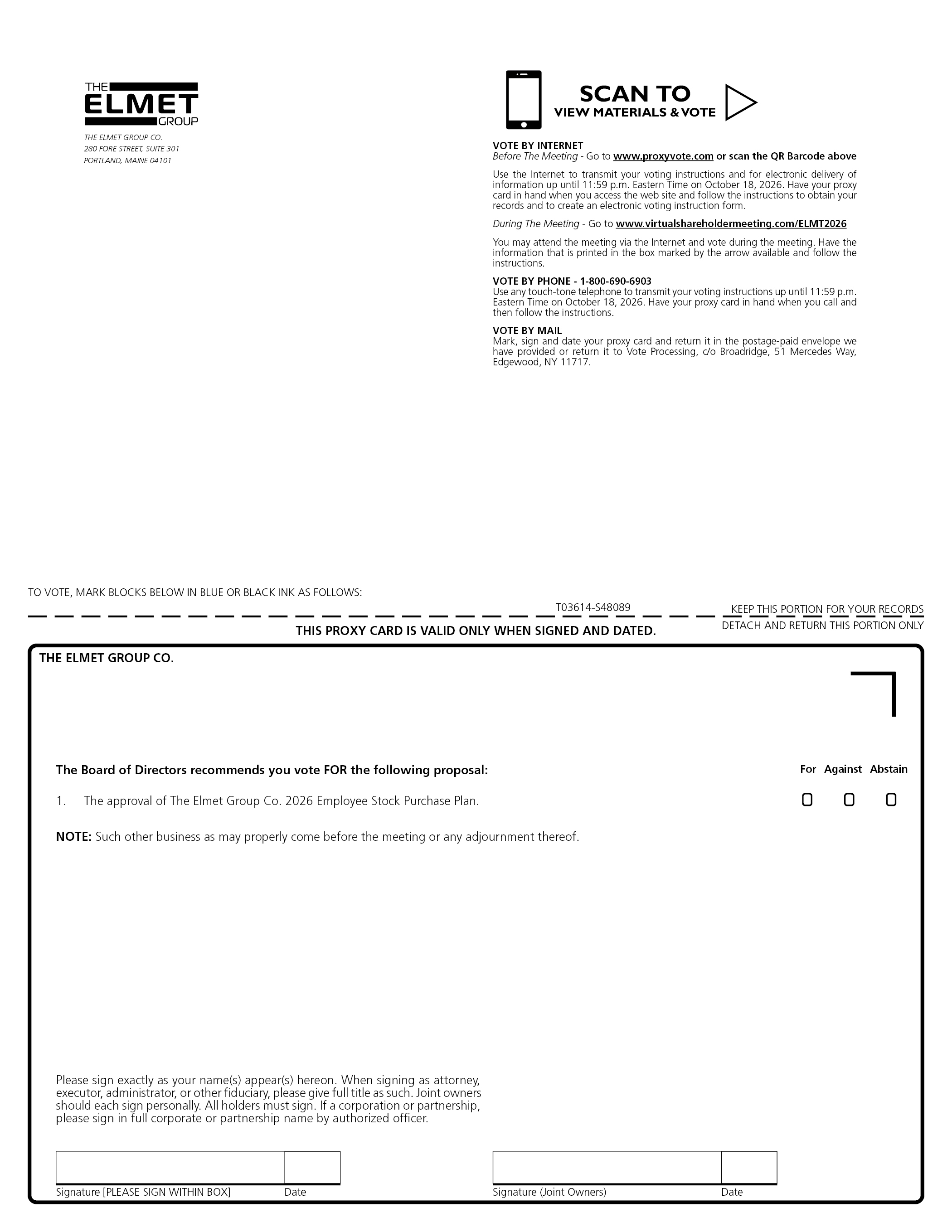
THE ELMET GROUP CO. 280 FORE STREET, SUITE 301 PORTLAND, MAINE 04101 SCAN TO VIEW MATERIALS & VOTE VOTE BY INTERNET Before The Meeting - Go to www.proxyvote.com or scan the QR Barcode above Use the Internet to transmit your voting instructions and for electronic delivery of information up until 11:59 p.m. Eastern Time on October 18, 2026. Have your proxy card in hand when you access the web site and follow the instructions to obtain your records and to create an electronic voting instruction form. During The Meeting - Go to www.virtualshareholdermeeting.com/ELMT2026 You may attend the meeting via the Internet and vote during the meeting. Have the information that is printed in the box marked by the arrow available and follow the instructions. VOTE BY PHONE - 1-800-690-6903 Use any touch-tone telephone to transmit your voting instructions up until 11:59 p.m. Eastern Time on October 18, 2026. Have your proxy card in hand when you call and then follow the instructions. VOTE BY MAIL Mark, sign and date your proxy card and return it in the postage-paid envelope we have provided or return it to Vote Processing, c/o Broadridge, 51 Mercedes Way, Edgewood, NY 11717. TO VOTE, MARK BLOCKS BELOW IN BLUE OR BLACK INK AS FOLLOWS: T03614-S48089 KEEP THIS PORTION FOR YOUR RECORDS THIS PROXY CARD IS VALID ONLY WHEN SIGNED AND DATED. DETACH AND RETURN THIS PORTION ONLY THE ELMET GROUP CO. The Board of Directors recommends you vote FOR the following proposal: 1. The approval of The Elmet Group Co. 2026 Employee Stock Purchase Plan. NOTE: Such other business as may properly come before the meeting or any adjournment thereof. For Against Abstain Please sign exactly as your name(s) appear(s) hereon. When signing as attorney, executor, administrator, or other fiduciary, please give full title as such. Joint owners should each sign personally. All holders must sign. If a corporation or partnership, please sign in full corporate or partnership name by authorized officer. Signature [PLEASE SIGN WITHIN BOX] Date Signature (Joint Owners) Date
Important Notice Regarding the Availability of Proxy Materials for the Special Meeting: The Proxy Statement is available at www.proxyvote.com. T03615-S48089 THE ELMET GROUP CO. SPECIAL MEETING OF SHAREHOLDERS OCTOBER 19, 2026 1:00 PM EST THIS PROXY IS SOLICITED ON BEHALF OF THE BOARD OF DIRECTORS The shareholder(s) hereby appoint(s) Christian Chandler, Secretary and Peter V. Anania, Chief Executive Officer, or either of them, as proxies, each with the power to appoint (his/her) substitute, and hereby authorize(s) them to represent and to vote, as designated on the reverse side of this ballot, all of the shares of Common Stock of THE ELMET GROUP CO. that the shareholder(s) is/are entitled to vote at the Special Meeting of Shareholders to be held at 1:00 PM EST, on October 19, 2026, at www.virtualshareholdermeeting.com/ELMT2026, and any adjournment or postponement thereof. This proxy, when properly executed, will be voted in the manner directed herein. If no such direction is made, this proxy will be voted in accordance with the Board of Directors’ recommendations. Continued and to be signed on the reverse side