S-1: General form for registration of securities under the Securities Act of 1933
Published on November 24, 2026
As filed with the U.S. Securities and Exchange Commission on November 24, 2026.
Registration No. 333-
UNITED STATES
SECURITIES AND EXCHANGE COMMISSION
Washington, D.C. 20549
FORM
REGISTRATION STATEMENT
UNDER
THE SECURITIES ACT OF 1933
(Exact Name of Registrant as Specified in its Charter)
| 3490 | 33-1881598 | |||
| (State or other jurisdiction of incorporation or organization) |
(Primary Standard Industrial Classification Code Number) |
(I.R.S. Employer Identification Number) |
280 Fore Street
Suite 301
Portland, ME 04101
(207) 518-6791
(Address, Including Zip Code, and Telephone Number, Including Area Code, of Registrant’s Principal Executive Offices)
Peter V. Anania
Chief Executive Officer
The Elmet Group
280 Fore Street
Suite 301
Portland, ME 04101
(207) 518-6791
(Name, Address, Including Zip Code, and Telephone Number, Including Area Code, of Agent for Service)
with copies to:
| Adam
Berkaw, Esq. Ellenoff Grossman & Schole LLP 1345 Avenue of the Americas New York, NY 10105 Phone: (212) 370-1300 Fax: (212) 370-7889 |
Approximate date of commencement of proposed sale to public: As soon as practicable after the effective date hereof.
If any of the securities being registered on this Form are to be offered on a delayed or continuous basis pursuant to Rule 415 under the Securities Act, check the following box. ☒
If this Form is filed to register additional securities for an offering pursuant to Rule 462(b) under the Securities Act, check the following box and list the Securities Act registration statement number of the earlier effective registration statement for the same offering. ☐
If this Form is a post-effective amendment filed pursuant to Rule 462(c) under the Securities Act, check the following box and list the Securities Act registration number of the earlier effective registration statement for the same offering. ☐
If this Form is a post-effective amendment filed pursuant to Rule 462(d) under the Securities Act, check the following box and list the Securities Act registration number of the earlier effective registration statement for the same offering. ☐
Indicate by check mark whether the registrant is a large accelerated filer, an accelerated filer, a non-accelerated filer, smaller reporting company, or an emerging growth company. See the definitions of “large accelerated filer,” “accelerated filer,” “smaller reporting company,” and “emerging growth company” in Rule 12b-2 of the Exchange Act.
| Large accelerated filer ☐ | Accelerated filer ☐ | Smaller reporting company | |
| Emerging growth company |
If an emerging growth company, indicate by check mark if the registrant has elected not to use the extended transition period for complying with any new or revised financial accounting standards provided to Section 7(a)(2)(B) of the Securities Act.
The registrant hereby amends this registration statement on such date or dates as may be necessary to delay its effective date until the registrant shall file a further amendment which specifically states that this registration statement shall thereafter become effective in accordance with Section 8(a) of the Securities Act of 1933 or until the registration statement shall become effective on such date as the Commission, acting pursuant to Section 8(a), may determine.
The information contained in this preliminary prospectus is not complete and may be changed. These securities may not be sold until the registration statement filed with the Securities and Exchange Commission is effective. This preliminary prospectus is not an offer to sell these securities and is not soliciting an offer to buy these securities in any state or jurisdiction where the offer or sale is not permitted.
| PRELIMINARY PROSPECTUS | SUBJECT TO COMPLETION, DATED NOVEMBER 24, 2026 |
Up to 5,675,506 Shares of Common Stock Issuable upon Exercise of the Penny Warrant
Up to 1,891,835 Shares of Common Stock Issuable upon Exercise of the Strike Price Warrant

This prospectus relates to the resale from time to time of up to an aggregate of 7,567,341 shares of common stock, par value $0.001 (our “common stock”), of The Elmet Group Co., a Delaware corporation (which we refer to herein as “we,” “us,” “our,” or the “Company”), held by the selling stockholders identified in this prospectus or its permitted transferees (the “Selling Stockholder”). The shares of our common stock registered for resale pursuant to the registration statement of which this prospectus forms a part include (i) 5,675,506 shares of our common stock issuable upon the exercise of the penny warrants (the “Penny Warrant”) and (ii) up to 1,891,835 shares of our common stock issuable upon the exercise of the strike price warrants (the “Strike Price Warrant,” and together with the Penny Warrant, the “Warrants”). We issued the Warrant to the Selling Stockholder in a private placement pursuant to an investment agreement, dated September 11, 2026 (the “Investment Agreement”), which closed on September 14, 2026. The Penny Warrants and Strike Price Warrant have an exercise price of $0.001 per share and $15.92 per share, respectively, will both expire on September 14, 2036, and are exercisable at any time after September 14, 2027, subject to earlier mandatory exercise immediately prior to a Liquidation Event or consummation of a Change of Control, in each case as provided in the Warrants.
The Selling Stockholder may, from time to time, sell, transfer or otherwise dispose of any or all of its common stock or interests in its common stock on any stock exchange, market or trading facility on which the common stock is traded or in private transactions. These dispositions may be at fixed prices, at prevailing market prices at the time of sale, at prices related to the prevailing market price, at varying prices determined at the time of sale, or at negotiated prices. See “Plan of Distribution” in this prospectus for more information. We will not receive any proceeds from the resale or other disposition of the shares of common stock by the Selling Stockholder. However, we will receive the proceeds of any cash exercise of the Warrants. If all of the Warrants are exercised for cash, we will receive aggregate proceeds of approximately $30.1 million. See “Use of Proceeds” beginning on page 58 and “Plan of Distribution” beginning on page 211 of this prospectus for more information.
On November 23, 2026, the last reported sale price of our common stock on The Nasdaq Stock Market LLC (“Nasdaq”) was $18.24 per share. Our shares of common stock are listed on the Nasdaq Capital Market under the symbol “ELMT.”
We are an “emerging growth company” and a “smaller reporting company” as defined under the U.S. federal securities laws and, as such, may elect to comply with certain reduced public company reporting requirements for this prospectus and future filings. See “Prospectus Summary — Implications of Being an Emerging Growth Company.”
Investing in our common stock is speculative and involves a high degree of risk. Please read “Risk Factors” beginning on page 19 of this prospectus.
Neither the Securities and Exchange Commission nor any state securities commission has approved or disapproved of these securities or determined if this prospectus is truthful or complete. Any representation to the contrary is a criminal offense.
Prospectus dated , 2026
Table of Contents
i
ABOUT THIS PROSPECTUS
This prospectus is part of a registration statement on Form S-1 filed with the SEC by The Elmet Group Co. The Selling Stockholder named in this prospectus may, from time to time, sell the securities described in this prospectus in one or more offerings. This prospectus includes important information about us, the securities being offered by the Selling Stockholder and other information you should know before investing. Any prospectus supplement may also add, update, or change information in this prospectus. If there is any inconsistency between the information contained in this prospectus and any prospectus supplement, you should rely on the information contained in that particular prospectus supplement. This prospectus does not contain all of the information provided in the registration statement that we filed with the SEC. You should read this prospectus together with the additional information about us described in the section below entitled “Where You Can Find More Information.” You should rely only on information contained in this prospectus. We have not, and the Selling Stockholder has not, authorized anyone to provide you with information different from that contained in this prospectus. The information contained in this prospectus is accurate only as of the date on the front cover of the prospectus. You should not assume that the information contained in this prospectus is accurate as of any other date.
The Selling Stockholder may offer and sell the securities directly to purchasers, through agents selected by the Selling Stockholder, or to or through underwriters or dealers. A prospectus supplement, if required, may describe the terms of the plan of distribution and set forth the names of any agents, underwriters or dealers involved in the sale of securities. See “Plan of Distribution.”
Discrepancies in any table between totals and sums of the amounts listed are due to rounding. Certain amounts and percentages have been rounded; consequently, certain figures may add up to be more or less than the total amount and certain percentages may add up to be more or less than 100% due to rounding. In particular and without limitation, amounts expressed in millions contained in this prospectus have been rounded to a single decimal place for the convenience of readers.
General Information
Unless otherwise indicated or the context otherwise requires, references in this prospectus to “Company,” “we,” “us,” “our” and “Elmet” refer to The Elmet Group Co., a Delaware corporation, and its subsidiaries. Elmet was incorporated as a Delaware corporation on September 13, 2024 and, prior to the consummation of the Reorganization (as defined in this prospectus) on January 2, 2026, did not conduct any activities other than those incidental to our formation and our initial public offering.
Beginning with the consummation of the Reorganization on January 2, 2026, we conduct our business through our operating subsidiaries.
Basis of Presentation
Except as otherwise disclosed in this prospectus, the historical consolidated financial statements and the other financial information included elsewhere in this prospectus have been presented in U.S. dollars in accordance with the generally accepted accounting principles in the United States (“GAAP”).
The historical consolidated financial statements and the other financial information included elsewhere in this prospectus as of December 31, 2025 and 2024 and for the years ended December 31, 2025 and 2024 reflect the consolidated financial statements of The Elmet Group Co. and its subsidiaries, after giving effect to the Reorganization(as defined in this prospectus).
The historical consolidated financial statements and the other financial information included elsewhere in this prospectus as of October 2, 2026, and December 31, 2025 and for the three and nine month periods ended October 2, 2026 and September 30, 2025 reflect the consolidated financial statements of Elmet, after giving effect to the Reorganization.
ii
The Reorganization was accounted for as a reorganization of entities under common control. As a result, the consolidated financial statements of Elmet recognized the assets and liabilities received in the Reorganization at their historical carrying amounts and were reflected as if Elmet owned them as of the original dates they were under common control.
On May 19, 2026, our board of directors approved a change in our fiscal year end from December 31 to a 4-4-5 fiscal calendar, whereby each fiscal quarter consists of thirteen weeks grouped into two four-week months and one five-week month. Under the new fiscal calendar, our fiscal year ends on the Friday closest to December 31 of each year. The change in our fiscal year end will not result in any changes to our historic financial statements.
Certain monetary amounts, percentages, and other figures included elsewhere in this prospectus have been subject to rounding adjustments. Accordingly, figures shown as totals in certain tables or charts may not be the arithmetic aggregation of the figures that precede them, and figures expressed as percentages in the text may not total 100% or, as applicable, when aggregated, may not be the arithmetic aggregation of the percentages that precede them.
Market, Industry, and Other Data
Unless otherwise indicated, information in this prospectus concerning economic conditions, our industry, our markets and our competitive position is based on a variety of sources, including information from third-party industry and academic research, publications and surveys, reports of governmental agencies and our own estimates and research. In some cases, we do not expressly refer to the sources from which the data used in this prospectus is derived.
The industry publications, surveys and forecasts and other public information generally indicate or suggest that their information has been obtained from sources believed to be reliable. None of the third-party industry publications used in this prospectus were prepared on our behalf. The industry in which we operate is subject to a high degree of uncertainty and risk due to a variety of factors, including those described in “Risk Factors” in this prospectus. All of the market and industry data used in this prospectus is inherently subject to uncertainties and involves a number of assumptions, estimates and limitations. These and other factors could cause results to differ materially from those expressed in the estimates made by the independent parties and us.
Trademarks
This prospectus contains references to our trademarks and service marks and to those belonging to other entities. Solely for convenience, trademarks and trade names referred to in this prospectus may appear without the ®, TM, or SM symbols, but such references are not intended to indicate, in any way, that we will not assert, to the fullest extent possible under applicable law, our rights or the rights of the applicable licensor to these trademarks and trade names. We do not intend our use or display of other companies’ trade names, trademarks, or service marks to imply a relationship with, or endorsement or sponsorship of us by any other companies.
iii
PROSPECTUS SUMMARY
This summary highlights certain information appearing elsewhere in this prospectus. Because it is only a summary, it does not contain all of the information you should consider before investing in shares of our common stock, and it is qualified in its entirety by, and should be read in conjunction with, the more detailed information appearing elsewhere in this prospectus. Before you decide to invest in our common stock, you should read the entire prospectus carefully, including “Risk Factors” beginning on page 19 (and “— Summary of Risk Factors” on page 12) and the financial statements and related notes included in this prospectus.
Unless the context indicates otherwise, as used in this prospectus, the terms “we,” “us,” “our,” “our Company” “Elmet,” “the Company” and “our business” refer to The Elmet Group Co., a Delaware corporation, or any one or more of its subsidiaries, or to such entities collectively. As of the consummation of the Reorganization on January 2, 2026, we acquired all of the outstanding membership interests of Elmet Technologies LLC (“Elmet Tech”) and Microwave Techniques LLC (“Microwave Techniques”). The acquisition of the membership interests of Elmet Tech and Microwave Techniques was accounted for as a transaction between entities under common control. All references in this prospectus to us when used in a historical context refer to our predecessor companies, Elmet Tech and Microwave Techniques, and when used in the present tense or prospectively refer to us and our subsidiaries, collectively, or individually, as the context may require. Except where otherwise indicated, the information in this prospectus gives effect to the Reorganization (as defined below).
Overview
Elmet currently provides precision-engineered components and advanced high-power systems for growth markets. Our customers in these markets require advanced technology involving critical and strategic materials, such as tungsten, molybdenum and niobium (such materials, the “Critical Materials”) and high-level radio frequency (“RF”) engineering, including plasma generation, radar, and other high-energy systems (together, “High-Power Microwave”). See “—Recent Developments” for information on anticipated additions to our business. Our products and solutions are integral to the Aerospace, Defense and Government, Industrial, Medical, Semiconductor and Electronics, and Energy industries. These are industries which require components capable of performing in extreme thermal, electromagnetic, and technical environments for vital use cases. Our fundamental mission is to strengthen U.S. domestic manufacturing capabilities to support the United States and its allies’ needs in both Critical Materials and advanced High-Power Microwave systems. We believe we are the leader and sole-source U.S. producer of many highly engineered Critical Materials products and a leading designer and manufacturer of High-Power Microwave components in the United States.
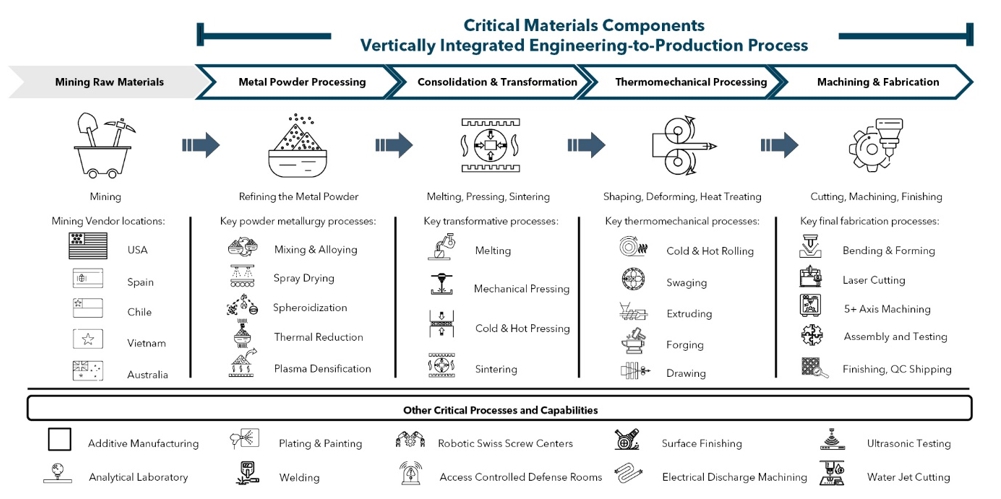
We own and operate a vertically integrated engineering-to-production system, with custom design, development, and processing expertise for Critical Materials and High-Power Microwave that is unmatched in our markets and the industries in which we compete. Our High-Power Microwave expertise capitalizes on our vertically integrated engineering-to-production system, enabling us to deliver microwave energy solutions with custom design and development expertise. Our Critical Materials engineering and production expertise enables us to custom design elegant solutions for some of the most challenging environments on the planet. We believe these capabilities provide a significant competitive advantage in our markets and the industries in which we compete.
1
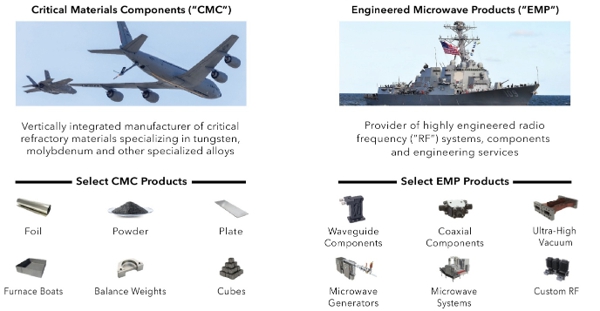
We are proud to be the only U.S.-owned and U.S.-based manufacturer of highly engineered tungsten and molybdenum products through our Critical Materials Components (“CMC”) division. We control the powder production, pressing, sintering, forming, milling and engineering of tungsten and molybdenum oxide to the finished engineered product. Our CMC products support many of the most critical programs of the United States Department of War (also referred to as the United States Department of Defense) (the “DoW”), on land, sea and in the air. Our engineering expertise in our Engineered Microwave Products (“EMP”) division has enabled us to provide products and services to a wide variety of existing and emerging programs which also support the DoW and space sector leaders, such as Lockheed Martin Corporation (“Lockheed Martin”), RTX Corporation (“Raytheon”), Teledyne Technologies Incorporated (“Teledyne”) and the National Aeronautics and Space Administration (“NASA”). We have supplied products to approximately 95 research programs at national laboratories, universities and other government-sponsored and international research facilities, including Fermi National Accelerator Laboratory (“Fermi”) and Los Alamos National Laboratory (“Los Alamos”). Because of the common relationship among some of the products we offer, we are able to incorporate our Critical Materials and our High-Power Microwave components in the same defense programs and high-powered energy research facilities throughout the United States, United Kingdom and Europe. Examples of such dual CMC and EMP programs include the U.S. Patriot Missile system, which incorporates molybdenum components in the missile and waveguide radar components in the tracking vehicle, and leading fusions reactors, which include tungsten shielding and specialty microwave components to power the fusion ignition process.
Our comprehensive in-house design and manufacturing capabilities are supported by approximately 100 engineers, engineering technicians, RF engineers, metallurgists and research and development scientists. Our customers benefit from the specialized expertise, know-how and product design we have developed in both engineered high-temperature, high-density Critical Materials and High-Power Microwave technology. Our specific capabilities provide our customers with a value proposition which allows these customers to simplify their supply chain, increase their speed to market and maintain competitive cost structures. Our engineering expertise and established track record position us to serve customers who need systems required to withstand extreme environments and meet stringent performance requirements. These customers rely on us to deliver technical design and scaled manufacturing to meet these standards. Given the critical nature of the components and solutions we provide, we engage with customers early in their design cycle to develop difficult-to-replicate solutions, using our specialized processes and equipment, creating a competitive advantage.
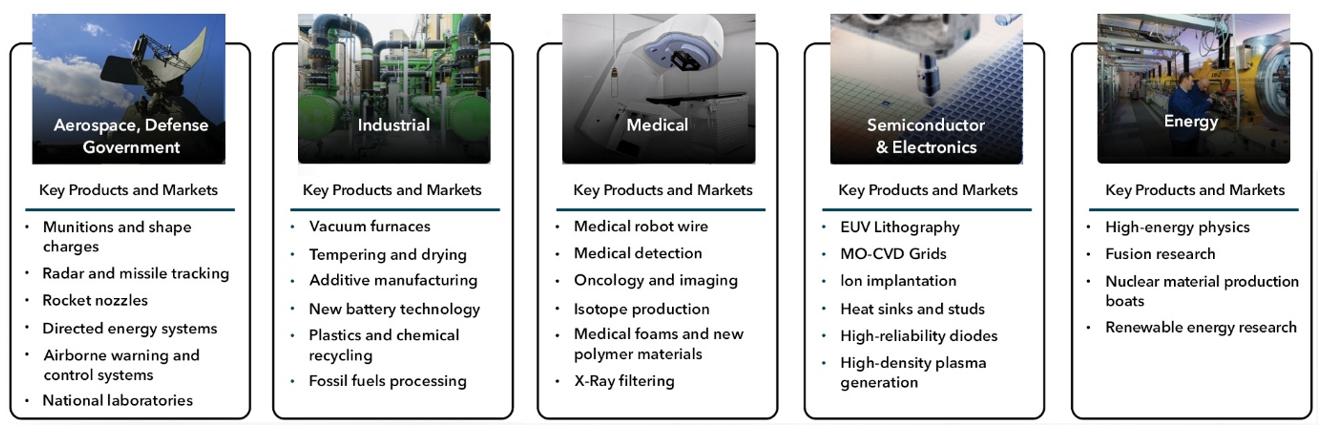
We leverage our vertical integration and engineering capabilities to provide our products and services to five high-growth, strategically critical U.S. and global end-markets, which require components capable of performing in extreme thermal, electromagnetic, and mechanical environments including: Aerospace, Defense and Government, Industrial, Medical, Semiconductor and Electronics and Energy.
2
Our CMC and EMP Divisions
Critical Materials Components: We are the only U.S.-owned vertically integrated manufacturer of engineered pure tungsten and pure molybdenum materials and products. Tungsten and molybdenum are metals considered to be “critical materials” possessing among the highest known densities and melting points of any element. These materials are indispensable for extreme environments and are foundational to aerospace, defense, semiconductor, medical, nuclear energy (fission and fusion), and industrial applications. Our CMC division maintains a supply chain for raw materials outside of The People’s Republic of China (the “PRC”) and controls every step of the manufacturing process. We machine these difficult-to-work metals into final form factors or highly engineered finished products for our customers. We sell these metals at every stage of the process, from powder to final machined components made to exacting customer specifications. This end-to-end capability promotes the supply chain security and technical excellence required by our customers.
3
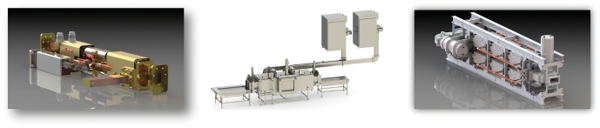
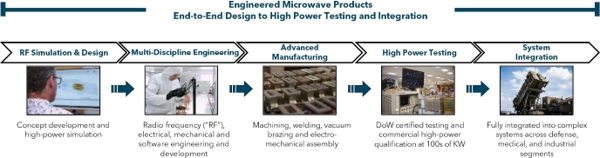
Engineered Microwave Products: Our EMP division enables mission-critical processes by designing and manufacturing the highest-power specialized RF and microwave components and systems. Our products facilitate the powering of radar, missile tracking, directed energy systems, semiconductor fabrication, fusion research, and advanced industrial processing. Our EMP division leverages its deep engineering expertise and vertically integrated production to deliver custom solutions which meet stringent performance requirements for defense and energy programs. This division designs and manufactures the broadest domestic portfolio of ultra-high-power passive and active RF components — waveguides, circulators, loads, pressure windows, and automatic tuning systems — proven at peak powers exceeding 60 Megawatts (“MW”) and continuous-wave levels in the multi-megawatt range. The components and systems developed by our EMP division support land, mobile, naval, and airborne radar applications, as well as the scientific, medical, and communication markets.
| Product Parameters | Range | ||
| RF Component Sizes | ● | WR28 to WR4600 | |
| Frequencies | ● | 50 MHz to 40 GHz | |
| Power Levels | ● | 50 W to 60 MW | |
| Bands | ● | UHF, L, S, C, X, Ku, K & Ka; special focus in ISM bands (915 and 2,400 MHz) | |
4
Our Competitive Strengths
Sole U.S.-owned Supplier of Highly Engineered Critical Materials Components for a Wide Range of Essential Industries
We are a leading producer of highly engineered Critical Materials components and High-Power Microwave products, supplying critical components and systems which underpin performance and reliability in essential industries. Our products and services are critical to multiple industries, including the Aerospace, Defense and Government industry, which often require a U.S.-based supplier due to potential national security concerns. Our operations are organized to control production from start to finish and promote highly consistent quality, non-PRC-sourced tungsten and molybdenum supply chain security and cost efficiency. The markets we participate in are highly fragmented, and our positioning as a U.S.-based supplier creates a competitive advantage. With increasing emphasis on secure supply chains for advanced materials, we believe our differentiated capabilities and strategic positioning will enable us to capture sustained growth opportunities. The PRC dominates global tungsten supply, producing approximately 80% of tungsten concentrate and a significant share of molybdenum while at the same time imposing escalating export controls on both these materials since February 2025. On October 26, 2025, the PRC’s Ministry of Commerce reiterated plans to continue stringent export license restrictions on tungsten into 2026 – 2027. The PRC subsequently reversed this position on November 10, 2025, and suspended the export restrictions for one year. On January 6, 2026, the PRC’s Ministry of Commerce imposed an additional ban on the export of all ‘dual-use’ items, including tungsten and molybdenum, to Japan for military applications. We believe our direct sourcing strategy mitigates the continuing market instability produced by the oscillating export restrictions and subsequent suspension of these restrictions.
Vertically-Integrated and Scaled Operations Supported by a Dedicated Engineering Team
Our manufacturing operations for both Critical Materials and High-Power Microwave products are vertically integrated, enabling us to support our customers from engineering to production. Our technical expertise positions us to serve customers who need us to deliver scaled manufacturing of highly engineered components for the most demanding applications. Our dedicated team of multi-disciplinary engineers, who support our comprehensive in-house design and manufacturing capabilities, work collaboratively with customers early in their design cycles. Early participation and cooperation with customers often leads to the creation of difficult-to-replicate solutions, which then become integrated into our customers’ underlying processes, making us the “supplier of record” for certain projects and providing a strong barrier to entry for our current or would-be competitors.
Difficult-to-Replicate Asset Base Paired with Specialized Production Capabilities
Between our CMC and EMP divisions, we operate seven facilities at six locations totaling more than 600,000 square feet, which are dedicated to engineering, design, testing and manufacturing. Over the last few decades, our CMC division, through Elmet Tech, and our EMP division, through Microwave Techniques, have each developed their manufacturing base as one of their most important assets. Given the significant amount of investment required to create our manufacturing base, as well as the scale of our operations, the cost to replicate what we own and operate establishes a high barrier to entry, especially for U.S. competitors. We believe that replicating and implementing our manufacturing base would require significant time and capital investment, with an estimated replacement value in excess of $1 billion. Our CMC and EMP divisions offer specialized services critical to key customers and give us a path to winning in a competitive environment. For example, the 5,500-ton extrusion press in our Coldwater facility is only one of two operating refractory metal presses in the United States capable of shaping the types of difficult-to-work materials that are essential to the U.S. military’s supply chain. We also have a spare, currently not operating, extrusion press in storage at our Coldwater facility. Within our EMP division, we are the only U.S.-owned and operated provider of 200-kilowatt (“kW”) magnetron microwave generating apparatuses, which are essential to our industrial processing customers. Combined, we believe our established manufacturing base and specialized production capabilities create a significant competitive advantage.
Experienced Management Team with Proven History of Executing Successful Mergers and Acquisitions
Our leadership team has a strong track record of pursuing growth and driving long-term value through strategic acquisitions and investments. Since 2000, we have successfully acquired and integrated seven different businesses in the Critical Materials and High-Power Microwave technology sectors. These acquisitions have added production capabilities and technologies which complement our product offerings and expand our market reach and exposure.
Our acquisitions have played an integral role in shaping our business, and we expect to continue evaluating strategic opportunities in the future. We believe our track record, expertise and strategy help us supplement organic growth and maintain our competitive positioning as a leading provider of mission-critical components and materials for essential industries.
5
Our Growth Strategy
We are the sole U.S.-owned vertically integrated producer of tungsten and molybdenum in many of the programs in the market segments we serve. In addition to the fundamental products we produce and processes we control, such as extrusion and rolling, we are one of a handful of companies in the United States capable of Critical Materials and RF engineering and manufacturing, with the capacity and range of capabilities required to support multiple demanding applications. Our inclusion in over 140 aerospace, defense and government programs and applications since January 2025, including defense and commercial aircraft, missiles, electronics and products for submarine components underscores our strategic importance. We believe the accelerating U.S. reshoring efforts and increasing defense spending by the DoW support our growth prospects.
Our growth strategy is built on three tiers: (i) capitalize on the development and infrastructure we own and operate; (ii) use our technology to develop critical products and services for our customers in response to their needs; and (iii) identify select acquisitions which supplement the expertise we currently possess for the markets we serve.
Capitalizing On Development and Infrastructure
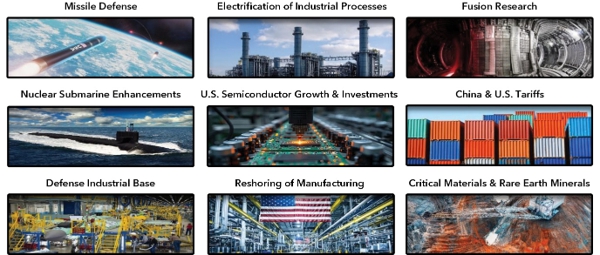
We believe that we are well placed to take advantage of current economic and geopolitical tailwinds through our substantial investments in research and development in our key industries. With the encouragement of the DoW, in the last six years we have invested more than $46.1 million into upgrading our manufacturing capabilities. The U.S. government and other North Atlantic Treaty Organization (“NATO”) governments have repeatedly articulated the current need to restock their supplies of various munitions and other military hardware. According to The Guardian, as of July 2025, the United States had only 25% of all Patriot missile interceptors needed for the Pentagon’s military plans. As of January 2026, the DoW also established a new acquisition model with Lockheed Martin to more than triple PAC-3 Missile Enhancement Segment (“Patriot”), production. On August 7, 2026, ABC news reported the war in Iran has depleted Patriot stockpiles by two thirds, Terminal High Altitude Area Defense (“THAAD”) by half and that inventories were low for Precision Strike Missile (“PrSM”). We believe this will lead to increased defense spending by these governments aggregating into billions of dollars. We have experience in providing critical components for these types of programs and have confidence we will be able to leverage our experience into similar new programs. Through our CMC division, we provide approximately $1,800 of molybdenum content per Patriot missile and $4 million of tungsten in the small prototype leading fusion reactor unit (larger units will contain three times the tungsten). Our supply of molybdenum content for Patriot missile production is expected to triple over the next several years. Our EMP division also supplies approximately $28,000 of waveguide radar components per Patriot missile tracking vehicle, and approximately $900,000 of specialty High-Power Microwave components per fusion reactor unit to power the ignition process. Accordingly, as the United States and other NATO governments restock their conventional military capacities and develop new defensive systems, and as additional investments are made in nuclear energy reactors, we believe we are well-positioned to capture additional business.
Since January 2025, our products have been included in over 140 aerospace, defense and government programs and applications, and our sales team is highly focused on working with the DoW and their contractors on new programs. We believe the increasingly complex research at national laboratories such as Fermi and Los Alamos and others focused on energy, pharmaceutical, fusion and high energy physics research presents other significant opportunities. The need to electrify manufacturing processes to reduce reliance on carbon-based energy is driving increased investments in equipment, such as High-Power Microwave generators, necessary to explore these alternative technologies. Both High-Power Microwave components and Critical Materials play a substantial role in fission and fusion energy, as well as other basic energy systems. For example, research is continuing to progress incorporating the use of High-Power Microwave systems in connection with green hydrogen energy production. Our components are well placed to take advantage of projected growth in both traditional and cutting-edge energy research and production. We are already a trusted supplier to advanced research institutions, and many of our components are already integrated into the operations of their research efforts. Our experience with Critical Materials, will also benefit us as space operations increase. These Critical Materials are essential to the exploration and exploitation of space since they provide dense shielding material for the protection of the delicate microwave components on satellites and mission sensitive aerospace technology.
6
Leverage Our Expertise and Experience
Our expertise with molybdenum and tungsten has positioned us to leverage this experience with other Critical Materials. We have established a number of strategic relationships with non-PRC sources of highly sought after materials such as niobium, C-103, a high-performance niobium alloy comprised of niobium, hafnium, and titanium, (“C-103”), FS85, a high strength niobium alloy comprised of niobium, tantalum, tungsten, and zirconium (“FS85”), and others. All these materials show significant promise in aerospace and other similar demanding applications. We believe our ability to source these materials, extrude them in large billet form, forge them into workable form factors, and expertly machine the forged materials creates a high barrier to entry for potential competitors. As these specialized materials become further integrated into aerospace, military and energy use, we believe we can meet future demand. We expect to be able to leverage the anticipated growth in the use of these materials by being able to increase production of our products, thereby driving both our sales and margins. For example, we believe that our flowable alloys and pure metal powders are an advantage that will provide another source of high value products as additive manufacturing, such as 3D metal printing, matures and becomes ubiquitous. Rare earth minerals and specialized magnets, which are incorporated into most microwave systems, are also growing markets where we believe our engineering experience and know-how gives us a competitive advantage. Our engineers have the expertise to help our customers design products and components using these materials and specialized magnets to tune their High-Power Microwave components, making them more efficient and reducing energy losses, providing custom engineered manufacturing solutions to meet our customers’ specific, and often first time, needs.
Continuing to Develop Specialized Technologies For Our Customers
Our research and design capabilities in both metallurgy and microwave technology enable us to build lasting relationships with our customer base. The customized solutions that we provide are difficult to replicate or reverse engineer, which establishes a degree of end user loyalty for, and reliance on, our products. Since our components are often integrated into customer designs, the commercial value of the components increases over time, which also promotes long-term growth and stability in our orderbook.
Our ability to design specific alloys for discrete functions is also a significant competitive strength. For example, our work in additive manufacturing has resulted in approximately 20 U.S. and international patents and three pending patent applications grouped into six patent families addressing multiple aspects of successfully printing Critical Materials, such as tungsten, tungsten heavy alloy and other Critical Material-based alloys. Additive manufacturing using laser-based techniques requires a deep understanding of how Critical Materials melt and solidify. The printing parameters and alloy chemistry of successful alloys must be designed to minimize cracking and porosity which would degrade the physical properties of the material. By using materials science-based thermodynamic models and leveraging the more than seven decades of collective Critical Materials experience of the research and development engineers of our CMC division, we have designed experiments that have resulted in materials such as C-103 or FS85 meeting or exceeding the properties of traditionally processed materials. Likewise, our EMP division has developed an important improvement in current technology by reducing tile load failures in tile load components needed in heat distribution in High-Power Microwave systems. We have also successfully advanced the technology needed to produce 200kW of combined microwave generation, providing significant high-power options to the market.
Identifying and Integrating Select Acquisitions
We have successfully acquired and integrated a number of companies, and we believe we have a demonstrated track record of adding capabilities to supplement our expertise or fill in gaps. For example, in late 2023, we acquired the molybdenum and tungsten operations of H.C. Starck Solutions (“H.C. Starck”) in the United States, supplementing our existing operations and vastly increasing our production capacity. Also, in 2023, we acquired Valvo Bauelemente GmbH (“Valvo”) in Hamburg, Germany, expanding our reach in 2.45 GHz, WR284 (R32), WR340 (R26), and WR430 (R22) waveguide components and technology, and also allowing us to expand sales and opportunities in the United Kingdom and European Union. In November 2025, we closed a small tuck-in acquisition of Symphony Microwave Technologies LLC (“Symphony”), adding engineering capabilities, a product line and new customer relationships in our EMP division. Most recently, we announced the anticipated acquisition from OSRAM GmbH (“OSRAM”) of its metal production operations located in Schwabmünchein, Germany. We have a rigorous strategy of finding complementary materials and products to build out our capabilities, particularly in serving our key customers and industries. We believe there are many opportunities available in the market for both Critical Materials and High-Power Microwave. Our metrics generally require any potential acquisition to add market scope and be positioned to increase margins and profitability once they are integrated into our operations. We will continue to seek out acquisitions to enable us to serve our existing customers and the expected needs of new customers.
7
Recent Developments
Our Strategic Transformation
In September 2026, we entered into a series of transactions that we believe fundamentally expand the scale and scope of our platform. Collectively, the DoW Transactions, the Springer Transactions, the Masan Investment, the DLA Offtake Agreement, the formation of Elmet Refining & Trading (“ERT”) and the OSRAM Acquisition (each as defined and discussed below) are intended to enhance our position as the only U.S.-owned, vertically integrated manufacturer of tungsten and molybdenum materials and products and transform the Company into an integrated mine-to-component platform across the U.S. and Europe. The DoW Transactions provide growth capital, the Springer Transactions and related offtake agreements will help secure raw material supply and processing capacity, and the DLA Offtake Agreement provides long-term demand visibility. Together with our expanded manufacturing footprint in the U.S. and Europe, we believe these initiatives will enhance our ability to supply critical products to our defense, semiconductor, medical and industrial customers.
We expect these transactions to:
| ● | Expand domestic manufacturing capacity: The DoW Transactions are intended to fund more than $165 million of capacity and infrastructure investment across our Lewiston, Maine; Coldwater, Michigan; and Euclid, Ohio facilities, including an expected five-fold increase in tungsten powder production capacity, which is the key component for our downstream CMC products. The investment is anticipated to enable expanded capacity for critical DoW programs including Patriot PAC, PrSM, Phalanx, SLAP, rocket components and F-35 programs. See “Business – Recent Developments – Department of War Transactions.” |
| ● | Establish independent U.S. midstream conversion capacity: Through the joint venture with Blue Moon Metals Inc., (“Blue Moon”) and EQ Resources Limited (“EQ”), we intend to upgrade and restart the Springer ammonium paratungstate (“APT”) plant, which we expect would be the first independent APT plant in the United States that is not foreign-owned or tungsten-carbide focused. We expect the Springer mine and mill to restart production in the fourth quarter of 2027 and the APT facility to begin operations in the second half of 2028. Feedstock from this facility will help secure our internal usage needs and be supplied to strategic external domestic customers. See “Business – Recent Developments – Springer Project.” |
| ● | Secure and diversify feedstock: Our refining and trading division, along with our equity investment in each of Blue Moon and Masan High-Tech Materials Corporation (“Masan”), concentrate supply arrangements with EQ Resources and Blue Moon, offtake agreement with Tungsten West PLC (“Tungsten West”), and tungsten prepayment facility to Blue Moon (each as discussed below), are intended to enable us to source and allocate tungsten across allied geographies. This will reduce our exposure to a market in which China controls nearly 80% of global supply and has imposed export restrictions that have driven tightening supply and price volatility. We also expect greater control over input costs for our core business lines. “Business – Recent Developments.” |
| ● | Anchor long-term demand: The DLA Offtake Agreement provides a five-year base ordering period with an additional two-year option period, a $150 million minimum offtake commitment and a $2.0 billion ceiling. We believe the DLA Offtake Agreement backstops refining volumes, de-risks the Springer investment and positions us ahead of the anticipated missile and munitions replenishment cycle. See “Business – Recent Developments – DLA Offtake Agreement.” |
| ● | Establish an integrated European base: The OSRAM Acquisition is expected to add a fully integrated tungsten and molybdenum manufacturing platform in Schwabmünchein, Germany, to be consolidated within our CMC division. With this facility, we expect to serve the European defense primes and other fusion, semiconductor, automotive, medical and industrial customers in rebuilding their supply chains for tungsten, an EU-designated critical raw material with limited European processing capacity today. |
8
| ● | Preserve capital structure flexibility: The Class A Preferred Stock (as defined below) issued in connection with the DoW Transactions has a 5.5% paid-in-kind dividend that requires no scheduled cash payments, and cannot be redeemed by the holder before September 14, 2036, except following certain default or liquidation events. We retain the right to redeem it at any time. The investment also contains a mechanism whereby the value of the Penny Warrant (as defined below) will partially reduce the preferred liquidation preference as our common stock appreciates, aligning DoW’s returns with common stockholders. Funding is drawn against project spend rather than in a single lump sum, aligning capital deployment with construction and qualification milestones. See “Business – Recent Developments – Department of War Transactions.” |
Our capacity to benefit from the foregoing transactions as currently contemplated are subject to certain risks and uncertainties. See “Risk Factors – Risks Related to Our Business, Strategy and Industry” below for a detailed discussion of these risks.
Formation of Elmet Refining & Trading
On September 14, 2026, we announced the formation of our refining and trading division, a new operating division responsible for coordinating sourcing, processing and delivering material across our expanding global network. We intend for the division to manage our APT conversion capacity, administer our mine offtake agreements, including the DLA Offtake Agreement and TW Offtake Agreement (each as defined below), and pursue a diversified and resilient feedstock portfolio through equity investments and long-term offtakes with allied producers. We believe the division represents a key step in establishing an integrated platform to source, refine, trade and allocate tungsten across allied geographies, and connects our upstream feedstock arrangements to downstream demand from our CMC division. The division will hold our interest in the joint venture entity that will be formed to upgrade and restart the Springer APT plant, which we expect would be the first independent APT plant in the United States that is not foreign-owned or tungsten-carbide focused. See “Business – Recent Developments – Springer Project,” “– DLA Offtake Agreement,” and “– Tungsten West Offtake Agreement.”
Department of War Transactions
On September 11, 2026, we entered into the Investment Agreement with the DoW (the transactions contemplated thereby, the “DoW Transactions”) providing for a preferred equity investment in our Company and related investor rights (the Investment Agreement, together with the other agreements executed concurrently therewith as contemplated by the Investment Agreement, the “DoW Transaction Documents”). We expect to receive an approximate package of investments and commitments from DoW of up to $450 million to expand and modernize our tungsten, processing, and manufacturing capabilities, including the planned upgrade and restart of the Springer APT plant and associated tungsten mine in Nevada, as well as to increase midstream processing capacity and expand and upgrade general infrastructure across our Coldwater, Lewiston and Euclid facilities. The investment was initially funded through a $200 million drawdown on September 14, 2026, and is expected to be followed by additional drawdowns, subject to certain timing considerations and our ability to meet certain milestones. In connection with the investment, the DoW received redeemable preferred equity, warrants representing up to 19.9% of our common stock on a post-exercise basis, and the right to appoint one independent director to our board of directors and one non-voting board observer.
Springer Project
On September 11, 2026, we entered into a binding letter agreement (the “Springer Agreement”) with Blue Moon, Blue Moon (Springer) Inc., an affiliate of Blue Moon (“BM US”), and EQ (together with us, Blue Moon, and BM US, the “Springer Parties”), regarding a series of strategic transactions associated with Blue Moon’s Springer Tungsten Complex (“Springer”), located in Pershing County, Nevada. The transactions contemplated under the Springer Agreement include: (i) the formation of a joint venture entity (the “JV Entity”) among the Springer Parties to restart, expand and operate the APT plant located at Springer (the “APT Plant”), (ii) an equity investment by the Company into Blue Moon, (iii) the Company’s receipt of board representation in both Blue Moon and the JV Entity; (iv) a supply agreement for EQ and Blue Moon tungsten concentrate offtakes to the Springer APT Plant at market pricing, (v) a tungsten prepayment facility provided by the Company to Blue Moon, to be repaid through a credit against sales of APT, and (vi) a site sharing agreement between Blue Moon and the JV Entity, covering the land, buildings, utilities, water, and services arrangements between the JV Entity and Blue Moon (collectively, the “Springer Transactions”). The equity investment in Blue Moon by the Company was consummated on October 16, 2026, and the Springer Parties expect to close the remaining Springer Transactions within the next twelve calendar months.
9
DLA Offtake Agreement
On September 11, 2026, we entered into an offtake agreement (the “DLA Offtake Agreement”) with The United States Defense Logistics Agency (the “DLA”) relating to exclusive offtake arrangements for tungsten ores and concentrates and sodium tungstate from mines outside of the PRC. Pursuant to the DLA Offtake Agreement, we will sell, upon the DLA’s request, a minimum of $150 million worth of tungsten ore and concentrate and sodium tungstate (the “Minimum Offtake Amount”) over the course of a five-year base ordering period, subject to an additional two-year option period, with such option being exercised at the DLA’s discretion. Delivery orders will be submitted to us through a request-for-proposal process, with each order subject to our review and acceptance. Each order shall then be delivered to the DLA within 48 months of the issuance of each respective delivery order. Upon the procurement of the Minimum Offtake Amount, the DLA, in its sole discretion, may purchase up to a maximum of $1.85 billion worth of additional tungsten ore and concentrate and sodium tungstate throughout the ordering period.
OSRAM Acquisition
On September 3, 2026, we entered into an asset purchase agreement (the “Purchase Agreement”) with OSRAM GmbH (a division of the ams OSRAM group companies), pursuant to which we agreed to purchase substantially all of the assets and rights associated with the OSRAM’s metal production operations located in Schwabmünchein, Germany, pertaining to OSRAM’s manufacturing and distribution of, among other things, metal pre-materials and metal products from tungsten and molybdenum metals required for various forms of lighting solutions, such as metal powders, rods, heavy wire, fine wire, electrodes and other formed parts (the “OSRAM Business”), and assume certain of OSRAM’s liabilities, including employee and pension liabilities, and contractual relationships exclusively entered into or pertaining to the OSRAM Business (the “OSRAM Acquisition”). The consummation of the OSRAM Acquisition is subject to the satisfaction or waiver of customary closing conditions, and each party’s obligation to consummate the OSRAM Acquisition is also subject to the accuracy of certain of the other party’s representations and warranties performance of its covenants and agreements in all material respects. The purchase price will be determined at the closing of the OSRAM Acquisition (the “OSRAM Closing”) pursuant to the purchase price formula and adjustment provisions as set forth in the Purchase Agreement, which generally consists of the aggregate of (i) a fixed amount of negative €18 million, (ii) plus certain pension assets, (iii) minus the amount of the defined benefit obligation for certain pension liabilities, (iv) minus a restructuring prepayment in the amount of €1 million, (v) plus the amount, if any, by which the Working Capital (as defined in the Purchase Agreement) of the OSRAM Business on the first day of the calendar month of the OSRAM Closing (the “OSRAM Effective Date”) exceeds €3.875 million, (vi) minus the amount, if any, by which the Working Capital of the Business on the OSRAM Effective Date falls below €3.875 million. We currently expect to close the OSRAM Acquisition in the first quarter of our 2027 fiscal year.
Tungsten West Offtake Agreement
On September 22, 2026, we entered into a Tungsten Concentrate Offtake Agreement (the “TW Offtake Agreement”) with Drakelands Restoration Limited, a private limited company incorporated in England and Wales (“Drakelands”), and Tungsten West, relating to a strategic offtake arrangement of tungsten concentrate. Under the TW Offtake Agreement, we will purchase an annual target quantity of tungsten concentrate from Drakelands, beginning in the calendar year 2027. As part of the Offtake Agreement, for a period of sixty (60) days from the date of the TW Offtake Agreement, we have the exclusive rights to negotiate with the DLA regarding the supply tungsten concentrate produced from Drakelands material to the DLA pursuant to the DLA Offtake Agreement. Until the commissioning of the APT Plant Drakelands tungsten concentrate product will additionally be given priority for supply by us to the DLA.
Masan Investment
On September 23, 2026, we entered into a share purchase agreement (the “Masan SPA”) and a shareholder rights agreement (the “Masan SHA”) with Masan’s parent company, Masan Horizon Company Limited (“Masan Horizon”). The Masan SPA contemplates our purchase of a 4.99% equity interest in Masan in exchange for approximately $124,750,000 and certain additional rights as a shareholder under the Masan SHA (the “Masan Investment”), including the right to nominate one individual to the board of directors of Masan. The Masan Investment was effected pursuant to a put-through transaction on the UPCoM, where Masan’s shares are currently registered for trading under the trading code “MSR.” The closing of the Masan Investment occurred on October 1, 2026. The settlement of the shares sold in the Masan Investment and the payment of the associated purchase price occurred on October 5, 2026.
See “Business—Recent Developments” for further information on the transactions described above.
10
General Counsel Retirement
On October 1, 2026, Christian T. Chandler, our Executive Vice President and General Counsel, provided notice to us of his decision to retire from his position effective December 31, 2026. Mr. Chandler has served as our General Counsel since our founding. Mr. Chandler will continue to serve as an advisor to the Company following his retirement in order to assist us on various legal, regulatory and compliance matters.
Special Meeting of Stockholders
On October 19, 2026, we held a special meeting of stockholders (the “Meeting”) to approve and adopt our proposed The Elmet Group Co. 2026 Employee Stock Purchase Plan (the “ESPP”). At the Meeting, a majority of our issued and outstanding shares of common stock as of August 28, 2026, the record date for the meeting, were voted in favor of approving and adopting the ESPP.
See “Executive Compensation—2026 Employee Stock Purchase Plan” for a detailed description of the ESPP.
Appointment of ERT President
On November 10, 2026, Mr. Jake Homiller, who currently serves as a member of the Board of Directors, was appointed by the Board to be the President of the Company’s newest division, ERT. In connection with this appointment, Mr. Homiller resigned from his membership of the Company’s Compensation Committee and Nominating and Governance Committee but will continue to serve as a member of the Company’s Board.
In connection with his appointment, the Company and Mr. Homiller entered into an agreement substantially in the form of the Company’s Form of Executive Employment Letter, whereby Mr. Homiller will receive an annual base salary of $300,000 and be eligible for an annual incentive bonus of between 50% and 100% of his base salary depending upon the Company’s, ERT’s and Mr. Homiller’s performance in a given year, to be awarded at the discretion of the Compensation Committee of the Board. Mr. Homiller will additionally receive a one-time signing bonus of $25,000, be eligible to receive an RSU award with a grant date value of $450,000, subject to receipt of required approvals and vesting over a four year period, and will be eligible to participate in the Company’s benefit plans, including the Company’s 401(k) plan. Mr. Homiller’s employment with the Company will be “at will” and may be terminated by either the Company or Mr. Homiller at any time, with or without cause or notice.
Our Challenges
Like any business, we face certain challenges. For example, a significant portion of our revenue is dependent on spending by various government departments and agencies, in particular, the DoW. Therefore, changes in the volume and relative mix of U.S. government spending could require us to realign our business strategy and could affect our operations and results. Policy shifts in strategies and priorities on homeland security, intelligence, defense-related programs and infrastructure could affect our customers and their demands for our products. In addition, uncertainty around the timing, extent, nature and effect of Congressional and other U.S. government actions (including the content and timing of passage of appropriations bills) may require us to direct our efforts in a different and less profitable area of the economy. Fiscal and budgetary constraints or spending caps on the discretionary budget for defense and non-defense departments and agencies generate uncertainty within a substantial portion of our markets and can be challenging to address.
Potential changes in international trade policies can also make our operations and those of our suppliers more expensive and can adversely affect our profitability. The PRC’s restrictions on the export of tungsten have generated market dysfunction and have the potential to reduce global supply. This reduction of supply can increase our raw material costs and generate significant volatility in the pricing and availability of these materials. Tungsten is very sensitive to the PRC’s control of the global supply chain, and this presents a challenge in the pricing of our products.
Revenue, net income and the timing of our cash flows depend on our ability to perform under our contracts and purchase orders in a timely manner. Our ability to perform is affected by multiple factors, including our ability to control the cost and availability of raw materials and components, the productivity and availability of skilled labor, the complexity of the work to be performed, our subcontractors’ capacities and lead times, the durability of our equipment and tooling, and the lead times to replace or procure any necessary equipment. The infrastructure robustness of public utilities supporting our factories can also affect our operations. A disruption in any of the above can result in a reduction in our ability to perform our obligations and service our customers.
See “Risk Factors” for a discussion of these and additional challenges that we face in conducting our business.
As of October 2, 2026, we had approximately $36.5 million of debt principal outstanding (much of which required interest calculations based upon variable interest rates). Changes to our revenue and cash flow from a slowdown of business would impose challenges to service our debt. For example, a substantial portion of our cash flow from operations could be dedicated to paying principal and interest on our debt, thereby reducing funds available for our acquisition strategy, capital expenditures or other purposes. We could also be vulnerable to changes in economic conditions or increases in prevailing interest rates which would also hamper our operations. If we are unable to obtain additional financing for acquisitions, capital expenditures or for other purposes, our growth strategy could be impaired and we would be less competitive in the markets we serve. See “Risk Factors — The amount of debt we have outstanding, as well as any debt we may incur in the future, could have an adverse effect on our operational and financial flexibility.” and “— Our variable rate Debt Facilities subject us to interest rate risk, which could cause our debt service obligations to increase significantly.”
11
Summary of Risk Factors
Our business and ability to execute our business strategy are subject to a number of risks of which you should be aware before you decide to buy our common stock. In particular, you should consider the following risks, which are discussed more fully in the section entitled “Risk Factors” in this prospectus:
Risks Related to Our Business, Strategy and Industry
| ● | A portion of our revenue is derived from the sale of defense-related products through various contracts and subcontracts and are subject to risks related to the U.S. government. These contracts may be suspended, cancelled or delayed, which could have an adverse impact on our revenues. |
| ● | We may fail to implement our strategic capital projects successfully, which could adversely impact our results of operations and keep us from achieving our goals. |
| ● | There may be negative effects on our business if we are unable to retain our qualified management and employees. |
| ● | Availability of, and volatility in the prices of, raw materials and energy prices and our ability to pass along increased costs to our customers could adversely affect our results of operations. |
| ● | Our manufacturing processes are complex and capital intensive. They depend upon critical, high-cost equipment which is difficult or very expensive to replace. As a result, our profitability could be constrained due to our inability to substitute other means of production. |
| ● | Uncertain foreign trade relations and associated tariffs, as well as our reliance on international suppliers for certain raw materials, could adversely impact our business. |
| ● | We build products in which end market pricing is correlated to raw material input costs, which can be volatile and negatively impact earnings. |
| ● | Many of our customers are subject to significant fluctuations as a result of the cyclical nature of their industries and their sensitivity to general economic conditions, which could adversely affect their demand for our products and reduce our sales and profitability. |
| ● | We may be dependent on a limited number of large customers for current and future sales. The loss of any of these customers or the loss of market share by these customers could materially adversely affect our business, financial condition, results of operations and cash flows. |
| ● | Our growth strategy includes acquisitions, and we may not be able to identify attractive acquisition targets or successfully integrate acquired targets without impacting our business. |
| ● | While we have executed the DoW Transaction Documents with the DoW and received funding thereunder, there can be no assurances that the authorization of and continued support for the transactions contemplated by the DoW Transaction Documents will not be modified, challenged or impaired in the future, which would have a material adverse effect on our business, prospects, financial condition and results of operations. |
| ● | An event of default or Liquidation Event (as defined herein) under the DoW Transaction Documents could require us to redeem all, or a portion of, the outstanding Class A Preferred Stock, which could have a material adverse effect on our business, liquidity, financial condition and results of operations. |
| ● | The DoW Transaction Documents contain affirmative and negative covenants that may restrict our ability and the ability of our subsidiaries to take actions management believes are important to our long term strategy and therefore could have a material adverse effect on our business, prospects, financial condition, or results of operations. |
12
| ● | The exercise of the Penny Warrant (as defined herein) and Strike Price Warrant (as defined herein) into shares of common stock would dilute the ownership position of existing common stockholders, and the subsequent sale of a substantial number of such shares of common stock in the public market, or the perception of such sales, could cause our stock price to decline |
| ● | The Springer Transactions will require substantial investments by the Company, and we may not realize the anticipated benefits from these investments. |
| ● | We may not realize the anticipated benefits of the DLA Offtake Agreement if we are unable to satisfy contractual requirements, achieve planned production levels, or deliver tungsten ore or concentrate or sodium tungstate in accordance with applicable specifications and timelines. |
| ● | The Defense Logistics Agency may modify, suspend, delay, or terminate the DLA Offtake Agreement, and government funding, policy priorities, or procurement decisions may change. |
| ● | The purchase price for the OSRAM Acquisition is not currently determinable. The final purchase price we pay at the OSRAM Closing will be determined by a number of factors, some of which, including the price of tungsten, will be outside of our control. |
Risks Related to Intellectual Property, Information Technology and Security
| ● | A cybersecurity incident impacting customer, employee, supplier or Company information, or Company systems or infrastructure, may have a material adverse effect on our business, financial condition and results of operations. |
| ● | If we are unable to protect the disclosure and use of our confidential information and trade secrets, the value of our products, services and technologies and our business and competitive position could be harmed. |
Risks Related to Legal, Compliance and Regulatory Matters
| ● | Government contracts are subject to extensive regulation, and failure to comply with such regulations may have a material adverse impact on our financial condition and operating results. |
| ● | We are subject to significant government regulation for U.S.-controlled goods and technologies, which may cause us to incur significant expenses to comply with new or more stringent governmental regulation and may subject us to regulatory actions, which may adversely impact our business, financial condition and results of operations. |
Risks Related to Indebtedness; Other Financial and Accounting Risks
| ● | We have identified material weaknesses in our internal control over financial reporting. If we are unable to remediate these weaknesses or otherwise fail to maintain proper and effective internal controls, our ability to produce timely and accurate financial statements could be impaired, which could adversely affect our operating results, our ability to operate our business, our stock price and access to the capital markets. |
| ● | Restrictions contained in our revolving credit facilities and other debt agreements may limit our ability to incur additional indebtedness. |
| ● | The amount of debt we have outstanding, as well as any debt we may incur in the future, could have an adverse effect on our operational and financial flexibility. |
13
| ● | Adverse business conditions could restrict our ability to generate cash and service our indebtedness. |
| ● | If we are unable to maintain effective disclosure controls and procedures and internal control over financial reporting, our stock price and investor confidence in us could be materially and adversely affected. |
Risks Related to Our Securities
| ● | The market price of our common stock may be volatile, which could result in substantial losses for investors purchasing shares in this offering. |
| ● | We are an “emerging growth company” and we cannot be certain if the reduced reporting requirements applicable to emerging growth companies will make our common stock less attractive to investors. |
| ● | We incur increased costs and demands on management as a result of compliance with laws and regulations associated with operating as a public company, which could lower our profits or make it more difficult to run our business. |
| ● | If we are deemed to be an investment company under the Investment Company Act of 1940, as amended (the “1940 Act”), including as a result of our investments in Masan and Blue Moon, applicable restrictions could make it impractical for us to continue our business as contemplated and could have a material adverse effect on our business. |
Corporate History
We are a Delaware corporation with headquarters in Portland, Maine and founded on September 13, 2024, for the purpose of acquiring, owning and operating Elmet Tech and Microwave Techniques. On January 2, 2026, we completed a Reorganization (as defined below) of our corporate structure, as a result of which we now wholly own our two primary operating subsidiaries, Elmet Tech and Microwave Techniques (see “Business — Corporate History and Reorganization” below). We acquired our original interest in Elmet Tech, a company originally established in 1929, in 2015 and became Elmet Tech’s majority member in 2021. In 2023, we acquired H.C. Starck’s operating entities H.C. Starck Solutions Coldwater LLC and H.C. Starck Solutions Euclid LLC. These entities were renamed Elmet Coldwater LLC (“Elmet Coldwater”) and Elmet Euclid LLC (“Elmet Euclid”) in 2024. Also in 2024, all the operating assets of Elmet Coldwater and Elmet Euclid were transferred to Elmet Tech. Elmet Coldwater and Elmet Euclid now act as real estate holding companies. We have owned Microwave Techniques, which originally began operations in 1989, since 2000. In 2023, we acquired Valvo in Hamburg, Germany for Microwave Techniques. Poly Labs Solar LLC (d/b/a Elmet Solar) was acquired from its owners in July 2025 to develop a solar facility to deliver energy to the Lewiston facility. We followed up this acquisition with the acquisition of Symphony in November 2025. On October 1, 2025, our subsidiary, Anania & Associates, a Maine corporation (“A&A”), distributed its interests in Polymer Laboratories and Solutions LLC to its then individual stockholders (see “Management’s Discussion and Analysis of Financial Condition and Results of Operations Overview” and “— Recent Acquisitions and Divestitures — Recent Divestitures”).
Corporate Information
We were organized as a corporation under the laws of the State of Delaware on September 13, 2024. Our principal executive offices are located at 280 Fore Street, Suite 301, Portland, ME 04101, and our phone number is (207) 518-6791. We maintain a website at https://www.theelmetgroup.com. The reference to our website is intended to be an inactive textual reference only. The information contained on, or that can be accessed through, our website is not part of this prospectus, and investors should not rely on such information in deciding whether to purchase shares of our common stock.
14
Implications of Being an Emerging Growth Company and a Smaller Reporting Company
We qualify as an “emerging growth company” as defined under the Securities Act of 1933, as amended (the “Securities Act”). As a result, we are permitted to, and intend to, rely on exemptions from certain disclosure requirements that are otherwise applicable to public companies. These provisions include, but are not limited to:
| ● | being permitted to present only two years of audited financial statements and only two years of related “Management’s Discussion and Analysis of Financial Condition and Results of Operations” in this prospectus; |
| ● | not being required to comply with the auditor attestation requirements of Section 404 of the Sarbanes-Oxley Act of 2002, as amended (the “Sarbanes-Oxley Act”); |
| ● | reduced disclosure obligations regarding executive compensation in our periodic reports, proxy statements and registration statements; and |
| ● | exemptions from the requirements of holding a nonbinding advisory vote on executive compensation and stockholder approval of any golden parachute payments not previously approved. |
In addition, an emerging growth company can take advantage of an extended transition period for complying with new or revised accounting standards. This provision allows an emerging growth company to delay the adoption of some accounting standards until those standards would otherwise apply to private companies. We have elected to avail ourselves of this extended transition period. We will remain an emerging growth company until the earliest to occur of: (i) our reporting $1.235 billion or more in annual gross revenues; (ii) the end of fiscal year 2031; (iii) our issuance, in a three year period, of more than $1 billion in non-convertible debt; and (iv) the end of the fiscal year in which the market value of our common stock held by non-affiliates exceeds $700 million on the last business day of our second fiscal quarter.
We have elected to take advantage of certain of the reduced disclosure obligations and may elect to take advantage of other reduced reporting requirements in future filings. As a result, the information that we provide to our stockholders may be different than the information you might receive from other public reporting companies in which you hold equity interests.
We are also a “smaller reporting company” as defined in Rule 12b-2 under the Securities Exchange Act of 1934, as amended (the “Exchange Act”). We may take advantage of certain of the scaled disclosures available to smaller reporting companies and will be able to take advantage of these scaled disclosures for so long as our voting and non-voting common stock held by non-affiliates is less than $250 million measured on the last business day of our second fiscal quarter, or our annual revenue is less than $100 million during the most recently completed fiscal year and our voting and non-voting common stock held by non-affiliates is less than $700 million measured on the last business day of our second fiscal quarter. Even after we cease to qualify as an “emerging growth company,” certain of the exemptions available to us as an “emerging growth company” may continue to be available to us as a smaller reporting company, including: (1) not being required to comply with the auditor attestation requirements of Section 404(b) of the Sarbanes-Oxley Act; (2) scaled executive compensation disclosures; and (3) the ability to provide only two years of audited financial statements, instead of three years.
15
THE OFFERING
| Common Stock Offered by the Selling Stockholder | An aggregate of up to 7,567,341 shares of our common stock comprised of (i) 5,675,506 shares of our common stock issuable upon the exercise of the Penny Warrant and (ii) 1,891,835 shares of our common stock issuable upon the exercise of the Strike Price Warrant. | |
| Common Stock Outstanding Prior to this Offering | 30,660,942 shares. | |
| Common Stock to be Outstanding After this Offering | 38,392,269 shares, assuming the exercise in full of the Warrants. | |
| Use of Proceeds | We will not receive any proceeds from the resale or other disposition of the shares of common stock offered by the Selling Stockholder under this prospectus. However, we will receive the proceeds of any cash exercise of the Warrants. If all of the Warrants are exercised for cash, we will receive aggregate proceeds of approximately $30.1 million. See “Use of Proceeds.” | |
| Terms of this Offering | The Selling Stockholder, including its respective transferees, donees, pledgees, assignees, and successors-in-interest, may sell, transfer, or otherwise dispose of any or all of the shares of our common stock offered by this prospectus from time to time on the Nasdaq Capital Market or any other stock exchange, market or trading facility on which the shares are traded or in private transactions. Shares of our common stock may be sold at fixed prices, at market prices prevailing at the time of sale, at prices related to prevailing market price or at negotiated prices. | |
| Concentration of Ownership | As of the date of this prospectus, our executive officers and directors will beneficially own, in the aggregate, approximately 28.63% of the outstanding shares of our common stock. | |
| Nasdaq Symbol | Our common stock is listed on the Nasdaq Capital Market under the symbol “ELMT.” | |
| Risk Factors | Investing in our common stock is speculative and involves a high degree of risk. See “Risk Factors” beginning on page 19 and the other information in this prospectus for a discussion of the factors you should consider carefully before you decide to invest in our common stock. |
The number of shares of our common stock to be outstanding upon completion of the resale are based on 30,660,942 shares of our common stock outstanding as of the date of this prospectus and the expected vesting of 152,538 shares of restricted stock and 11,448 restricted stock units, respectively, within 60 days of this prospectus, and excludes:
| ● | 147,857 shares of common stock reserved for issuance upon exercise of warrants issued to Cantor Fitzgerald & Co. (“Cantor”) in connection with our initial public offering with an exercise price of $17.50 (the “IPO Warrants”); |
| ● | 1,166,970 shares of common stock reserved for issuance upon exercise of the Elmet Warrants (as defined herein), with an exercise price of $21.423 per share; |
| ● | 256,908 shares of unvested restricted stock that will vest more than sixty days after the date of this prospectus; |
| ● | 653,399 shares of unvested restricted stock units that will vest more than sixty days after the date of this prospectus; and |
| ● | 2,951,156 shares of common stock reserved for issuance under our 2026 Equity Incentive Plan (the “2026 Plan”). |
Unless otherwise indicated, this prospectus reflects and assumes no exercise of outstanding warrants.
16
CAUTIONARY NOTE REGARDING FORWARD-LOOKING STATEMENTS
This prospectus and the documents incorporated herein by reference contains forward-looking statements within the meaning of the Private Securities Litigation Reform Act of 1995. These forward-looking statements about us and our industry involve substantial risks and uncertainties. All statements other than statements of historical fact contained in this prospectus, including, without limitation, statements regarding our future results of operations or financial condition, business strategy and plans, expansion plans and strategy, economic conditions, both generally and in particular in the regions in which we operate or plan to operate, and objectives of management for future operations, are forward-looking statements. In some cases, you can identify forward-looking statements by terminology such as “anticipate,” “believe,” “consider,” “contemplate,” “continue,” “could,” “estimate,” “expect,” “intend,” “may,” “plan,” “potential,” “predict,” “project,” “should,” “target,” “will” or “would” or the negative of these words or other similar terms or expressions.
You should not rely on forward-looking statements as predictions of future events. We have based the forward-looking statements contained in this prospectus primarily on our current expectations and projections about future events and trends that we believe may affect our business, financial condition and operating results. The outcome of the events described in these forward-looking statements is subject to risks, uncertainties and other factors described in the section titled “Risk Factors” and elsewhere in this prospectus, including, but not limited to, the following:
| ● | our market opportunities and the potential growth of those markets; |
| ● | our strategy, expected outcomes, and growth prospects; |
| ● | trends in our operations, industry, and markets; |
| ● | our ability to execute our growth strategy and successfully acquire and integrate potential acquisition targets; |
| ● | our ability to benefit from the DoW Transactions as currently contemplated, to a lesser degree, or at all; |
| ● | our ability to successfully negotiate and execute on the projects contemplated by the DoW Transactions; |
| ● | uncertainties relating to the timing of the consummation of the OSRAM Acquisition; |
| ● | delays in project development or production; |
| ● | fluctuations, variability and uncertainty in demand and pricing in the market for raw materials, including critical materials such as tungsten; |
| ● | our future profitability, indebtedness, liquidity, access to capital and financial condition; |
| ● | the amount of, and our ability to service, our current and future indebtedness; |
| ● | any inability to attract, train or retain employees with the requisite skills and experience; |
| ● | failure by us or our employees to obtain and maintain necessary security clearances or certifications; |
| ● | changes in U.S. government procurement, contract or other practices or the adoption by governments of new laws, rules, regulations and programs in a manner adverse to us; |
17
| ● | the termination or nonrenewal of our government contracts and subcontracts, particularly those contracts with the U.S. government and DoW; |
| ● | availability and volatility in the prices of raw materials and energy; |
| ● | our ability to remain in compliance with extensive laws and regulations that apply to our business and operations; |
| ● | the increased expenses associated with being a public company; |
| ● | changes in estimates used in recognizing revenue; |
| ● | internal system or service failures and security breaches, including cyber intrusions, ransom attacks or other information technology exposure; |
| ● | inherent uncertainties and potential adverse developments in legal proceedings, including litigation, audits, reviews and investigations, which may result in materially adverse judgments, settlements or other unfavorable outcomes; |
| ● | the ability to maintain the listing of our common stock on Nasdaq; |
| ● | the future trading prices of our common stock; and |
| ● | other risks, uncertainties and factors set forth in this prospectus, including those set forth under “Risk Factors,” “Management’s Discussion and Analysis of Financial Condition and Results of Operations” and “Business.” |
Moreover, we operate in a very competitive and rapidly changing environment. New risks and uncertainties emerge from time to time, and it is not possible for us to predict all risks and uncertainties that could have an impact on the forward-looking statements contained in this prospectus. The results, events and circumstances reflected in the forward-looking statements may not be achieved or occur, and actual results, events or circumstances could differ materially from those described in the forward-looking statements.
In addition, statements that “we believe” and similar statements reflect our beliefs and opinions on the relevant subject. These statements are based on information available to us as of the date of this prospectus. And while we believe that information provides a reasonable basis for these statements, that information may be limited or incomplete. Our statements should not be read to indicate that we have conducted an exhaustive inquiry into, or review of, all relevant information. These statements are inherently uncertain, and investors are cautioned not to unduly rely on these statements.
The forward-looking statements made in this prospectus relate only to events as of the date on which the statements are made. We undertake no obligation to update any forward-looking statements made in this prospectus to reflect events or circumstances after the date of this prospectus or to reflect new information or the occurrence of unanticipated events, except as required by law. We may not actually achieve the plans, intentions or expectations disclosed in our forward-looking statements, and you should not place undue reliance on our forward-looking statements. Our forward-looking statements do not reflect the potential impact of any future acquisitions, mergers, dispositions, joint ventures or investments.
18
RISK FACTORS
An investment in our securities is speculative and involves a high degree of risk. You should carefully consider the risks described below, which we believe represent certain of the material risks to our business, together with the information contained elsewhere in this prospectus, before you decide to invest in our shares of common stock. Please note that the risks highlighted here are not the only ones that we may face. For example, additional risks presently unknown to us or that we currently consider immaterial or unlikely to occur could also impair our operations. In addition, the risks identified reflect the Company’s beliefs about factors that could materially and adversely affect the Company and its securities in the future. References to past events are provided by way of example only and are not intended to be a complete listing of all risks, or a representation as to whether or not such factors have occurred in the past or are likely to occur in the future. If any of the following events occur or any additional risks presently unknown to us actually occur, our business, financial condition, results of operations and cash flows may be materially adversely affected. In that event, the trading price of our securities could decline and you could lose all or part of your investment.
Risks Related to Our Business, Strategy and Industry
A portion of our revenue is derived from the sale of defense-related products through various contracts and subcontracts and are subject to risks related to the U.S. government. These contracts may be suspended, canceled or delayed, which could have an adverse impact on our revenues.
Because the U.S. government is the largest end user of some of our customers’ products, representing a substantial majority of our total defense sales, we are exposed to many of the same regulatory schemes as our customers. U.S. government contracts are subject to termination by the government, either for convenience or for default in the event of our customer’s failure to perform under the applicable contract. In the case of a termination for convenience, we could be entitled to reimbursement from our customers for our allowable costs incurred, termination costs and a reasonable profit. If terminated by the government as a result of our customer’s default, we could be liable for payments made to us for undelivered goods or services, additional costs the government incurs in acquiring undelivered goods or services from another source, and any other damages it suffers.
In addition, a reduction in overall DoW or wider government spending, on an absolute or inflation-adjusted basis, because of shifting priorities, budget compromises or otherwise could adversely affect our business. Budget uncertainty, the growing U.S. national debt, the ability of the U.S. Congress to determine how to allocate the available resources and pass appropriations bills, the potential for U.S. government shutdowns, the use of continuing resolutions, and the federal debt ceiling can adversely affect our customers and our sales. If appropriations or grants are delayed, if federal spending is broadly reduced, or if a government shutdown were to occur and continue for an extended period, we could be at risk of reduced orders, program cancellations and other disruptions and nonpayment. When the U.S. government operates under a continuing resolution, new contract and program starts are restricted, and funding for our customers’ programs may be unavailable, reduced or delayed. Any delays in the completion of future U.S. government budgets could delay procurement of the products we provide or the grants which we receive. Specifically, DoW’s changes in funding priorities could reduce opportunities in existing programs and in future programs or initiatives where we intend to compete and where we have made investments. While we would expect to compete and be well positioned as the incumbent supplier on existing programs, we may not be successful and, even if we are successful, the replacement programs may be funded at lower levels or result in lower margins.
Availability of, and volatility in the prices of, raw materials and energy prices and our ability to pass along increased costs to our customers could adversely affect our results of operations.
The prices and availability of raw materials critical to our business and performance, specifically raw tungsten, molybdenum and niobium, are based on global supply and demand conditions. Certain raw materials used by us are only available from a limited number of suppliers, and it may be difficult to find alternative suppliers at the same or similar costs. While we strive to pass through the price of raw materials to our customers, we may not be able to do so in the future, and volatility in the prices of raw materials (including as a result of macroeconomic conditions and geopolitical events) may affect customer demand for certain components.
19
In addition, we, along with our suppliers and customers, rely on various energy sources for a number of activities connected with our business, such as the production and transportation of raw materials and finished components. The availability and pricing of these resources are subject to market forces that are beyond our control. For example, our operations in Hamburg, Germany have recently experienced a large increase in the price of ferrite due to supply chain issues caused by the ongoing military conflict in Eastern Europe and tariffs. There is no guarantee that these price increases can be passed along to our customers, and as a result could adversely affect our results of operations in Germany.
Furthermore, we are vulnerable to any reliability issues experienced by our suppliers in sourcing the materials that we purchase from them, which also are beyond our control. Our suppliers contract separately for the purchase of raw materials and energy resources, and our sources of supply could be interrupted should our suppliers not be able to obtain these materials due to higher demand or other factors that interrupt their availability (including as a result of a supplier’s bankruptcy, macroeconomic conditions and geopolitical events).
In addition, the relationship between the United States and the PRC has recently faced increased challenges. Because the PRC possesses the world’s largest tungsten and molybdenum reserves, and a significant majority of rare earth mineral mining, refining and production capacity, any actions that it may take to restrict or withhold tungsten, molybdenum or rare earth mineral products, such as magnets, could result in global shortages and harm our business. The tensions between the United States and the PRC have intensified as exemplified by the ongoing trade conflicts between the two countries, and there is significant uncertainty about the future relationship between the two countries with respect to trade policies, treaties, government regulations, and tariffs. For example, effective February 4, 2025, the PRC introduced new controls on the export of tungsten, and in October 2025, the PRC’s Ministry of Commerce reiterated plans to continue stringent export license restrictions on tungsten into 2026 – 2027. While we do not purchase any tungsten raw materials sourced from the PRC, the controls had an immediate impact on the international tungsten market, affecting the global supply of tungsten and causing prices to surge over 748% during 2025 and 2026, from $330 per metric ton unit on January 1, 2025, to over $2,800 per metric ton unit on October 2, 2026. The PRC has similarly announced plans for stringent export license restrictions on rare earth minerals and related compounds, metals and magnets, including the possible denial of licensure to any companies affiliated with foreign militaries. We currently source approximately 33% of the magnets used in our equipment from PRC sources. As a result of these export controls, the cost of production of our products may increase, and our operating margins could be reduced if we are unable to pass through the increase in tungsten or magnet prices to our customers. Restrictions on supply may mean that we are unable to fulfill orders in a timely manner, which could adversely affect our results of operations.
Energy, principally in the form of electricity and natural gas, is a significant manufacturing input to the production of our metals. Energy and utility prices, including electricity and water prices, and in particular prices for petroleum-based energy sources, are volatile. Long term macro-economic forecasts for energy demand driven by the anticipated need for datacenters to support artificial intelligence computing processes, are expected to add volatility to energy market pricing. Increased supplier and customer operating costs arising from volatility in the prices of energy sources, such as increased energy and utility costs and transportation costs, could be passed through to us, and we may not be able to increase our product prices sufficiently or at all to offset such increased costs.
The impact of any volatility on the prices of energy or the raw materials on which we rely, including the reduction in demand for certain components caused by such price volatility, could result in a loss of sales and profitability and adversely affect our results of operations.
We may fail to implement our strategic capital projects successfully, which could adversely impact our results of operations and keep us from achieving our goals.
From time to time, we undertake strategic capital projects in order to enhance, expand and/or upgrade our facilities and operational capabilities. Our ability to achieve the anticipated increased revenues or otherwise realize acceptable returns on these investments or other strategic capital projects that we may undertake is subject to a number of risks, many of which are beyond our control, including a variety of market, operational, permitting and labor-related factors. In addition, the cost to implement any given strategic capital project ultimately may prove to be greater than originally anticipated. If we are not able to achieve the anticipated results from the implementation of any of our strategic capital projects, or if we incur unanticipated implementation costs or delays, our financial condition and results of operations may be materially adversely affected.
20
For example, the new tungsten furnace scheduled to be installed in our Coldwater facility in the first half of 2028, which we expect to be operational in second half of 2028, was originally ordered on June 18, 2024. Due to the long lead time to install such complex equipment, if we were to experience any delays in the installation process, such delays could have a negative impact on planned production capabilities and our ability to deliver our products to our customers within the time periods they expect, as well as our financial condition and results of operations. We periodically undertake maintenance activities, routine or otherwise, involving facilities and pieces of equipment that are key to our operations. It is possible that unanticipated maintenance needs, or unanticipated circumstances arising in connection with planned maintenance activities could result in equipment outages that are longer, or costs that exceed, those originally anticipated. Significant repair delays or unanticipated costs associated with these activities could have a negative impact on our financial condition and results of operations.
There may be negative effects on our business if we are unable to retain our qualified management and employees.
Our business and manufacturing processes are complex. We require highly skilled personnel with relevant industry and technical experience in the areas of management, product engineering, servicing and sales to effectively operate, and as such, we depend on our ability to recruit, retain and motivate our employees. Shortages in skilled labor and other labor market pressures currently are resulting in greater competition for skilled labor and increased labor costs in some instances. For example, we have experienced some difficulty finding qualified machinists to operate the complex machinery used within both our CMC and EMP divisions. Our operations could be adversely impacted if we fail to attract, develop, retain and motivate a sustainable workforce with the skills and in the locations we need to operate and grow our business.
We have “key-man” life insurance covering Michael Lee, our Chief Financial Officer, and Derek Fox, the President of our CMC division. The loss of key members of management and other personnel, particularly Peter V. Anania, our Chief Executive Officer and Chairman, could negatively impact our business. Mr. Anania is critical to the management of our Company and instrumental in the development of our strategic direction and growth plan, and should he stop working for us for any reason, finding a suitable replacement could take significant time and divert the attention of our management. Any unplanned turnover, or failure to develop adequate succession plans for key positions, could result in loss of technical or other expertise or institutional knowledge, delay or impede the execution of our strategic plans and priorities and, ultimately, negatively impact our business, financial condition, results of operations and cash flows.
Our manufacturing processes are complex and capital intensive. They depend upon critical, high-cost equipment which is difficult or very expensive to replace. As a result, our profitability could be constrained due to our inability to substitute other means of production.
Due to the complexity of our manufacturing processes, it is possible that we could experience prolonged periods of reduced production due to unplanned equipment failures, and we could incur significant repair or replacement costs in the event of those failures. It is also possible that operations could be disrupted due to other unforeseen circumstances such as power outages, explosions, fires, floods, accidents and severe weather conditions. For example, on July 16, 2025, as a result of a catastrophic failure of the local utility’s transformer, our CMC Euclid, Ohio facility experienced a significant external power event causing damage to our electrical switch gear and transformers. This electrical failure disrupted production and delayed our Euclid facility’s shipments from July through September 2025. We implemented a recovery plan based on an aggressive shipment schedule, using rental equipment, working longer shifts and adding additional production days. Our recovery plan concluded in December 2025.
To remain competitive, we must make regular, substantial capital investments and changes to our manufacturing processes to lower production costs, improve productivity and manufacture new or improved products. We may not be in a position to take advantage of business opportunities or respond to competitive pressures if we fail to update, replace or make additions to our equipment or our manufacturing processes in a timely manner. The cost to repair or replace much of our equipment or facilities would be significant. Although we believe our current cash balance, along with our projected internal cash flows and available financing sources, will provide sufficient cash to support our currently anticipated operating and capital needs, if we are unable to generate sufficient cash to purchase and maintain the property, plants and equipment necessary to operate our business, we may be required to reduce or delay planned capital expenditures or to incur additional indebtedness.
21
Uncertain foreign trade relations and associated tariffs, as well as our reliance on international suppliers for certain raw materials, could adversely impact our business.
We currently source certain raw materials, in particular tungsten and niobium and to a lesser extent molybdenum, from international suppliers based principally in Vietnam, Spain and Chile. Import tariffs, taxes, customs duties and/or other trade restrictions and regulations imposed by the U.S. government on foreign countries, or by foreign countries on the United States, could significantly increase the prices we pay for certain raw materials, such as tungsten, molybdenum, aluminum and purchased components, that are critical to our ability to manufacture milled products and components for our customers. For example, the PRC’s actual and threatened export controls had an immediate impact on the international tungsten market when announced and have affected the global supply of tungsten, causing prices to surge over 748% from January 1, 2025 to October 2, 2026. See “— Availability of, and volatility in the prices of, raw materials and energy prices and our ability to pass along increased costs to our customers could adversely affect our results of operation.” above. The international sourcing for these materials may also be hurt by health concerns regarding infectious diseases in countries from which these materials are purchased, adverse weather, natural disasters or geopolitical events. In addition, we may be unable to find a domestic or alternative international supplier to provide the necessary raw materials in the amounts we require on an economical basis. If the cost of our raw materials increases, or if we are unable to procure the necessary raw materials required to manufacture our products and components, then we could experience a negative impact on our operating results, profitability, customer relationships and future cash flows.
Moreover, our customers’ businesses may be negatively affected by import tariffs, taxes, customs duties and/or other trade regulations imposed by the U.S. government on foreign countries or by foreign countries on the United States, which could, in turn, reduce our customers’ demand for the components that we manufacture for them. Any reduction in customer demand for our components as a result of such tariffs, taxes, customs duties and/or other trade regulations, or as a result of the impact of infectious diseases, could have a material adverse impact on our financial position, results of operations, cash flows and liquidity.
Global trade policy continues to evolve, and the ultimate impact of recent developments with respect to U.S. tariffs is unclear. On February 20, 2026, the United States Supreme Court issued a ruling striking down certain tariffs previously imposed under the International Emergency Economic Powers Act (“IEEPA”). Following the Supreme Court’s decision, the U.S. presidential administration announced its intention to invoke other laws to collect tariffs and announced new tariffs on imports from all countries, in addition to any existing non-IEEPA tariffs. There remains substantial uncertainty regarding the duration of existing and newly announced tariffs, potential changes or pauses to such tariffs, tariff levels, and whether further additional tariffs or other retaliatory actions may be imposed, modified, or suspended, and the impacts of such actions on our business. These and future changes in tariffs, trade policies, trade actions, or retaliatory trade measures in response, have resulted and may continue to result in additional costs and pricing pressures, supply chain disruptions, volatile or unpredictable customer spending patterns, and increased economic or geopolitical risks, which could adversely impact our future sales, business, financial condition, and results of operations, materially or in ways that we cannot predict.
We build products in which end market pricing is correlated to raw material input costs, which can be volatile and negatively impact earnings.
U.S. GAAP requires us to value inventory at the lower of cost or net realizable value. Our strategic metals inventory valuation is influenced by related metal ore pricing which can be volatile. If the market price of ore were to drop rapidly or materially, the market price of our metals products would be at risk of dropping, potentially triggering a required inventory valuation change, which could significantly reduce gross margins.
We are affected by developments in the industries in which our customers operate.
We derive our sales from customers in the following industry sectors: Aerospace, Defense and Government; Industrial; Medical; Semiconductor and Electronics; and Energy. Factors affecting any of these industries in general, or any of our customers in particular, could adversely affect us because our expected sales growth largely depends on the continued growth of our customers’ businesses in their respective industries. These factors include:
| ● | intermittent demand from our customers for our products, which may cause our manufacturing capacity to be underutilized for periods of time; |
| ● | our customers’ failure to successfully market their products, to gain or retain widespread commercial acceptance of their products or to compete effectively in their industries; |
22
| ● | loss of market share for our customers’ products, which may lead to our customers reducing or discontinuing their purchase of our processes and solutions or to reduced prices, thereby exerting pricing pressure on us; |
| ● | economic conditions in the markets in which our customers operate, in particular, the United States, including inflationary pressures and other negative impacts on economic conditions, as well as recessionary periods such as a global economic downturn; |
| ● | our customers’ decision to internally manufacture components that have traditionally been outsourced to us; and |
| ● | product design changes or manufacturing process changes that may reduce or eliminate demand for the components we supply. |
We expect that future sales will continue to depend on the success of our customers. If economic conditions and demand for our customers’ products deteriorate, we may experience a material adverse effect on our business, financial condition, results of operations and cash flows.
Many of our customers are subject to significant fluctuations as a result of the cyclical nature of their industries and their sensitivity to general economic conditions, which could adversely affect their demand for our products and reduce our sales and profitability.
A substantial number of our key customers are in the same or adjacent industries. Each of these industries is cyclical in nature, influenced by a combination of factors which could have a negative impact on our business, including, among other things, periods of economic growth or recession, industry specific capital investment cycles, inflation, changes in applicable regulation, global geopolitical conditions, tariffs, rising interest rates and the strength or weakness of the U.S. dollar, and government spending on defense and research. We expect that these industries will remain highly cyclical. Future downturns in these industries could have an adverse effect on the prices at which we are able to sell our products, and our business, financial condition, results of operations and cash flows could be materially adversely affected.
Our exposure is heightened in the Industrial sector, specifically with original equipment manufacturers (“OEMs”) and with respect to aftermarket molybdenum furnace materials. Demand for industrial processing products is becoming increasingly more price sensitive, with customers turning towards suppliers in regions producing lower cost products to improve profitability and price competitiveness. These types of products typically do not require lengthy qualification periods for new suppliers and face no geographic restrictions within their supply chains.
Our exposure is also heightened in the Aerospace industry, as some of our products are also subject to the highly cyclical nature of the commercial airline industry, with significant downturns in the past and sensitivity to such factors as fuel price increases, labor disputes, global economic conditions, availability of capital to fund new aircraft purchases and upgrades of existing aircraft and passenger demand. Any change in these factors could result in a further reduction in the amount of discretionary air travel and the ability of airlines to invest in new aircraft or to upgrade existing aircraft. These factors can also add to the challenges faced in the Industrial sector described above, as aerospace parts sometimes make use of molybdenum furnace materials.
Finally, in times when growth rates in our markets are lower, or negative, there may be temporary inventory adjustments by our customers that may negatively affect our business. For example, we have experienced customers building inventory in anticipation of increased demand, whereas in other periods, we have experienced decreased demand because our customers have had excess inventory.
23
We depend on a limited number of suppliers for our raw materials, and the loss of one or more of these suppliers could disrupt our operations, increase our costs or otherwise adversely affect our business.
Unlike many other businesses who deal in Critical Materials, we source over 99% of our raw Critical Materials from non-PRC sources. We source our tungsten concentrate from Masan Tungsten LLC in Vietnam and from EQ Resources Limited’s tungsten mine in Spain. Similarly, we source a majority of our ammonium dimolybdate from Freeport-McMoRan Inc.’s Climax mine in Colorado, with the remainder supplied by Molibdenos y Metales SA (“Molymet”) in Chile (see “Business — Sources and Availability of Raw Materials”). There are only a small number of other non-PRC source suppliers of raw Critical Materials. As a result, our business depends on a limited number of suppliers, and our operations could be disrupted if we lose a key supplier, experience delays or shortages in supply or face price increases from such suppliers. Any disruption in supply could negatively impact our ability to meet customer demand and may result in a loss of revenue and customer relationships.
If we were to lose a key supplier or otherwise experience delays or shortages in supply, we may be forced to purchase our raw Critical Materials on the spot market at higher prices than we currently pay or find substitute suppliers. There is no guarantee that alternative suppliers or the spot market would be able to meet our needs in a timely manner, on favorable terms, or at comparable quality and sourcing standards. If we are unable to obtain products from our existing suppliers or identify suitable substitutes on acceptable terms, our business, financial condition and results of operations could be materially and adversely affected.
While we have executed the DoW Transaction Documents with the DoW and received funding thereunder, there can be no assurances that the authorization of and continued support for the transactions contemplated by the DoW Transaction Documents will not be modified, challenged or impaired in the future, which would have a material adverse effect on our business, prospects, financial condition and results of operations.
The DoW Transaction Documents contain representations by the DoW regarding its authority to enter into the DoW Transaction Documents and the availability of funds for the initial closing on the Initial Closing Date (as defined herein). Those representations were made solely for purposes of the Investment Agreement and should not be construed as a legal opinion, a representation by any other U.S. Government entity, or an endorsement of the Company, its securities, or its projects. The parties’ respective obligations under the DoW Transaction Documents are subject to the terms of those agreements and applicable law. A dispute or legal or administrative challenge concerning the interpretation, validity, enforceability, or performance of the DoW Transaction Documents could materially adversely affect our business, prospects, financial condition and results of operations. No U.S. Government entity other than the DoW is a party to, or assumes obligations under, the DoW Transaction Documents. The DoW Transaction Documents contain affirmative covenants requiring us to take certain actions and negative covenants restricting us from taking certain actions. A failure by us to comply with those covenants could constitute an event of default under the DoW Transaction Documents. In that event, subject to the applicable terms of the DoW Transaction Documents, the DoW may exercise the remedies provided therein, which may include termination of one or more of the DoW Transaction Documents and redemption of the Class A Preferred Stock (as defined below), any of which could materially adversely affect our business, results of operations and financial position.
The DoW Transaction Documents require us to make substantial investments in and commitments to specific aspects of our business, including, among others, the Springer Transactions. We received $200 million on the Initial Closing Date and expect to rely in part on the additional funding commitment provided for in the Investment Agreement to implement certain planned projects and its related business strategy. The Investment Agreement contemplates up to $250 million of additional Class A Preferred Stock purchases during specified funding periods following the Initial Closing Date, subject to our exercise of our funding rights and the satisfaction or waiver by the DoW of applicable closing conditions. Those conditions include, among other things, continuing congressional authorization or reauthorization for the contemplated investments and the availability of appropriations. If the subsequent closing does not occur when expected, including because applicable conditions are not satisfied or waived, we may need to seek alternate financing or modify the timing, scope, or sequencing of our planned projects. There can be no assurance that alternative financing would be available on acceptable terms, in a timely manner or at all. If we cannot obtain alternate financing when needed, we may be required to reduce costs, or delay, cancel, or scale back development projects. Further, historically, market prices for critical materials, such as tungsten, and their downstream products have been subject to a high degree of volatility. Because many of our products may be designed to satisfy DoW specifications and requirements, our products may not find customers in the commercial marketplace, and our profitability may be materially adversely impacted if we are unable to identify alternative sales channels, which could have a material adverse impact on our business, prospects, financial condition and results of operations.
24
Our operations are subject to extensive federal, state, local and other regulatory requirements. If applicable laws or regulations are interpreted or enforced in a manner adverse to us, we may be subject to enforcement actions, penalties, exclusion, and other material limitations on our operations. Our obligations under, and the performance or termination of, the DoW Transaction Documents may affect our operations and strategic plans. The DoW Transaction Documents do not assure us of access to sources of supply, the receipt of permits and approvals, or action or assistance by any government entity except as expressly provided therein. We remain responsible for obtaining all permits, approvals, supply arrangements, and authorizations required for our operations and projects. A modification, termination or failure of performance under one or more of the DoW Transaction Documents could adversely affect our business, financial condition, and results of operations, and any remedies available to us would be subject to the applicable agreements and applicable law.
In addition, our performance under the DoW Transaction Documents may subject us to additional contractual and compliance requirements that could constrain our future business or otherwise adversely affect our financial results. We may be subject to heightened scrutiny of our business activities with both government and non-government customers, government audits, investigations, congressional scrutiny, inquiries about conflicts of interest, civil or criminal enforcement by the Department of Justice (including actions under the False Claims Act), exclusion or limitation on future government-funded opportunities, suspension, debarment, and other administrative remedies. See “Business — Recent Developments — Department of War Transactions.”
An event of default or Liquidation Event under the DoW Transaction Documents could require us to redeem all, or a portion of, the outstanding Class A Preferred Stock, which could have a material adverse effect on our business, liquidity, financial condition and results of operations.
Upon the occurrence of an event of default or Liquidation Event under the DoW Transaction Documents, each of the holders of Class A Preferred Stock may, in its sole discretion, require the Company to redeem all, or any portion, of its outstanding shares of Class A Preferred Stock in accordance with the terms of the Class A Certificate of Designations. Any such redemption obligation could require the Company to use a significant portion of its available cash or obtain additional financing, which may not be available on favorable terms or at all. If the Company fails to pay the applicable redemption price when due, such failure will constitute an event of default under the DoW Transaction Documents. The resulting reduction in our liquidity and available capital, or an event of default under the DoW Transaction Documents, could materially adversely affect our ability to fund our operations and meet our other obligations and could have a material adverse effect on our business, financial condition and results of operations. See “Business — Recent Developments — Department of War Transactions.”
The DoW Transaction Documents contain affirmative and negative covenants that may restrict our ability and the ability of our subsidiaries to take actions management believes are important to our long-term strategy, and therefore could have a material adverse effect on our business, prospects, financial condition, or results of operations.
The DoW Transaction Documents contain affirmative covenants requiring us to take certain actions and negative covenants restricting our ability to take certain actions. The affirmative covenants impose obligations on us with respect to, among other things, (i) own or hold valid licensed rights to use all intellectual property and technology material to the Projects; (ii) maintain, prosecute and defend all material registrations and applications included in the intellectual property material to the Projects, and use commercially reasonable efforts to preserve the confidentiality of all material trade secrets and know-how included in the intellectual property material to the Projects; and (iii) comply in all material respects with all applicable export control and technology-transfer laws. The negative covenants in the DoW Transaction Documents restrict us with respect to, among other things, (i) authorize, create or issue any additional equity securities, or any securities convertible into or exercisable for any equity securities, of the Company having rights, preferences or privileges senior to, or in parity with the Class A Preferred Stock; (ii) change the authorized number of directors of the Board of Directors (or the number of votes provided to each director); (iii) enter into any transactions with an affiliate of the Company pursuant to which the Company shall make any payment, sell, lease, transfer, or dispose of any of this properties or assets to, or purchase any property or assets from, or enter or amend any transaction or arrangement with, or for the benefit of, such affiliate of the Company involving aggregate value in excess of $120,000; (iv) knowingly issuing common stock to Restricted Entities (as defined in the Investor Rights Agreement) and person(s) from foreign jurisdictions other than certain permitted jurisdictions; (v) being owned or controlled by, transferring property to, or otherwise doing business with any Restricted Entity in violation of applicable law, subject to specified exceptions; and (vi) making any Restricted Payments (as defined in the Investor Rights Agreement).
Compliance with the affirmative and negative covenants contained in the DoW Transaction Documents could restrict our ability to take actions that management believes are important to our long-term strategy. If strategic transactions we wish to undertake are prohibited by the DoW Transaction Documents, our ability to execute our long-term strategy could be materially adversely affected, which could in turn have a material adverse effect on our business, prospects, financial condition, or results of operations. See “Business — Recent Developments — Department of War Transactions.”
25
The exercise of the Penny Warrant and Strike Price Warrant into shares of common stock would dilute the ownership position of existing common stockholders, and the subsequent sale of a substantial number of such shares of common stock in the public market, or the perception of such sales, could cause our stock price to decline.
Without giving effect to the issuance of the shares of common stock into which the Penny Warrant and Strike Price Warrant are initially exercisable, the shares of common stock underlying in the Warrants collectively represent 24.68% of our issued and outstanding common stock as of November 20, 2026. The Penny Warrant and Strike Price Warrant are exercisable at any time and from time to time after the date that is twelve (12) months after the Initial Closing Date, and the initial exercise prices of the Penny Warrant and Strike Price Warrant are equal to $0.001 and $15.92, respectively. At any time after the three-year anniversary of the Initial Closing Date, if the VWAP of our common stock exceeds 400% of the exercise price of the Strike Price Warrant for 20 consecutive trading days, the Warrants will be subject to a mandatory exercise, on a cashless basis, provided, that, we provide 20 calendar days’ prior notice, allowing the holders of the Warrants to exercise for cash. Any portion of the Warrants that remains unexercised upon their expiration shall be automatically exercised by means of a “cashless” exercise as set forth in the Warrants. As such, existing common stockholders may experience substantial dilution of their ownership positions.
Furthermore, the sale of a substantial number of shares of our common stock in the public market, or the perception that these sales might occur, including of the shares issuable upon exercise of the Warrants, could depress the market price of our common stock and could impair our ability to raise capital through the sale of additional equity securities. We are unable to predict the effect that sales may have on the prevailing market price of our common stock. See “Business — Recent Developments — Department of War Transactions – Penny Warrant and Strike Price Warrant.”
The financial, tax and accounting treatment of the DoW Transactions contemplated by the DoW Transaction Documents remains uncertain and subject to change.
Given both the novelty and complexity of the DoW Transactions, our initial analysis of the financial, tax and accounting implications of its commitments and obligations under the DoW Transaction Documents has not been completed and may take considerable time and require significant attention from management. Additionally, management will be required to use significant judgements and estimates in accounting for the DoW Transactions. As a result, no assurance can be provided that this initial assessment will not require adjustment or amendment over time due to changes in tax law or regulations, accounting practices and requirements and unforeseen developments in the course of providing services and receiving cash flows relating to the DoW Transactions. While our conclusions are based on the current contractual terms and facts and may require revisions if those terms are modified or relevant facts change. The DoW Transaction Documents are also highly integrated, and certain of the obligations under each DoW Transaction Document are contingent upon or impacted by the terms and obligations of the others. If one or more of the DoW Transaction Documents, or one or more elements of the DoW Transactions, were to be altered, amended or terminated, management would need to assess the financial, tax and accounting implications of such changes, which could be significant, together with any related remedies available to us and the present condition of our business and operations. We are unable to predict, and may not be able to anticipate, either these changes or the impact thereof. Any of the foregoing may have a material adverse effect on our business, prospects, financial condition and results of operations, including, but not limited to, material changes to our financial outlook, recharacterizations, restatements or other modifications of our financial statements or adjustments to previously provided estimates or guidance.
The Springer Transactions will require substantial investments, and we may not realize the anticipated benefits from these investments.
We have made and will be making substantial investments in connection with the Springer Transactions, specifically the JV Entity and the equity investment in Blue Moon. We may not realize the anticipated strategic, operational or financial benefits of these investments, and the costs required to develop and operate the JV Entity, including but not limited to, the APT Plant, may exceed our expectations. We may also encounter difficulties in managing the JV Entity, aligning the interests of the JV Entity partners, achieving anticipated synergies and efficiencies, and retaining key personnel and business relationships. If the JV Entity and its operations or the equity investment in Blue Moon do not perform as anticipated, or if we are unable to realize the expected benefits of such investments, our business, financial condition and results of operations could be materially and adversely affected. See “Business — Recent Developments — Springer Project.”
26
We may not realize the anticipated benefits of the DLA Offtake Agreement if it is unable to satisfy contractual requirements, achieve planned production levels, or deliver tungsten ore or concentrate or sodium tungstate in accordance with applicable specifications and timelines.
Our ability to generate revenue and achieve the strategic benefits contemplated by the DLA Offtake Agreement depends on our ability to successfully develop, finance, construct, and operate our production facilities or contract for supply of tungsten ore and concentrate and sodium tungstate to meet contractual requirements, including volume commitments, delivery schedules, quality standards, and other performance obligations. Delays in project execution, permitting, financing, supply chain disruptions, technical challenges, or operational difficulties could impair our ability to fulfill our obligations under the DLA Offtake Agreement and could result in reduced purchases, contractual penalties, termination, or loss of anticipated commercial opportunities with the U.S. government or other industry participants.
The Defense Logistics Agency may modify, suspend, delay, or terminate the DLA Offtake Agreement, and government funding, policy priorities, or procurement decisions may change.
Offtake agreements with U.S. government entities may be subject to federal procurement requirements, appropriations, agency priorities, and contractual provisions that provide the government with certain rights not typically available in commercial agreements. Changes in government policy, legislation, administration priorities, funding availability, national security priorities, or procurement requirements could adversely affect the continuation, timing, scope, or economic terms of the DLA Offtake Agreement. Any reduction, delay, modification, or termination of the agreement could materially impact our expected revenues, business plans, and financial condition.
The purchase price for the OSRAM Acquisition is not currently determinable. The final purchase price we pay at the closing will be determined by a number of factors, some of which, including the price of tungsten, will be outside of our control. The final purchase price may differ from our pre-closing expectations, which if the difference is significant, could materially affect our financial results.
The final purchase price we pay for the OSRAM Acquisition will not be determined until the closing of the acquisition and will be determined in accordance with a purchase price formulation detailed in the Purchase Agreement, which includes factors outside of our control. For example, part of the value that will be ascribed to the OSRAM Business at the closing is the current inventory of the OSRAM Business, which includes significant amounts of APT, molybdenum powder, work in process and finished goods that will be valued at prevailing market prices. The international tungsten market has seen significant volatility in recent years, with prices surging from $330 per metric ton unit on January 1, 2025, to over $2,800 per metric ton unit on October 2, 2026, an increase of over 748%. If the price of tungsten were to significantly increase, or the value of any of the factors of the purchase price formulation were to significantly change between the date hereof and the closing of the OSRAM Acquisition, it could result in a significant increase in the purchase price for the OSRAM Acquisition. If the purchase price for the OSRAM Acquisition were to significantly increase above our current expectations, among other things, the OSRAM Acquisition may become economically unviable, forcing us to abandon the OSRAM Acquisition and potentially pay liquidated damages to OSRAM, or, if we consummate the transaction it may take us longer than anticipated to obtain the anticipated benefits from the OSRAM Acquisition, if we are able to obtain a benefit at all. Whether the OSRAM Acquisition is consummated or abandoned, any significant increase to the purchase price for the OSRAM Acquisition could have a material adverse impact on our business, liquidity position, financial condition and results of operations. See “Business — Recent Developments — OSRAM Acquisition.”
27
We may be dependent on a limited number of large customers for current and future sales. The loss of any of these customers or the loss of market share by these customers could materially adversely affect our business, financial condition, results of operations and cash flows.
We depend on a limited number of major manufacturers for a substantial portion of our sales. For example, while no one customer accounted for more than 10% of our revenue in the fiscal year ended December 31, 2025, in the fiscal year ended December 31, 2024, our two largest customers, combined, accounted for approximately 15% of our sales, with our largest customer accounting for approximately 10% of our sales. For the three and nine months ended October 2, 2026, there was one customer that accounted for approximately 11% of the Company’s total revenue for the period. For the three months and nine months ended September 30, 2025, there were no customers that accounted for more than 10% of the Company’s total revenue. Our financial performance depends in large part on our ability to continue to arrange for the purchase of our products, processes and solutions by these customers, and we expect these customers to continue to make up a large portion of our sales in the foreseeable future. The loss of all or a substantial portion of our sales to any of our large-volume customers could have a material adverse effect on our business, financial condition and results of operations by reducing cash flows and by limiting our ability to spread our fixed costs over a larger sales base. We may in the future make fewer sales to these customers for a variety of reasons, including, but not limited to:
| ● | loss of business relationship due to competition or otherwise; |
| ● | reduced or delayed customer requirements; |
| ● | the internal manufacturing of components that have been traditionally outsourced to us; |
| ● | strikes or other work stoppages affecting production by our customers; or |
| ● | reduced demand for our customers’ products, including, among others, as a result of inflationary pressures, elevated interest rates and/or geopolitical events. |
We may be unable to realize sales represented by our awarded business, which could materially and adversely impact our business, financial condition, results of operations and cash flows.
The realization of future sales from awarded business is inherently subject to a number of important risks and uncertainties, including a lack of long-term commitments and production schedules with customers and anticipated new customers. Accordingly, we cannot assure you that we will realize any or all of the future sales represented by our awarded business. Any failure to realize these sales could have a material adverse effect on our business, financial condition, results of operations and cash flows.
Most of our customers do not commit to long-term production schedules, which makes it difficult for us to schedule production accurately and achieve maximum efficiency of our manufacturing capacity.
Most of our customers do not commit to long-term contracts or firm production schedules, and we have experienced variable lead-times in customer orders. Additionally, customers may change production quantities or delay production with little lead-time or advance notice. Therefore, we rely on and plan our production and inventory levels based on our customers’ advance orders, commitments and/or forecasts as well as our internal assessments and forecasts of customer demand. The volume and timing of sales to our customers may vary due to, among others:
| ● | variation in demand for or discontinuation of our customers’ products; |
| ● | our customers’ attempts to manage their inventory; |
28
| ● | design changes; |
| ● | changes in our customers’ manufacturing strategies; |
| ● | disruptive events in the markets in which our customers operate, including natural disasters and epidemics; or |
| ● | acquisitions of or consolidation among customers. |
The variations in volume and timing of sales make it difficult to schedule production and optimize utilization of manufacturing capacity. This uncertainty may require us to increase staffing and incur other expenses in order to meet an unexpected increase in customer demand, potentially placing a significant burden on our resources. Additionally, an inability to respond to such increases in a timely manner may cause customer dissatisfaction, which may negatively affect our customer relationships.
Further, in order to secure sufficient production scale, we may make capital investments in advance of anticipated customer demand (including, in some instances, new customer demand). Such investments may lead to low utilization levels if demand forecasts change and we are unable to utilize the additional capacity. Because fixed costs make up a large proportion of our total production costs, a reduction in customer demand can have a significant adverse impact on our gross profits and margins and operating results. Additionally, we order materials and components based on customer forecasts and orders, and suppliers may require us to purchase materials and components in minimum quantities that exceed customer requirements, which may have an adverse impact on our gross profits and operating results. In the past, anticipated orders from some of our customers and anticipated new customers have failed to materialize and/or delivery schedules have been deferred as a result of changes in our customers’ business needs, which has suppressed our results of operations in certain quarterly periods.
In some of our contracts, the terms and conditions of the agreements with our customers provide that they have the contractual right to unilaterally terminate our contracts with them without cause. In many cases, we must commit substantial resources in preparation for production under awarded customer business well in advance of the customer’s production start date. If our customers terminate these contracts, our ability to obtain compensation from our customers for such termination is generally limited to the direct out-of-pocket costs that we incurred for raw materials and work-in-progress. Although we have the legal right to recover these costs, we cannot assure you that our results of operations will not be materially adversely impacted in the future if we are unable to recover these types of pre-production costs related to our customers’ cancellation of awarded business. In addition, when anticipating production capacity requirements for a particular contract, we may defer other potential business to accommodate expected manufacturing demands, which could make it difficult to find alternative uses for facilities and other available resources, in the event of an unexpected contract termination.
Our long and variable sales and development cycle makes it difficult for us to predict if and when a new product will be sold to customers.
Our sales and development cycle, which is the period from the generation of a sales lead or new product idea through the development of the product and the recording of sales, may take several years, making it very difficult to forecast sales and results of operations. Our inability to accurately predict the timing and magnitude of sales of our products, especially newly introduced products, could affect our ability to meet our customers’ product delivery requirements or cause our results of operations to suffer if we incur expenses in a particular period that do not translate into sales during that period, or at all. In addition, these failures would make it difficult to plan future capital expenditure needs and could cause us to fail to meet our cash flow requirements.
29
Our new product development efforts may not be successful, which could result in a reduction in our sales and earnings.
We may experience difficulties that could delay or prevent the successful development of new products or product enhancements, and new products or product enhancements may not be accepted by our customers. Because it is difficult to predict the amount of time required and the costs involved in achieving certain research, development, and engineering objectives, the development expenses we incur may exceed our cost estimates and estimated product development schedules may be extended. Furthermore, any new products we develop may not generate sales sufficient to offset our costs to develop these products. If any of these events occur, our sales and profits could be materially adversely affected.
Some of our contracts contain late delivery penalties.
Our failure to deliver our products in a timely manner, whether due to supplier and supply chain problems, labor availability, delays in development schedules, manufacturing difficulties, similar schedule-related events or otherwise, may trigger late delivery penalties pursuant to certain of our contracts, which could materially adversely affect our business, financial condition and results of operations and cash flows. While no significant penalties have been incurred to date, the risk factors described herein may cause future deliveries to be delayed and may cause us to incur such significant penalties in the future.
We may not be able to maintain our manufacturing, engineering and technological expertise.
The markets for our processes and solutions are characterized by changing technology and evolving process development. The continued success of our business will depend upon our ability to:
| ● | hire, retain and expand our pool of qualified engineering and trade-skilled personnel; |
| ● | maintain technological leadership in manufacturing Critical Materials components and High-Power Microwave systems; |
| ● | implement new and expand upon current robotics, automation and tooling technologies; and |
| ● | anticipate or respond to changes in manufacturing processes in a cost-effective and timely manner. |
We cannot be certain that we will develop the capabilities required by our customers in the future. The emergence of new technologies, industry standards or customer requirements may render our equipment, inventory or processes obsolete or uncompetitive. We may have to acquire new technologies and equipment to remain competitive. The acquisition and implementation of new technologies and equipment may require us to incur significant expense and capital investment, which could reduce our margins and affect our operating results. When we establish or acquire new facilities, we may not be able to maintain or develop our manufacturing, engineering and technological expertise due to a lack of trained personnel, effective training of new staff or technical difficulties with machinery. Failure to anticipate and adapt to customers’ changing technological needs and requirements or to hire and retain a sufficient number of engineers and maintain manufacturing, engineering and technological expertise may have a material adverse effect on our business, financial condition, results of operations and cash flows.
Entering new markets, either organically or via acquisition, poses new competitive threats and commercial risks.
As we look to expand into new markets, such as fragmentation products for the defense industry, border security detection and products associated with lab-grown diamonds, either organically or via acquisition, we expect to diversify our sales by leveraging our development, engineering and manufacturing capabilities in order to service these additional opportunities. The manufacturing of technically challenging parts and components for other industries carries additional risk of failure, increased expenses and reduced margins. Such diversification requires investments and resources that may not be available as needed. Furthermore, even if we sign contracts in new markets, we cannot guarantee that we will be successful in leveraging our capabilities into these new markets and thus in meeting the needs of these new customers and competing favorably in these new markets. If these new customers experience reduced demand for their products or financial difficulties, our future prospects will be negatively affected as well.
30
We may be subject to work stoppages at our facilities or those of our principal customers and suppliers, which could seriously restrict the profitability of our business.
Between our divisions, as of November 20, 2026, we had approximately 578 active employees, of which approximately 2.4% were located outside the United States. Approximately 15.2% of our workforce is covered by our collective bargaining agreement (“CBA”) with the International Brotherhood of Teamsters (“Teamsters”). We recently renegotiated this CBA, which expires on May 15, 2028, and covers approximately 88 Teamster-represented full-time employees at our Lewiston, Maine facility.
After the expiration of our CBA, the agreement remains in effect until terminated by either party by sixty days’ written notice. After termination, the union may authorize either a strike or a lock-out. Labor disputes could lead to a strike, lockout or other work stoppage by the employees covered by the CBA, and could have a material adverse effect on production at one of our facilities and, depending upon the length of such dispute or work stoppage, on our operating results. There can be no assurance that we will succeed in obtaining a new collective bargaining agreement to replace the current CBA when it expires on May 15, 2028.
In addition, many of our customers have unionized work forces. Any strikes, work stoppages or slowdowns experienced by other defense contractors, aircraft manufacturers, airlines or aerospace suppliers, general industry or other customers could reduce our customers’ demand for our products or prevent us from completing production of our products. Such delays can cause us to incur increased costs, delay our production schedule and otherwise result in an adverse impact on our business.
If our subcontractors fail to perform their contractual obligations, our prime contract performance and our ability to obtain future business could be materially adversely affected.
Many of our contracts involve subcontracts with other companies upon whom we rely to manufacture a portion of the goods or perform a portion of the services we must provide to our customers. There is a risk that we may have disputes with our subcontractors, including disputes regarding the quality and timeliness of work performed by a subcontractor, or customers could raise concerns about a subcontractor. Failure by our subcontractors to satisfactorily provide, on a timely basis, the agreed-upon supplies or goods or perform the agreed-upon services may materially adversely affect our ability to perform our obligations to our customers and could result in the assessment of late delivery penalties or cancellation of purchase orders. Subcontractor performance deficiencies could result in a customer terminating our contract for cause or could otherwise result in our default under the applicable contract. A termination for cause or other default could expose us to liability, damage our reputation and substantially impair our ability to compete for future contracts and orders.
We build many products to customer specifications which increases the risk of building excess inventory that could negatively impact earnings.
Our product offerings are broad, and our production times can take months, due to the multiple production stages required to take Critical Materials from raw materials to final machined products and the long lead time required to obtain certain components such as rare earth magnets. Furthermore, our products are often specially designed for customer needs. As a result, if our production plans or our build rates are inaccurate in specifications or quantities needed, we are at risk of producing excess inventory. In addition, if we elect to build excess inventory in anticipation of demand, we are at risk of holding excess and aged inventory if such demand does not occur. Should any of the above occur, it could adversely impact our business, financial condition, results of operations and cash flows.
31
Access to consigned metals may restrict our operations.
We use tungsten, molybdenum, niobium and other Critical Materials in the production of some of our products. We obtain approximately 88% of our molybdenum supply from consignors under consignment agreements. The consignors retain ownership of the metals and charge us fees based on the amounts we consign and the period of consignment. Because we do not control the consigned inventory, we may not be able to access the inventory to meet our forecasted needs, which could adversely impact our results of operations. In addition, if we do not use our consigned molybdenum supply within a specified period, the consignor may charge us for the unused material. A significant decline in demand for our molybdenum products could result in excess molybdenum inventories, which could adversely affect our results of operations.
Our growth strategy includes acquisitions, and we may not be able to identify attractive acquisition targets or successfully integrate acquired targets without impacting our business.
Acquisitions have played a key role in our growth strategy, and we expect to continue to grow through acquisitions in the future. We expect to continue evaluating potential strategic acquisitions of businesses, assets and product lines. However, we may not be able to identify suitable candidates, negotiate appropriate or favorable acquisition terms, have sufficient available cash, obtain financing that may be needed to consummate such transactions or complete proposed acquisitions. There is regular and significant competition for acquisition and expansion opportunities in our businesses, including from larger companies, private equity firms and others capable of submitting more competitive bids, which may increase the cost of any acquisition or result in the loss of attractive acquisition targets.
In addition, acquisitions involve numerous risks, including: (i) incurring the time and expense associated with identifying and evaluating potential acquisitions and negotiating potential transactions, resulting in management’s attention being diverted from the operation of our existing business; (ii) using estimates and judgments to evaluate credit, operations, funding, liquidity, business, management and market risks with respect to the target entity or assets; (iii) litigation relating to an acquisition, particularly in the context of a publicly held acquisition target, could require us to incur significant expenses or result in the delaying or enjoining of the transaction; (iv) failing to properly identify an acquisition candidate’s liabilities, potential liabilities or risks; and (v) not receiving required regulatory approvals or such approvals being delayed or restrictively conditional. In addition, any acquisitions could involve the incurrence of substantial additional indebtedness or dilution to our stockholders through additional financings, which may not be available on satisfactory terms. We cannot assure you that we will be able to successfully integrate any acquisitions that we undertake or that such acquisitions will perform as planned or prove to be beneficial to our operations and cash flows. Any such failure could seriously harm our financial condition, results of operations and cash flows.
We routinely evaluate potential acquisition candidates and engage in discussions and negotiations regarding potential acquisitions; however, even if we execute a definitive agreement for an acquisition, there can be no assurance that we will consummate the transaction within the anticipated closing timeframe, or at all. Further, acquisitions typically involve the payment of a premium over book and market values for the target business or assets and, therefore, some dilution of our tangible book value and/or earnings per common share may occur in connection with any future transaction.
Because our industry is capital intensive and we have significant fixed and semi-fixed costs, our profitability is sensitive to changes in volume.
The property, plants and equipment needed to produce components for our customers and provide our processes and solutions can be very expensive. We must spend a substantial amount of capital to purchase and maintain our properties, plants and equipment. We believe our current cash balance, along with our projected internal cash flows and available financing sources, will provide sufficient cash to support our currently anticipated operating and capital needs. Notwithstanding our current belief, if we are unable to generate sufficient cash to purchase and maintain the property, plants and equipment necessary to operate our business, we may be required to reduce or delay planned capital expenditures or to incur additional indebtedness.
32
Any significant delay or inability to successfully expand our operations in a timely and cost-effective manner could materially adversely affect our business, financial condition, results of operations and cash flows.
Over the last few years, we have undertaken capital projects associated with expanding our production capacity and capability, focused within the United States. Many of these projects have been funded through grants and other programs sponsored by the U.S. government as part of its reshoring efforts for Critical Materials. For example, over the last six years, we have invested more than $46.1 million into upgrading our manufacturing facilities and capabilities, all of which was funded by grants and other programs sponsored by the U.S. government. This includes the recent $5.1 million strategic order for the U.S. Navy to develop domestic extrusion capabilities for Inconel® and Monel®, two high-performance superalloys. This order is part of a broader collaboration with the U.S. Navy, Maritime Industrial Base Program, and BlueForge Alliance to develop and deploy assets utilizing these superalloys. Should this funding be eliminated or drastically reduced, it could have a significant effect on our ability to expand our operations in a cost-effective manner. These projects place a significant demand on management and operational resources.
Our success in expanding our operations in a cost-effective manner depends upon numerous factors including continued funding through grants and other U.S.-sponsored programs, the ability of management to ensure that the necessary resources are in place to properly execute these projects, our ability to obtain the necessary internal and customer qualifications to produce materials from our facilities and our ability to operate our facilities to maximize the potential opportunities with minimal impacts to our existing operations. For example, while we expect to continue our expansion of operations in Germany, including through the recently announced OSRAM Acquisition, due to the location of our current facility in Hamburg, we may need to relocate the facility in order to expand. There is no guarantee that we would be able to find a new facility that meets our needs within Hamburg, which could adversely impact employee retention and cause delays in operations. If we are not able to achieve the anticipated results from our capital expansion projects, or if we incur unanticipated delays, or excess costs, our financial condition and results of operations may be materially adversely affected.
Our results would be negatively affected if we fail to develop new and innovative processes, or if customers in our market do not accept them.
Our processes must be kept current to meet our customers’ needs. To remain competitive, we therefore must develop new and innovative processes on an ongoing basis. If we fail to make innovations or the market does not accept our new processes, our sales and results of operations will suffer. We make significant investments in the research and development of new processes; however, these expenditures may not always result in processes that will be accepted by the market. To the extent that customers do not adopt a new process or product that we have devoted resources to develop, whether as a function of the process or the business cycle, we will have increased expenses without significant sales to offset such costs. Failure to develop successful new processes may also cause potential customers to choose to work with competitors in developing and producing their processes and products.
If we experience delays or interruptions in our manufacturing processes, including interruptions due to factors outside of our control, such disruptions could lead to customer dissatisfaction and harm our reputation.
The manufacture of many of our products is a highly exacting and complex process. If we encounter disruptions to our manufacturing processes due to equipment malfunction, human error or the failure to follow specific protocols, specifications and procedures, supply chain interruptions, natural disasters, health pandemics, labor unrest, or otherwise, it could limit our ability to fulfill orders or impact product quality or performance. This limitation could result in significant costs to and liability for us that could have a material adverse effect on our business, financial condition or results of operations. It could also result in negative publicity and damage to our reputation, which could adversely affect product demand and customer relationships.
33
Our operations depend on the continued and efficient functioning of our facilities, including critical equipment. If our operations, particularly one of our manufacturing facilities, were to be materially disrupted for any reason, such disruption may not be covered by our current insurance policies and we may be unable to effectively meet our obligations to or demand from our customers, which could cause our customers to seek alternative suppliers and adversely affect our business, financial condition, results of operations, cash flows and stock price. For example, on July 16, 2025, as a result of a catastrophic failure of the local utility’s transformer, our CMC Euclid, Ohio facility experienced a significant external power event causing damage to our electrical switch gear and transformers. This electrical failure disrupted production and delayed our Euclid facility’s shipments from July through September 2025. We implemented a recovery plan which included an aggressive shipment schedule using rental equipment, working longer shifts and adding additional production days. We were able to conclude these recovery actions by December 31, 2025. See “Management’s Discussion and Analysis of Financial Condition and Results of Operations — Cost of Goods Sold and Gross Profit.”
Our international operations are subject to risks inherent in such activities.
We have operations in Germany. In fiscal year 2025, approximately 1.4% of our sales were generated by our international operations in Germany. In the nine months ending October 2, 2026, approximately 1.1% of our sales were generated by our international operations in Germany, respectively.
Our international operations are subject to the risks inherent in such activities such as: currency devaluations, logistical and communication challenges, costs of complying with a variety of foreign laws and regulations, greater difficulties in protecting and maintaining our rights to intellectual property, difficulty in staffing and managing geographically diverse operations, acts of terrorism or war or other acts that may cause social disruption which are difficult to quantify or predict, and general economic conditions in these foreign markets. Our operations in Germany may be negatively impacted by changes in government policies, such as changes in laws and regulations, restrictions on imports and exports, sources of supply, duties or tariffs, the introduction of measures to control inflation, and changes in the rate or method of taxation. To date we have not experienced significant difficulties with the foregoing risks associated with our international operations.
In addition, we could be adversely affected by violations of the Foreign Corrupt Practices Act (“FCPA”) and similar worldwide anti-bribery laws. The FCPA and similar anti-bribery laws in other jurisdictions generally prohibit companies and their intermediaries from making improper payments to non-U.S. officials for the purpose of obtaining or retaining business. While policies mandate compliance with these anti-bribery laws, we operate in many parts of the world that have experienced governmental corruption to some degree and, in certain circumstances, strict compliance with anti-bribery laws may conflict with local customs and practices. We cannot assure that our internal controls and procedures will always protect us from the reckless or criminal acts committed by our employees or agents. If we are found to be liable for FCPA violations or other anti-bribery laws, we could suffer from criminal or civil penalties or other sanctions, which could have a material adverse effect on our business.
Our current and future insurance coverage may not provide adequate protection from losses.
We have maintained various forms of insurance, including insurance covering claims related to our properties and risks associated with our operations. Our existing property and liability insurance coverages contain exclusions and limitations on coverage. From time-to-time, in connection with renewals of insurance, we have experienced additional exclusions and limitations on coverage, larger self-insured retentions and deductibles and significantly higher premiums. As a result, in the future, our insurance coverage may not cover claims to the extent that it has in the past, and the costs that we incur to procure insurance may increase significantly, either of which could have an adverse effect on our results of operations. If we are required to cover the costs of business losses without insurance reimbursements, we may choose to pursue litigation to recover the amounts of such business losses from potentially responsible parties or absorb such losses, both of which could adversely impact our results of operations.
34
We provide benefits to active employees for our unionized workforce, including defined benefit pension plans, which could cause us to incur unplanned liabilities.
We have obligations to pay for substantial health and pension benefits to active employees through our relationship with the Teamsters and their pension fund. In addition, a portion of the employees represented by the Teamsters are covered by defined benefit pension plans. Many domestic and international competitors do not provide defined benefit plans, and other international competitors operate in jurisdictions with government sponsored health care plans that may offer our competitors a cost advantage. A decline in the value of plan investments in the future, defaults by contributing employers, an increase in costs or liabilities, or unfavorable changes in laws or regulations that govern pension plan funding could materially change the timing and amount of our required pension funding. Further, our required recurrent contributions to these plans could unexpectedly increase during the term of a collective bargaining agreement due to ERISA laws that require additional contributions to be made when a pension fund enters into critical status, which may occur for reasons that are beyond our control. We may be required by law to fulfill our pension withdrawal liability with respect to any multiemployer pension plans from which we may withdraw or partially withdraw. Our potential withdrawal liability will increase if a multiemployer pension plan in which we participate has significant underfunded liabilities. Any unplanned or greater than expected multiemployer pension liabilities, or any requirement to accelerate or increase pension contributions in the future, could have a material adverse effect on our business, financial condition, results of operations and cash flows.
Risks Related to Intellectual Property, Information Technology and Security
A cybersecurity incident impacting customer, employee, supplier or Company information, or Company systems or infrastructure, may have a material adverse effect on our business, financial condition and results of operations.
Increased global information technology (“IT”) threats, vulnerabilities and a rise in sophisticated and targeted international computer crime pose a risk to the security of our systems and networks and the confidentiality, availability and integrity of our data. We believe that we face the threat of such cyberattacks due to the defense markets we serve, the refractory metal products we manufacture, the locations of our operations and global interest in our technology. Due to the evolving nature of cybersecurity threats, the scope and impact of any incident cannot be predicted.
In the conduct of our business, we collect, use, transmit, store and report data on information systems owned by us or supported or hosted by third parties, and interact with customers, vendors and employees. We and third parties upon whom we rely to host or protect our data, facilities and IT systems may be vulnerable to cybersecurity threats and future cybersecurity incidents. Despite our and their security measures, the IT systems and infrastructure of the Company and third parties who host or secure our data may be vulnerable to customer viruses, cyber-attacks, harmful malware or ransomware, denial-of-services attacks and other attacks, which may affect business continuity and threaten the availability, confidentiality and integrity of our systems and information. Cybersecurity incidents can also include employee or personnel failures, fraud, phishing or other social engineering attempts or other methods to cause confidential information, payments, account access or access credentials, or other data to be transmitted to an unintended recipient. Cybersecurity threat actors also may attempt to exploit vulnerabilities that exist in software, including software commonly used by companies in cloud-based services and bundled software. Any such threat or incident could compromise our networks and those of third parties, and the information stored there could be accessed, publicly disclosed, lost or stolen. A cybersecurity incident or any attacks impacting our systems or data could interrupt or damage our operations or harm our reputation, resulting in a loss of sales, operating profits, and assets, including major disruptions to business operations, loss of intellectual property, release of confidential information, alteration or corruption of data or systems, costs related to remediation or the payment of ransom, litigation including individual claims or consumer class actions, commercial litigation and administrative, civil or criminal investigations or actions, regulatory intervention and sanctions or fines, investigation and remediation costs and possible prolonged negative publicity. For example, in February 2026, our EMP division suffered a ransomware attack through what we believe to be a firewall vulnerability. The ransomware attack caused us to lose access to the data contained on certain servers in our EMP division network for a brief period of time before we were able to restore the data from unaffected backups and expel the threat actor from our network. While we have taken significant remedial actions to attempt to inhibit the success of similar attacks in the future, including the implementation of enhanced network security features and testing, multifactor authentication, increased messaging regarding cybersecurity awareness, and increased employee training, there is always a risk of successful intrusions or attacks, and any intrusions or attacks could pose a risk of undetected data loss or theft that could later be used to harm us.
35
These cybersecurity threats exist with respect to the IT systems of our lenders, suppliers, consultants, advisers, and other third parties with whom we conduct business, including the U.S. government. Cyber-attacks, vulnerabilities and disruptions impacting those systems could result in the loss, theft or disclosure of our confidential, proprietary or personal information or intellectual property and could also interrupt or damage our operations, harm our reputation and subject us to legal claims. Although we maintain a cyber insurance policy, which in the case of the phishing attack discussed above was able to cover a portion of the losses, there is no guarantee that such coverage will be sufficient to address costs, liabilities and damages we may incur in connection with a future cybersecurity incident or that such coverage will continue to be available on commercially reasonable terms or at all.
If we are unable to protect the disclosure and use of our confidential information and trade secrets, the value of our products, services and technologies and our business and competitive position could be harmed.
In addition to patent protection, we also rely on other intellectual property rights, including trade secrets, know-how, and/or other proprietary information that is not patentable or that we elect not to patent. However, trade secrets can be difficult to protect, and some courts are less willing or unwilling to protect trade secrets. We generally enter into confidentiality and inventions assignment agreements with our employees, consultants and applicable third parties upon their commencement of a relationship with us. However, we cannot guarantee that we have entered into such agreements with each party that may have or have had access to our trade secrets or proprietary technology and processes, and we may not enter into such agreements with all employees, consultants and third parties who have been involved in the development of our inventions. Although we generally require all of our employees, consultants, advisors and any third parties who have access to our proprietary know-how, information, or technology to enter into confidentiality agreements, we cannot provide any assurances that all such agreements have been duly executed, and any of these parties may breach the agreements and disclose our proprietary information, including our trade secrets.
In addition, despite the protections we place on our intellectual property and our other proprietary rights, monitoring unauthorized use and disclosure by employees, consultants and other third parties who have access to such intellectual property or other proprietary rights is difficult, and we do not know whether the steps we have taken to protect our intellectual property or other proprietary rights will be adequate. Therefore, we may not be able to prevent the unauthorized disclosure or use of our technical knowledge or other trade secrets by such employees, consultants, advisors or third parties, despite the existence of our protections, including non-disclosure and use restrictions. These agreements may not provide meaningful protection against the unauthorized disclosure or use or of our trade secrets, know-how, or other proprietary information in the event the unwanted use is outside the scope of the provisions of the contracts or in the event of any unauthorized use, misappropriation or disclosure of such trade secrets, know-how or other proprietary information that we fail to detect. There can be no assurances that such employees, consultants, advisors or third parties will not intentionally or unintentionally breach their agreements with us, that we will have adequate remedies for any breach, or that our trade secrets will not otherwise become known or independently developed by third parties, including our competitors. If any of our trade secrets were to be lawfully obtained or independently developed by a competitor, we would have no right to prevent them, or those to whom they communicate it, from using that information to compete with us. In addition to contractual measures, we try to protect the confidential nature of our proprietary information by maintaining physical security of our premises and electronic security of our information technology systems. Such security measures may not, for example, in the case of misappropriation of a trade secret by an employee, consultant or other third party with authorized access, provide adequate protection for our proprietary information. Our security measures may not prevent an employee, consultant, or other third party from misappropriating our trade secrets and providing them to a competitor, and recourse we take against such misconduct may not provide an adequate remedy to protect our interests fully.
If any of our trade secrets were to be disclosed to or independently developed by a competitor, our competitive position would be harmed. The exposure of our trade secrets and other proprietary information would impair our competitive advantages and could have a material adverse effect on our business, financial condition, results of operations and prospects. In particular, a failure to protect our proprietary rights may allow competitors to copy our products, services or technologies, which could adversely affect our pricing and market share. Unauthorized parties may also attempt to copy or reverse engineer certain aspects of our products, services or technologies that we consider proprietary. Costly and time-consuming litigation could be necessary to enforce and determine the scope of our trade secret rights and related confidentiality, non-disclosure and non-use provisions, and outcomes of such litigation are unpredictable. Enforcing a claim that a party illegally disclosed, used or misappropriated a trade secret can be difficult, expensive and time-consuming, and the outcome is unpredictable. While we use commonly accepted security measures, trade secret violations are often a combination of federal and state law in the United States, and the criteria for protection of trade secrets can vary among different jurisdictions. If the steps we have taken to maintain our trade secrets are deemed inadequate, we may have insufficient recourse against third parties for misappropriating the trade secret. In addition, some courts are less willing or unwilling to protect trade secrets, and agreement terms that address non-competition are difficult to enforce in many jurisdictions and might not be enforceable in certain cases. Finally, even if we were to be successful on the enforcement of our claims, we may not be able to obtain adequate remedies.
36
It is also possible that others may independently develop information or technologies that are the same as or similar to our trade secrets or other proprietary technologies and develop products, services or technologies without obtaining access to our trade secrets or other proprietary information, in which case we could not assert any intellectual property rights, including trade secret rights, against such parties in a manner that could prevent legal recourse by us. If we fail to obtain or maintain trade secret protection, or if any of our confidential or proprietary information, such as our trade secrets, were to be disclosed or used by others without our consent or otherwise misappropriated, or if any such information was independently developed by a competitor, or if our competitors obtain our trade secrets or independently develop products, services or technologies that are the same as or similar to ours, our competitive market position could be materially and adversely harmed.
We may not be able to adequately protect our intellectual property.
We own valuable intellectual property, including trade secrets, patents, trademarks and copyrights. Our intellectual property protects our investments in technological innovation, research and development and plays an important role in maintaining our competitive position in the markets we serve. Our intellectual property may be infringed or misappropriated by our employees, our competitors or other third parties. The pursuit of remedies for infringement or misappropriation of intellectual property is expensive and uncertain. Additionally, our competitors may develop technologies of their own that are similar or superior to our proprietary technologies, or design around our patents, to lawfully avoid our intellectual property rights or challenge the validity of our patents in court or administrative proceedings. A failure to sufficiently secure or successfully enforce our intellectual property rights could adversely affect our business and competitive position.
Obtaining and maintaining patent protection depends on compliance with various procedural, document submission, fee payment and other requirements imposed by governmental patent agencies, and our patent protection could be reduced or eliminated for non-compliance with these requirements.
Governmental patent agencies require compliance with a number of procedural, documentary, fee payment and other similar provisions during the patent application process. In addition, periodic maintenance fees, renewal fees, annuity fees and various other government fees on issued patents often must be paid to patent agencies over the lifetime of the patent and/or applications and any patent rights we may obtain in the future. While an unintentional lapse of a patent or patent application can in many cases be cured by payment of a late fee or by other means in accordance with the applicable rules, there are situations in which non-compliance can result in abandonment or lapse of the patent or patent application, resulting in partial or complete loss of patent rights in the relevant jurisdiction. Non-compliance events that could result in abandonment or lapse of a patent or patent application include, but are not limited to, failure to respond to official actions within prescribed time limits, non-payment of fees and failure to properly legalize and submit formal documents. If we fail to maintain our patents and patent applications, we may not be able to stop a competitor from marketing products, services or technologies that are the same as or similar to our products, services or technologies, which would have a material adverse effect on our business, financial condition, results of operations and prospects.
We may incur costs to defend against, face liability for or be vulnerable to intellectual property infringement claims brought against us by others.
Third parties may assert claims against us alleging that we infringe upon, misappropriate, dilute or otherwise violate their intellectual property rights.
Any claim of infringement by a third party, even those without merit, could cause us to incur substantial costs defending against the claim, could distract our management from our business, could require us to cease use of such intellectual property and could create ongoing obligations if we are subject to agreements or injunctions (stipulated or imposed) preventing us from engaging in certain acts. Furthermore, because of the substantial amount of discovery required in connection with intellectual property litigation, we risk compromising our confidential information during this type of litigation. Our defense of any claim, regardless of its merit, could be expensive and time consuming and could divert management resources. We cannot predict the outcome of lawsuits and cannot ensure that the results of any such actions will not have an adverse effect on our business, financial condition or results of operations. Successful infringement claims against us could result in significant monetary liability or prevent us from selling our products or providing our services if licenses to the intellectual property in question are not available. In addition, resolution of claims may require us to redesign or rebrand our products, license rights from third parties on potentially unfavorable terms, cease using certain brand names or other intellectual property rights altogether, make substantial payments for royalty or license fees, legal fees, settlement payments or other costs or damages, or admit liability. Such outcomes could encourage others to bring claims against us. To the extent we seek a license to continue product or service offerings or operations found or alleged to infringe third-party intellectual property rights, such a license may be non-exclusive, and therefore our competitors may have access to the same technology licensed to us. In the event we are required to develop alternative, non-infringing technology, this could require significant time (during which we would be unable to continue to offer our affected product and service offerings), effort and expense, and may ultimately not be successful. Any of these events could harm our business and cause our financial condition, results of operations and liquidity to suffer.
37
Changes in patent laws or their interpretations could diminish the value of our patents in general, thereby impairing our ability to protect our current and future products, services or technologies, and could increase the uncertainties and costs surrounding the prosecution of our patent applications and the enforcement or defense of our current or future patents.
Our ability to obtain patents and the breadth of any patents obtained is uncertain in part because, to date, some legal principles remain unresolved, and there has not been a consistent policy regarding the breadth or interpretation of claims allowed in patents in the United States and other countries. Changes in either patent laws or in interpretations of patent laws may diminish the value of our intellectual property rights or narrow the scope of our patent protection, which in turn could diminish the commercial value of our products, services and technologies.
If our trademarks and trade names are not adequately protected, we may not be able to build brand name recognition in our markets of interest, and our competitive position may be harmed.
Any trademarks we own or seek to register could be challenged, opposed, invalidated, infringed and circumvented by third parties, and our trademarks could also be diluted, declared generic or descriptive, or found to be infringing on other marks. If any of the foregoing occurs, we could be forced to re-brand our Company, products, services or technologies, resulting in loss of brand recognition, and requiring us to devote resources to advertising and marketing new brands, and suffer other competitive harm. Third parties, including competitors, may also adopt trade names or trademarks similar to ours, which could harm our brand identity and lead to market confusion. Further, there can be no assurance that competitors will not infringe our trademarks or that we will have adequate resources to enforce our trademarks. Certain of our current or future trademarks may become so well known by the public that their use becomes generic, and they lose trademark protection. Over the long term, if we are unable to establish name recognition based on our trademarks and trade names, then we may not be able to compete effectively. Any of the foregoing could have a material adverse effect on our competitive position, business, financial condition, results of operations and prospects.
There can be no assurance that any trademark applications we file will be approved for registration. During trademark registration proceedings, we may receive rejections. Although we are given an opportunity to respond to those rejections, we may be unable to overcome such rejections. In addition, in proceedings before the USPTO and comparable agencies in many foreign jurisdictions, third parties have opposed and may further oppose in the future our trademark applications and may seek to cancel trademark registrations or otherwise challenge our use of the trademarks. Opposition or cancellation proceedings may be filed against our trademark filings in these agencies, and such filings may not survive such proceedings. While we may be able to continue the use of our trademarks in the event registration is not available, particularly in the United States, where trademark rights are acquired based on use and not registration, third parties may be able to enjoin the continued use of our trademarks if such parties are able to successfully claim infringement in court. In addition, opposition or cancellation proceedings may be filed against our trademark applications and registrations and our trademarks may not survive such proceedings. If we do not secure registrations for our trademarks, we may encounter more difficulty in enforcing them against third parties than we otherwise would. Our trademarks or trade names may be infringed, circumvented, declared generic or determined to be violating or infringing on other marks.
Interruption or failure of our information technology systems could restrain our ability to effectively operate our business.
IT infrastructure is critical to supporting business objectives; failure of our IT infrastructure to operate effectively could adversely affect our business. If a problem occurs that impairs this infrastructure, the resulting disruption could impede our ability to record or process orders, manufacture and ship in a timely manner, or otherwise carry on business in the normal course. Any such events could cause us to lose customers or revenue and could require us to incur significant remediation expense. As we integrate, implement and deploy new IT processes and information infrastructure across our operations, we could experience disruptions in our business that could have an adverse effect on our business, financial condition, results of operations and cash flows.
38
Data privacy compliance and breaches and the evolving global governmental regulations relating to data privacy and cybersecurity could adversely affect our results of operations and profitability.
We are subject to increasingly complex and changing laws and regulations enacted to protect business and personal information in the United States and other jurisdictions regarding privacy, data protection and data security, including those related to the collection, storage, use, transmission and protection of personal information and other customer, vendor or employee data. Laws and regulations addressing personal information, including with respect to the European Union’s General Data Protection Regulation (“GDPR”), and the California Consumer Privacy Act of 2018 (“CCPA”) as amended by the California Privacy Rights Act (“CPRA”), and other similar U.S. state privacy laws, and the interpretation and enforcement of these and similar laws and regulations, are continuously evolving, and there is significant uncertainty with respect to how compliance with these laws and regulations may develop and the costs and complexity of future compliance. While we currently only collect personal information of our employees, the interpretation and application of data protection laws may be interpreted and applied in a manner that is inconsistent with our data practices. In addition, as a result of existing or new data protection requirements, we incur and expect to continue to incur significant ongoing costs as part of our efforts to protect our business data and personal information and comply with applicable law. Any failure, or perceived failure, to comply with our data protection or privacy-related legal obligations may result in governmental enforcement actions, litigation, or negative publicity, and could have an adverse effect on our financial condition and results of operations.
Risks Related to Legal, Compliance and Regulatory Matters
Government contracts are subject to extensive regulation, and failure to comply with such regulations may have a material adverse impact on our financial condition and results of operations.
We and many of our customers are parties to U.S. government contracts, which are subject to extensive regulations such as the Federal Acquisition Regulation (“FAR”), the Truth in Negotiations Act, the Service Contract Act and DoW security regulations. See “— We are subject to extensive government regulations, and changes in laws or regulations or the manner of their interpretation or enforcement could adversely impact our financial performance and restrict our ability to operate our business or execute our strategies.” Failure to comply with any of these regulations and other government requirements may result in contract price adjustments, financial penalties or contract termination. We may be subject to criminal and civil penalties, suspension or debarment from future government contracts, and qui tam litigation brought by private individuals on behalf of the U.S. government under the False Claims Act, which could include claims for treble damages. These suits may remain under seal (and hence, be unknown to us) for some time while the government decides whether to intervene on behalf of the qui tam plaintiff. Our failure to comply with regulations applicable to government contracts could have a material adverse impact on our business, financial condition, results of operations and cash flows.
We are subject to significant government regulation for U.S.-controlled goods and technologies, which may cause us to incur significant expenses to comply with new or more stringent governmental regulation and may subject us to regulatory actions, which may adversely impact our business, financial condition and results of operations.
The U.S. Department of Commerce (the “Commerce Department”) and the U.S. Department of State (“State Department”) regulate the export, re-export and re-transfer of U.S.-controlled goods and technologies. We are subject to the Commerce Department’s and the State Department’s regulations with respect to the lease and sale to foreign entities of all controlled articles that we manufacture. The Commerce Department and the State Department, in certain cases, require us to obtain authorization for the export, re-export or re-transfer within foreign countries of certain items. We must expend resources to comply with these regulations, and our failure to comply with these regulations may subject us to regulatory actions, which may adversely impact our business, financial condition or results of operations.
We must comply with all applicable export control laws and regulations of the United States and other countries. U.S. laws and regulations applicable to us include the Arms Export Control Act (“AECA”), the International Traffic in Arms Regulations (“ITAR”), the Export Administration Regulations (“EAR”), and the trade sanctions laws and regulations administered by the U.S. Department of the Treasury’s Office of Foreign Assets Control (“OFAC”). The EAR restricts the export of dual-use products and technical data to certain countries, while ITAR restricts the export of defense products, technical data and defense services. The U.S. government agencies responsible for administering the EAR and ITAR have significant discretion in the interpretation and enforcement of these regulations. We cannot provide services to certain countries subject to U.S. trade sanctions or restrictions unless we first obtain the necessary authorizations from the applicable regulatory agency.
39
We are prohibited from doing business with entities designated by OFAC on its “Specially Designated Nationals List,” and must monitor our operations and existing and potential lessees and other counterparties for compliance with OFAC’s rules. Similarly, sanctions or prohibitions issued by the United Nations, the U.S. government, the European Union or other governments could prohibit or restrict us from doing business in certain countries, or with certain customers or persons, and we must monitor our operations and existing and potential customers and other counterparties for compliance with such sanctions. We must expend resources to comply with these regulations, and our failure to comply with these regulations may subject us to regulatory actions, which may adversely impact our business, financial condition or results of operations.
We are subject to extensive government regulations, and changes in laws or regulations or the manner of their interpretation or enforcement could adversely impact our financial performance and restrict our ability to operate our business or execute our strategies.
We sell a significant number of products, and provide solutions, to the U.S. government and to customers whose products are sold or services are provided to the U.S. government, and therefore we must comply with numerous laws and regulations, for which compliance is costly. See “— Government contracts are subject to extensive regulation and failure to comply with such regulations may have a material adverse impact on our financial condition and results of operations.”
New laws or regulations, or changes in existing laws or regulations or the manner of their interpretation or enforcement, could increase our cost of doing business and restrict our ability to operate our business or execute our strategies. There may be significant changes in U.S. laws and regulations and international trade agreements that could affect a wide variety of industries and businesses, including those businesses we own and operate. In particular, as a contractor subject to terms of U.S. government contracts, we are heavily regulated in most fields in which we operate.
We engage with numerous U.S. governmental agencies and entities, and when working with these and other entities, we must comply with and are affected by certain laws and regulations relating to the formation, administration and performance of government contracts. Some significant laws and regulations that may affect us include the following:
| ● | the FAR, and agency regulations supplemental to FAR, which regulate the formation, administration and performance of U.S. government contracts; |
| ● | the Defense Counterintelligence and Security Agency (“DCSA”) and agency regulations at our Gorham, Maine facility which has a “classified” facility clearance, restricted test equipment and certain “cleared” employees. Failure to maintain any of these various DCSA certifications could lead to extended delays in being able to process products deemed “classified” by the U.S. government; |
| ● | the False Statements Act, which imposes civil and criminal liability for making false statements to the U.S. government; |
| ● | the Truthful Cost or Pricing Data Statute (formerly known as the “Truth in Negotiations Act”), which requires certification and disclosure of cost and pricing data in connection with the negotiation of certain contracts, modifications or task orders; |
| ● | the Procurement Integrity Act, which regulates access to competitor bid and proposal information and certain internal government procurement sensitive information, and our ability to provide compensation to certain former government procurement officials; |
| ● | laws and regulations restricting the ability of a contractor to provide gifts or gratuities to employees of the U.S. government, including the FCPA which prohibits U.S. citizens and entities from bribing foreign government officials to benefit their business interests; |
40
| ● | post-government employment laws and regulations, which restrict the ability of a contractor to recruit and hire current employees of the U.S. government and deploy former employees of the U.S. government; |
| ● | laws, regulations and executive orders restricting the handling, use and dissemination of information classified for national security purposes or determined to be “controlled unclassified information” or “for official use only,” and the export of certain products, services and technical data, including requirements regarding any applicable licensing of our employees involved in such work; |
| ● | laws, regulations, and executive orders regulating the handling, use and dissemination of personally identifiable information in the course of performing a U.S. government contract; |
| ● | International trade compliance laws, regulations, and executive orders that prohibit business with certain sanctioned entities and require authorization for certain exports or imports in order to protect national security and global stability, including ITAR that controls the manufacture, sale and distribution of defense and space-related articles and services as defined in the United States Munitions List; |
| ● | laws, regulations and executive orders governing organizational conflicts of interest that may restrict our ability to compete for certain U.S. government contracts because of the work that we currently perform for the U.S. government or may require that we take measures such as firewalling off certain employees or restricting their future work activities due to the current work that they perform under a U.S. government contract; |
| ● | laws, regulations and executive orders that impose requirements on us to ensure compliance with requirements and protect the U.S. government from risks related to our supply chain such as compliance with Cybersecurity Maturity Model Certification; |
| ● | laws, regulations, and mandatory contract provisions providing protections to employees or subcontractors seeking to report alleged fraud, waste and abuse related to a U.S. government contract; |
| ● | the Contractor Business Systems rule, which authorizes DoW agencies to withhold a portion of our payments if we are determined to have a significant deficiency in our accounting, cost estimating, purchasing, earned value management, material management and accounting, and/or property management system; and |
| ● | the Cost Accounting Standards (“CAS”) and Cost Principles, which impose accounting and allowability requirements that govern our right to reimbursement under certain cost-based U.S. government contracts and require consistency of accounting practices over time. |
The U.S. government may revise its procurement practices or adopt new contract rules and regulations at any time. In addition to federal laws and regulations, we are also subject to various local government regulations and procurement policies and practices, including regulations relating to import-export control, investments, exchange controls, and repatriation of earnings, as well as varying currency, political and economic risks.
U.S. government contracts are, by their terms, subject to termination by the U.S. government either for convenience or default by the contractor. In addition, U.S. government contracts are conditioned upon the continuing availability of Congressional appropriations. The U.S. Congress usually appropriates funds for a given program on a September 30 fiscal year basis, even though contract performance could take many years. As is common in the industry, we are subject to business risk, including changes in governmental appropriations, delays in passage by Congress of annual federal government budgets, national defense policies, service modernization plans, military base reductions and closures, and availability of funds. Any of these factors could materially adversely affect our business with the U.S. government in the future.
41
The U.S. government has a broad range of actions it can instigate to enforce its procurement laws and policies. These include proposing debarment or suspending for a contractor, certain of its operations or individual employees or debarring a contractor, certain of its operations or individual employees from future government business. In addition to criminal, civil, and administrative actions by the U.S. government, under The False Claims Act, an individual alleging fraud related to payments under a U.S. government contract or program may file a qui tam lawsuit against us on behalf of the government; if successful in obtaining a judgment or settlement, the individual filing the suit may receive up to 30% of the amount recovered by the government. If we are subject to an enforcement action by the U.S. government, it could materially and adversely affect our reputation, the willingness of our current or prospective customers to do business with us and our results of operations.
Compliance with disclosure obligations relating to “conflict minerals” may require us and our suppliers to incur additional expenses and may result in disclosure by us that the tungsten used in products we manufacture or contract to manufacture is not “DRC conflict free.”
Because we manufacture or contract to manufacture products that contain tungsten, we are required under rules promulgated by the SEC governing disclosure of the use of “conflict minerals” to determine whether tungsten is necessary to the functionality or production of our products and, if so, conduct a country of origin inquiry with respect to all sourced tungsten. If any sourced tungsten may have originated in the Democratic Republic of the Congo, or DRC, or any of its adjoining countries, or the “covered countries,” then we and our suppliers must conduct diligence on the source and chain of custody of such tungsten to determine if it originated in one of the covered countries. Disclosures relating to our products that may contain such tungsten must be provided in a Form SD (and accompanying conflict minerals report, if required, to disclose the diligence undertaken by us in sourcing the tungsten and our conclusions relating to such diligence). Compliance with this disclosure rule may be very time-consuming for our management and personnel (as well as time-consuming for our suppliers) and could involve the expenditure of significant amounts of money by us and our suppliers.
We are subject to the requirements of the National Industrial Security Program Operating Manual for facility security clearance, which is a prerequisite for our ability to perform on classified contracts for the U.S. government.
DoW facility security clearance is required in order to be awarded, and to be able to perform on, classified contracts for the DoW and certain other agencies of the U.S. government, which is a significant part of our business. We have obtained clearance at appropriate levels that require stringent qualifications, and we may be required to seek higher level clearances in the future which could cause us to incur costs associated with compliance and the implementation of any required security features. We cannot assure you that we will be able to maintain our security clearance. If for some reason our security clearance is invalidated or terminated, we may not be able to continue to perform our present classified contracts or be able to enter into new classified contracts, which could affect our ability to compete for and capture new business.
The construction of aircraft is heavily regulated, and failure to comply with applicable laws could reduce our sales or require us to incur additional costs to achieve compliance, and we may incur significant expenses to comply with new or more stringent governmental regulation.
We manufacture a number of products used in the Aerospace industry. The Aerospace industry is highly regulated in the United States by the Federal Aviation Administration and in other countries by similar agencies. Individual OEMs require us to maintain Quality Management Systems consistent with AS9100 at our Lewiston, Coldwater and Euclid facilities in order to engineer and provide parts. If we fail to maintain our certification to AS9100, our operations would be adversely affected. New or more stringent governmental regulations may be adopted, or industry oversight heightened in the future, and we may incur significant expenses to comply with any new regulations or any heightened industry oversight.
In addition, recent U.S. government administrations have relied on executive orders in lieu of federal legislation to implement regulatory policy and objectives, and the U.S. Supreme Court has recently issued decisions that have added uncertainty to the federal regulatory apparatus. Each of these developments could exacerbate regulatory unpredictability. We may be unable to anticipate changes in regulatory approaches by different branches and administrations of the U.S. federal government. Therefore, we may be unable to make timely operational or other changes or to ensure compliance with federal regulations or executive orders. Executive orders or regulatory priorities issued or rescinded by the U.S. federal government administrations may require us to make additional capital expenditures, incur additional costs, or cause a delay or the abandonment of projects or awarded contracts, which could materially adversely affect our business, financial condition and results of operations. The increased regulatory uncertainty following the aforementioned U.S. Supreme Court decisions could also result in delays and other impediments to the federal agency rulemaking process, which could materially adversely affect our business, financial condition and results of operations.
42
Our manufacturing processes, and the manufacturing processes of many of our suppliers and customers, are energy intensive and generate carbon dioxide and other “Greenhouse Gases.” Legislation or regulations restricting emissions of Greenhouse Gases, if enacted or adopted in an onerous form, could have a material adverse impact on our results of operations, financial condition and cash flows.
Our manufacturing processes require extensive amounts of energy, which produce greenhouse gases, and the manufacturing processes themselves often generate greenhouse gases as part of these processes. Political debates related to the impacts of greenhouse gas emissions on the global climate are prevalent. There has been an increased focus in the last several years on climate change in response to findings that emissions of carbon dioxide, methane and other greenhouse gases present an endangerment to public health and the environment. As a result, there have been a variety of regulatory developments, proposals or requirements and legislative initiatives that have been introduced in the United States and other parts of the world that are focused on restricting the emission of greenhouse gases and enhancing greenhouse gas emissions disclosure requirements, including increased fuel efficiency standards, carbon taxes or cap and trade systems, restrictive permitting and incentives for renewable energy. The adoption of new or more stringent legislation or regulatory programs limiting greenhouse gas emissions from our business or our clients, or reducing the demand for our clients’ products, could in turn affect demand for our products and services, which could have a material adverse impact on our financial condition, results of operations and cash flows.
Further, technology to support the transition to lower-carbon operations within the timeframe that could be required by future regulation or expected in the future by our customers may not be available at the scale necessary to support our operations, in a timely or cost-effective manner or at all. It is possible that, over time, due to both regulatory action and/or changing customer and societal norms and expectations regarding the causes and importance of climate change issues, demand for products in one or more of our key industries could decline due to the nature of the climate impact associated with such products. If we fail to keep pace with changing demand and technological advancement, our customers could shift in favor of products that we do not produce and that generate fewer greenhouse gases. If we fail to appropriately adapt to the expectations of our customers or other stakeholders, or otherwise are perceived as failing to adequately address climate change concerns, the resulting negative perceptions could adversely affect our business, reputation and access to capital.
Any failure to comply with applicable environmental laws could result in significant liabilities or harm our reputation.
We are subject to various domestic and international environmental laws and regulations that govern the discharge of pollutants and disposal of wastes, and which may require that we investigate and remediate the effects of the release or disposal of materials, such as acetone, phosphoric acid, butyl acetate, hydrochloric acid, toluene, sulfuric acid, ethanol and sodium hydroxide, at sites associated with past and present operations. We could incur substantial cleanup costs, fines and civil or criminal sanctions, third party property damage or personal injury claims as a result of violations or liabilities under these laws or non-compliance with environmental permits required at our facilities. We currently monitor our Lewiston site to ensure compliance with a Maine Department of Environmental Protection corrective action plan. We also could be subject to future laws and regulations that govern greenhouse gas emissions and various matters related to climate change and other air emissions, including laws restricting or requiring significant disclosure obligations associated with such omissions, which could increase our operating costs. See “— Our manufacturing processes, and the manufacturing processes of many of our suppliers and customers, are energy intensive and generate carbon dioxide and other ‘Greenhouse Gases.’ Legislation or regulations restricting emissions of Greenhouse Gases, if enacted or adopted in an onerous form, could have a material adverse impact on our results of operations, financial condition and cash flows.”
From time-to-time, we may be a party to lawsuits and other proceedings involving alleged violations of, or liabilities arising from, environmental laws. If our liability is probable and we can reasonably estimate our costs, we may record environmental liabilities in our financial statements. In many cases, we are not able to determine whether we are liable or if liability is probable or to reasonably estimate the loss or range of loss. Estimates of our liability remain subject to additional uncertainties, including the nature and extent of site contamination, available remediation alternatives, the extent of corrective actions that may be required, and the participation, number and financial condition of other potentially responsible parties, as well as the extent of their responsibility for the remediation. We will adjust our accruals to reflect new information as necessary. Future adjustments could have a material adverse effect on our results of operations in a given period, but we cannot reliably predict the amounts of such future adjustments. As of October 2, 2026, our reserves for environmental matters totaled approximately $550,000 relating to the cleanup of a dissolving line in Lewiston. Based on currently available information, we do not believe that there is a reasonable possibility that a loss exceeding the amount already accrued for any of the sites with which we are currently associated (either individually or in the aggregate) will be material, but estimating the extent of possible losses is subject to many factors and is uncertain. Future developments, administrative actions or liabilities relating to environmental matters could also have a material adverse effect on our business, financial condition and results of operations.
43
Changes in the regulatory environment, including environmental, health and safety regulations, could subject us to increased compliance and manufacturing costs, which could have a material adverse effect on our business.
Health and safety regulations. Certain of our products contain hard metals, including tungsten and molybdenum. Hard metal dust is being studied for potential adverse health effects by organizations in several regions throughout the world, including the United States, Europe and Japan. Future studies on the health effects of hard metals may result in our products being classified as hazardous to human health, which could lead to new regulations in countries in which we operate that may restrict or prohibit the use of, and/or exposure to, hard metal dust. New regulation of hard metals could require us to change our operations, and these changes could affect the quality of our products and materially increase our costs.
Environmental regulations. We are subject to various environmental laws, and any violation of, or our liabilities under, these laws could adversely affect us. Our operations necessitate the use and handling of hazardous materials such as acetone, phosphoric acid, butyl acetate, hydrochloric acid, hydrofluoric acid, toluene, sulfuric acid, ethanol and sodium hydroxide and, as a result, we are subject to various federal, state, local and foreign laws, regulations and ordinances relating to the protection of the environment, including those governing discharges to air and water, handling and disposal practices for solid and hazardous wastes, the cleanup of contaminated sites and the maintenance of a safe workplace. These laws impose penalties, fines and other sanctions for noncompliance and liability for response costs, property damages and personal injury resulting from past and current spills, disposals or other releases of, or exposure to, hazardous materials. We could incur substantial costs as a result of noncompliance with or liability for cleanup or other costs or damages under these laws. We may be subject to more stringent environmental laws in the future. If more stringent environmental laws are enacted in the future, these laws could have a material adverse effect on our business, financial condition and results of operations.
Climate change and resulting legal or regulatory responses. There is growing concern that a gradual increase in global average temperatures may cause significant changes in weather patterns around the globe and an increase in the frequency and severity of natural disasters. Such climate change may impair our production capabilities, disrupt our supply chain or impact demand for our products, and may also result in additional legal or regulatory requirements designed to reduce or mitigate the effects of carbon dioxide and other greenhouse gas emissions on the environment. The impacts of climate change and legal or regulatory initiatives to address climate change could have a long-term adverse impact on our business, financial condition and results of operations. See “— Our manufacturing processes, and the manufacturing processes of many of our suppliers and customers, are energy intensive and generate carbon dioxide and other “Greenhouse Gases,” and legislation or regulations restricting emissions of Greenhouse Gases, if enacted or adopted in an onerous form, could have a material adverse impact on our results of operations, financial condition and cash flows.”
Product liability and product quality claims could adversely affect our operating results.
We produce ultra-high strength, high temperature, corrosion-resistant alloys and high-power systems designed for our customers’ demanding applications, particularly in our Aerospace, Defense and Government, Industrial, Medical, Semiconductor and Electronics and Energy end markets. Failure of the materials or components that are included in our customers’ applications could give rise to substantial product liability claims. There can be no assurance that our insurance coverage will be adequate or continue to be available on terms acceptable to us. We have complex manufacturing processes necessary to meet our customers’ stringent product specifications. We are also required to adhere to various third-party quality certifications and perform sufficient internal quality reviews to ensure compliance with established standards. If we fail to meet customers’ specifications for their products or these certifications, we may be subject to product quality costs and claims. These costs are generally not insured. The impacts of product liability and quality claims could have a material adverse impact on our business, financial condition, results of operations and cash flows.
44
Adverse judgments or settlements in legal disputes, including product liability, intellectual property infringement and other claims, could result in materially adverse monetary damages or injunctive relief, and damage our business and/or our reputation.
We are subject to, and may become a party to, a variety of litigation or other claims and suits that arise from time to time in the ordinary course of our business. The results of litigation and other legal proceedings are inherently uncertain, and adverse judgments or settlements in some or all of these legal disputes may result in materially adverse monetary damages or injunctive relief against us, or in other adverse consequences to our financial condition and results of operations. Our insurance policies may not protect us against potential liability due to various exclusions in the policies, self-insured retention amounts or policy limits. Partially or completely uninsured claims, if successful and of significant magnitude, could have a material adverse effect on our business, financial condition and results of operations. Any claims or litigation, even if fully indemnified or insured, could damage our reputation and make it more difficult to compete effectively or obtain adequate insurance at an acceptable cost in the future.
The components we manufacture can expose us to potential liabilities. For instance, our manufacturing operations expose us to potential product liability claims resulting from injuries caused by defects in components we design or manufacture, as well as potential claims that components we design infringe on third-party intellectual property rights. Such claims could subject us to significant liability for damages, subject the infringing portion of our business to injunction and, regardless of their merits, could be time-consuming and expensive to resolve. We may also have greater potential exposure from warranty claims due to problems caused by component or product design. Although we have product liability insurance coverage, it may not be sufficient to cover the full extent of our product liability, if at all. A successful product liability claim in excess or outside of our insurance coverage or any material claim for which insurance coverage is denied or limited and for which indemnification is not available could have a material adverse effect on our business, financial condition and results of operations.
Risks Related to Indebtedness; Other Financial and Accounting Risks
We have identified material weaknesses in our internal control over financial reporting. If we are unable to remediate these weaknesses, or otherwise fail to maintain proper and effective internal controls, our ability to produce timely and accurate financial statements could be impaired, which could adversely affect our operating results, our ability to operate our business, our stock price and access to the capital markets.
As a public company, we are required to maintain internal control over financial reporting and to report any material weaknesses in such internal controls. In addition, beginning with our second annual report on Form 10-K, we will be required to furnish a report by management on the effectiveness of our internal control over financial reporting, pursuant to the rules and regulations of the SEC regarding compliance with Section 404 of the Sarbanes-Oxley Act. The process of designing, implementing and testing the internal control over financial reporting required to comply with this obligation is time-consuming, costly and complicated. We have identified material weaknesses in our internal control over financial reporting relating to (1) the segregation of duties surrounding the review and approval of transactions in our EMP division, which is a result of limited headcount resources within the finance department, and (2) ineffective information technology general controls, which is a result of a lack of design and maintenance of such controls. These material weaknesses have led to a conclusion that our internal control over financial reporting and disclosure controls and procedures were not effective as of December 31, 2025 and continue into 2026. Our inability to remediate these material weaknesses, our discovery of additional control deficiencies or material weaknesses in internal control, and our inability to achieve and maintain effective disclosure controls and procedures and internal control over financial reporting could adversely affect our results of operations, our stock price and investor confidence in our Company.
Our management has taken action to begin remediating these material weaknesses we have identified in our internal control over financial reporting; however, certain remedial actions have not started or have only recently been undertaken. While we undertook steps to implement our remediation plan throughout the fiscal year ending December 31, 2025, we cannot be certain as to when remediation will be fully completed. In addition, we could in the future identify additional internal control deficiencies that could rise to the level of a material weakness or uncover other errors in financial reporting. During the course of our evaluation, we may identify areas requiring improvement and may be required to design additional enhanced processes and controls to address issues identified through this review. In addition, there can be no assurance that such remediation efforts will be successful, that our internal control over financial reporting will be effective as a result of these efforts or that any such future deficiencies identified may not be material weaknesses that would be required to be reported in future periods.
45
If we fail to remediate these material weaknesses and maintain effective disclosure controls and procedures or internal control over financial reporting, we may not be able to rely on the integrity of our financial results, which could result in inaccurate or late reporting of our financial results, as well as delays or the inability to meet our future reporting obligations or to comply with SEC rules and regulations. As a result, investors may lose confidence in the accuracy and completeness of our financial reports and the market price of our common stock could decline. We could also become subject to investigations by the stock exchange on which our common stock is listed, the SEC or other regulatory authorities, which could require additional financial and management resources. Failure to remedy any material weakness in our internal control over financial reporting, or to implement or maintain other effective control systems required of public companies, could also restrict our future access to the capital markets.
Failure to have effective internal control over financial reporting and disclosure controls and procedures can impair our ability to produce accurate financial statements on a timely basis and could lead to a restatement of our financial statements. If, as a result of the ineffectiveness of our internal control over financial reporting and disclosure controls and procedures, we cannot provide reliable financial statements, our business decision processes may be adversely affected, our business and results of operations could be harmed, investors could lose confidence in our reported financial information and our ability to obtain additional financing, or additional financing on favorable terms, could be adversely affected.
Restrictions contained in our revolving credit facilities and other debt agreements may limit our ability to incur additional indebtedness, or our failure to comply with the related covenants could result in an event of default that may accelerate our repayment obligations.
Our existing revolving credit facilities and other debt agreements (each a “Debt Facility” and collectively, “Debt Facilities”) contain restrictive covenants, including restrictions on our and our subsidiaries’ ability to incur indebtedness. These restrictions could limit our ability to effectuate future acquisitions, limit our ability to pay dividends, limit our ability to make capital expenditures or restrict our financial flexibility. A number of our Debt Facilities contain covenants requiring us to achieve certain financial and operating results and maintain compliance with specified financial ratios. Our ability to meet the financial covenants or requirements in our Debt Facilities may be affected by events beyond our control, and we may not be able to satisfy such covenants and requirements.
For example, the Wells Fargo LOC (as defined later in this prospectus) contains customary event of default provisions, as well as restrictions on our ability to incur indebtedness, grant liens, dispose of assets, make investments, bail or cosign inventory or engage in transactions with affiliates (each such covenant subject to certain exceptions). The Wells Fargo LOC also requires us to maintain a minimum net worth and leverage ratio.
A breach of these covenants or our inability to comply with the financial ratios, tests or other restrictions contained in a Debt Facility could result in an event of default under one or more of our other Debt Facilities. Upon the occurrence of an event of default under a Debt Facility, and the expiration of any grace periods, the lenders could elect to declare to be immediately due and payable all amounts outstanding under one or more of our other Debt Facilities, together with accrued interest. If this were to occur, our assets may not be sufficient to fully repay the amounts due under our Debt Facilities or our other indebtedness. Additionally, we may not be able to amend our Debt Facilities or any future debt agreement or obtain needed waivers on satisfactory terms. There can be no assurance that, if needed to avoid noncompliance with our Debt Facilities in the future, we will obtain the necessary waivers from the applicable lenders on satisfactory terms or at all. As a result, there could be an event of default under such agreements, which could result in an acceleration of repayment and have a material adverse impact on our financial condition and results of operations. See “Management’s Discussion and Analysis of Financial Condition and Results of Operations — Indebtedness” for a more detailed discussion of our current Debt Facilities.
46
The amount of debt we have outstanding, as well as any debt we may incur in the future, could have an adverse effect on our operational and financial flexibility.
As of December 31, 2025, we had approximately $53.5 million of debt principal outstanding, which includes approximately $17.3 million of related-party debt and excludes a forgivable loan of $0.1 million. For the nine months ending October 2, 2026, we had approximately $36.5 million of debt principal outstanding, which excludes a forgivable loan of $0.1 million. Changes to our level of debt subsequent to October 2, 2026, could have significant consequences on our business, including the following:
| ● | depending on interest rates and debt maturities, a substantial portion of our cash flow from operations could be dedicated to paying principal and interest on our debt, thereby reducing funds available for our acquisition strategy, capital expenditures or other purposes; |
| ● | a significant amount of additional debt could make us more vulnerable to changes in economic conditions or increases in prevailing interest rates; |
| ● | our ability to obtain additional financing for acquisitions, capital expenditures or for other purposes could be impaired; |
| ● | our indebtedness-related hedging activities may not perform as expected or as they have historically performed, which could increase our exposure to interest rate, currency, or other financial risks; |
| ● | the increase in the amount of debt we have outstanding and the associated interest expense increases the risk of non-compliance with some of the covenants in our debt agreements which require us to maintain specified financial ratios (See “— Restrictions contained in our revolving credit facilities and other debt agreements may limit our ability to incur additional indebtedness, or our failure to comply with related covenants could result in an event of default that may accelerate our repayment obligations.”); and |
| ● | we may be more leveraged than some of our competitors, which may result in a competitive disadvantage. |
Our variable rate Debt Facilities subject us to interest rate risk, which could cause our debt service obligations to increase significantly.
Borrowings under certain of our Debt Facilities, including the Wells Fargo LOC, the Wells Fargo Term Note, the Domestic March 2020 Line of Credit and the Great Falls Term Loan (as defined below), which is held by a related party (see “Certain Relationships and Related Party Transactions”), are at a variable rate of interest and expose us to interest rate risk. As of December 31, 2025, and October 2, 2026, we had $46.8 million and $33.7 million of outstanding indebtedness subject to variable interest rates, respectively. If interest rates were to increase, our debt service obligations on the variable rate Debt Facilities would increase, even though the amount borrowed under certain of our Debt Facilities remained the same, and our net income and cash flows, including cash available for servicing our Debt Facilities, will correspondingly decrease. See “Management’s Discussion and Analysis of Financial Condition and Results of Operations — Indebtedness” for a more detailed discussion of our current Debt Facilities and corresponding interest rates.
47
We may be exposed to liabilities if it is determined that our compensation arrangements do not comply with, or are not exempt from, Section 409A (“Section 409A”) of the Internal Revenue Code of 1986, as amended (the “Code”).
Section 409A of the Code, sets forth the rules governing non-qualified deferred compensation arrangements. Section 409A contains many technical, complicated and ambiguous rules and regulations, including proposed but not yet finalized regulations that do not currently have the force of law, all of which make compliance with Section 409A difficult to assess and to ensure. While we believe we have structured our compensation arrangements (including our equity incentive awards) so that they either comply with, or are exempt from, Section 409A, it is possible that some of these compensation arrangements will be later determined to be not exempt or compliant. In some instances, we have determined that amendments to certain of our compensation arrangements were advisable in order to mitigate or eliminate potential Section 409A non-compliance risk, though there can be no assurance that such amendments will mitigate or eliminate any such risk. If it is determined that any of our compensation arrangements are neither compliant with, nor exempt from, Section 409A, we may be subject to significant liabilities and costs, including penalties for failing to properly report deferred compensation arrangements under Section 409A and to withhold taxes payable by our service providers, including our employees, and we may be required to pay to the applicable governmental authorities the amount of taxes we should have withheld and related interest and penalties. In addition, our service providers, including our employees, that participate in such arrangements may experience significant adverse tax consequences under Section 409A, including a 20% federal penalty tax imposed on the amount of compensation involved (plus, as applicable, similar excise taxes under state law or foreign law). These liabilities may be significant, and the imposition of such liabilities may materially affect our employee relations. In addition, in the event any such liabilities were imposed on our service providers, including our employees, we could decide to take remedial action, including making cash payments to adversely affected service providers, including our employees. Any amounts so paid by us could materially and adversely affect our results of operations, financial condition, business and prospects.
Adverse business conditions could restrict our ability to generate cash and service our indebtedness.
Our ability to pay interest on our debt and to satisfy our other debt obligations depends in part upon our future financial and operating performance and that of our subsidiaries, and upon our ability to renew or refinance borrowings. Prevailing economic conditions and financial, business, competitive, legislative, regulatory and other factors, many of which are beyond our control, affect our ability to make these payments. While we believe that cash flow from our current level of operations, available cash and available borrowings under our revolving credit facility provide adequate sources of liquidity, a significant drop in operating cash flow resulting from economic conditions, competition or other uncertainties beyond our control could create the need for alternative sources of liquidity. If we are unable to generate sufficient cash flow to meet our debt service obligations, we will have to pursue one or more alternatives, such as reducing or delaying capital or other expenditures, refinancing debt, selling assets or raising equity capital.
If we are unable to maintain effective disclosure controls and procedures and internal control over financial reporting, our stock price and investor confidence in us could be materially and adversely affected.
As a public company, we are required to maintain both disclosure controls and procedures and internal control over financial reporting that are effective, and we have recently made changes to our internal controls and procedures in order to comply with these requirements. Because of its inherent limitations, internal control over financial reporting, however well designed and operated, can only provide reasonable, and not absolute, assurance that the controls will prevent or detect misstatements. Also, projections of any evaluation of effectiveness to future periods are subject to the risk that controls may become inadequate because of changes in conditions, or that the degree of compliance with the policies or procedures may deteriorate. Because of these and other inherent limitations of control systems, there is only a reasonable assurance that our controls will succeed in achieving their goals under all potential conditions. The failure of controls by design deficiencies or absence of adequate controls could result in a material adverse effect on our business, financial condition and results of operations. See “— We have identified material weaknesses in our internal control over financial reporting. If we are unable to remediate these weaknesses, or otherwise fail to maintain proper and effective internal controls, our ability to produce timely and accurate financial statements could be impaired, which could adversely affect our operating results, our ability to operate our business, our stock price and access to the capital markets.” and “Management’s Discussion and Analysis of Financial Condition and Results of Operations” for more a more detailed discussion of our identified material weaknesses in internal controls and procedures.
48
Any determination requiring the impairment of a significant portion of goodwill or other long-lived assets has had, and may in the future have, a negative impact on our financial condition and results of operations.
The preparation of financial statements in conformity with U.S. GAAP requires management to make significant and subjective estimates and assumptions that may affect the reported amounts of tangible and intangible long-lived assets, including goodwill, in the consolidated financial statements. These estimates are integral in the determination of whether a potential non-cash impairment loss exists as well as the calculation of that loss. We have various long-lived assets that are subject to impairment testing. We review the recoverability of goodwill annually, or more frequently whenever significant events or changes in circumstances indicate that the recorded goodwill of a reporting unit may be below that reporting unit’s fair value. Our businesses operate in highly cyclical industries, such as Aerospace, Defense and Government and, our estimates of future cash flows, market demand, the cost of capital, and forecasted growth rates and other factors may fluctuate, which may lead to changes in estimated fair value and, therefore, impairment charges in future periods. Additionally, we have a significant amount of property, plant and equipment and acquired intangible assets that may be subject to impairment testing, depending on factors such as market conditions, the demand for our products, and facility utilization levels. While we have not historically had any impairments of goodwill or other long-lived assets, determinations requiring the impairment of a significant portion of goodwill or other long-lived assets may in the future have a negative impact on our financial condition and results of operations.
If our estimates or judgments relating to our critical accounting policies prove to be incorrect, our results of operations could be adversely affected.
The preparation of financial statements in conformity with GAAP requires management to make estimates and assumptions that affect the amounts reported in our consolidated financial statements and accompanying notes appearing elsewhere in this prospectus. We base our estimates on short duration historical experience and on various other assumptions that we believe to be reasonable under the circumstances, as provided in “Management’s Discussion and Analysis of Financial Condition and Results of Operations — Critical Accounting Policies and Estimates.” The results of these estimates form the basis for making judgments about the carrying values of assets, liabilities and equity, and the amount of revenue and expenses. Significant estimates and judgments include: over time revenue recognition, the valuation of marketable securities, the valuation of forward instruments, the valuation of redeemable preferred stock and equity instruments, the valuation of stock-based compensations, the valuation of inventory and related reserves and the assessment of recoverability of goodwill. Our results of operations may be adversely affected if our assumptions change or if actual circumstances differ from those in our assumptions, which could cause our results of operations to fall below the expectations of securities analysts and investors, resulting in a decline in the market price of our common stock.
Changes in tax laws and regulations or exposure to additional tax liabilities could adversely affect our financial results.
Changes in U.S. federal, state and local or foreign tax laws and regulations, or their interpretation and application, including those with retroactive effect, could result in increases in our tax expense and affect profitability and cash flows. Furthermore, compliance with the tax regimes we are subject to is difficult and expensive. If we fail to adhere, or are alleged to have failed to adhere, to any applicable U.S. federal, state and local, or foreign laws or regulations, or if such laws or regulations negatively affect sales of our products, our business, financial condition and results of operations may be materially adversely affected. In addition, our future results could be materially adversely affected by changes in applicable federal, state and foreign laws and regulations, or the interpretation or enforcement thereof (including tax-rate changes, new tax laws such as the proposed 15% global minimum tax under the Organization for Economic Co-operation and Development Pillar Two, Global Anti-Base Erosion Rules, or revised tax law interpretations).
For example, on July 4, 2025, the One Big Beautiful Bill Act (“the OBBB Act”) was enacted into law. The OBBB Act includes significant changes to the U.S. tax code, including restoration of immediate recognition of domestic research and development expenditures and reinstatement of 100% bonus depreciation for qualifying property. The OBBB Act also removes the deductions under Code Section 179D for energy-efficient commercial buildings, effective for properties where construction begins after June 30, 2026. Additionally, the OBBB Act eases the limitation on interest expense deductions by allowing companies to calculate their income for 163(j) purposes before deducting depreciation and amortization. We have evaluated the impact of the OBBB Act on our financial statements for the year ended December 31, 2025, and have determined the effects were not material for that period. However, the ultimate impact of the OBBB Act remains uncertain and depends on various factors, including the issuance of future regulatory guidance and further judicial or administrative interpretations.
We continue to monitor developments and evaluate the impact of the OBBB Act on our consolidated financial statements, specifically regarding our deferred tax assets and liabilities. If our interpretations of this legislation are incorrect, or if the underlying tax laws change, we may be required to recognize adjustments in future periods. Such adjustments could be material and could negatively impact our results of operations and the market price of our common stock.
49
Issues relating to tax audits or examinations and any related interest or penalties and uncertainty in obtaining deductions or credits claimed in various jurisdictions could also impact the accounting for income taxes. Our results of operations are reported based on our determination of the amount of taxes we owe in various tax jurisdictions, and our provision for income taxes and tax liabilities are subject to review or examination by taxing authorities in applicable tax jurisdictions. An adverse outcome of such a review or examination could adversely affect our business, financial condition and results of operations. Further, the results of tax examinations and audits could have a negative impact on our results of operations and financial condition where the results differ from the liabilities recorded in our financial statements.
General Risk Factors
Macroeconomic conditions could have a material adverse impact on our business, financial condition, results of operations and cash flows.
Customer demand for our products may be impacted by weak macroeconomic conditions, inflation, stagflation, recessionary or lower-growth environments, high or rising interest rates, equity market volatility or other negative economic factors in the United States or other nations. For example, under these conditions or expectation of such conditions, our customers may cancel orders, delay purchasing decisions or reduce their use of our services. In addition, these economic conditions have resulted in the past, and could result in the future, in higher inventory levels and the resulting excess capacity charges from our manufacturing partners if we need to slow production to reduce inventory levels. Further, in the event of a recession or threat of a recession, our manufacturing partners, suppliers, distributors, and other third-party partners may suffer their own financial and economic challenges and as a result they may demand pricing accommodations, delay payment or become insolvent, which could harm our ability to meet our customer demands or collect revenue or otherwise could harm our business. Similarly, disruptions in financial and/or credit markets may limit our ability to manage normal commercial relationships with our manufacturing partners, customers, suppliers and creditors and might prevent us from accessing preferred sources of liquidity when we would like and increase our borrowing costs. Thus, if general macroeconomic conditions, or conditions in key markets, deteriorate or experience a sustained period of weakness or slower growth, our business, financial condition and results of operations could be materially and adversely affected.
Economic turmoil, political instability, and social unrest globally could have a material adverse impact on our business, financial condition and results of operations.
Economic and political conditions in the geographic markets we serve have experienced significant turmoil over the last several years, including recent changes in U.S. geopolitical priorities, a potential global recession, slow economic activity, war and refugee crises in the Middle East and Europe, tight credit markets, inflation and deflation concerns, increased interest rates, low consumer confidence, limited capital spending, adverse business conditions, terrorist attacks, changes in government priorities, trade wars, anti-globalization movements, efforts to combat climate change, a government shutdown, gridlock from a divided Congress, and liquidity concerns. These factors vary in intensity by region. For example, hostilities in the Middle East have resulted in periodic disruptions to global shipping, which could intensify and result in significant delays in shipments of products or supplies, materially increased shipping costs and loss of revenues. Likewise, recent tax reform legislation is predicted to substantially increase borrowing by the federal government, which could lead to both increased interest rates and increased inflation. We cannot predict the timing, duration or ultimate impact of turmoil on our markets or our suppliers. We expect our business would be adversely affected by any significant turmoil, to varying degrees and for varying amounts of time, in all our geographic markets.
Geopolitical instability due to the ongoing military conflict between Russia and Ukraine, hostilities in Iran and the increasingly strained relationship between the United States and the PRC have created a period of economic and capital market uncertainty. Our business, financial condition and results of operations could be materially adversely affected by any negative impact on the global economy and capital markets resulting from the conflicts in Ukraine and Iran or any other geopolitical tensions.
U.S. and global markets are experiencing volatility and disruption following the escalation of geopolitical tensions and the ongoing war between Russia and Ukraine and the recent hostilities in Iran. Although the length and impact of the ongoing military conflicts is highly unpredictable, the conflicts in Ukraine and Iran could lead to continuing market disruptions, including significant volatility in commodity prices, credit and capital markets, as well as supply chain interruptions.
The military conflict in Ukraine has led to sanctions and other penalties being levied by the United States, European Union and other countries against Russia. Additional potential sanctions and penalties have also been proposed or threatened. Russian military actions and the resulting sanctions could adversely affect the global economy and financial markets and lead to instability and lack of liquidity in capital markets, potentially making it more difficult for us to obtain additional funds. Although our business has not seen a material adverse impact resulting from the ongoing military conflicts between Russia and Ukraine and in the Middle East to date, it is impossible to predict the extent to which our operations, or those of our suppliers and manufacturers, will be affected in the short and long term, or the ways in which the conflict may affect our business. The extent and duration of the military action, sanctions and resulting market disruptions are impossible to predict, but could be substantial. Any such disruptions may also magnify the impact of other risks described in this prospectus.
In addition, the U.S.-PRC relationship has recently faced increased challenges. Because the PRC possesses the world’s largest tungsten and molybdenum reserves, any actions that it may take to restrict or withhold tungsten or molybdenum could result in global shortages and harm our business. We currently source our supplies of tungsten and molybdenum raw materials from outside of the PRC, but any increase in trade tensions with the PRC could restrict the global supply, and therefore the price, and availability of tungsten and molybdenum. See “— Availability of, and volatility in the prices of, raw materials and energy prices and our ability to pass along increased costs to our customers could adversely affect our results of operations.”
50
Risks Related to Our Securities
The market price of our common stock may be volatile, which could result in substantial losses for investors purchasing shares in this offering.
The market price of our common stock may be highly volatile and could be subject to wide fluctuations. The prices at which the Selling Stockholder may sell its shares may differ from the market price of our common stock. Some of the factors that may cause the market price of our common stock to fluctuate include:
| ● | market conditions in the industries in which our customers operate, including the Aerospace, Defense and Government sector; |
| ● | delays or setbacks in the creation, production or sale of new or existing products; |
| ● | the success of existing or new competitive products or technologies; |
| ● | regulatory or legal developments in the United States and other countries in which we operate or that we pursue expansion in; |
| ● | changes in the anticipated future size and growth rate of our market; |
| ● | developments or disputes concerning patent applications, issued patents or other proprietary rights; |
| ● | the recruitment or departure of key personnel; |
| ● | the commencement of or developments in litigation; |
| ● | actual or anticipated changes in estimates as to financial condition and results of operations; |
| ● | announcement or expectation of additional financing efforts; |
| ● | announcements by us or our competitors of significant business developments, acquisitions, new offerings, licenses, strategic partnerships, joint ventures or capital commitments; |
| ● | the impact of pandemics, epidemics, endemics and other public health emergencies on our performance; |
| ● | the impact of political instability, natural disasters, events of terrorism or war, such as the ongoing conflict between Ukraine and Russia and in Iran and surrounding areas of the Middle East, and the corresponding tensions created from such conflict between Russia, the United States and countries in Europe as well as other countries such as the PRC and Taiwan; |
| ● | sales of our common stock by us, our insiders or other stockholders, or the anticipation of such sales; |
| ● | variations between our actual operating results, or those of companies that are perceived to be similar to us, and the expectations of securities analysts, investors and the financial community; |
| ● | any forward-looking financial or operating information we may provide to the public or securities analysts, any changes in this information or our failure to meet expectations based on this information; |
| ● | changes in estimates or recommendations by securities analysts, if any, that cover our stock; |
| ● | various macroeconomic events, including changes in inflation, interest rates and overall economic conditions and uncertainties; |
| ● | an increase in the rate of returns of our products; |
| ● | general economic, industry and market conditions, including economic recessions or slowdowns; and |
| ● | the other factors described in this “Risk Factors” section. |
51
In recent years, the stock market in general has experienced significant price and volume fluctuations that have often been unrelated or disproportionate to changes in the operating performance of the companies whose stock is experiencing those price and volume fluctuations. Further, the stock market in general has been highly volatile due to various macroeconomic events. Broad market and industry factors may seriously affect the market price of our common stock, regardless of our actual operating performance. These fluctuations may be even more pronounced in the trading market for our stock shortly following this offering. Following periods of such volatility in the market price of a company’s securities, securities class action litigation has often been brought against that company. Because of the potential volatility of our stock price, we may become the target of securities litigation in the future. Securities litigation could result in substantial costs and divert management’s attention and resources from our business.
Our management team has limited experience running a public company.
While our management team has a wide breadth of business experience, none of our executive officers have held an executive position, and only a limited number of our board of directors has prior experience serving as a board member, at a publicly traded company. As a result of the complexity involved in complying with the rules and regulations applicable to public companies, our management’s attention may be diverted from other business concerns in order to focus on and address public company compliance matters, which could harm our business, financial condition and results of operations, and adversely affect our stock price.
An active, liquid trading market for our common stock may not be sustained, which may limit your ability to sell your shares.
Our initial public offering occurred in April 2026. Therefore, there has only been a public market for our common stock for a short period of time. Although our common stock is listed on Nasdaq Capital Market under the symbol “ELMT,” there is a very limited trading history and an active trading market for our common stock may not be sustained. A public trading market having the desirable characteristics of depth, liquidity and orderliness depends upon the existence of willing buyers and sellers at any given time, such existence being dependent upon the individual decisions of buyers and sellers over which neither we nor any market maker has control. The failure of an active and liquid trading market to continue would likely have a material adverse effect on the value of our common stock. An inactive market may also impair our ability to raise capital to continue to fund operations by issuing additional shares of our common stock or other equity or equity-linked securities and may impair our ability to acquire other companies or technologies by using any such securities as consideration.
You may experience future dilution as a result of future equity offerings and other issuances of our securities.
In order to raise additional capital, we may in the future offer additional shares of common stock or other securities convertible into or exchangeable for our common stock. We may not be able to sell shares or other securities in any other offering at a price per share that is equal to or greater than the price per share paid by the investors who purchase from the Selling Stockholder in this resale offering, and investors purchasing shares or other securities in the future could have rights superior to existing stockholders. Our stockholders will incur dilution upon the issuance of shares of common stock under our 2026 Plan or upon the exercise of any outstanding warrants, including the Warrants, the IPO Warrants, and the Elmet Warrants, or the exercise or conversion of any other securities we may issue in the future that are exercisable or convertible into shares of our common stock.
Any additional capital raised through the sale of equity or equity-backed securities may dilute our stockholders’ ownership percentages and could also result in a decrease in the market value of our equity securities. The terms of any securities issued by us in future capital transactions may be more favorable to new investors, and may include preferences, superior voting rights and the issuance of warrants or other derivative securities, which may have a further dilutive effect on the holders of any of our securities then outstanding.
We are an “emerging growth company” and we cannot be certain if the reduced reporting requirements applicable to emerging growth companies will make our common stock less attractive to investors.
We are an “emerging growth company,” as defined in the JOBS Act. We will remain an “emerging growth company” until the earliest to occur of:
| ● | the last day of the fiscal year during which our total annual revenue equals or exceeds $1.235 billion (subject to adjustment for inflation); |
| ● | the last day of the fiscal year following the fifth anniversary of our initial public offering; |
| ● | the date on which we have, during the previous three-year period, issued more than $1 billion in non-convertible debt; or |
| ● | the date on which we are deemed to be a “large accelerated filer” under the Exchange Act. |
52
As a result of our “emerging growth company” status, we may use exemptions from various reporting requirements that would otherwise be applicable to public companies including, but not limited to, reduced disclosure obligations regarding executive compensation in our periodic reports and proxy statements and exemptions from the requirements of holding a nonbinding advisory vote on executive compensation and stockholder approval of any golden parachute payments not previously approved.
Investors may find our common stock less attractive because we may rely on these exemptions. If some investors find our common stock less attractive as a result, there may be a less active trading market for our common stock and the market price of our common stock may be adversely affected and more volatile.
If we are deemed to be an investment company under the 1940 Act, including as a result of our investments in Masan and Blue Moon, applicable restrictions could make it impractical for us to continue our business as contemplated and could have a material adverse effect on our business.
Under Sections 3(a)(1)(A) and (C) of the 1940 Act, a company generally will be deemed to be an “investment company” for purposes of the 1940 Act if (1) it is, or holds itself out as being, engaged primarily, or proposes to engage primarily, in the business of investing, reinvesting or trading in securities, or (2) it engages, or proposes to engage, in the business of investing, reinvesting, owning, holding or trading in securities and it owns or proposes to acquire investment securities having a value exceeding 40% of the value of its total assets (exclusive of U.S. government securities and cash items) on an unconsolidated basis (the “40% Test”). We do not believe that we are an “investment company,” as such term is defined in either of those sections of the 1940 Act. We intend to conduct our operations so that we will not be deemed an investment company. However, our investments in Masan, Blue Moon and other strategic relationships could be considered “investment securities” for purposes of the 1940 Act, and if the value of our investments in Masan, Blue Moon or others were to violate the 40% Test, we may inadvertently be deemed an investment company and be forced to divest some of our ownership of Masan, Blue Moon or other companies’ securities. If it were established that we were an unregistered investment company, we could be subject to monetary penalties and injunctive relief in an action brought by the SEC, we could be unable to enforce contracts with third parties and third parties could seek to obtain rescission of transactions undertaken during the period it was established that we were an unregistered investment company. If we were required to register as an investment company, restrictions imposed by the 1940 Act, including limitations on our capital structure and our ability to transact with affiliates, could make it impractical for us to continue our business as contemplated and could have a material adverse effect on our business.
We incur increased costs and demands on management as a result of compliance with laws and regulations associated with operating as a public company, which could lower our profits or make it more difficult to run our business.
As a public company, we incur significant legal, accounting, board of directors and other expenses that we did not incur as a private company, including costs associated with public company reporting requirements. We have also incurred and will continue to incur costs associated with the Sarbanes-Oxley Act and related rules implemented by the SEC and Nasdaq. The expenses generally incurred by public companies for reporting and corporate governance purposes have been increasing. Compliance with these rules and regulations have increased our legal and financial compliance costs, make some activities more time-consuming and costly, and require significant time and attention from our management. These laws and regulations also could make it more difficult or costly for us to obtain certain types of insurance, including director and officer liability insurance, and we may be forced to accept reduced policy limits and coverage or incur substantially higher costs to obtain the same or similar coverage. These laws and regulations could also make it more difficult for us to attract and retain qualified persons to serve on our board of directors, on our board committees or as our executive officers. Furthermore, if we are unable to satisfy our obligations as a public company, we could be subject to delisting of our common stock, fines, sanctions, other regulatory action and potentially civil litigation.
We do not intend to pay dividends to our common stockholders for the foreseeable future. As a result, your ability to achieve a return on your investment will depend on appreciation in the market price of our common stock.
The Elmet Group Co. has never declared or paid cash dividends on our common stock, and we do not currently intend to pay any cash dividends on our common stock in the foreseeable future. We currently intend to retain the maximum amount of available funds and any future earnings to fund the development and expansion of our business. Any future determination related to our dividend policy as it pertains to our common stock will be made at the discretion of our board of directors, subject to applicable laws, and will depend upon, among other factors, our results of operations, prospects, financial condition, contractual restrictions and capital requirements. In addition, our ability to pay cash dividends on our common stock is limited by the terms of the DoW Transaction Documents and may be limited by the terms of any future debt or preferred securities we issue or any future credit facilities we enter into. Accordingly, investors must for the foreseeable future rely on sales of their common stock after price appreciation, which may never occur, as the only way to realize any future gains on their investments.
53
If our operating and financial performance in any given period does not meet any guidance that we provide to the public, the market price of our common stock may decline.
We may, but are not obligated to, provide public guidance on our expected operating and financial results for future periods. Any such guidance will be comprised of forward-looking statements subject to the risks and uncertainties described in this prospectus and in our other public filings and public statements. Our actual results may not always be in line with or exceed any guidance we have provided, especially in times of economic uncertainty. If actual circumstances differ from those in our assumptions, our operating and financial results could fall below our publicly announced guidance or the expectations of investors. If, in the future, our operating or financial results for a particular period do not meet any guidance we provide or the expectations of investment analysts or investors generally, or if we reduce our guidance for future periods, the market price of our common stock may decline. Even if we do issue public guidance, there can be no assurance that we will continue to do so in the future.
We will have broad discretion in the use of net proceeds to us from the exercise of the Warrants and may not use them effectively.
While we will not receive any proceeds from sales made by the Selling Stockholder, we will have broad discretion in the application of the net proceeds to us from the exercise of the Warrants, including for any of the purposes described in “Use of Proceeds,” and you will not have the opportunity as part of your investment decision to assess whether the net proceeds are being used appropriately. Because of the number and variability of factors that will determine our use of the net proceeds from the exercise of the Warrants, their ultimate use may vary substantially from their currently intended use. If we do not use the net proceeds that we receive from the exercise of the Warrants effectively, our business, financial condition, results of operations, and prospects could be harmed, and the market price of our common stock could decline. Pending their use, we may invest the net proceeds from any exercise of the Warrants in short-term, investment-grade, interest-bearing securities such as money market accounts, certificates of deposit, commercial paper and guaranteed obligations of the U.S. government that may not generate a high yield for our stockholders. These investments may not yield a favorable return to our investors.
Our principal stockholders and management own a significant percentage of our stock and are able to exert significant control over matters subject to stockholder approval.
Our directors, officers, holders of more than 5% of our outstanding stock and their respective affiliates beneficially own shares representing approximately 53.87% of our outstanding shares of common stock. As a result, these stockholders, if they act together, will be able to influence our management and affairs and all matters requiring stockholder approval, including the election of directors and approval of significant corporate transactions. This concentration of ownership may have the effect of delaying or preventing a change in control of our Company and might affect the market price of our common stock.
Sales of a substantial number of shares of our common stock in the public market, including sales made by the Selling Stockholder pursuant to this offering, could cause our stock price to fall.
Sales of a substantial number of shares of our common stock in the public market could occur at any time, including as a result of sales made by the Selling Stockholder pursuant to this prospectus. These sales, by the Selling Stockholder in this offering or the perception in the market that the holders of a large number of shares of our common stock intend to sell shares, including as a result of this offering, could reduce the market price of our common stock. After this offering, we expect that we will have 38,392,269 shares of our common stock outstanding, assuming full exercise of the Warrants held by the Selling Stockholder. Of these shares, the shares we are registering for resale may be resold in the public market immediately upon the exercise of the Warrants, unless purchased by our executive officers, directors, current stockholders or other affiliates. The remaining shares, or a majority of our outstanding shares after this offering, are restricted to some degree under securities laws.
54
Once issued upon exercise of the Warrants, all of the shares of common stock registered on the resale registration statement of which this prospectus forms a part will be freely tradable without restriction or further registration under the Securities Act, except that any shares held by our “affiliates,” as that term is defined under Rule 144 of the Securities Act (“Rule 144”), may be sold only in compliance with the limitations described in “Shares Eligible for Future Sale — Affiliate Resales of Restricted Securities.”
In addition, shares issued upon the vesting of restricted stock units or pursuant to future awards granted under our equity incentive plans will become available for sale in the public market to the extent permitted by the provisions of applicable vesting schedules, any applicable market standoff and lock-up agreements and Rule 144 and Rule 701 under the Securities Act (“Rule 701”). See “Shares Eligible for Future Sale” for additional information.
We have filed registration statements on Form S-8 providing for the registration of all shares of our common stock that we may issue under our 2026 Plan, and we intend to do the same for our ESPP. These shares can or will be freely sold in the public market upon issuance and once vested, subject to volume limitations applicable to affiliates. If any of these additional shares are sold, or if it is perceived that they will be sold, in the public market, the market price of our common stock could decline.
If securities analysts or industry analysts downgrade our common stock, publish negative research or reports, or fail to publish reports about our business, our stock price and trading volume could decline.
The market price and trading market for our common stock will be influenced by the research and reports that industry or securities analysts publish about us, our business and our market. If one or more analysts adversely change their recommendation regarding our stock or change their recommendation about our competitors’ stock, our stock price would likely decline. If one or more analysts cease coverage of us or fail to regularly publish reports on us, we could lose visibility in the financial markets which in turn could cause our stock price or trading volume to decline. In addition, if our operating results fail to meet the expectations created by securities analysts’ reports, our stock price could decline.
Provisions in our charter documents and under Delaware law could discourage a takeover that stockholders may consider favorable and may lead to entrenchment of management.
Our second amended and restated certificate of incorporation and amended and restated bylaws contain provisions that could delay or prevent changes in control or changes in our management without the consent of our board of directors. These provisions include the following:
| ● | a classified board of directors with three-year staggered terms, which may delay the ability of stockholders to change the membership of a majority of our board of directors; |
| ● | no cumulative voting in the election of directors, which limits the ability of minority stockholders to elect director candidates; |
| ● | the exclusive right of our board of directors, unless the board of directors grants such right to the stockholders, to elect a director to fill a vacancy created by the expansion of the board of directors or the resignation, death or removal of a director, which prevents stockholders from being able to fill vacancies on our board of directors; |
| ● | the required approval of at least 66-2/3% of the shares entitled to vote to remove a director; |
| ● | the ability of our board of directors to authorize the issuance of shares of preferred stock and to determine the price and other terms of those shares, including preferences and voting rights, without stockholder approval, which could be used to significantly dilute the ownership of a hostile acquiror; |
| ● | the ability of our board of directors to alter our amended and restated bylaws without obtaining stockholder approval; |
55
| ● | the required approval of at least 66-2/3% of the shares entitled to vote to adopt, amend or repeal our amended and restated bylaws or repeal the provisions of our amended and restated certificate of incorporation regarding the election and removal of directors; |
| ● | an exclusive forum provision providing that the Court of Chancery of the State of Delaware is the exclusive forum for certain actions and proceedings; |
| ● | the requirement that a special meeting of stockholders may be called only by the board of directors, which may delay the ability of our stockholders to force consideration of a proposal or to take action, including the removal of directors; and |
| ● | advance notice procedures that stockholders must comply with in order to nominate candidates to our board of directors or to propose matters to be acted upon at a stockholders’ meeting, which may discourage or deter a potential acquiror from conducting a solicitation of proxies to elect the acquiror’s own slate of directors or otherwise attempting to obtain control of us. |
We are also subject to the anti-takeover provisions contained in Section 203 of the General Corporation Law of the State of Delaware (the “Delaware General Corporation Law”). Under Section 203, a corporation may not, in general, engage in a business combination with any holder of 15% or more of its capital stock unless the holder has held the stock for three years or, among other exceptions, the board of directors has approved the transaction. For a description of our capital stock, see “Description of Capital Stock.”
Claims for indemnification by our directors, officers and other employees or agents may reduce our available funds to satisfy successful third-party claims against us and may reduce the amount of money available to us.
Our second amended and restated certificate of incorporation and amended and restated bylaws provide that we will indemnify our directors and officers, in each case to the fullest extent permitted by Delaware law. In addition, as permitted by Section 145 of the Delaware General Corporation Law, our amended and restated bylaws and our indemnification agreements that we have entered into with our directors, officers and certain other employees will provide that:
| ● | we will indemnify our directors and officers for serving us in those capacities or for serving other business enterprises at our request, to the fullest extent permitted by Delaware law. Delaware law provides that a corporation may indemnify such person if such person acted in good faith and in a manner such person reasonably believed to be in or not opposed to the best interests of the registrant and, with respect to any criminal proceeding, had no reasonable cause to believe such person’s conduct was unlawful; | |
| ● | we may, in our discretion, indemnify employees and agents in those circumstances where indemnification is permitted by applicable law; |
56
| ● | we are required to advance expenses, as incurred, to our directors and officers in connection with defending a proceeding, except that such directors or officers shall undertake to repay such advances if it is ultimately determined that such person is not entitled to indemnification; |
| ● | we will not be obligated pursuant to our amended and restated bylaws to indemnify a person with respect to proceedings initiated by that person against us or our other indemnitees, except with respect to proceedings authorized by our board of directors or brought to enforce a right to indemnification; |
| ● | the rights conferred in our amended and restated bylaws are not exclusive, and we are authorized to enter into indemnification agreements with our directors, officers, employees, and agents and to obtain insurance to indemnify such persons; and |
| ● | we may not retroactively amend our amended and restated bylaws provisions to reduce our indemnification obligations to directors, officers, employees, and agents. |
Our second amended and restated certificate of incorporation and our amended and restated bylaws provide that the Court of Chancery of the State of Delaware is the exclusive forum for substantially all disputes between us and our stockholders and that the federal district courts shall be the exclusive forum for the resolution of any complaint asserting a cause of action arising under the Securities Act. These restrictions could limit our stockholders’ ability to obtain a favorable judicial forum for disputes with us or our directors, officers or employees or any offering giving rise to such claim.
Our second amended and restated certificate of incorporation and our amended and restated bylaws provide that, unless we consent in writing to the selection of an alternative forum, the Court of Chancery of the State of Delaware is the sole and exclusive forum for: (a) any derivative action or proceeding brought on our behalf, (b) any action asserting a breach of fiduciary duty owed by any of our directors, officers, other employees, or stockholders to us or our stockholders; (c) any action asserting a claim against us or any of our directors and officers arising pursuant to any provision of the Delaware General Corporation Law, our second amended and restated certificate of incorporation or our amended and restated bylaws; or (d) any other action asserting a claim against us or our directors and officers that is governed by the internal affairs doctrine; provided, that, this provision would not apply to suits brought to enforce a duty or liability created by the Securities Act, the Exchange Act or any other claim for which the federal courts have exclusive jurisdiction. Furthermore, our second amended and restated certificate of incorporation and our amended and restated bylaws will also provide that, unless we consent in writing to the selection of an alternative forum, the federal district courts of the United States shall be the exclusive forum for the resolution of any complaint asserting a cause of action arising under the Securities Act. These choice of forum provisions may result in increased costs to stockholders to bring a claim, limit a stockholder’s ability to bring a claim in a judicial forum that it finds favorable for disputes with us or our directors, officers or other employees, and may generally have the effect of discouraging lawsuits against us and our directors, officers and other employees. By agreeing to this provision, however, stockholders will not be deemed to have waived our compliance with the federal securities laws and the rules and regulations thereunder. Furthermore, the enforceability of similar choice of forum provisions in other companies’ bylaws has been challenged in legal proceedings, and it is possible that a court could find these types of provisions to be inapplicable or unenforceable. If a court were to find the choice of forum provisions in our amended and restated bylaws to be inapplicable or unenforceable in an action, we may incur additional costs associated with resolving such action in other jurisdictions, which could adversely affect our business and financial condition.
57
USE OF PROCEEDS
We will receive the proceeds of any cash exercise of the Warrants, but will not receive any proceeds from the net exercise of any of the Warrants. If all of the Warrants offered hereby were exercised for cash, we would receive aggregate proceeds of approximately $30.1 million. The amount of cash we would receive from the exercise of the Warrants will decrease to the extent that Warrants are exercised on a cashless basis. We intend to use the net proceeds, if any, from the cash exercise of the Warrants for general corporate purposes.
We will not receive any proceeds from the resale or other disposition of the shares of common stock offered by the Selling Stockholder under this prospectus. With respect to the registration of shares being offered by the Selling Stockholder, the Selling Stockholder will pay any underwriting discounts and commissions incurred by it in disposing of such securities, and fees and expenses of legal counsel representing the Selling Stockholder. We have borne all other costs, fees and expenses incurred in effecting the registration of the shares of common stock offered by this prospectus, such as registration and filing fees and fees of our counsel and our independent registered public accountants.
58
DETERMINATION OF OFFERING PRICE
The Selling Stockholder will offer or sell the shares of common stock offered by this prospectus at market prices prevailing at the time of sale, at prices related to prevailing market price or at privately negotiated prices. The offering price of our common stock does not necessarily bear any relationship to our book value, assets, past operating results, financial condition or any other established criteria of value. Our common stock might not trade at market prices in excess of the offering price as prices for our Common Stock in any public market will be determined in the marketplace and may be influenced by many factors, including the depth and liquidity. See “Plan of Distribution” for more information.
59
SELLING STOCKHOLDER
This prospectus relates to the offer and resale from time to time by the Selling Stockholder of up to 7,567,341 shares of our common stock underlying the Warrants issued to the Selling Stockholder named herein in connection with the DoW Transactions. When we refer to the “Selling Stockholder” in this prospectus, we mean the persons and entities listed in the table below, and their respective pledgees, donees, permitted transferees, assignees, successors and others who later come to hold any of the Selling Stockholder’s interests in shares of our common stock other than through a public sale.
The Selling Stockholder may sell some, all or none of its respective shares of common stock. We do not know how long the Selling Stockholder will hold the shares of common stock before selling them, and we currently have no agreements, arrangements or understandings with the Selling Stockholder regarding the sale or disposition of any of the shares of common stock covered by this prospectus other than the Registration Rights Agreement and the Investor Rights Agreement. See “Business – Recent Developments – Department of War Transactions – Registration Rights Agreement” and “– Investor Rights Agreement.” The shares of common stock covered hereby may be offered from time to time by the Selling Stockholder. As a result, we cannot estimate the number of shares of common stock the Selling Stockholder will beneficially own after termination of sales under this prospectus.
The following table presents information regarding (i) the names of the Selling Stockholder, (ii) the number of shares of our common stock beneficially owned by the Selling Stockholder (see “Beneficial Ownership Prior to this Offering” in the table below) and (iii) the number of shares of common stock beneficially owned by the Selling Stockholder, excluding the Warrant Shares (see “Beneficial Ownership After this Offering” in the table below).
The number of shares of common stock beneficially owned by the Selling Stockholder is determined in accordance with Rule 13d-3(d) under the Exchange Act and under rules promulgated by the SEC.
| Shares of Common Stock Beneficially
Owned Prior to this |
Maximum Number of Shares Underlying Warrants to be Sold Pursuant
to This |
Shares of Common Stock Beneficially Owned After this Offering | ||||||||||||||
| Name of Selling Stockholder | Offering(1)(2) | Prospectus | Number | Percent (3) | ||||||||||||
| U.S. Department of War(4) | 0 | 7,567,341 | (5) | -- | (6) | -- | % | |||||||||
| (1) | Beneficial ownership is determined in accordance with the rules of the SEC and generally includes voting or investment power with respect to securities. All entries exclude beneficial ownership of shares issuable pursuant to warrants, options or other derivative securities that have not vested or that are not otherwise exercisable as of the date hereof or which will not become vested or exercisable within 60 days of the date of this prospectus. |
| (2) | The information set forth in the table above is based upon publicly available information and information obtained from the Selling Stockholder. |
| (3) | All percentage calculations are based on 30,660,942 shares of our common stock outstanding as of the date of this prospectus. Warrants, options or other derivative securities that are presently exercisable or exercisable within 60 days are deemed to be beneficially owned by the person holding such securities for the purpose of calculating the percentage ownership of that person, but are not treated as outstanding for the purpose of calculating the percentage ownership of any other person. |
| (4) | The securities are directly held by the DoW. The address of the DoW is 1000 Defense Pentagon, Washington, DC 20301-1000. |
| (5) | The maximum number of shares of common stock being offered pursuant to this prospectus consists of the number of shares of common stock issuable upon the exercise on a cash basis in the aggregate of (i) the Strike Price Warrant exercisable into 1,891,835 shares of our common stock at an exercise price of $15.92 per share and (ii) the Penny Warrant exercisable into 5,675,506 shares of our common stock at an exercise price of $0.001 per share, in each case subject to adjustment in accordance with the terms of the Warrants. |
| (6) | For purposes of this table, we have assumed that, after completion of the offering, none of the shares of common stock issuable upon exercise of the Warrants will be held by the Selling Stockholder. We do not know when or in what amounts a Selling Stockholder may offer shares for sale. The Selling Stockholder might not sell any or might sell all of the shares offered by this prospectus. |
Issuances of our common stock to the Selling Stockholder will not affect the rights or privileges of our existing stockholder, except that the economic interests of each of our existing stockholders will be diluted as a result of any such issuance. Although the number of shares of common stock that our existing stockholders own will not decrease, the shares owned by our existing stockholders will represent a smaller percentage of our total outstanding shares of common stock after any such issuance to the Selling Stockholder identified herein. See “Risk Factors – The exercise of the Penny Warrant and Strike Price Warrant into shares of common stock would dilute the ownership position of existing common stockholders, and the subsequent sale of a substantial number of such shares of common stock in the public market, or the perception of such sales, could cause our stock price to decline.”
60
CAPITALIZATION
The following table sets forth our cash and equivalents and capitalization as of October 2, 2026:
| ● | on an actual basis; |
| ● | on an as adjusted basis, to give effect to the exercise of the Warrants to purchase 7,567,341 shares of common stock; and |
The adjusted information below is illustrative only, and our cash and capitalization. For more information, see “Use of Proceeds”. You should read the information in this table together with our financial statements and accompanying notes and “Management’s Discussion and Analysis of Financial Condition and Results of Operations” appearing elsewhere in this prospectus.
| As of October 2, 2026 | ||||||||
| ($ in thousands) | Actual | As Adjusted | ||||||
| Cash | $ | 105,714 |
$ | 135,842 | ||||
| Indebtedness: | ||||||||
| Long-term debt(1) | 36,588 | 36,588 | ||||||
| Redeemable preferred stock: | ||||||||
| Shares of Class A redeemable preferred stock, $0.001 par value; 450,000 shares authorized, 200,000 shares issued and outstanding on an actual and as adjusted basis | 120,378 | 120,378 | ||||||
| Stockholders’ equity: | ||||||||
| Shares of preferred stock, $0.001 par value; 20,000,000 shares authorized, no shares issued and outstanding on an actual and as adjusted basis | — | — | ||||||
| Shares of Class B junior participating preferred stock, $0.001 par value; 540,000 shares authorized, no shares issued and outstanding on an actual and as adjusted basis | — | — | ||||||
| Shares of common stock, $0.001 par value; 540,000,000 shares authorized, 30,459,498 shares issued and outstanding on an actual basis; 540,000,000 shares authorized, 38,026,839 shares issued and outstanding on an as adjusted basis | 30 | 38 | ||||||
| Additional paid-in-capital | 229,830 | 259,950 | ||||||
| Retained earnings | 48,164 | 48,164 | ||||||
| Accumulated other comprehensive loss | (334 | ) | (334 | ) | ||||
| Total stockholders’ equity | 277,690 | 307,818 | ||||||
| Total capitalization | $ | 434,656 | $ | 464,784 | ||||
| (1) | Includes both current and noncurrent portions from the historical consolidated financial statements included elsewhere in this prospectus. |
61
The number of shares of our common stock to be outstanding is based on 30,459,498 shares of our common stock outstanding as of October 2, 2026 and assumes the full exercise of the Warrants, and excludes:
| ● | 201,444 shares of common stock issued and outstanding as of the date of this offering that were issued subsequent to October 2, 2026; |
| ● | 147,857 shares of common stock reserved for issuance upon exercise of the IPO Warrants; |
| ● | 1,166,970 shares of common stock reserved for issuance upon exercise of the Elmet Warrants, with an exercise price of $21.423 per share; |
| ● | 152,538 shares of unvested restricted stock that are expected to vest in less than sixty days after the date of this offering; |
| ● | 11,448 shares of unvested restricted stock units that are expected to vest in less than sixty days after the date of this offering; |
| ● | 256,908 shares of unvested restricted stock that will vest more than sixty days after the date of this prospectus; |
| ● | 653,399 shares of unvested restricted stock units that will vest more than sixty days after the date of this prospectus; and |
| ● | 2,951,156 shares of common stock reserved for issuance under our 2026 Plan. |
62
DIVIDEND POLICY
The Elmet Group Co. has never declared or paid cash dividends on its capital stock. We do not anticipate paying any cash dividends in the foreseeable future. The payment of such dividends, if any, in the future is within the discretion of our board of directors and will depend on our earnings, capital requirements and our financial condition and other relevant facts. We currently intend to retain all future earnings, if any, to finance the development and growth of our business.
Shares of our Class A Preferred Stock accrue cumulative dividends at a rate of 5.5% per year (the “Dividend Rate”), compounding quarterly and payable solely in-kind through an increase to the stated value of each share of Class A Preferred Stock (each such dividend, a “PIK Dividend”). The terms of the Class A Preferred Stock do not restrict the payment of cash dividends by the Company; however, the Company is prohibited from paying cash dividends pursuant to the Investor Rights Agreement (as defined below). Additionally, the holders of Class A Preferred Stock are entitled to receive accruing PIK Dividends in preference to any dividend on the common stock or any other Junior Securities (as defined in the Class A Certificate of Designations) at the Dividend Rate on the then-current stated value of each outstanding share of Class A Preferred Stock. See “Business – Recent Developments – Department of War Transactions” for more information on the restrictions on our ability to pay cash dividends.
63
MANAGEMENT’S DISCUSSION AND ANALYSIS OF FINANCIAL CONDITION
AND RESULTS OF OPERATIONS
The following is a discussion and analysis of our financial condition and results of operations and should be read together with our audited consolidated financial statements for our fiscal years ended December 31, 2025 and 2024, our unaudited consolidated financial statements for the three and nine month periods ended October 2, 2026 and September 30, 2025, and the respective related notes, each included elsewhere in this Prospectus. In addition to our audited and unaudited historical consolidated financial information, the following discussions and other parts of this Prospectus contain forward-looking statements that reflect our plans, objectives, expectations, intentions, and beliefs, which involve risks, uncertainties and assumptions. Our actual results could differ materially from those discussed in these forward-looking statements. Factors that could cause or contribute to such differences include, but are not limited to, those identified below and those discussed in the sections titled “Cautionary Note Regarding Forward-Looking Statements” and “Risk Factors” included elsewhere in this Prospectus.
Overview
We provide precision-engineered components and advanced high-energy systems for growth markets requiring advanced technology involving Critical Materials, such as tungsten, molybdenum and niobium and High-Power Microwave, such as plasma, radar, and high energy research. Our products and solutions are integral to the Aerospace, Defense and Government, Industrial, Medical, Semiconductor and Electronics and Energy industries. These are industries which require components capable of performing in extreme thermal, electromagnetic, and technical environments for vital use cases. Our fundamental mission is to strengthen U.S. domestic manufacturing capabilities to support the United States and its allies’ needs in both Critical Materials and advanced High-Power Microwave systems. We believe we are the leader and sole-source U.S. producer of many highly engineered Critical Materials products and a leading designer and manufacturer of High-Power Microwave components in the United States.
Through our CMC and EMP divisions, we own and operate a vertically integrated engineering-to-production system, with custom design, development, and processing expertise for Critical Materials and High-Power Microwave that we believe is unmatched in our markets and the industries in which we compete. Our Critical Materials engineering and production expertise enables us to custom design elegant solutions for some of the most challenging environments on the planet. Our High-Power Microwave expertise capitalizes on our vertically integrated engineering-to-production system, enabling us to deliver microwave energy solutions with custom design and development expertise. We believe these capabilities provide a significant competitive advantage in our markets and the industries in which we compete.
We are proud to be the only U.S.-owned and U.S.-based manufacturer of highly engineered tungsten and molybdenum products through our CMC division. We control the powder production, pressing, sintering, forming, milling and engineering of tungsten and molybdenum oxide to the finished engineered product. Our CMC products support many of the DoW’s most critical programs on land, sea and air. Our engineering expertise in our EMP division has enabled us to provide products and services to a wide variety of existing and emerging programs also supporting the DoW and space sector leaders like Lockheed Martin, Raytheon, Teledyne and NASA. We have supplied products to approximately 95 research programs at national laboratories, universities and other government-sponsored and international research facilities, including Fermi and Los Alamos. Because of the common relationship among some of the products we offer, we are regularly able to incorporate our Critical Materials and our High-Power Microwave components in the same defense programs and high-powered energy research facilities throughout the United States, United Kingdom and Europe.
Through our CMC and EMP divisions, our comprehensive in-house design and manufacturing capabilities are supported by approximately 100 engineers, engineering technicians, RF experts, metallurgists and research and development scientists. Our customers benefit from the specialized expertise, know-how and product design we have developed in both engineered high-temperature, highly dense Critical Materials and High-Power Microwave technology. Our specific capabilities provide our customers with a value proposition which allows these customers to simplify their supply chain, increase their speed to market and maintain competitive cost structures. Our engineering expertise and established track record position us to serve customers who need a systems solution required to withstand extreme environments and meet stringent performance requirements. These customers rely on us to deliver technical design and scaled manufacturing of integrated systems to meet these standards. Given the critical nature of the components and solutions we provide, we engage with customers early in their design cycle to develop difficult-to-replicate solutions, using our difficult-to-replicate processes and equipment, creating a competitive advantage.
64
Through our CMC and EMP divisions, we leverage our vertical integration and engineering capabilities to provide our products and services to five high-growth, strategically critical U.S. and global end-markets, who require components capable of performing in extreme thermal, electromagnetic, and mechanical environments including: Aerospace, Defense and Government, Industrial, Medical, Semiconductor and Electronics and Energy.
Corporate Reorganization and Structure
We are a Delaware corporation with headquarters in Portland, Maine and founded on September 13, 2024, for the purpose of acquiring, owning and operating Elmet Tech and Microwave Techniques. On January 2, 2026, we completed the Reorganization, as a result of which we now wholly own our two primary operating subsidiaries, Elmet Tech and Microwave Techniques (see “— Reorganization” below and the section entitled “Business — Corporate History and Reorganization — Reorganization” included elsewhere in this Prospectus). We acquired our original interest in Elmet Tech, a company originally established in 1929, in 2015 and became Elmet Tech’s majority member in 2021. In 2023, we acquired H.C. Starck’s operating entities H.C. Starck Solutions Coldwater LLC and H.C. Starck Solutions Euclid LLC. These entities were renamed Elmet Coldwater LLC and Elmet Euclid LLC in 2024. Also in 2024, all the operating assets of Elmet Coldwater and Elmet Euclid were transferred to Elmet Tech. Elmet Coldwater and Elmet Euclid now act as real estate holding companies. We have owned Microwave Techniques, which originally began operations in 1989, since 2000. In 2023, we acquired Valvo in Hamburg, Germany for Microwave Techniques. We followed up this acquisition with the acquisition of Symphony in November 2025.
Reorganization
Prior to January 2, 2026, Peter V. Anania, our Chief Executive Officer and Chairman, was the President and majority stockholder of A&A, and through his personal holdings and the holdings of A&A, Mr. Anania was the holder of a majority of the voting interests of Anania & Associates Investment Company, LLC (“AAI”). Prior to January 2, 2026, AAI was the majority holder of the membership interests of each of Elmet Tech and Microwave Techniques. The Reorganization will be recognized in 2026 with recasting of historical financial information.
On October 1, 2025, A&A distributed its membership interests in Polymer Laboratories and Solutions LLC (“Poly Labs”) that it held to its stockholders (see “Management’s Discussion and Analysis of Financial Condition and Results of Operations — Recent Acquisitions and Divestitures — Recent Divestitures” and “Management’s Discussion and Analysis of Financial Condition and Results of Operations — Discontinued Operations” herein).
On January 2, 2026 (the following actions and transactions collectively termed the “Reorganization”):
| ● | AAI distributed the membership interests in Elmet Tech and Microwave Techniques that it held to A&A in redemption of A&A’s interests in AAI, which resulted in A&A becoming the direct, rather than indirect, owner of the Elmet Tech and Microwave Techniques membership interests previously held by AAI, as well as A&A no longer being a member of AAI; |
| ● | We adopted our amended and restated certificate of incorporation, which, among other things, bifurcated our common stock into two classes, Class A Common Stock, par value $0.001 per share (“Class A Common Stock”), and Class B Common Stock, par value $0.001 per share (“Class B Common Stock”), with the Class A Common Stock having one vote per share and the Class B Common Stock having 10,000 votes per share but no economic rights; |
| ● | We issued to Mr. Anania 466 shares of Class B Common Stock for an aggregate consideration of $25,000 (the “Subscription Agreement”); and |
| ● | We directly acquired all of the (i) outstanding membership interests of each of Elmet Tech and Microwave Techniques and (ii) the outstanding stock of A&A (together, the “Contributed Interests”) in exchange for, in each case, shares of Class A Common Stock pursuant to a Contribution Agreement among the Company, the members of Elmet Tech, the members of Microwave Techniques and the stockholders of A&A (the “Contribution Agreement”) and the cancellation of all of A&A’s membership interests in Elmet Tech and Microwave Techniques. |
65
The diagram below depicts the material aspects of our corporate structure after giving effect to the Reorganization and the IPO.
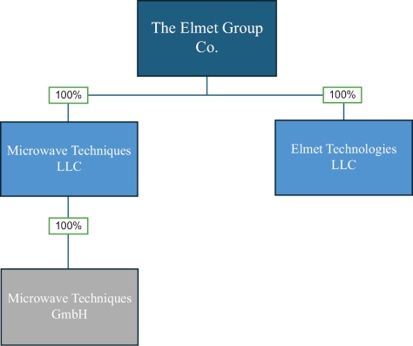
Initial Public Offering
On April 24, 2026, we completed our initial public offering (“IPO”) of 9,857,142 shares of our common stock, which includes 1,285,714 sold by us pursuant to the exercise of the underwriters’ over-allotment option which was exercised in full, at a public offering price of $14.00 per share. The IPO resulted in net proceeds to us of $128.2 million after deducting the underwriting discounts and commissions and before deducting offering costs of $2.8 million, which were charged to additional paid-in capital as a reduction of the net proceeds received from the IPO. In connection with the IPO, we also granted Cantor Fitzgerald & Co., as representative of the underwriters, a warrant to purchase up to 147,857 shares of common stock (the “Underwriter’s Warrant”) that has an exercise price per share equal to 125% of the public offering price of $14.00 per share, or $17.50 per share. The Underwriter’s Warrant is not exercisable for a period of 180 days following the IPO date and expire four years from the date of issuance. In connection with the IPO, we redeemed all issued and outstanding shares of Class B common stock from Mr. Anania for $25,000 and consolidated and reclassified all Class A and Class B common stock into a single class of $0.001 par value common stock.
Change in Fiscal Year
On May 19, 2026, our board of directors of the Company (the “Board of Directors”) approved a change in our fiscal year end from December 31 to a 4-4-5 fiscal calendar, whereby each three months consists of thirteen weeks grouped into two four-week months and one five-week month. Under the new fiscal calendar, our fiscal year ends on the Friday closest to December 31. The first fiscal year under the new calendar began on January 1, 2026, and ends on January 1, 2027. As a result of this change, our three months ending April 3, 2026, July 3, 2026 and October 2, 2026, may include an additional or lesser number of days compared to the prior year quarters ended March 31, 2025, June 30, 2025 and September 30, 2025, and accordingly, results for these periods may not be fully comparable to those of the prior year periods primarily due to the change in the number of days included in those periods. Our subsidiaries that have a fiscal year end different from that of our Company’s are consolidated using financial statements for periods that are within three months of our Company’s fiscal year end, with adjustments for material transactions, if any. This change was implemented to better align the Company’s accounting operations with quarterly public reporting requirements and to improve comparability of financial performance. The change in fiscal year will not impact our previously issued financial statements or tax reporting.
Our audited and unaudited consolidated financial statements and Management’s Discussion and Analysis of Financial Condition and Results of Operations reflect estimates and assumptions made by management. Events and changes in circumstances arising after December 31, 2025, and October 2, 2026, respectively, including those resulting from the continuing impacts of the currently unfavorable macroeconomic climate, will be reflected in management’s estimates for future periods.
66
Recent Developments
Our Strategic Transformation
In September 2026, we entered into a series of transactions that we believe fundamentally expand the scale and scope of our platform. Collectively, the DoW Transactions, the Springer Transactions, the Masan Investment, the DLA Offtake Agreement, the formation of ERT and the OSRAM Acquisition (each as discussed below) are intended to enhance our position as the only U.S.-owned, vertically integrated manufacturer of tungsten and molybdenum materials and products and transform our Company into an integrated mine-to-component platform across the U.S. and Europe. The DoW Transactions provide growth capital, the Springer Transactions and related offtake agreements will help secure raw material supply and processing capacity, and the DLA Offtake Agreement provides long-term demand visibility. Together with our expanded manufacturing footprint in the U.S. and Europe, we believe these initiatives will enhance our ability to supply critical products to our defense, semiconductor, medical and industrial customers.
We expect these transactions to:
| ● | Expand domestic manufacturing capacity: The DoW Transactions are intended to fund more than $165 million of capacity and infrastructure investment across our Lewiston, Maine; Coldwater, Michigan; and Euclid, Ohio facilities, including an expected five-fold increase in tungsten powder production capacity, which is the key input for our downstream CMC products. Additionally, the investment is anticipated to enable expanded capacity for critical DoW programs including Patriot PAC, PrSM, Phalanx, SLAP, rocket components and F-35 programs, as well as expanded capacity for tungsten wire products and tungsten heavy alloy balance weights. See “– Department of War Transaction.” |
| ● | Establish independent U.S. midstream conversion capacity: Through the joint venture with Blue Moon and EQ, we intend to upgrade and restart the Springer APT plant, which would be the first independent APT plant in the United States that is not foreign-owned or tungsten-carbide focused. We expect the Springer mine and mill to restart production in the fourth quarter of 2027 and the APT facility to begin operations in the second half of 2028. Once operational, we expect the APT plant to have an annual APT conversion capacity of approximately 4,000 tons per year. Feedstock from this facility will help secure our internal usage needs and be supplied to strategic external domestic customers. See “– Springer Project.” |
| ● | Secure and diversify feedstock: Our refining and trading division, along with our planned equity investment in each of Blue Moon and Masan, concentrate supply arrangements with EQ Resources and Blue Moon, offtake agreement with Tungsten West, and tungsten prepayment facility to Blue Moon, are intended to enable us to source and allocate tungsten across allied geographies and reduce our exposure to a market in which China controls more than 85% of global supply and has imposed export restrictions that have driven tightening supply and price volatility. We also expect greater control over input costs for our core business lines. |
| ● | Anchor long-term demand: The DLA Offtake Agreement provides a five-year base ordering period with an additional two-year option period, a $150 million minimum offtake commitment and a $2.0 billion ceiling, which we believe backstops refining volumes, de-risks the Springer investment and positions us ahead of the anticipated missile and munitions replenishment cycle. See “– DLA Offtake Agreement.” |
| ● | Establish an integrated European base: The OSRAM Acquisition is expected to add a fully integrated tungsten and molybdenum manufacturing platform in Schwabmünchein, Germany, to be consolidated within our CMC division. With this approximately 26,800 square meter facility, we expect to serve the European defense primes and other fusion, semiconductor, automotive, medical and industrial customers in rebuilding their supply chains for tungsten, an EU-designated critical raw material with limited European processing capacity today. |
| ● | Preserve capital structure flexibility: The Class A Preferred Stock issued in connection with the DoW Transactions has a 5.5% paid-in-kind dividend that requires no scheduled cash payments, and cannot be redeemed by the holder before September 14, 2036, except following certain default or liquidation events. We retain the right to redeem it at any time. The investment also contains a mechanism whereby the value of the Penny Warrant will partially reduce the preferred liquidation preference as our common stock appreciates, aligning DoW’s returns with common stockholders. Funding is drawn against project spend rather than in a single lump sum, aligning capital deployment with construction and qualification milestones. See “– Department of War Transaction.” |
67
We expect the initial phase of our transformation to focus on enhancing our existing facilities through modernization of infrastructure and expanded production capacity and securing long-term tungsten supply through the various offtake agreements discussed above and below. The second phase we expect to focus on the Springer Project, developing an independent U.S.-based APT facility and expanding our vertically-integrated capabilities.
Our capacity to benefit from the foregoing transactions as currently contemplated are subject to certain risks and uncertainties. See “Risk Factors – Risks Related to Our Business, Strategy and Industry” for a detailed discussion of these risks.
Department of War Transaction
On September 11, 2026, we entered into the DoW Transactions providing for an equity investment in the Company and related investor rights. We expect to receive an approximate package of investments and commitments from DoW of $450 million to expand and modernize our tungsten mining, processing, and manufacturing capabilities, including the planned upgrade and restart of the Springer APT plant and associated tungsten mine in Nevada, as well as to increase midstream processing capacity and expand and upgrade general infrastructure across our Coldwater, Lewiston and Euclid facilities.
Critical materials, such as tungsten, are some of the most strategically important components in advanced technology systems spanning commercial, industrial, and defense applications. However, global production of tungsten is highly concentrated in China. We intend to use this investment to build on our operational foundation to catalyze domestic production, strengthen U.S. supply chain resiliency, and secure critical supply chains for high-growth industries.
We currently plan on allocating the $450.0 million of committed capital from the DoW in the following manner: (i) approximately $165 million will be put towards upgrading and expanding our existing CMC facilities to expand production capacity for tungsten powder and components supporting key defense programs; (ii) approximately $100 million will be put toward the Masan Investment to help strengthen our long term strategic collaboration for tungsten conversion capacity; (iii) approximately $75 million will be put towards the JV Entity to restart the Springer APT plant; (iv) approximately $75 million will be put towards an investment in Blue Moon and commercial agreements related to the Springer Project; and (v) approximately $35 million will be put toward fees, expenses and miscellaneous costs.
The Investment Agreement contemplates the concurrent execution of a number of additional agreements, and the Investment Agreement and the additional agreements entered into with the DoW. The DoW Transactions closed on September 14, 2026.
Investment Agreement
Pursuant to the Investment Agreement, we agreed to sell and issue, and the DoW has agreed to purchase and acquire, up to an aggregate of $450.0 million of shares of Class A Preferred Stock (as defined below) in a private placement, which will consist of (i) an initial issuance of 200,000 shares of Class A Preferred Stock and the Warrants to purchase up to 7,567,341 shares of the Company’s common stock, for a purchase price of $200.0 million and (ii) additional issuances (each, a “Tranche”) of up to 50,000 shares of Class A Preferred Stock per Tranche at a purchase price of $1,000 per share of Class A Preferred Stock, respectively, for an additional aggregate of up to 250,000 shares of Class A Preferred Stock, at an aggregate purchase price of up to $250.0 million across all Tranches (the “Total Subsequent Funding Commitment Amount”). Beginning six months following the Initial Closing Date, each Tranche will be available for purchase by the DoW during a six-month commitment period, with successive Tranches becoming available at six-month intervals (each, a “Commitment Period”). The issuance of each Tranche shall be subject to (i) the delivery by us of at least thirty (30) days’ prior written notice to the DoW prior to the applicable funding date (a “Subsequent Issuance Notice”), (ii) a minimum funding amount of $25.0 million per Subsequent Issuance Notice, (iii) specification of the number of shares of Class A Preferred Stock to be issued and the intended use of the proceeds of such funding, and (iv) the satisfaction or waiver by the DoW in its sole discretion of certain closing conditions set forth in the Investment Agreement, including certain use-of-proceeds-specific conditions, and other customary closing conditions. If we do not exercise our right to draw the full amount of the Total Subsequent Funding Commitment Amount during the aggregate Commitment Period, any portion of the Total Subsequent Funding Commitment Amount not drawn shall be forfeited.
68
The Investment Agreement contains certain representations, warranties and covenants of each of us and the DoW, including covenants by us related to use of proceeds in connection with funding of specified projects agreed upon by us and the DoW (the “Projects”).
Class A Redeemable Preferred Stock
On September 14, 2026 (the “Effective Date”), pursuant to the terms of the Investment Agreement, we issued and sold to the DoW 200,000 shares of our Class A Redeemable Preferred Stock, par value $0.001 per share (the “Class A Preferred Stock”), and filed the related Certificate of Designations (the “Class A Certificate of Designations”) with the Secretary of State of the State of Delaware to establish and fix the terms thereof. The Class A Preferred Stock has an initial stated value of $1,000 per share. Shares of Class A Preferred Stock accrue cumulative dividends at a rate of 5.5% per year, compounding quarterly and payable solely in-kind through an increase to the stated value of each share of Class A Preferred Stock.
The Class A Preferred Stock is entitled to vote together with the holders of our common stock as a single class on all matters submitted to a vote of the holders of our common stock. The aggregate number of votes to which the Class A Preferred Stock shall be entitled as a class shall, as of the Initial Closing Date, equal 19.9% of the total voting power of all voting securities of the Company outstanding as of the Initial Closing Date (determined immediately after giving effect to the issuance of the Class A Preferred Stock and the Warrants as if such Warrants had been exercised in full for shares of our common stock at the Initial Closing Date) (the “Voting Cap”).
For so long as the DoW, or any permitted DoW transferee (collectively, the “DoW Investors”), beneficially own any shares of Class A Preferred Stock, the holders of outstanding shares of Class A Preferred Stock, voting separately as a single class, shall have the exclusive right to (i) appoint and elect one individual (the “Independent Director”) to our Board of Directors, who, subject to applicable law, rules and regulations, will also serve on our Audit Committee and Compensation Committee and (ii) separately designate one additional representative (the “DoW Board Observer”) to attend all meetings of our board of directors (and any committees thereof) in a non-voting observer capacity, subject to certain requirements and exceptions.
DoW Warrants
On the Initial Closing Date, as required under the Investment Agreement, the Company issued the Penny Warrant to the DoW. The Penny Warrant is exercisable by the initial holder thereof at any time and from time to time after the date that is twelve (12) months after the Initial Closing Date for a period of ten (10) years from the Initial Closing Date for up to 5,675,506 shares of our common stock, at an initial exercise price of $0.001 per share. The number of shares to be issued under the terms of the Penny Warrant is subject to adjustment in connection with certain transactions, including payments of stock dividends on our common stock, and stock splits and combinations of our common stock (each, an “Adjustment”). Any exercise of the Penny Warrant (including any mandatory exercise) will reduce the Liquidation Preference of the Class A Preferred Stock as provided in the Class A Certificate of Designations.
On the Initial Closing Date, the Company also issued the Strike Price Warrant to the DoW. The Strike Price Warrant is exercisable by the initial holder thereof at any time and from time to time after the date that is twelve (12) months after the Initial Closing Date for a period of ten (10) years from the Initial Closing Date for up to 1,891,835 shares of Common Stock, at an initial exercise price of $15.92 per share, representing the last-reported sale price of our common stock on the last trading day prior to execution of the Investment Agreement and consistent with the Nasdaq “Minimum Price” requirement. The exercise price of the Strike Price Warrant and the number of shares issuable under the Penny Warrant is subject to adjustment in connection with an Adjustment.
The Warrants are subject to mandatory exercise, on a cashless basis, upon expiration, a Liquidation Event, a Change of Control (as defined in the Class A Certificate of Designations), or, at our election, any time following September 14, 2029, if our common stock’s volume weighted average price (“VWAP”) exceeds 400% of the exercise price of the Strike Price Warrant for 20 consecutive trading days. We must provide 20 calendar days’ prior notice, allowing the holder to exercise for cash.
69
Any portion of the Warrants that remains unexercised upon their expiration shall be automatically exercised by means of a “cashless” exercise as set forth in the Warrants. No fractional shares of common stock are to be issued upon the exercise of the Warrants. In lieu of a fractional share of common stock, we will, upon exercise, pay a cash adjustment in respect of such final fraction in an amount equal to such fraction multiplied by the last reported sale price of our common stock.
Subject to applicable laws, the Warrants may not be offered for sale, sold, transferred, assigned, pledged or disposed of without our consent (not to be unreasonably withheld, conditioned or delayed), subject to certain exceptions.
Except as provided in the Warrants, the holder of a Warrant, solely in its capacity as holder of a Warrant, does not have the rights of a holder of our common stock, including any voting rights, prior to the issuance to the holder of the common stock which it is then entitled to receive upon the due exercise of a Warrant.
Registration Rights Agreement
On the Initial Closing Date, as required under the Investment Agreement, we entered into the Registration Rights Agreement (the “Registration Rights Agreement”) with the DoW. The Registration Rights Agreement provides that we will, among other things, prepare and file with the SEC a resale registration statement (a “Shelf Registration Statement”) on Form S-3, or if not available to us, on another appropriate form, including Form S-1, or an amendment or supplement to an existing registration statement on Form S-3, for the shares of common stock into which the Warrants are exercisable. The deadline for us to file the Shelf Registration Statement with the SEC is 60 days after the Initial Closing Date.
Pursuant to the Registration Rights Agreement, the DoW will have certain “demand” and “piggyback” registration rights and indemnification rights customary for transactions of this type, and we will under certain circumstances have the right to defer the registration and/or suspend the use of a registration statement or prospectus.
Investor Rights Agreement
On the Initial Closing Date, as required by the Investment Agreement, the Company also entered into an Investor Rights Agreement (the “Investor Rights Agreement”) with the DoW.
The Investor Rights Agreement provides, among other things, that we will provide the DoW, or any DoW Investors, so long as the DoW Investors continue to own any Class A Preferred Stock and/or at least 25% of the Warrants (or the common stock issued upon exercise of the Warrants) (the “Minimum Ownership Condition”), the right to purchase all or any portion of new equity securities of our or any of our subsidiaries, prior to the issuance and sale of such securities, under the same terms and conditions such securities would be offered to other purchasers, subject to certain exceptions and limitations. We must provide the DoW Investors with written notice at least sixty (60) days prior to the proposed issuance. In addition, without limiting the DoW’s right of first offer set forth above, for so long as the DoW Investors continue to satisfy the Minimum Ownership Condition, if the Company issues, sells, or authorizes the issuance or sale of any new equity securities of the Company or any of the Company’s subsidiaries, the Company shall offer the DoW within sixty (60) days prior to such issuance, the right to purchase up to their Percentage Interest (as defined in the Investors Rights Agreement) of such new securities, to enable the DoW Investors to maintain their then current holdings percentage determined on a fully diluted as-converted basis following such issuance. If the DoW Investors exercise such right of first offer or preemptive rights, as applicable, and their participation would result in their aggregate voting power of the Company to exceed 19.9%, then we shall, within sixty (60) calendar days of such date, use commercially reasonable efforts to obtain stockholder approval, if required, to issue the securities in excess of 19.9% in accordance with the requirements of Nasdaq.
70
Pursuant to the Investor Rights Agreement, prior to our offering any product(s) produced or derived by, associated with, attributable to or otherwise regarding us from certain projects agreed upon between us and the DoW (the “Project Products”) to any other party, the DoW Investors shall have the exclusive right to negotiate for the purchase, acquisition or exclusive offtake of such products (a “Product Contract”) at arm’s length and pricing terms consistent with then-prevailing market conditions, subject to certain exceptions. If the DoW Investors elect not to exercise their rights to Project Products, the Company will satisfy rated orders in accordance with 15 C.F.R Part 700 and will allocate and sell all remaining Project Products in accordance with the following order of priority, each as defined in the Investor Rights Agreement: (i) first, to the United States Defense Primes; (ii) second, the suppliers of the Defense Industrial Base; (iii) third, to U.S. Businesses; (iv) fourth, to U.S. Allies; and (v) fifth, to any other Person that is not a Restricted Entity (as such term is defined in the Investor Rights Agreement). We may sell Project Products to a lower priority tier in the event that (a) no higher-priority requester has submitted a purchase request within 30 days of capacity availability or (b) a higher-priority requester has submitted an offer, and a lower-priority requester subsequently offers superior commercial terms. None of the foregoing restrictions will preclude us from sales to any non-Restricted Entity so long as we have sufficient capacity to satisfy its obligations under any Product Contract.
For so long as the DoW Investors continue to satisfy the Minimum Ownership Condition, without the prior written consent of the DoW, we and our subsidiaries shall not, among other actions: (i) voluntarily liquidate, dissolve or wind-up the Company or any of its subsidiaries; (ii) authorize, create or issue any additional equity securities, or any securities convertible into or exercisable for any equity securities, of the Company having rights, preferences or privileges senior to, or in parity with the Class A Preferred Stock; (iii) change the authorized number of directors of our Board of Directors (or the number of votes provided to each director); (iv) enter into any transactions with an affiliate of ours pursuant to which we shall make any payment, sell, lease, transfer, or dispose of any of this properties or assets to, or purchase any property or assets from, or enter or amend any transaction or arrangement with, or for the benefit of, such affiliate of ours involving aggregate value in excess of $120,000; (v) dispose of, license, transfer, abandon, or fail to maintain, prosecute or defend any material technology or intellectual property, subject to customary exceptions for ordinary-course customer licenses, strategic transactions approved by our Board of Directors, and non-material intellectual property or technology; (vi) declare, pay, or make any (a) dividends or distributions on any common stock or other equity securities (other than the Class A Preferred Stock), and (b) repurchases, redemptions, or other acquisitions of common stock or other equity securities; (vii) change the authorized number of shares of Class A Preferred Stock; (viii) create, incur, assume, or suffer to exist any Indebtedness (as defined in the Investor Rights Agreement), other than Permitted Indebtedness (as defined in the Investor Rights Agreement) subject to certain net leverage ratio criteria; (iv) make any loan or advance to, or own any stock or other securities of, any subsidiary or other corporation, partnership, or other entity unless it is a wholly-owned subsidiary of ours following such transaction; (x) make any loan or advance to any person, including, any employee or director except advances and similar expenditures in the ordinary course of business or under the terms of our equity incentive plan or successor plan; (xi) affect any Change of Control (as defined in the Investor Rights Agreement); or (xii) make any Restricted Payments (as defined in the Investor Rights Agreement), each subject to certain exceptions, conditions and exempt issuances.
Furthermore, the Investor Rights Agreement restricts us, without the DoW’s prior written approval, from being owned or controlled by, transferring property to, or otherwise doing business with any Restricted Entity, subject to specified exceptions. We and our subsidiaries must also maintain commercially reasonable compliance procedures and use reasonable best efforts to maintain a shareholder rights plan or similar arrangement designed to prevent a Restricted Entity, or a group including a Restricted Entity, from acquiring 10% or more of our outstanding common stock.
At any time after the DoW Investors no longer own any Class A Preferred Stock but continue to own at least 25% of the Warrants (or the common stock issued upon exercise of the Warrants), the DoW will have the right to (i) designate for nomination to the Board of Directors one independent third-party director, who meets certain qualification as set forth in the Investor Rights Agreement and (ii) designate one additional representative to attend all meetings of the Board of Directors (and any committees thereof) in a non-voting observer capacity, subject to certain requirements and exceptions. For so long as the DoW Investors have a right to designate an Independent Director, the Board of Directors (or any committee thereof) will appoint the Independent Director for membership on our Audit Committee and Compensation Committee in accordance with Nasdaq rules and SEC rules and regulations. If the Independent Director is not permitted by Nasdaq rules and SEC rules and regulations to be a member of the Audit Committee or the Compensation Committee, the Independent Director shall attend all meetings of the Audit Committee or the Compensation Committee, as applicable, in a strictly non-voting observer capacity. The removal of the DoW Board Observer will only be permitted upon the written request of the DoW. The removal of the Independent Director will only be permitted in accordance with our Second Amended and Restated Certificate of Incorporation and Delaware law.
71
Additionally, the Investor Rights Agreement allows the DoW Investors or an Authorized Government Official to submit a written notice on its behalf (an “Activation Notice”) to us exercising its ability to, on commercially reasonable, arm’s-length terms, including pricing terms substantially consistent with then-prevailing market conditions, designate up to one hundred percent (100%) of production capacity of the Projects, and to the extent reasonably necessary to satisfy such requirement, the corresponding production, processing, storage, loading, transportation coordination, inventory management and deliver capacity associated with the applicable Projects (collectively, the “Emergency Allocation Right”). An Activation Notice is only permitted to be issued if an Authorized Government Official (as defined in the Investor Rights Agreement) determines in writing that the Project Products are required to support national defense, war, armed conflict, military contingency operations, industrial mobilization, emergency preparedness, or response to a national emergency, and that exercise of the Emergency Allocation Right is necessary or advisable to ensure timely availability of the applicable Project Products.
The receipt of an Activation Notice supersedes our obligations to third-party customers with respect to the affected production capacity of the Projects, except to the extent prohibited by applicable law, provided that (1) we use our best efforts to obtain any exemption, license, or waiver required to eliminate such prohibition and promptly notifies the DoW Investors of any such prohibition and the actions being taken to remove it; (2) we cease entering into new commitments that would conflict with the volumes specified in the Activation Notice; (3) we take all actions reasonably necessary to redirect, defer, unwind, cancel, swap, or reassign previously committed volumes so as to maximize delivery to the DoW Investors or its designee(s); (4) we prioritize performance for the DoW Investors in all production, storage, handling, and logistics scheduling; (5) we do not assert that conflicting commercial commitments excuse performance to the extent such commitments were entered into contrary to the Investor Rights Agreement; and (6) we provide an initial response acknowledging the Activation Notice within 24 hours and a preliminary implementation plan within 3 Business Days. Our obligations under the Investor Rights Agreement shall not be conditioned upon, or delayed by, our acknowledgment or provision of an implementation plan.
Furthermore, the DoW Investors, subject to certain qualifiers, will reimburse us reasonable and documented out-of-pocket costs incurred as a direct result of an Activation Notice. We may request up to $250,000 for any single expense or up to $2,500,000 in aggregate per issued activation notice. In the event that resulting out-of-pocket expense are in excess of either of the aforementioned amount we may request additional reimbursements to be approved by an Authorized Government Official, which approval may or may not be granted.
Restricted Entity Compliance Plan
On September 14, 2026, we entered into a Restricted Entity Compliance Plan (the “Restricted Entity Compliance Plan” or the “Plan”) with Continental Stock Transfer & Trust Company, as rights agent. In connection therewith, the Board of Directors declared a dividend of one preferred share purchase right (“Right”) for each outstanding share of our common stock. The dividend is payable on September 24, 2026, to stockholders of record as of the close of business on such date (the “Record Date”). In addition, one Right will automatically attach to each share of common stock issued between the Record Date and the Distribution Date (as defined below). The terms used in this section but not otherwise defined herein shall have the meaning ascribed to such terms in the Plan.
The Board of Directors adopted the Plan in connection with the entry into by us of the DoW Transaction Documents, pursuant to which, among other things, we agreed to use its reasonable best efforts to maintain in effect the Plan or a substantially similar arrangement to prevent any Restricted Entity (as defined in the Investor Rights Agreement) from acquiring beneficial ownership of 10% or more of our outstanding common stock.
Other than with respect to Restricted Entities, the Plan does not impact the ability of any person from acquiring shares of our common stock or making offers to acquire, merge or combine with us.
72
The following is a general description of the terms of the Rights, the Class B Preferred Stock (as defined below) and the Plan. This description is qualified in its entirety by the full text of the Certificate of Designations of the Class B Preferred Stock (the “Class B Certificate of Designations”) and the Plan.
The Rights. The Board of Directors authorized the issuance of one Right with respect to each share of common stock outstanding on the Record Date. The Rights will initially trade with, and will be inseparable from, the common stock. The Rights will accompany any new shares of common stock issued after the Record Date until the earlier of the Distribution Date, the Redemption Date or the Expiration Date of the Rights, as described below.
Exercise Price. Each Right will allow its holder to purchase from our one one-thousandth of a share of Class B Junior Participating Preferred Stock, par value $0.001 per share (“Class B Preferred Stock”), for $86.00 per share, subject to adjustment under certain conditions (the “Purchase Price”), once the Rights become exercisable.
Exercisability. The Rights will not be exercisable until:
| ● | 10 business days after the public announcement that a Restricted Entity has become an “Acquiring Person” (as defined in the Plan) by obtaining beneficial ownership of 10% or more of the outstanding common stock, or, if earlier; |
| ● | 10 business days (or a later date determined by the Board of Directors before any person or group becomes an Acquiring Person) after a Restricted Entity Commences (as defined in the Plan) a tender or exchange offer which, if completed, would result in that person or group becoming an Acquiring Person. |
The date when the Rights become exercisable is referred to as the “Distribution Date.” Until the Distribution Date, our common stock certificates or, in the case of uncertificated shares, notations in the book-entry account system, will evidence the Rights. Until the Distribution Date (or earlier redemption, exchange, termination or expiration of the Rights), the surrender for transfer of any certificates for common stock or book-entry shares will also constitute the transfer of the associated Rights. After the Distribution Date, the Rights will separate from the common stock and be evidenced by Right certificates that we will mail to all eligible holders of common stock. Any Rights held by an Acquiring Person will be void and may not be exercised.
Consequences of a Person or Group Becoming an Acquiring Person.
| ● | Flip In. If a person or group becomes an Acquiring Person, all holders of Rights except the Acquiring Person or any associate or affiliate thereof may, upon exercise of a Right, purchase for the Purchase Price shares of common stock with a market value of two times the Purchase Price, based on the market price of the common stock prior to such acquisition. If we do not have a sufficient number of shares of common stock available, we may, under certain circumstances, substitute Class B Preferred Stock or other securities or property for the common stock into which the Rights would have otherwise been exercisable. |
| ● | Exchange. After a person or group becomes an Acquiring Person, the Board of Directors may extinguish all or a portion of the Rights by exchanging one share of common stock, or such greater number as shall be sufficient to ensure that immediately following such exchange, the beneficial ownership of each Acquiring Person, together with its Affiliates and Associates, shall be less than 10% of the outstanding common stock, for each Right, other than Rights held by the Acquiring Person. |
73
Springer Project
Springer Project Binding Letter Agreement
On September 11, 2026, we entered into the Springer Agreement with Blue Moon, BM US, and EQ, regarding a series of strategic transactions associated with Springer located in Pershing County, Nevada. The transactions contemplated under the Springer Agreement include: (i) the formation of the JV Entity among the Springer Parties to restart, expand and operate the APT Plant, (ii) an equity investment by us into Blue Moon, (iii) our receipt of board representation in both Blue Moon and the JV Entity; (iv) a supply agreement for EQ and Blue Moon tungsten concentrate offtakes to the Springer APT Plant at market pricing, (v) a tungsten prepayment facility provided by us to Blue Moon, to be repaid through a credit against sales of concentrate from Springer, and (vi) a site sharing agreement between Blue Moon and the JV Entity, covering the land, buildings, utilities, water, and services arrangements between the JV Entity and Blue Moon. The Springer Parties expect to close the Springer Transactions within twelve calendar months from the date of the Springer Agreement.
The successful execution and consummation of the Springer Transactions are subject to numerous factors and conditions discussed under “General” below. The currently contemplated terms of the definitive agreements relating to the Springer Transactions are as follows:
APT Plant Joint Venture
The Springer Parties intend to form the JV Entity to restart, expand and operate the APT Plant, with us initially owning a 70% equity interest in the JV Entity, Blue Moon owning 20%, and EQ owning the remaining 10% interest. In connection with the JV Entity formation, Blue Moon will cause BM US to grant an irrevocable and exclusive 99-year use and operating agreement to use and operate the APT Plant, all equipment and associated infrastructure contributed to the JV Entity at a value to be determined in the definitive agreement. We will provide an initial capital contribution of approximately $75.0 million to the JV Entity to bring the APT Plant into a fully operational posture and EQ will contribute its industry know-how, including overseeing engineering and project management, provision of ore sorting technology and certain off-take commitments. In the case of cost overrun in excess of the $75.0 million contributed by us, we and EQ will contribute up to an addition $25.0 million, in proportion to their respective JV Entity ownership interests, after which the Springer Parties will contribute as needed on a pro-rata ownership basis. The initial board of directors for the JV Entity will be comprised of seven members, including four directors chosen by us, two directors chosen by Blue Moon, and one director chosen by EQ. We will operate and control the JV Entity.
Equity Investment in Blue Moon
Pursuant to the Springer Agreement, we agreed to purchase, and Blue Moon has agreed to issue and sell, new equity in Blue Moon comprised of 3,500,000 units (the “Units”), within forty-five (45) calendar days of September 14, 2026, with each Unit to be comprised of one common share of Blue Moon (“BM Share”) and one Blue Moon Warrant at a price per unit of CAD 10.00 (the “Blue Moon Investment”). On October 16, 2026, we entered into a subscription agreement with Blue Moon (the “BM Purchase Agreement”) to give effect to the Blue Moon Investment. As part of the Blue Moon Investment, the Company and Blue Moon also entered into the BM Investor Rights Agreement (as defined below).
The BM Purchase Agreement contains certain representations, warranties and covenants of each of the Company and Blue Moon, including covenants by Blue Moon related to the use of proceeds in connection with the development of Springer and with respect to Material Properties and Mining Rights (as defined in the BM Purchase Agreement). The closing of the Blue Moon Investment occurred on October 16, 2026. Pursuant to applicable U.S. and Canadian securities laws, the BM Shares, the Blue Moon Warrants and the BM Shares issuable upon exercise of the Blue Moon Warrants will be subject to certain restrictions on transfer, including, but not limited to, a prohibition on sales, transfers and trades in Canada or for the benefit of a Canadian resident until February 16, 2027, four months from the date of the issuance of the Units.
Proceeds of the Blue Moon Investment will be limited to use solely in connection with the development of the projects being undertaken at Springer, with all mine and mill proceeds to be earmarked for tungsten development purposes only. Blue Moon will not apply any portions of the Blue Moon Investment proceeds to activities unrelated to Springer without our prior written consent. We will have audit rights to confirm Blue Moon’s compliance with the use of proceeds restrictions.
74
BM Investor Rights Agreement and Board Representation
On October 16, 2026, as required by the BM Purchase Agreement, the Company also entered into an investor rights agreement (the “BM Investor Rights Agreement”) with Blue Moon. The BM Investor Rights Agreement provides, among other things, that Blue Moon will provide us with participation rights (the “Participation Right”) in the event Blue Moon issues any equity, voting or convertible securities (an “Offering”). Pursuant to the Participation Right, we will be granted the opportunity to participate in an Offering on substantially the same terms and conditions as well as purchase price offered to potential subscribers, subject to certain ownership limitations. We will hold the Participation Right so long as we hold at least forty percent (40%) of the equity it purchased in the Blue Moon Investment (the “Ownership Condition”).
Additionally, the Investor Rights Agreement provides us with a “Top-Up Right,” in connection with the issuance of BM Shares on the conversion, exercise or exchange of convertible securities or pursuant to any other contract, agreement or understanding that provides for the issuance of BM Shares, excluding contracts and agreements pursuant to which we have the right to exercise our Participation Right (a “Dilutive Issuance”). Should a Dilutive Issuances occur that result in an aggregate reduction of our ownership percentage of Blue Moon of at least 1.0%, we will be provided an opportunity to purchase additional BM Shares to restore our ownership percentage we would have had but for such Dilutive Issuances, adjusted for any non-exercise or deferral of our Participation Right. The purchase price of any BM Shares offered to us pursuant to the Top-Up Right will equal the volume-weighted average trading price of BM Shares on the TSX Venture Exchange or other exchange on which the BM Shares are listed for trading for the five (5) trading days prior to the date on which Blue Moon delivers a Top-up Notice (as defined in the BM Investor Rights Agreement) to us.
Furthermore, we have the right to designate a nominee to serve on the board of directors of Blue Moon (the “Blue Moon Board”). Blue Moon has agreed to take all necessary steps to appoint our initial nominee within ten (10) days of the date of the Investor Rights Agreement. We will maintain the right to designate a nominee to the Blue Moon Board at any meeting of Blue Moon shareholders, and our nominee will be reasonably considered for inclusion on one or more of the committees of the Blue Moon Board, for so long as the Ownership Condition is met. Finally, should our nominee resign, fail to be elected or if the seat is otherwise vacant, we will be entitled to appoint a non-voting board observer.
EQ and Blue Moon Offtake Agreements
Each of Blue Moon and EQ will enter into offtake agreements with the JV Entity (the “Blue Moon Offtake Agreement” and the “EQ Offtake Agreement,” respectively) to govern the purchase of tungsten concentrate by the JV Entity. The Blue Moon Offtake Agreement will obligate the JV Entity to use its best efforts to take tungsten concentrate produced from the mill and mine at Springer (the “Springer Concentrate”).
Tungsten Prepayment Facility
As part of the Blue Moon Investment, we will provide Blue Moon’s group with a prepayment facility in the aggregate principal amount of approximately $50.0 million (the “Tungsten Prepayment Facility”), to be funded in two tranches as follows: (i) the first tranche, in the amount of $25.0 million (“BM Tranche 1”), shall be funded at the closing of the Tungsten Prepayment Facility; (ii) the second tranche, in the amount of $25.0 million (“BM Tranche 2”), will be funded upon completion of milestones to be set forth in the definitive agreements, aligned with Blue Moon’s readiness covenants relating to Springer’s mine, mill, and flotation circuit, and, if test work is favorable, ore sorting progress. BM Tranche 2 will be funded only upon satisfactory completion of the construction milestones applicable to BM Tranche 1, as mutually determined by the Springer Parties. The Tungsten Prepayment Facility will be repaid through a twenty-five percent (25%) credit against sales of Springer Concentrate until the outstanding balances of BM Tranche 1 and BM Tranche 2 have both been fully retired, and no interest shall accrue on amounts outstanding thereunder except in the event of default. Security on the Tungsten Prepayment Facility will be covered by a dedicated bank account and over Springer Concentrate.
In connection with the Tungsten Prepayment Facility, we agreed to issue Blue Moon warrants to purchase an aggregate of $25.0 million of shares of our common stock within five business days of September 14, 2026 with a strike price equal to the greater of a five-day VWAP as of September 21, 2026, or the Nasdaq minimum price as determined under Nasdaq Rule 5635 at the time of issuance. On September 21, 2026, we entered into a securities purchase agreement with Blue Moon, pursuant to which the TEG Warrants were issued. The TEG Warrants are exercisable for up to an aggregated of 1,166,970 shares of our common stock and have an initial exercise price of $21.423 per share. The TEG Warrants will expire three years from the date of issuance and will become exercisable starting six months from the date of issuance.
75
Springer Site Plan
The Springer Agreement contemplates Blue Moon and its U.S. affiliates (the “BM Group”) maintaining complete ownership and operation of the mine and mill at Springer, including holding all permits to operate at the site. The BM Group will additionally retain ownership of certain ancillary assets on behalf of the JV Entity, including, but not limited to, utilities interconnections, water rights, and tailings facilities. Blue Moon and the JV Entity will enter into a site master plan (the “Site Master Plan”), which will provide for, among other things, land allocation, buildings, roads and logistics, utilities and interconnections, water supply and storage, waste and tailings, lay down and receiving areas, solar, natural gas and other power generation, a potential scrap processing plant, and future expansion plans. The Site Master Plan will be subject to the approval of all Springer Parties and will govern the development of Springer. The costs of preparation of the Site Master Plan will be shared between the JV Entity and Blue Moon based on the relative percentage of the APT Plant and its associated facilities to the entirety of Springer.
General
The Springer Agreement additionally contained customary representations and warranties of the Springer Parties and will remain binding on the Springer Parties until the earliest of (i) execution and delivery of the definitive documentation for the Springer Transactions, (ii) mutual written agreement of the Springer Parties to terminate the Springer Agreement, (iii) the definitive documentation for the Springer Transactions having not been executed by the applicable Outside Date (as such term is defined in the Springer Agreement), and (iv) a material breach by any Springer Party of its obligations under the Springer Agreement that remains uncured for a thirty (30) day period following written notice thereof. The closing of the Springer Transactions (the “Springer Closing”) is conditioned upon several factors, including receipt of applicable third party and regulatory approvals, the accuracies of the representations and warranties of the Springer Parties as of the applicable Springer Closing, the performance of each of the Springer Parties under the Springer Agreement in all material respects, the satisfactory completion of due diligence by the Springer Parties, the negotiation and execution of the definitive documentation for the Springer Transactions, and the absence of a material adverse effect (as such term is defined in the Springer Agreement) having occurred with respect to a Springer Party that is continuing as of the date of the Springer Closing.
DLA Offtake Agreement
On September 11, 2026, we, through our wholly owned subsidiary, Elmet Technologies LLC, entered into the DLA Offtake Agreement with the DLA relating to an exclusive offtake arrangement for tungsten ores and concentrates and sodium tungstate. Pursuant to the DLA Offtake Agreement, we will sell, upon the DLA’s request, a minimum of $150.0 million worth of tungsten ore and concentrate and sodium tungstate over the course of a five-year base ordering period, subject to an additional two-year option period, with such option being exercised at the DLA’s discretion. Delivery orders will be submitted to us through a request-for-proposal process, with each order subject to our review and acceptance. Each order will then be delivered to the DLA within 48 months of the issuance of each respective delivery order. Upon the procurement of the Minimum Offtake Amount, the DLA, in its sole discretion, may purchase up to a maximum of $1.85 billion worth of additional tungsten ore and concentrate and sodium tungstate throughout the ordering period.
The DLA has the right to determine the source of the tungsten ore and concentrate and sodium tungstate, for which certain pre-determined sources have been agreed upon. The tungsten material supplied is required to meet certain material and packaging specifications and will be subject to certain sampling and testing requirements prior to procurement of the tungsten material to the DLA.
76
Formation of Elmet Refining & Trading
On September 14, 2026, we announced the formation of our refining and trading division, a new operating division responsible for coordinating sourcing, processing and delivering material across our expanding global network. We intend for the division to manage our APT conversion capacity, administer our mine offtake agreements, including the DLA Offtake Agreement and TW Offtake Agreement, and pursue a diversified and resilient feedstock portfolio through equity investments and long-term offtakes with allied producers. We believe the division represents a key step in establishing an integrated platform to source, refine, trade and allocate tungsten across allied geographies, and connects our upstream feedstock arrangements to downstream demand from our Critical Materials Components division. The division will hold our interest in the JV Entity formed to upgrade and restart the Springer APT plant, which we expect would be the first independent APT plant in the United States that is not foreign-owned or tungsten-carbide focused. There has been no current activity and no material costs incurred for this new operating division as of October 2, 2026. See “– Springer Project” and “– DLA Offtake Agreement” above and “– Tungsten West Offtake Agreement” below.
Tungsten West Offtake Agreement
On September 22, 2026, through Elmet Tech, we entered into the TW Offtake Agreement with Drakelands , and Tungsten West, relating to a strategic offtake arrangement of tungsten concentrate. Under the TW Offtake Agreement, we will purchase an annual target quantity of tungsten concentrate of 1,000 metric tonnes from Drakelands, beginning in the calendar year 2027. Until Drakelands has produced a minimum target of tungsten concentrate over a twelve-month period that meets certain product specifications, we are entitled to receive not less than 50% of all tungsten concentrate produced by Drakelands that meets the product specifications. Additionally, at Drakelands’ request, we will process up to an additional amount of tungsten concentrate per annum for the United Kingdom Government or its nominee, or for entities requiring tungsten for use in the United Kingdom.
As part of the TW Offtake Agreement, for a period of sixty (60) days from the date of the TW Offtake Agreement, we will have the exclusive rights to supply tungsten concentrate produced from Drakelands material to the DLA pursuant to the DLA Offtake Agreement. Furthermore, Drakelands tungsten concentrate product will be given priority for supply by us to the DLA until the commissioning of the Springer APT Plant.
The TW Offtake Agreement will remain in effect until December 31, 2034, subject to extension by mutual agreement of the parties or unless otherwise terminated earlier by written notice in accordance with its terms.
Masan Investment
Masan SPA
On September 23, 2026, we entered into a Securities Purchase Agreement (the “SPA”) with Masan Horizon pursuant to which Masan Horizon agreed to issue and sell, and we agreed to purchase, a 4.99% interest in the total issued and outstanding voting ordinary shares of Masan, a public company incorporated in Vietnam and controlled subsidiary of Masan Horizon, or 55,138,174 ordinary shares (the “Masan Shares”) of Masan for an aggregate purchase price of approximately $124.8 (the “Masan Purchase Price”) pursuant to a put-through transaction on the UPCoM in accordance with applicable trading rules and regulations. The Masan Investment was conducted in VND based on the converted VND amount of the Masan Purchase Price. Masan’s ordinary shares are currently registered for trading on the UPCoM under the trading code “MSR.”
The SPA included customary representations, warranties and covenants by us and Masan Horizon. The representations, warranties and covenants contained in the SPA were made only for the purposes of such agreement and as of the specific dates, were solely for the benefit of the parties to such agreement and may be subject to limitations agreed upon by the contracting parties. The closing of the Masan Investment occurred on October 1, 2026 (the “Masan Closing Date”), and was subject to the satisfaction or waiver of certain closing conditions, including, but not limited to, the execution of certain commercial agreements between the parties, the receipt of applicable regulatory and trading market approvals, the accuracies of the representations and warranties of the parties as of the applicable Masan Closing Date, the performance of each of the parties under the SPA in all material respects, the execution of all definitive documentation for the Masan Investment, and the absence of a material adverse effect (as such term is defined in the SPA) having occurred with respect to a party that is continuing as of the time immediately prior to the first put-through order is entered in connection with the Masan Investment. The settlement of the Masan Shares and payment of the Masan Purchase Price occurred on October 5, 2026 (the “Masan Settlement Date”).
77
Masan SHA
On September 23, 2026, we also entered into the Masan SHA with Masan Horizon pursuant to which the parties memorialized certain of our rights in connection with the Masan Investment.
We are entitled to all dividends and other distributions declared, paid or made by Masan in respect of the Masan Shares on or after the Settlement Date, in accordance with our percentage shareholding in Masan; provided, however, that the parties acknowledged that we will not participate in the interim dividends for the 2026 financial year declared by Masan. For each of the three (3) financial years following the financial year in which the Masan Closing Date falls, Masan Horizon will procure that Masan targets a dividend payout ratio of up to eighty percent (80%).
For so long as we, or any of our permitted transferees (collectively, the “Elmet Investors”), hold at least eighty percent (80%) of the Masan Shares, subject to customary adjustments for corporate actions affecting the Masan Shares following the Masan Closing Date (the “Retention Threshold”), we will have the right to nominate one individual (the “Elmet Director”) for appointment to Masan’s board of directors (the “Masan Board of Directors”) for whom Masan Horizon will make all reasonable efforts to ensure the Elmet Director is appointed to the Masan Board of Directors at the first annual general meeting of shareholders of Masan held after the Masan Closing Date or at any other general meeting of shareholders of Masan held before that annual general meeting. During the period commencing on the Masan Closing Date and ending on the date on which the Elmet Director is appointed to the Masan Board of Directors, Masan Horizon will ensure the Elmet Director, or another individual designated by us, may attend all meetings of the Masan Board of Directors in a non-voting observer capacity, subject to certain requirements and exceptions (the “Elmet Observer”).
If at any time the Retention Threshold is no longer satisfied, the Masan SHA ceases to be in full force and effect, or we are in material breach of the Masan SHA which is not remedied within the applicable cure period, at Masan Horizon’s request, we will procure that the Elmet Director immediately resign as a member of the Masan Board of Directors and such nomination right will terminate. However, if at any time the Retention Threshold is no longer satisfied, but the Elmet Investors continue to hold, in aggregate, at least fifty percent (50%) of the Masan Shares originally acquired pursuant to the SPA and we are not in material breach of the Masan SHA, then we will remain entitled to designate one individual as the Elmet Observer to attend the meetings of the Masan Board of Directors in a non-voting observer capacity, subject to certain requirements and exceptions.
Pursuant to the Masan SHA, and subject to certain exceptions, the Elmet Investors have agreed not to transfer any Masan Shares, without the prior written consent of Masan Horizon, for a period of eighteen (18) months following the Masan Closing Date. In addition, for a period commencing on the Masan Closing Date and ending on the date falling six (6) months after the Masan Closing Date, we will not enter into any transaction or series of transactions with any third party comprising a sale of Masan’s ordinary shares at a valuation lower than the valuation of Masan applicable to the Masan Investment, subject to certain exceptions.
For so long as the Retention Threshold is satisfied, if Masan Horizon or Masan propose to enter into a Restricted Transaction (as defined in the Masan SHA), we will have the right to participate in such Restricted Transaction by matching the terms, subject to certain conditions and exceptions. Provided that Masan Horizon or Masan completes a Restricted Transaction for which we did not exercise our right to participate, then (i) all lock-up and transfer restrictions applicable to the Masan Shares held by the Elmet Investors will cease to apply, to the extent permissible under applicable law, and (ii) we will have the option, exercisable by written notice to Masan Horizon within thirty (30) days of completion of the relevant Restricted Transaction, to terminate any relevant commercial agreement entered into between the parties or their affiliates in accordance with their terms.
78
Furthermore, if Masan proposes to issue new securities at a price per Masan Share lower than the purchase price per Masan Share in the Masan Investment within eighteen (18) months following the Masan Closing Date, then we will have the right to acquire up to such portion of the new securities of Masan offered in such proposed offering equal to our ownership percentage of the then issued and outstanding ordinary shares of Masan, subject to certain exceptions.
Pursuant to the Masan SHA, the parties shall establish a joint committee (the “Masan Offtake Rights Committee”) comprised of two (2) representatives appointed by each of us and Masan, or such other equal number as the parties may agree in writing, which will serve solely an advisory function with no decision-making authority. The Masan Offtake Rights Committee will coordinate volumes, scheduling, quality specifications, logistics and approved customers solely in respect of volumes subject to the offtake and conversion arrangements under the commercial agreements entered into between the parties.
The Masan SHA will terminate upon the occurrence of any of the following: (i) termination of the SPA prior to the Masan Closing Date, (ii) Masan being dissolved, liquidated or wound up, (iii) either us or Masan Horizon ceasing to hold any equity securities of Masan, (iv) a liquidation event with respect to either us or Masan Horizon, (v) by mutual written agreement of us and Masan Horizon or (vi) if necessary to comply with applicable securities laws, trading market rules and regulations or the requirements of any securities exchange in connection with a listing of the ordinary shares of Masan.
We also entered into certain additional commercial agreements, including offtake agreements, with Masan Horizon for the supply of tungsten concentrate and blue tungsten oxide on the Masan Closing Date. These agreements, together with the Masan SHA and SPA, are intended to create a multi-year commercial framework and formalize our already long-standing commercial relationship with Masan, and are expected to provide for dedicated allocations of tungsten concentrate and blue tungsten oxide for our manufacturing purposes as well as for sales to strategic North American customers through our newly established refining and trading division, and for Masan to receive a best efforts supply of tungsten ore from our other offtake arrangements.
OSRAM Acquisition
On September 3, 2026, we, through our wholly owned subsidiary, Elmet Tech, entered into the Purchase Agreement with OSRAM, pursuant to which Elmet Tech agreed to purchase substantially all of the assets and rights associated with the OSRAM’s metal production operations located in Schwabmünchein, Germany, pertaining to the OSRAM’s manufacturing and distribution of, among other things, metal pre-materials and metal products from tungsten and molybdenum metals required for various forms of lighting solutions, such as metal powders, rods, heavy wire, fine wire, electrodes and other formed parts, and assume certain of the OSRAM’s liabilities, including employee and pension liabilities, and contractual relationships exclusively entered into or pertaining to the OSRAM Business, as such terms are set forth in the Purchase Agreement. The purchase price will be determined at the closing of the OSRAM Acquisition pursuant to the purchase price formula and adjustment provisions as set forth in the Purchase Agreement, which generally consists of the aggregate of (i) a fixed amount of negative €18.0 million, (ii) plus certain pension assets, (iii) minus the amount of the defined benefit obligation for certain pension liabilities, (iv) minus a restructuring prepayment in the amount of €1 million, (v) plus the amount, if any, by which the Working Capital (as defined in the Purchase Agreement) of the OSRAM Business on the first day of the calendar month of the OSRAM Closing exceeds €3.875 million, (vi) minus the amount, if any, by which the Working Capital of the Business on the OSRAM Effective Date falls below €3.875 million.
The Purchase Agreement contains certain representations, warranties and covenants of each of Elmet Tech and OSRAM, including covenants by OSRAM relating to the operation of the OSRAM Business prior to the OSRAM Closing. Elmet Tech will not acquire the real property on which the OSRAM Business is operated in the OSRAM Acquisition, and OSRAM will retain ownership of such real property and continue to operate, on the same premises, the portion of its business that is not being sold pursuant to the OSRAM Acquisition.
79
Each of Elmet Tech and OSRAM has agreed to indemnify the other for certain losses arising out of breaches of fundamental representations and covenants and for certain losses arising out of retained liabilities or assumed liabilities, as applicable, subject to customary limitations.
The consummation of the OSRAM Acquisition is subject to the satisfaction or waiver of customary closing conditions, including required regulatory and anti-trust approvals and the absence of any law or judgment preventing the OSRAM Closing. Each party’s obligation to consummate the OSRAM Acquisition is also subject to the accuracy of the other party’s representations and warranties contained in the Purchase Agreement (subject, with specified exceptions, to customary materiality standards) and the other party’s performance of its covenants and agreements in all material respects. The parties’ obligation to consummate the OSRAM Acquisition is also subject to a condition that, since the date of the Purchase Agreement, there has not been a “Material Adverse Change,” as defined in the Purchase Agreement. The parties have agreed to certain efforts and obligations to promptly obtain the antitrust and other regulatory approvals required for the OSRAM Acquisition.
Furthermore, the parties have agreed to the following additional closing conditions:
| ● | OSRAM will have conducted a separation of the OSRAM Business from the remainder of the OSRAM’s business that is being retained; |
| ● | OSRAM will initiate a certain reduction in the workforce operationally assigned to the OSRAM Business as of December 31, 2027, for which associated costs are borne by OSRAM; |
| ● | Elmet Tech must provide its signed contractual trust agreement (“CTA”) documents and independent expert confirmation that Elmet Tech’s CTA protects the pension benefits of the relevant OSRAM Business employees, whose employment relationships shall be transferred to Elmet Tech from OSRAM, at least as well as the OSRAM’s CTA; and |
| ● | Elmet Tech shall have ensured all OSRAM Business employees transferred in the OSRAM Acquisition are covered by collective bargaining and enter into a binding agreement with the works council of OSRAM. |
We expect to close the OSRAM Acquisition in the first quarter of our 2027 fiscal year.
Subject to the OSRAM Closing, OSRAM will grant Elmet Tech a vendor loan in the aggregate principal amount of €2.5 million, which shall bear no interest (the “Vendor Loan”) and provide funding of the Vendor Loan on the closing date of the OSRAM Acquisition. The Vendor Loan shall be repaid in two equal installment payments within twelve months of the OSRAM Effective Date, with the first installment due and payable six months following the OSRAM Effective Date and the second and final installment due and payable twelve months following the OSRAM Effective Date.
The Purchase Agreement provides withdrawal rights for Elmet Tech and OSRAM under certain circumstances, including, subject to certain conditions, an uncured material breach by the other party or if the OSRAM Acquisition is not consummated by June 30, 2027. If OSRAM withdraws from the Purchase Agreement due to Elmet Tech’s failure to consummate the OSRAM Acquisition under certain circumstances, Elmet Tech will be required to pay OSRAM liquidated damages of €1.35 million in cash.
80
In connection with the OSRAM Acquisition, the parties also intend to enter into a framework contract manufacturing agreement and related project agreements, a lease agreement, a transitional services agreement and certain other ancillary agreements at the OSRAM Closing.
General Counsel Retirement
On October 1, 2026, Christian T. Chandler, our Executive Vice President and General Counsel, provided notice to us of his decision to retire from his position effective December 31, 2026. Mr. Chandler has served as our General Counsel since our founding. Mr. Chandler will continue to serve as an advisor to the Company following his retirement in order to assist us on various legal, regulatory and compliance matters.
Special Meeting of Stockholders
On October 19, 2026, we held the Meeting to approve and adopt our proposed ESPP. At the Meeting, a majority of our issued and outstanding shares of common stock as of August 28, 2026, the record date for the meeting, were voted in favor of approving and adopting the ESPP.
Appointment of ERT President
On November 10, 2026, Mr. Jake Homiller, who currently serves as a member of the Board of Directors, was appointed by the Board to be the President of the Company’s newest division, ERT. In connection with this appointment, Mr. Homiller resigned from his membership of the Company’s Compensation Committee and Nominating and Governance Committee but will continue to serve as a member of the Company’s Board.
In connection with his appointment, the Company and Mr. Homiller entered into an agreement substantially in the form of the Company’s Form of Executive Employment Letter, whereby Mr. Homiller will receive an annual base salary of $300,000 and be eligible for an annual incentive bonus of between 50% and 100% of his base salary depending upon the Company’s, ERT’s and Mr. Homiller’s performance in a given year, to be awarded at the discretion of the Compensation Committee of the Board. Mr. Homiller will additionally receive a one-time signing bonus of $25,000, be eligible to receive an RSU award with a grant date value of $450,000, subject to receipt of required approvals and vesting over a four year period, and will be eligible to participate in the Company’s benefit plans, including the Company’s 401(k) plan. Mr. Homiller’s employment with the Company will be “at will” and may be terminated by either the Company or Mr. Homiller at any time, with or without cause or notice.
Key Factors Impacting Our Performance
U.S. Government Spending and Federal Budget Uncertainty
Changes in the volume and relative mix of U.S. government spending as well as areas of spending growth could impact our business and results of operations. In particular, our results can be affected by shifts in strategies and priorities on homeland security, intelligence, defense-related programs and infrastructure. Changes in spending on technology and innovation, including cybersecurity, artificial intelligence, connected communities and physical infrastructure will also affect our business and results of operations. Cost-cutting and efficiency initiatives, along with current and future budget restrictions, spending cuts and shifts in priorities, could lead some of our customers, including those conducting significant business related to U.S. government contracts and funding, to reduce or delay orders. This may result in diminishing demand for our products and services.
Furthermore, change in grant funding through the DoW or other defense agencies or any disruption in the functioning of other government agencies, including national laboratories or other facilities, as a result of government closures and shutdowns, could increase our costs and negatively impact our results of operations.
81
There is also uncertainty around the timing, extent, nature and effect of congressional and other U.S. government actions to address budgetary constraints, spending caps on the discretionary budget for defense and non-defense departments and agencies. The ability of Congress to determine how to allocate the available resources and pass appropriations bills to fund both U.S. government departments and agencies that are, and are not, subject to the caps also makes fiscal planning a challenge. Budget deficits and the growing U.S. national debt may increase pressure on the U.S. government to reduce federal spending across all federal agencies, with uncertainty about the size and timing of those reductions. Any delays in the completion of future U.S. government budgets could in the future delay procurement of the products we provide or grants which we receive. A reduction in the amount, delays in or cancellations of funding for services or products we are contracted to provide to prime U.S. government contractors could have a material adverse effect on our business and results of operations. Significant delays or reductions in appropriations for programs which fund our capital expansion or incorporate our products and services, or changes in U.S. government priorities or spending levels more broadly may affect our business and could have a material adverse effect on our financial condition and results of operations. See “Risk Factors — A portion of our revenue is derived from the sale of defense-related products through various contracts and subcontracts and are subject to risks related to the U.S. government. These contracts may be suspended, canceled or delayed, which could have an adverse impact on our revenues.”
The PRC’s Export Controls and Related Trade Measures on Critical Materials
Our operations and those of our suppliers may be adversely affected by recent and potential future changes in international trade policies, including the PRC’s restrictions on the export of molybdenum and tungsten and the imposition of tariffs on goods imported to the United States. The Chinese government has implemented export controls, licensing requirements and quotas that limit the availability of what has been deemed “dual use” materials, used in commercial and defense applications, for foreign buyers. These restrictions have the potential to reduce global supply, increase raw-material costs, and create significant volatility in the pricing and availability of these materials. Tungsten is very sensitive to the PRC’s control of the global supply chain. If we or our suppliers are unable to obtain sufficient quantities of tungsten on commercially acceptable terms, our production timelines, input costs and product margins could be materially affected. We source the raw materials of our tungsten from suppliers outside of the PRC; however, we may be indirectly affected due to the collective disruption in the global tungsten supply chain, including increases in the global market prices of tungsten in response to actions of the PRC.
The outcome and duration of these trade restrictions and tariff regimes remain unknown and could change with geopolitical developments or modifications in governmental trade policy. Any escalation of export controls or expansion of tariff measures could intensify supply chain risks and suppress our operating results, cash flows and overall financial condition. While we continue to evaluate mitigation strategies — including supplier diversification, inventory management and contractual adjustments — there can be no assurance that these measures will be successful or economically feasible. See “Risk Factors — Availability of, and volatility in the prices of, raw materials and energy prices and our ability to pass along increased costs to our customers could adversely affect our results of operations.” and “— Uncertain foreign trade relations and associated tariffs, as well as our reliance on international suppliers for certain raw materials, could adversely impact our business.”
Operational Performance on Contracts
Revenue, net income and the timing of our cash flows depend on our ability to perform on our contracts and purchase orders in a timely manner. When agreeing to contractual terms, our management team makes assumptions and projections about future conditions and events. The accounting for our contracts and programs requires assumptions and estimates concerning these conditions and events, including:
| ● | the cost and availability of raw materials and components; |
| ● | the productivity and availability of skilled labor; |
82
| ● | the complexity of the work to be performed; |
| ● | our subcontractors’ capacities, capabilities and lead times; |
| ● | equipment & tooling durability, capabilities and lead times to procure; |
| ● | schedule requirements; |
| ● | robustness of public utilities supporting our factories; and |
| ● | our ability to protect against and respond to threats to our IT infrastructure and our confidential and proprietary information. |
If there is a significant change in one or more of these circumstances, estimates or assumptions, or if the risks under our contracts are not managed adequately, the profitability of our operations could be adversely affected. This could result in a material change in our net income and margin.
The timing of our cash flows can be affected by rapid changes in material costs, in particular tungsten and molybdenum, and the availability of skilled labor. For instance, rapid market price increases of raw material feed stock can lead to temporary cash flow shortfalls. By contract, cash flow influxes will result from early completions compared to initial delivery estimates. Historically, this has resulted in, and could continue to result in, fluctuations in working capital levels and quarterly free cash flow results.
To manage these fluctuations, we have implemented several strategies, such as engaging in long-term strategic supply agreements, structuring our terms of sale to initiate prepayments and deposits from customers, restructuring our revolving debt facilities and incentivizing our workforce to deliver products within specifications and on time. Despite these measures, the inherent variability in order flow and material demand means that quarter-to-quarter comparisons of our results of operations may not necessarily be meaningful and should not be relied upon as indicators of future performance. We expect these fluctuations to persist, particularly as the materials, products and services with which we work become subject to higher global demand. However, we believe our proactive cash flow management strategies will help mitigate the impact of these fluctuations and contribute to our overall financial stability. See “Risk Factors — Many of our customers are subject to significant fluctuations as a result of the cyclical nature of their industries and their sensitivity to general economic conditions, which could adversely affect their demand for our products and reduce our sales and profitability.”
Oversight
U.S. government procurement regulations impose various operational requirements on government contractors and their subcontractors. Non-compliance with these regulations could lead to civil or criminal penalties, which may materially adversely affect our operating results. U.S. government agencies routinely audit, review, investigate and scrutinize our performance, and that of our customers, under government contracts, and any failure by us or our customers to comply with the terms of those contracts and applicable laws could affect our operating results. If a government inquiry or investigation reveals improper or illegal activities, we or our customers may face civil or criminal penalties or administrative sanctions, including contract termination, fines, fee forfeiture, payment suspension, or suspension and debarment from conducting business with U.S. government agencies. Any of these actions could materially and adversely affect our reputation, business, financial condition, results of operations and cash flows. See “Risk Factors — Government contracts are subject to extensive regulation, and failure to comply with such regulations may have a material adverse impact on our financial condition and results of operations.”
83
Results of Operations for the Three and Nine Month Periods Ended October 2, 2026 and September 30, 2025
Three Months Ended October 2, 2026 Compared to Three Months Ended September 30, 2025
The following table sets forth, for the three months ended October 2, 2026 and September 30, 2025, our results of continuing operations, including presentation of the changes in between reporting periods:
| Three Months Ended | ||||||||||||||||||||||||
| ($ in thousands) | October 2, 2026 | % of Revenue | September 30, 2025 | % of Revenue | $ Change | % Change | ||||||||||||||||||
| Revenue | $ | 79,560 | 100.0 | % | $ | 51,124 | 100.0 | % | $ | 28,436 | 55.6 | % | ||||||||||||
| Cost of goods sold | 54,686 | 68.7 | % | 40,023 | 78.3 | % | 14,663 | 36.6 | % | |||||||||||||||
| Gross profit | 24,874 | 31.3 | % | 11,101 | 21.7 | % | 13,773 | 124.1 | % | |||||||||||||||
| Operating expenses | ||||||||||||||||||||||||
| General and administrative | 9,592 | 12.1 | % | 5,565 | 10.9 | % | 4,027 | 72.4 | % | |||||||||||||||
| Research and development | 850 | 1.1 | % | 770 | 1.5 | % | 80 | 10.4 | % | |||||||||||||||
| Sales and marketing | 2,455 | 3.1 | % | 1,353 | 2.6 | % | 1,102 | 81.4 | % | |||||||||||||||
| Total operating expenses | 12,897 | 16.3 | % | 7,688 | 15.0 | % | 5,209 | 67.8 | % | |||||||||||||||
| Operating income | 11,977 | 15.0 | % | 3,413 | 6.7 | % | 8,564 | 250.9 | % | |||||||||||||||
| Other expense, net: | ||||||||||||||||||||||||
| Interest (income) expense, net | (345 | ) | (0.4 | )% | 552 | 1.1 | % | (897 | ) | (162.5 | )% | |||||||||||||
| Interest expense – related party, net | — | — | % | 505 | 1.0 | % | (505 | ) | (100.0 | )% | ||||||||||||||
| Change in fair value of forward instruments | 222 | 0.3 | % | — | — | % | 222 | 100.0 | % | |||||||||||||||
| Gain on remeasurement of fair value of marketable securities | (1,640 | ) | (2.1 | )% | — | — | % | (1,640 | ) | (100.0 | )% | |||||||||||||
| Other (income) expense, net | (55 | ) | (0.1 | )% | (66 | ) | (0.1 | )% | 11 | 16.7 | % | |||||||||||||
| Total other income, net | (1,818 | ) | (2.3 | )% | $ | 991 | 2.0 | % | (2,809 | ) | (283.5 | )% | ||||||||||||
| Income from continuing operations before taxes | 13,795 | 17.3 | % | 2,422 | 4.7 | % | 11,373 | 469.6 | % | |||||||||||||||
| Income tax provision | 5,504 | 6.9 | % | — | — | % | 5,504 | 100.0 | % | |||||||||||||||
| Income from continuing operations | $ | 8,291 | 10.4 | % | $ | 2,422 | 4.7 | % | $ | 5,869 | 242.3 | % | ||||||||||||
n/m = not meaningful
Nine Months Ended October 2, 2026 Compared to Nine Months Ended September 30, 2025
| Nine Months Ended | $ | % | ||||||||||||||||||||||
| ($ in thousands) | October 2, 2026 | % of Revenue | September 30, 2025 | % of Revenue | Change | Change | ||||||||||||||||||
| Revenue | $ | 201,968 | 100.0 | % | $ | 146,641 | 100.0 | % | $ | 55,327 | 37.7 | % | ||||||||||||
| Cost of goods sold | 148,660 | 73.6 | % | 116,782 | 79.6 | % | 31,878 | 27.3 | % | |||||||||||||||
| Gross profit | 53,308 | 26.4 | % | 29,859 | 20.4 | % | 23,449 | 78.5 | % | |||||||||||||||
| Operating expenses | ||||||||||||||||||||||||
| General and administrative | 34,416 | 17.0 | % | 12,840 | 8.8 | % | 21,576 | 168.0 | % | |||||||||||||||
| Research and development | 6,021 | 3.0 | % | 2,590 | 1.8 | % | 3,431 | 132.5 | % | |||||||||||||||
| Sales and marketing | 6,659 | 3.3 | % | 4,912 | 3.3 | % | 1,747 | 35.6 | % | |||||||||||||||
| Total operating expenses | 47,096 | 23.3 | % | 20,342 | 13.9 | % | 26,754 | 131.5 | % | |||||||||||||||
| Operating income | 6,212 | 3.1 | % | 9,517 | 6.5 | % | (3,305 | ) | (34.7 | )% | ||||||||||||||
| Other (income) expense, net: | ||||||||||||||||||||||||
| Interest expense, net | 395 | 0.2 | % | 1,855 | 1.3 | % | (1,460 | ) | (78.7 | )% | ||||||||||||||
| Interest expense – related party, net | 860 | 0.4 | % | 1,298 | 0.9 | % | (438 | ) | (33.7 | )% | ||||||||||||||
| Change in fair value of derivative asset | (2,214 | ) | (1.1 | )% | — | — | % | (2,214 | ) | (100.0 | )% | |||||||||||||
| Change in fair value of forward instruments | 222 | 0.1 | % | — | — | % | 222 | 100.0 | % | |||||||||||||||
| (Gain) loss on remeasurement of fair value of marketable securities | (2,721 | ) | (1.3 | )% | 23 | — | % | (2,744 | ) | n/m | ||||||||||||||
| Other income, net | (259 | ) | (0.1 | )% | (64 | ) | — | % | (195 | ) | (304.7 | )% | ||||||||||||
| Total other income, net | (3,717 | ) | (1.8 | )% | 3,112 | 2.2 | % | (6,829 | ) | (219.4 | )% | |||||||||||||
| Income from continuing operations before taxes | 9,929 | 4.9 | % | 6,405 | 4.3 | % | 3,524 | 55.0 | % | |||||||||||||||
| Income tax provision | 6,464 | 3.2 | % | — | — | % | 6,464 | 100.0 | % | |||||||||||||||
| Income from continuing operations | $ | 3,465 | 1.7 | % | $ | 6,405 | 4.3 | % | $ | (2,940 | ) | (45.9 | )% | |||||||||||
The following table sets forth, for the nine months ended October 2, 2026 and September 30, 2025, our results of continuing operations, including presentation of the changes in between reporting periods:
n/m = not meaningful
84
Revenues
Three Months Ended October 2, 2026 Compared to Three Months Ended September 30, 2025
Revenues for the three months ended October 2, 2026, increased $28.4 million, or 55.6%, compared to the three months ended September 30, 2025. Our CMC division revenues for the three months ended October 2, 2026, increased $28.1 million, or 64.7%, compared to the three months ended September 30, 2025, driven by increases molybdenum powder products in our medical end market, increased shipments with key missile programs Javelin and Hellfire and favorable pricing impacts associated with tungsten products in general. Our EMP division saw an increase of $0.3 million or 4.4%, driven by increased sales of radar components.
Nine Months Ended October 2, 2026 Compared to Nine Months Ended September 30, 2025
Revenues for the nine months ended October 2, 2026, increased $55.3 million, or 37.7%, compared to the nine months ended September 30, 2025. Our EMP division saw an increase of $2.8 million, or 12.5%, driven by industrial microwave systems for tempering and drying. Our CMC division revenues for the nine months ended October 2, 2026, increased $52.5 million, or 42.3%, compared to the nine months ended September 30, 2025, driven by increases in molybdenum powder products in our medical end market, increased shipments with key missile programs Next Generation Interceptor, Javelin and Hellfire and favorable pricing impacts associated with tungsten products in general.
Revenue by Market
For our CMC and EMP divisions, we track our revenue and customers for our operating divisions across five key markets. We develop sales strategies for each and incentivize our sales resources to profitably grow our business. The following tables demonstrate revenues by markets for the three month and nine month periods ended October 2, 2026 and September 30, 2025.
Three Months Ended October 2, 2026 Compared to Three Months Ended September 30, 2025
| Three Months Ended | ||||||||||||||||||||||||
| ($ in thousands) | October 2, 2026 | % of Revenue | September 30, 2025 | % of Revenue | $ Change | % Change | ||||||||||||||||||
| Aerospace, Defense & Government | $ | 35,990 | 45.2 | % | $ | 21,692 | 42.4 | % | $ | 14,298 | 65.9 | % | ||||||||||||
| Industrial | 26,033 | 32.7 | % | 17,146 | 33.5 | % | 8,887 | 51.8 | % | |||||||||||||||
| Medical | 13,492 | 17.0 | % | 9,030 | 17.7 | % | 4,462 | 49.4 | % | |||||||||||||||
| Semiconductor & Electronics | 2,875 | 3.6 | % | 2,252 | 4.4 | % | 623 | 27.7 | % | |||||||||||||||
| Energy | 1,170 | 1.5 | % | 1,004 | 2.0 | % | 166 | 16.5 | % | |||||||||||||||
| Total | $ | 79,560 | 100.0 | % | $ | 51,124 | 100.0 | % | $ | 28,436 | 55.6 | % | ||||||||||||
Nine Months Ended October 2, 2026 Compared to Nine Months Ended September 30, 2025
| Nine Months Ended | ||||||||||||||||||||||||
| ($ in thousands) | October 2, 2026 | % of Revenue | September 30, 2025 | % of Revenue | $ Change | % Change | ||||||||||||||||||
| Aerospace, Defense & Government | $ | 84,880 | 42.0 | % | $ | 61,892 | 42.2 | % | $ | 22,988 | 37.1 | % | ||||||||||||
| Industrial | 68,236 | 33.8 | % | 47,999 | 32.7 | % | 20,237 | 42.2 | % | |||||||||||||||
| Medical | 35,287 | 17.5 | % | 27,343 | 18.6 | % | 7,944 | 29.1 | % | |||||||||||||||
| Semiconductor & Electronics | 9,187 | 4.5 | % | 5,863 | 4.0 | % | 3,324 | 56.7 | % | |||||||||||||||
| Energy | 4,378 | 2.2 | % | 3,544 | 2.5 | % | 834 | 23.5 | % | |||||||||||||||
| Total | $ | 201,968 | 100.0 | % | $ | 146,641 | 100.0 | % | $ | 55,327 | 37.7 | % | ||||||||||||
85
Aerospace, Defense and Government
Aerospace, Defense and Government revenues increased $14.3 million, or 65.9%, and increased as a percentage of our business from 42.4% to 45.2% in the three months ended October 2, 2026, as compared to the prior year period. Growth was driven by increased sales to larger defense programs including Hellfire and Javelin, commercial aerospace programs, radar programs and favorable pricing impacts associated with tungsten products in general.
Aerospace, Defense and Government revenues increased $23.0 million, or 37.1%, but decreased as a percentage of our business from 42.2% to 42.0% in the nine months ended October 2, 2026, as compared to the prior year period. Growth was driven by increased sales to larger defense programs including the Hellfire, Javelin and Next Generation Interceptor, commercial aerospace programs, radar programs and favorable pricing impacts associated with tungsten products in general.
Industrial
Industrial revenues increased $8.9 million, or 51.8%, but decreased as a percentage of our business from 33.5% to 32.7% in the three months ended October 2, 2026, as compared to the prior year period. We saw higher sales of industrial microwave systems for tempering and drying, increased EMP sales into communications end applications, along with favorable pricing impacts associated with tungsten products.
Industrial revenues increased $20.2 million, or 42.2%, and increased as a percentage of our business from 32.7% to 33.8% in the nine months ended October 2, 2026, as compared to the prior year period. Drivers of the increase were consistent with the drivers from the previously stated three month comparisons.
Medical
Medical revenues increased $4.5 million, or 49.4%, but decreased as a percentage of our business from 17.7% to 17.0% in the three months ended October 2, 2026, as compared to the prior year period.
For the nine months ended October 2, 2026, revenues increased $7.9 million, or 29.1%, but decreased as a percentage of our business from 18.6% to 17.5%, as compared to the prior year period. Changes in revenue for both comparable periods were substantially driven by one long term customer demand.
Semiconductor and Electronics
Semiconductor and Electronics revenues increased $0.6 million, or 27.7%, but decreased as a percentage of our business from 4.4% to 3.6% in the three months ended October 2, 2026, as compared to the prior year period. Increases were driven by demand from semiconductor equipment customers and favorable pricing impacts associated with tungsten products.
Semiconductor and Electronics revenues increased $3.3 million, or 56.7%, and increased as a percentage of our business from 4.0% to 4.5% in the nine months ended October 2, 2026, as compared to the prior year period. Drivers of the increase were consistent with the drivers from the previously stated three month comparisons.
Energy
Energy revenues increased $0.2 million, or 16.5%, but decreased as a percentage of our business from 2.0% to 1.5% in the three months ended October 2, 2026, as compared to the prior year period.
Energy revenues increased $0.8 million, or 23.5%, but decreased as a percentage of our business from 2.5% to 2.2% for the nine months ended October 2, 2026, as compared to the prior year period. Both comparable periods reflect normal fluctuations in this developing end market with changes distributed across multiple customers in both the oil and gas and nuclear sub-markets.
86
Shipments by Geography, Material and Type
For our CMC and EMP divisions, we track our shipments of products by geography and material type. It is important to note that this tracking is based on physical shipments and is not reconciled back to revenue timing adjustments associated with ASC 606, Revenue from Contracts with Customers. These metrics are intended to provide relative versus absolute changes and are therefore expressed as percentages versus dollars. We use these metrics to help navigate the impacts of global supply chain disruptions and capital allocation.
Shipments by Geography
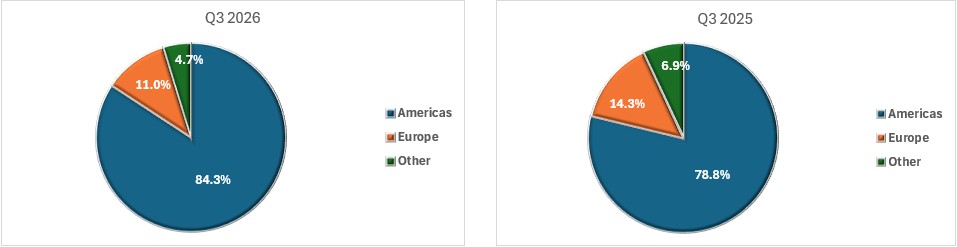
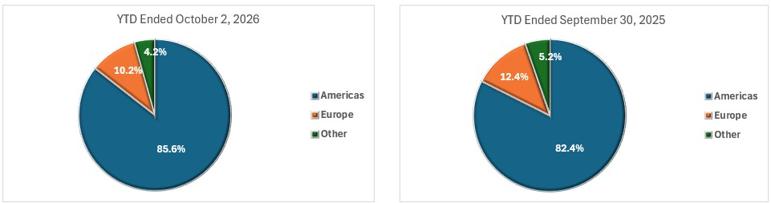
Shipments based on major geographic territory as a percentage of total shipments for the three and nine months ended October 2, 2026, as compared to the prior year periods, saw an increase in the Americas from 78.8% to 84.3% and 82.4% to 85.6%, respectively, driven by increased shipments into various Aerospace, Defense and Government programs, industrial microwave systems for tempering and drying and tungsten pricing impacts. Shipments to Europe saw a decrease as a percentage of total shipments for the three and nine months ended October 2, 2026 as compared to the prior year periods, from 14.3% to 11.0% and 12.4% to 10.2%, respectively. However, gross shipments to Europe increased 17.2%, or $1.2 million, and 17.1%, or $3.0 million, for the three and nine month periods as compared to the respective prior year periods, driven by multiple customers within our CMC segment.
Shipments by Type of Materials and Services
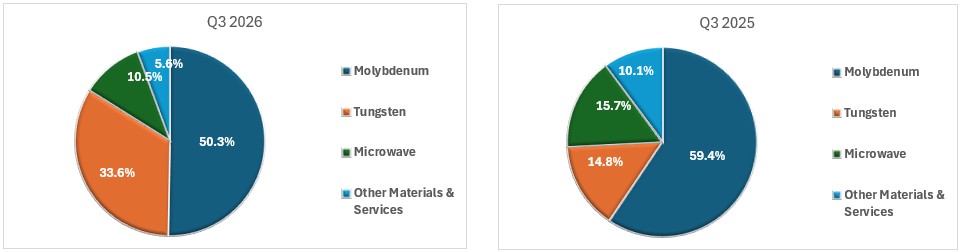
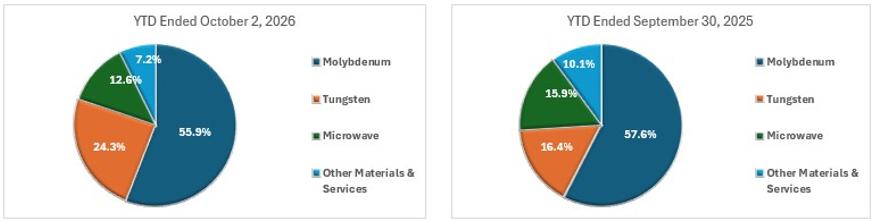
87
Shipment composition based on the type of materials and services as a percentage of total shipments for the three and nine months ended October 2, 2026, as compared to the prior year periods, saw tungsten increase from 14.8% to 33.6% and 16.4% to 24.3%, respectively. These increases were driven by pricing increases associated with material input costs and increased volumes across multiple Aerospace and Defense customers. Molybdenum saw gross shipment increases in the comparable periods driven by several key medical customers and ADG programs Javelin and Hellfire; however, Molybdenum also saw a decrease in the percent total shipments period-over-period for the three and nine months ended October 2, 2026 from 59.4% to 50.3% and 57.6% to 55.9%, respectively. Microwave products saw a decrease for the three and nine month period-over-periods from 15.7% to 10.5% and 15.9% to 12.6%, respectively, primarily driven by a lower rate of growth compared to tungsten. Other materials and services saw a decrease for the three and nine month period-over-periods from 10.2% to 5.6% and 10.1% to 7.2%, respectively, driven by a lower rate of growth compared to tungsten.
Cost of Goods Sold and Gross Profit
Three Months Ended October 2, 2026 Compared to Three Months Ended September 30, 2025
Costs of goods sold for the three months ended October 2, 2026 increased $14.7 million, or 36.6%, compared to the prior year period. Gross profit margin improved from 21.7% for the three months ended September 30, 2025, to 31.3% for the three months ended October 2, 2026.
EMP saw an increase in cost of goods sold for the three months ended October 2, 2026 of $0.6 million, or 11.3%, associated with an increase of $0.3 million, or 4.4%, in revenue compared to the prior year period, resulting in a decrease of $0.3 million, or 11.2%, in gross profit between the three months ended October 2, 2026 and the prior year period. This was driven by a shift in product mix within the division toward lower-margin industrial products, a rapid increase in aluminum and copper material input pricing as well as operating throughput challenges at one of our facilities, which resulted in a decrease in EMP’s gross profit margin from 30.7% for the three months ended September 30, 2025, to 26.1% for the three months ended October 2, 2026.
CMC cost of goods sold for the three months ended October 2, 2026 increased $14.1 million, or 40.5%, associated with an increase of $28.1 million, or 64.7%, in revenue compared to the prior year period, resulting in an increase of $14.0 million, or 160.5%, in gross profit between the three months ended October 2, 2026 and the prior year period. This change was primarily driven by active sourcing and pricing management of the tungsten supply chain during the rapid increase in tungsten concentrate price over the first three months of 2026, as well as increased demand and productivity gains, which together increased CMC’s gross profit margin from 20.1% for the three months ended September 30, 2025, to 31.8% for the three months ended October 2, 2026.
Nine Months Ended October 2, 2026 Compared to Nine Months Ended September 30, 2025
Costs of goods sold for the nine months ended October 2, 2026 increased $31.9 million, or 27.3%, compared to the prior year period. Gross profit margin improved from 20.4% for the nine months ended September 30, 2025, to 26.4% for the nine months ended October 2, 2026.
EMP saw an increase in cost of goods sold for the nine months ended October 2, 2026 of $4.0 million, or 26.5%, associated with an increase of $2.8 million, or 12.5%, in revenue compared to the prior year period, resulting in a decrease of $1.2 million, or 17.6%, in gross profit between the nine months ended October 2, 2026 and the prior year period. This was driven by a shift in product mix within the division toward lower-margin industrial products, a rapid increase in aluminum and copper material input pricing as well as operating throughput challenges at one of our facilities, which together resulted in a decrease in EMP’s gross profit margin from 31.7% for the nine months ended September 30, 2025, to 23.2% for the nine months ended October 2, 2026.
88
CMC cost of goods sold for the nine months ended October 2, 2026 increased $27.8 million, or 27.4%, associated with an increase of $52.5 million, or 42.3%, in revenue compared to the prior year period, resulting in an increase of $24.7 million, or 108.5%, in gross profit between the nine months ended October 2, 2026 and the prior year period. This change was primarily driven by active sourcing and pricing management of the tungsten supply chain during the rapid increase in tungsten concentrate price over the first three months of 2026, increased demand from key missile programs Next Generation Interceptor, Javelin and Hellfire, increased demand for commercial aerospace programs and productivity gains which together increased CMC’s gross profit margin from 18.3% for the nine months ended September 30, 2025, to 26.8% for the nine months ended October 2, 2026.
General and Administrative Expenses
General and administrative expenses increased $4.0 million, or 72.4%, for the three months ended October 2, 2026, compared to the prior year period. The increase was primarily related to $1.7 million of stock-based compensation and $0.9 million of one-time expenses incurred with diligence activities related to the anticipated acquisition on AMS Osram’s Schwabmünchein, Germany facility, and expenses incurred associated with the consummated and contemplated agreements announced in September 2026 in relationship to the DoW Transactions, during the three months ended October 2, 2026. Additional general and administrative expenses growth was attributable to the increase of staffing and professional services to support public company compliance.
General and administrative expenses increased $21.6 million, or 168.0%, for the nine months ended October 2, 2026, compared to the prior year period. The increase was primarily a result of approximately $12.5 million related to stock-based compensation incurred in connection with the acceleration of certain vesting criteria associated with the IPO, $3.6 million of equity compensation recognized over time and $1.0 million of one-time expenses incurred with diligence activities related to the anticipated acquisition on AMS Osram’s Schwabmünchein, Germany facility, and expenses incurred associated with the consummated and contemplated agreements announced in September 2026 in relationship to the DoW Transactions, during the nine months ended October 2, 2026. Additionally, general and administrative expenses growth was attributable to the increase of staffing and professional services to support public company compliance, which included $1.2 million of one-time costs associated with third-party accounting and legal assistance in preparation for the IPO.
Research and Development
Research and development expenses did not materially change for the three months ended October 2, 2026, compared to the prior year period.
Research and development expenses increased $3.4 million, or 132.5%, for the nine months ended October 2, 2026 compared to the prior year period. The increase was primarily related to stock-based compensation incurred in connection with the acceleration of certain vesting criteria associated with the IPO, during the nine month periods ending October 2, 2026 as compared to the prior year periods.
Sales and Marketing
Sales and marketing expenses increased $1.1 million, or 81.4%, for the three months ended October 2, 2026, compared to the prior year period. This increase was due to variable sales compensation associated with sales growth, stock-based compensation, and the expansion of our sales team in support of our strategy.
Sales and marketing expenses increased $1.7 million, or 35.6%, for the nine months ended October 2, 2026, compared to the prior year period. This increase was due to variable sales compensation associated with sales growth, stock-based compensation, and the expansion of our sales team in support of our strategy.
89
Interest (Income) Expense, Net
Interest (income) expense, net changed $0.9 million, or 162.5%, for the three months ended October 2, 2026 of $0.3 million interest income, compared to the prior year period of $0.6 million interest expense. The change was primarily attributable to debt repayments made in the current year compared to the same prior year period.
Interest expense, net decreased $1.5 million, or 78.7%, for the nine months ended October 2, 2026, compared to the prior year period. The decrease was primarily attributable to debt repayments made in the current year compared to the same prior year period.
Interest Expense - Related Party, Net
Related party interest expense, net decreased $0.5 million, or 100.0%, for the three months ended October 2, 2026, compared to the prior year period. This was primarily attributable to repayment of the CEO Line of Credit (as defined below) following the IPO.
Related party interest expense, net decreased $0.4 million, or 33.7%, for the nine months ended October 2, 2026, compared to the prior year period. This was primarily attributable to repayment of the CEO Line of Credit following the IPO.
Change in Fair Value of Derivative Asset
The change in fair value of derivative assets increased $2.2 million, or 100%, during the nine months ended October 2, 2026, due to changes in the value of the equity underlying the options to purchase common stock in a publicly-traded company in each period.
Change in Fair Value of Forward Instruments
The change in the fair value of forward instruments decreased approximately $0.2 million, or 100%, during the three and nine months ended October 2, 2026, compared to the prior year periods, due to the forwards related to the Blue Moon Investment and the Masan SHA.
(Gain) Loss on Remeasurement of Fair Value of Marketable Securities
The (gain) loss on remeasurement of fair value of marketable securities increased approximately $1.6 million and $2.7 million during the three and nine months ended October 2, 2026, respectively, compared to the prior year periods, respectively, due to an increase in the fair value of the Company’s marketable securities investments in both periods.
Other Income (Expense), Net
Other income (expense), net did not materially change for the three and nine months ended October 2, 2026, compared to the prior year period.
Income Tax Provision
The income tax provision for the three months ended October 2, 2026 was $5.5 million as compared to $0.0 million for the period year period. For the nine months ended October 2, 2026, the Company recognized an income tax provision of $6.5 million, as compared to $0.0 million for the prior year period. Both changes were a result of our being subject to income taxes as a C-corporation following the Reorganization. Prior to the Reorganization A&A was an S-corporation for taxation purposes, and its income and losses were passed through to its shareholders and reported on their individual tax returns.
For the nine months ended October 2, 2026, of the total tax expense of $6.5 million, $3.8 million was attributable to a one-time deferred tax expense recorded in connection with the Company’s reorganization into a C-corporation ahead of its IPO, reflecting the initial recognition of deferred tax balances for a structure not previously subject to entity-level income tax. The remaining balance was primarily attributable to the year-to-date pretax income incurred through October 2, 2026.
90
Pro Forma Net Income Per Share Information
The following pro forma net income per share information is presented for comparative purposes only and does not purport to be indicative of the results that would have been achieved had the Reorganization occurred at an earlier date, nor of future results.
The following table sets forth a reconciliation of the numerators and denominators used to compute pro forma basic and diluted net income per share (in thousands, except share and per share amounts):
| Three Months Ended | Nine Months Ended | |||||||||||||||
| ($ in thousands) | October 2, 2026 | September 30, 2025 | October 2, 2026 | September 30, 2025 | ||||||||||||
| Numerator: | ||||||||||||||||
| Net income | $ | 8,291 | $ | 1,570 | $ | 3,465 | $ | 4,007 | ||||||||
| Income tax effects of Reorganization(a) | — | (109 | ) | 3,791 | (278 | ) | ||||||||||
| Pro forma net income | 8,291 | 1,461 | 7,256 | 3,729 | ||||||||||||
| Less: cumulative dividend on Class A Preferred Stock | (551 | ) | — | (551 | ) | — | ||||||||||
| Less: accretion of Class A Preferred Stock to redemption value | (83 | ) | — | (83 | ) | — | ||||||||||
| Pro forma net income available to common stockholders | 7,657 | 1,461 | 6,622 | 3,729 | ||||||||||||
| Less: undistributed earnings allocated to participating securities | (37 | ) | — | (5 | ) | — | ||||||||||
| Pro forma net income attributable to common stockholders – basic | $ | 7,620 | $ | 1,461 | $ | 6,617 | $ | 3,729 | ||||||||
| Add: reallocation of undistributed earnings to participating securities | 1 | — | — | — | ||||||||||||
| Pro forma net income attributable to common stockholders – diluted | $ | 7,621 | $ | 1,461 | $ | 6,617 | $ | 3,729 | ||||||||
| Denominator: | ||||||||||||||||
| Pro forma weighted average common stock outstanding – basic(b) | 31,644,494 | 20,123,187 | 26,679,325 | 20,123,187 | ||||||||||||
| Pro forma weighted average common stock outstanding – diluted(b,c) | 32,300,797 | 20,302,389 | 27,219,588 | 20,231,912 | ||||||||||||
| Pro forma net income per share – basic | $ | 0.24 | $ | 0.07 | $ | 0.25 | $ | 0.19 | ||||||||
| Pro forma net income per share – diluted | $ | 0.24 | $ | 0.07 | $ | 0.24 | $ | 0.18 | ||||||||
| (a) | Following the Reorganization, the Company is subject to U.S. federal and applicable state income taxes. The adjustment for income taxes reflects the estimated income tax expense that would have been recognized had the Reorganization occurred on January 1, 2025, based on an effective tax rate of 6.95% for the three and nine months ended September 30, 2025. No pro forma adjustment for income taxes was required for the three months ended October 2, 2026, as the Reorganization was in effect for the entirety of that period, such that the Company’s actual effective tax rate reflects its full corporate tax status without adjustment. The pro forma impacts for the nine months ended October 2, 2026 represents the effect of the deferred tax adjustment of $3.5 million, which was recognized in the period of the Reorganization and does not reflect ongoing income tax expense, and other discrete tax impacts of $0.3 million related to the Reorganization Since the Reorganization occurred during the three months ended April 3, 2026, these amounts are fully reflected within the nine-month period and no incremental adjustment relates to the three months ended October 2, 2026. For the three and nine months ended September 30, 2025, the difference between the U.S. federal statutory rate of 21.0% and the effective tax rate of 6.95% is primarily driven by a 15.45% reduction due to federal tax credits, partially offset by other immaterial rate items of 1.4%, including state taxes and permanent differences. The pro forma income tax effect for the three and nine months ended September 30, 2025 includes the results of discontinued operations. |
91
| (b) | Pro forma weighted-average common stock outstanding (basic and diluted) for the three and nine months ended September 30, 2025 reflects the Reorganization as if it occurred on January 1, 2025, resulting in 20,122,721 shares of Class A common stock and 466 shares of Class B common stock issued and outstanding. For the three and nine months ended October 2, 2026, pro forma weighted-average shares equal actual weighted-average shares, including 1,184,996 and 392,126 weighted-average shares underlying the Penny Warrant, respectively. |
| (c) | The potential impact on pro forma weighted-average common stock outstanding (diluted) of restricted stock awards, restricted stock units, stock options and stock appreciation rights, and the Strike Price Warrant were evaluated under the treasury stock method. For the three months ended October 2, 2026, the Company determined that the impact represented 656,303 dilutive shares, and for the nine months ended October 2, 2026, 540,263 dilutive shares, which include 141,424 shares for stock appreciation rights exercised during the three months ended July 3, 2026, weighted for the period outstanding before exercise, considering the weighted-average unrecognized compensation costs of approximately $8.4 million and $6.0 million, respectively, and the estimated fair value of the Company’s common stock for the period. For the three and nine months ended September 30, 2025, the Company determined that the impact represented 179,202 and 108,725 dilutive shares, respectively, considering the weighted-average unrecognized compensation costs of approximately $2.2 million and $1.4 million, respectively, and the estimated fair value of the Company’s common stock for the period. |
Critical Materials and Components Results
Three Months Ended October 2, 2026 Compared to Three Months Ended September 30, 2025
| Three Months Ended | ||||||||||||||||||||||||
| ($ in thousands) | October 2, 2026 | % of Revenue | September 30, 2025 | % of Revenue | $ Change | % Change | ||||||||||||||||||
| Revenue | $ | 71,550 | 100.0 | % | $ | 43,454 | 100.0 | % | $ | 28,096 | 64.7 | % | ||||||||||||
| Cost of goods sold | 48,768 | 68.2 | % | 34,708 | 79.9 | % | 14,060 | 40.5 | % | |||||||||||||||
| Gross profit | 22,782 | 31.8 | % | 8,746 | 20.1 | % | 14,036 | 160.5 | % | |||||||||||||||
| Operating expenses: | ||||||||||||||||||||||||
| General and administrative | 2,923 | 4.1 | % | 2,484 | 5.7 | % | 439 | 17.7 | % | |||||||||||||||
| Research and development | 555 | 0.8 | % | 496 | 1.1 | % | 59 | 11.9 | % | |||||||||||||||
| Sales and marketing | 1,711 | 2.4 | % | 1,047 | 2.4 | % | 664 | 63.4 | % | |||||||||||||||
| Total operating expenses | 5,189 | 7.3 | % | 4,027 | 9.2 | % | 1,162 | 28.9 | % | |||||||||||||||
| Operating income | 17,593 | 24.5 | % | 4,719 | 10.9 | % | 12,874 | 272.8 | % | |||||||||||||||
| Other expense, net: | ||||||||||||||||||||||||
| Interest expense | 451 | 0.6 | % | 466 | 1.1 | % | (15 | ) | (3.2 | )% | ||||||||||||||
| Interest expense – related party | — | — | % | 420 | 1.0 | % | (420 | ) | (100.0 | )% | ||||||||||||||
| Other income, net | (18 | ) | — | % | (23 | ) | (0.1 | )% | 5 | 21.7 | % | |||||||||||||
| Total other expense, net | 433 | 0.6 | % | 863 | 2.0 | % | (430 | ) | (49.8 | )% | ||||||||||||||
| Income from continuing operations before taxes | 17,160 | 23.9 | % | 3,856 | 8.9 | % | 13,304 | 345.0 | % | |||||||||||||||
| Income tax provision | — | — | % | — | — | % | — | — | % | |||||||||||||||
| Income from continuing operations | $ | 17,160 | 23.9 | % | $ | 3,856 | 8.9 | % | $ | 13,304 | 345.0 | % | ||||||||||||
n/m = not meaningful
92
Nine Months Ended October 2, 2026 Compared to Nine Months Ended September 30, 2025
| Nine Months Ended | ||||||||||||||||||||||||
| ($ in thousands) | October 2, 2026 | % of Revenue | September 30, 2025 | % of Revenue | $ Change | % Change | ||||||||||||||||||
| Revenue | $ | 176,803 | 100.0 | % | $ | 124,272 | 100.0 | % | $ | 52,531 | 42.3 | % | ||||||||||||
| Cost of goods sold | 129,338 | 73.2 | % | 101,503 | 81.7 | % | 27,835 | 27.4 | % | |||||||||||||||
| Gross profit | 47,465 | 26.8 | % | 22,769 | 18.3 | % | 24,696 | 108.5 | % | |||||||||||||||
| Operating expenses: | ||||||||||||||||||||||||
| General and administrative | 8,888 | 5.0 | % | 6,264 | 5.0 | % | 2,624 | 41.9 | % | |||||||||||||||
| Research and development | 5,129 | 2.9 | % | 1,648 | 1.3 | % | 3,481 | 211.2 | % | |||||||||||||||
| Sales and marketing | 4,448 | 2.5 | % | 3,397 | 2.7 | % | 1,051 | 30.9 | % | |||||||||||||||
| Total operating expenses | 18,465 | 10.4 | % | 11,309 | 9.0 | % | 7,156 | 63.3 | % | |||||||||||||||
| Operating income | 29,000 | 16.4 | % | 11,460 | 9.3 | % | 17,540 | 153.1 | % | |||||||||||||||
| Other expense, net: | ||||||||||||||||||||||||
| Interest expense | 1,354 | 0.8 | % | 1,410 | 1.1 | % | (56 | ) | (4.0 | )% | ||||||||||||||
| Interest expense – related party | 467 | 0.3 | % | 1,189 | 1.0 | % | (722 | ) | (60.7 | )% | ||||||||||||||
| Other (income) expense, net | (56 | ) | — | % | 1 | — | % | (57 | ) | n/m | ||||||||||||||
| Total other expense, net | 1,765 | 1.1 | % | 2,600 | 2.1 | % | (835 | ) | (32.1 | )% | ||||||||||||||
| Income from continuing operations before taxes | 27,235 | 15.3 | % | 8,860 | 7.2 | % | 18,375 | 207.4 | % | |||||||||||||||
| Income tax provision | — | — | % | — | — | % | — | — | % | |||||||||||||||
| Income from continuing operations | $ | 27,235 | 15.3 | % | $ | 8,860 | 7.2 | % | $ | 18,375 | 207.4 | % | ||||||||||||
n/m = not meaningful
Revenues
Revenues for the three months ended October 2, 2026, increased $28.1 million, or 64.7%, compared to the prior year period. Revenues for the nine months ended October 2, 2026, increased $52.5 million, or 42.3%, compared to the prior year period. Growth was driven by increases in molybdenum powder products in our medical end market, increased shipments with key missile programs Javelin, Hellfire and Next Generation Interceptor, and favorable pricing impacts associated with tungsten products in general.
Cost of Goods Sold
Cost of goods sold for the three months ended October 2, 2026 increased $14.1 million, or 40.5%, associated with an increase of $28.1 million, or 64.7%, in revenue compared to the prior year period, resulting in an increase of $14.0 million, or 160.5%, in gross profit between the three months ended October 2, 2026 and the prior year period. Cost of goods sold for the nine months ended October 2, 2026 increased $27.8 million, or 27.4%, associated with an increase of $52.5 million, or 42.3%, in revenue compared to the prior year period, resulting in an increase of $24.7 million, or 108.5%, in gross profit between the nine months ended October 2, 2026 and the prior year period. This change was driven by active sourcing and pricing management of the tungsten supply chain during the rapid increase in tungsten concentrate price over the first three months of 2026, increased demand and productivity gains, together increasing CMC’s gross profit margin from 20.1% for the three months ended September 30, 2025, to 31.8% for the three months ended October 2, 2026 and 18.3% for the nine months ended September 30, 2025 to 26.8% for the nine months ended October 2, 2026.
93
General and Administrative Expenses
CMC general and administrative expenses for the three months ended October 2, 2026 increased $0.4 million, or 17.7%, compared to the prior year period and $2.6 million, or 41.9% for the nine months ended October 2, 2026 compared to the prior year period. These increases for both periods were attributable to multiple factors including stock-based compensation incurred in connection with the IPO, internal reorganization and resource increases in support of the IPO and public company compliance, additional IT costs associated with defense contractor compliance requirements and variable compensation associated with growth.
Research and Development
CMC research and development expenses did not meaningfully change for the three months ended October 2, 2026 compared to the prior year period and increased $3.5 million, or 211.2%, for the nine months ended October 2, 2026 compared to the prior year period. The increase was primarily related to stock-based compensation incurred with the IPO during the nine month period ending October 2, 2026 as compared to the prior year period.
Sales and Marketing
CMC selling and marketing expenses for the three months ended October 2, 2026 increased $0.7 million, or 63.4%, compared to the prior year period and $1.1 million, or 30.9%, for the nine months ended October 2, 2026 compared to the prior year period. The increase was driven by primarily increased sales staffing and commissions in support of growth, contributing to the 64.7% revenue growth for the three month period and 42.3% revenue growth for the nine month period at the CMC division.
Interest Expense
CMC interest expense did not meaningfully change for the three and nine months ended October 2, 2026, compared to the prior year periods.
Interest Expense - Related Party
CMC related party interest expense for the three months ended October 2, 2026 decreased $0.4 million, or 100.0% as compared to the prior year period, and $0.7 million, or 60.7%, for the nine months ended October 2, 2026 compared to the prior year period. The decrease in interest expense for both periods was primarily due to the repayment of the Great Falls Term Loan in April 2026 and IPO proceeds used to manage revolving debt associated with our Wells Fargo credit facility.
Other (Income) Expense, Net
CMC other (income) expense, net for the three and nine months ended October 2, 2026 did not meaningfully change compared to the prior year periods.
94
Engineered Microwave Products Results
Three Months Ended October 2, 2026 Compared to Three Months Ended September 30, 2025
| Three Months Ended | ||||||||||||||||||||||||
| ($ in thousands) | October 2, 2026 | % of Revenue | September 30, 2025 | % of Revenue | $ Change | % Change | ||||||||||||||||||
| Revenue | $ | 8,010 | 100.0 | % | $ | 7,670 | 100.0 | % | $ | 340 | 4.4 | % | ||||||||||||
| Cost of goods sold | 5,918 | 73.9 | % | 5,315 | 69.3 | % | 603 | 11.3 | % | |||||||||||||||
| Gross profit | 2,092 | 26.1 | % | 2,355 | 30.7 | % | (263 | ) | (11.2 | )% | ||||||||||||||
| Operating expenses: | ||||||||||||||||||||||||
| General and administrative | 1,799 | 22.5 | % | 1,465 | 19.1 | % | 334 | 22.8 | % | |||||||||||||||
| Research and development | 295 | 3.7 | % | 274 | 3.6 | % | 21 | 7.7 | % | |||||||||||||||
| Sales and marketing | 568 | 7.1 | % | 162 | 2.1 | % | 406 | 250.6 | % | |||||||||||||||
| Total operating expenses | 2,662 | 33.3 | % | 1,901 | 24.8 | % | 761 | 40.0 | % | |||||||||||||||
| Operating (loss) income | (570 | ) | (7.2 | )% | 454 | 5.9 | % | (1,024 | ) | (225.6 | )% | |||||||||||||
| Other (income) expense, net: | ||||||||||||||||||||||||
| Interest expense | 16 | 0.2 | % | 90 | 1.2 | % | (74 | ) | (82.2 | )% | ||||||||||||||
| Interest expense – related party | — | — | % | 60 | 0.8 | % | (60 | ) | (100.0 | )% | ||||||||||||||
| Other income, net | (27 | ) | (0.3 | )% | (17 | ) | (0.2 | )% | (10 | ) | (58.8 | )% | ||||||||||||
| Total other (income) expense, net | (11 | ) | (0.1 | )% | 133 | 1.8 | % | (144 | ) | (108.3 | )% | |||||||||||||
| (Loss) income from continuing operations before taxes | (559 | ) | (7.1 | )% | 321 | 4.1 | % | (880 | ) | (274.1 | )% | |||||||||||||
| Income tax provision | — | — | % | — | — | % | — | — | % | |||||||||||||||
| (Loss) income from continuing operations | $ | (559 | ) | (7.1 | )% | $ | 321 | 4.1 | % | $ | (880 | ) | (274.1 | )% | ||||||||||
n/m = not meaningful
Nine Months Ended October 2, 2026 Compared to Nine Months Ended September 30, 2025
| Nine Months Ended | ||||||||||||||||||||||||
| ($ in thousands) | October 2, 2026 | % of Revenue | September 30, 2025 | % of Revenue | $ Change | % Change | ||||||||||||||||||
| Revenue | $ | 25,165 | 100.0 | % | $ | 22,369 | 100.0 | % | $ | 2,796 | 12.5 | % | ||||||||||||
| Cost of goods sold | 19,322 | 76.8 | % | 15,279 | 68.3 | % | 4,043 | 26.5 | % | |||||||||||||||
| Gross profit | 5,843 | 23.2 | % | 7,090 | 31.7 | % | (1,247 | ) | (17.6 | )% | ||||||||||||||
| Operating expenses: | ||||||||||||||||||||||||
| General and administrative | 4,843 | 19.2 | % | 3,784 | 16.9 | % | 1,059 | 28.0 | % | |||||||||||||||
| Research and development | 890 | 3.5 | % | 942 | 4.2 | % | (52 | ) | (5.5 | )% | ||||||||||||||
| Sales and marketing | 1,695 | 6.7 | % | 1,083 | 4.8 | % | 612 | 56.5 | % | |||||||||||||||
| Total operating expenses | 7,428 | 29.4 | % | 5,809 | 25.9 | % | 1,619 | 27.9 | % | |||||||||||||||
| Operating (loss) income | (1,585 | ) | (6.2 | )% | 1,281 | 5.8 | % | (2,866 | ) | (223.7 | )% | |||||||||||||
| Other expense, net: | ||||||||||||||||||||||||
| Interest expense | 171 | 0.7 | % | 280 | 1.3 | % | (109 | ) | (38.9 | )% | ||||||||||||||
| Interest expense – related party | 78 | 0.3 | % | 165 | 0.7 | % | (87 | ) | (52.7 | )% | ||||||||||||||
| Other income, net | (89 | ) | (0.4 | )% | (74 | ) | (0.3 | )% | (15 | ) | (20.3 | )% | ||||||||||||
| Total other expense, net | 160 | 0.6 | % | 371 | 1.7 | % | (211 | ) | (56.9 | )% | ||||||||||||||
| (Loss) income from continuing operations before taxes | (1,745 | ) | (6.8 | )% | 910 | 4.1 | % | (2,655 | ) | (291.8 | )% | |||||||||||||
| Income tax provision | 4 | — | % | — | — | % | 4 | n/m | ||||||||||||||||
| (Loss) income from continuing operations | $ | (1,749 | ) | (6.8 | )% | $ | 910 | 4.1 | % | $ | (2,659 | ) | (292.2 | )% | ||||||||||
n/m = not meaningful
95
Revenue
Revenue for the three months ended October 2, 2026, increased $0.3 million, or 4.4%, as compared to the prior year period, and $2.8 million, or 12.5%, for the nine months ended October 2, 2026 compared to the prior year period. This was primarily driven by increased sales of radar components and industrial microwave systems.
Cost of Goods Sold
Cost of goods sold for the three months ended October 2, 2026, increased $0.6 million, or 11.3%, associated with an increase in revenue of $0.3 million, or 4.4%, compared to the prior year period, resulting in a decrease of $0.3 million, or 11.2%, in gross profit between the three months ended October 2, 2026 and the prior year period. This was driven by a shift in product mix within EMP toward lower margin industrial products, rapid increases in aluminum and copper material input pricing, and operating throughput challenges at one of our facilities, together resulting in a decrease in EMP’s gross profit margin from 30.7% for the three months ended September 30, 2025, to 26.1% for the three months ended October 2, 2026.
Cost of goods sold for the nine months ended October 2, 2026, increased $4.0 million, or 26.5%, associated with an increase of $2.8 million, or 12.5%, in revenue compared to the prior year period, resulting in a decrease of $1.2 million, or 17.6%, in gross profit between the nine months ended October 2, 2026 and the prior year period. This was driven by a shift in product mix within EMP toward lower margin industrial products, rapid increases in aluminum and copper material input pricing and operating throughput challenges at one of our facilities, together resulting in a decrease in EMP’s gross profit margin from 31.7% for the nine months ended September 30, 2025, to 23.2% for the nine months ended October 2, 2026.
General and Administrative Expenses
General and administrative expenses for the three months ended October 2, 2026, increased $0.3 million, or 22.8%, compared to the prior year period, and increased $1.1 million, or 28.0%, for the nine months ended October 2, 2026 compared to the prior year period. The increase was attributable to multiple factors including stock-based compensation, internal reorganization, resource increases in support of the IPO and public company compliance and variable compensation associated with growth.
Research and Development
Research and development expenses for the three and nine months ended October 2, 2026, did not meaningfully change compared to the prior year periods.
Sales and Marketing
EMP sales and marketing expenses for the three months ended October 2, 2026, increased $0.4 million, or 250.6%, compared to the prior year period, and increased $0.6 million, or 56.5%, for the nine months ended October 2, 2026 compared to the prior year period. This increase was attributable to additional technical sales resources associated with the acquisition of Symphony Microwave Technologies in November of 2025 and stock based compensation.
Interest Expense
EMP interest expense for the three and nine months ended October 2, 2026, did not meaningfully change as compared to the prior year periods.
Interest Expense - Related Party
EMP related party interest expense for the three and nine months ended October 2, 2026, did not meaningfully change compared to the prior year periods.
Other Income, Net
EMP other income, net, for the three and nine months ended October 2, 2026, did not meaningfully change compared to the prior year periods.
96
Corporate and Other
Three Months Ended October 2, 2026 Compared to Three Months Ended September 30, 2025
| Three Months Ended | ||||||||||||||||
| ($ in thousands) | October 2, 2026 | September 30, 2025 | $ Change | % Change | ||||||||||||
| General and administrative | $ | 4,870 | $ | 1,616 | $ | 3,254 | 201.4 | % | ||||||||
| Sales and marketing | 176 | 144 | 32 | 22.2 | % | |||||||||||
| Total operating expenses | 5,046 | 1,760 | 3,286 | 186.7 | % | |||||||||||
| Operating loss | (5,046 | ) | (1,760 | ) | (3,286 | ) | (186.7 | )% | ||||||||
| Other income, net: | ||||||||||||||||
| Interest income, net | (812 | ) | (4 | ) | (808 | ) | n/m | |||||||||
| Interest expense (income) – related party, net | — | 25 | (25 | ) | n/m | |||||||||||
| Change in fair value of forward instruments | 222 | — | 222 | 100.0 | % | |||||||||||
| (Gain) loss on remeasurement of fair value of marketable securities | (1,640 | ) | — | (1,640 | ) | (100.0 | )% | |||||||||
| Other income, net | (10 | ) | (26 | ) | 16 | n/m | ||||||||||
| Total other income, net | (2,240 | ) | (5 | ) | (2,235 | ) | n/m | |||||||||
| Loss from continuing operations before taxes | (2,806 | ) | (1,755 | ) | (1,051 | ) | (59.8 | )% | ||||||||
| Income tax provision | 5,504 | — | 5,504 | n/m | ||||||||||||
| Loss from continuing operations | $ | (8,310 | ) | $ | (1,755 | ) | $ | (6,555 | ) | (373.4 | )% | |||||
n/m = not meaningful
Nine Months Ended October 2, 2026 Compared to Nine Months Ended September 30, 2025
| Nine Months Ended | ||||||||||||||||
| ($ in thousands) | October 2, 2026 | September 30, 2025 | $ Change | % Change | ||||||||||||
| General and administrative | $ | 20,685 | $ | 2,792 | $ | 17,893 | 640.9 | % | ||||||||
| Research and development | 2 | — | 2 | n/m | ||||||||||||
| Sales and marketing | 516 | 432 | 84 | 19.4 | % | |||||||||||
| Total operating expenses | 21,203 | 3,224 | 17,979 | 557.7 | % | |||||||||||
| Operating loss | (21,203 | ) | (3,224 | ) | (17,979 | ) | (557.7 | )% | ||||||||
| Other (income) expense, net: | ||||||||||||||||
| Interest (income) expense, net | (1,130 | ) | 165 | (1,295 | ) | (784.8 | )% | |||||||||
| Interest expense (income) – related party, net | 315 | (56 | ) | 371 | 662.5 | % | ||||||||||
| Change in fair value of derivative asset | (2,214 | ) | — | (2,214 | ) | (100.0 | )% | |||||||||
| Change in fair value of forward instruments | 222 | — | 222 | 100.0 | % | |||||||||||
| (Gain) loss on remeasurement of fair value of marketable securities | (2,721 | ) | 23 | (2,744 | ) | n/m | ||||||||||
| Other (income) expense, net | (114 | ) | 9 | (123 | ) | n/m | ||||||||||
| Total other (income) expense, net | (5,642 | ) | 141 | (5,783 | ) | n/m | ||||||||||
| Loss from continuing operations before taxes | (15,561 | ) | (3,365 | ) | (12,196 | ) | (362.4 | )% | ||||||||
| Income tax provision | 6,460 | — | 6,460 | 100.0 | % | |||||||||||
| Loss from continuing operations | $ | (22,021 | ) | $ | (3,365 | ) | $ | (18,656 | ) | (554.4 | )% | |||||
n/m = not meaningful
97
General and Administrative Expenses
General and administrative expenses for the three months ended October 2, 2026, increased $3.3 million, or 201.4%, compared to the prior year period, driven by approximately $0.5 million increase in stock-based compensation, and $0.9 million one-time expenses associated with acquisitions, and one-time expenses associated with the aforementioned DoW Transactions. Additional general and administrative expenses growth was attributable to the increase in staffing and professional services to support public company compliance.
General and administrative expenses increased $17.9 million, or 640.9%, for the nine months ended October 2, 2026 compared to the prior year period. This was primarily attributable to an increase in stock-based compensation of approximately $10.7 million including grants in anticipation of the IPO, $1.2 million of non-recurring expenses associated with preparation for the IPO, and $1.0 million of one-time expenses associated with the aforementioned DoW Transactions. Additional general and administrative expenses growth was attributable to the increase in staffing and professional services to support public company compliance.
Research and Development
Research and development expenses for the nine months ended October 2, 2026, did not meaningfully change as compared to the prior year period.
Sales and Marketing
Sales and marketing expenses for the three and nine months ended October 2, 2026, did not meaningfully change as compared to the prior year periods.
Interest (Income) Expense, net
Interest (income) expense, net, increased $0.8 million for the three months ended October 2, 2026, compared to the prior year period, from less than $0.1 million of interest income for the three months ended September 30, 2026 to $0.8 million of interest income for the three months ended October 2, 2026. Interest (income) expense increased $1.3 million for the nine months ended October 2, 2026 compared to the prior year period, from $0.1 million of interest expense for the nine months ended September 30, 2025 to $1.1 million of interest income for the nine months ended October 2, 2026. This was primarily due to interest income earned from IPO proceeds.
Interest Expense (Income) - Related Party, net
Interest expense (income) – related party, net, did not meaningfully change for the three months ended October 2, 2026 compared to the prior year period, and increased $0.4 million for the nine months ended October 2, 2026, compared to the prior year period, from less than $0.1 million of interest income for the nine months ended September 30, 2025 to $0.3 million of interest expense for the nine months ended October 2, 2026, primarily due to an origination fee paid on related part debt.
Change in Fair Value of Derivative Asset
The change in fair value of derivative assets increased $2.2 million during the nine months ended October 2, 2026, compared to the prior year period, due to changes in the value of the equity underlying the options to purchase common stock in one of our publicly-traded vendors in each period.
Change in Fair Value of Forward Instruments
The change in the fair value of forward instruments decreased approximately $0.2 million during the three and nine months ended October 2, 2026, compared to the prior year periods, due to the forward related to the Blue Moon Investment and the Masan SHA.
98
(Gain) Loss on Remeasurement of Fair Value of Marketable Securities
The (gain) loss on remeasurement of fair value of marketable securities increased approximately $1.6 million and $2.7 million during the three and nine months ended October 2, 2026, respectively, compared to the prior year periods, respectively, due to an increase in the fair value of the Company’s marketable securities investments in both periods.
Other (Income) Expense, Net
Other (income) expense, net, did not meaningfully change for the three and nine months ended October 2, 2026, compared to the prior year periods.
Income Tax Provision
The income tax provision for the three months ended October 2, 2026 was $5.5 million as compared to $0.0 million for the prior year period. For the nine months ended October 2, 2026, the Company recognized an income tax provision of $6.5 million, as compared to $0.0 million for the prior year period. Both changes were as result of our being subject to income taxes as a C-corporation following the Reorganization. Prior to the Reorganization A&A was an S-corporation for taxation purposes, and its income and losses were passed through to its shareholders and reported on their individual tax returns.
For the nine months ended October 2, 2026, of the tax expense of $6.5 million, $3.8 million was attributable to a one-time deferred tax expense recorded in connection with the Company’s reorganization into a C-corporation ahead of its IPO, reflecting the initial recognition of deferred tax balances for a structure not previously subject to entity-level income tax. The remaining balance was primarily attributable to the year-to-date pretax income incurred through October 2, 2026.
Key Performance Indicators and Non-GAAP Financial Measures
We measure our business, monitor results of operations and ensure proper allocation of capital using the following key performance indicators and non-GAAP financial measures: (i) Revenue, (ii) Backlog, (iii) Gross Profit, (iv) Gross Profit Margin, (v) Adjusted EBITDA from Continuing Operations, (vi) Adjusted EBITDA Margin from Continuing Operations, (vii) Net Income, and (viii) Adjusted Net Income, and (ix) Adjusted Net Income Per Share. We believe the non-GAAP financial measures presented in this Prospectus will help investors understand our financial condition and operating results and assess our future prospects. We believe these non-GAAP financial measures, each of which are discussed in greater detail below, are important supplemental measures because they exclude unusual or non-recurring items as well as non-cash items that are unrelated to or may not be indicative of our ongoing operating results. Further, when read in conjunction with our U.S. GAAP results, these non-GAAP financial measures provide a baseline for analyzing trends in our underlying businesses and can be used by management as a tool to help make financial, operational and planning decisions. We may use non-GAAP financial metrics in certain management compensation plans, debt covenants, internal budgetary decision making, and other resource allocation decisions. Finally, these measures are often used by analysts and other interested parties to evaluate companies in our industry by providing more comparable measures that are less affected by factors such as capital structure.
99
Open Order Backlog
Our focus on Aerospace, Defense and Government (“ADG”) end market has improved our open order backlog (“Backlog”), as described below. See “Twelve-Month Backlog Trend.” As of October 2, 2026, compared to September 30, 2025, our total backlog increased $260.1 million, or 297.8% driven by the ADG end market. Our recently formed ERT division received the DLA Offtake Agreement from the DLA for tungsten offtake in the amount of $2.0 billion, with $161.9 million initially funded and now reflected in backlog. While this award falls within our ADG end market, we have separately identified the related impact on backlog to maintain adequate comparability to prior reported quarters. Our preexisting CMC and EMP divisions saw ADG backlog growth of $96.9 million, or 184.2% driven by a mix of programs and contracts including a separate DLA award of $35.6 million for primarily molybdenum products in support of numerous defense related programs, tungsten material price flowing through to our end product pricing, defense programs such as PrSM, Next Generation Interceptor, Hellfire, Javelin, Aegis, Patriot and KC-135 Stratotanker, commercial aerospace programs, and various defense radar programs. All other end markets’ backlog for CMC and EMP divisions saw an increase of 3.5%, period-over-period, driven by a mix of growth across multiple industrial customers offset by the timing of orders with our largest medical customer. This customer drove the medical revenue increases in the reported periods, but also places inconsistent short duration purchase orders creating variability in the aggregated other end markets backlog.
Twelve-Month Backlog Trend
Backlog is measured by confirmed orders and contracts from customers less revenues recognized as of the date measured. The chart below presents our Backlog as of the dates indicated, which represents a key measure of our business growth. Backlog in the chart below excludes discontinued operations.
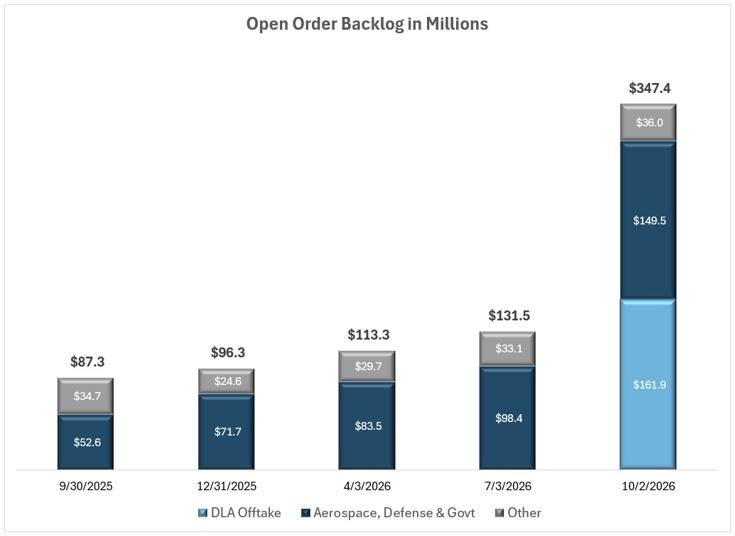
100
Adjusted Net Income and Adjusted Net Income Per Share
Adjusted Net Income and Adjusted Net Income Per Share are non-GAAP measurements and are performance measures. We define adjusted net income as net income less stock-based compensation and one-time non-recurring costs such as tax impacts of the Reorganization, discontinued operations, the costs associated with the IPO, certain acquisition and transaction costs, severance and restructuring costs, and other non-recurring costs and the income tax effect of such adjustments, as applicable.
The following table summarizes our reconciliation of adjusted earnings per share from continuing operations for the three and nine month periods ended October 2, 2026 and September 30, 2025, with discontinued operations excluded from the results of continuing operations (in thousands, except percentages):
| Three Months Ended | Nine Months Ended | |||||||||||||||
| ($ in thousands) | October 2, 2026 | September 30, 2025 | October 2, 2026 | September 30, 2025 | ||||||||||||
| Numerator: | ||||||||||||||||
| Net income | $ | 8,291 | $ | 1,570 | $ | 3,465 | $ | 4,007 | ||||||||
| Less: cumulative dividend on Class A Preferred Stock | (551 | ) | — | (551 | ) | — | ||||||||||
| Less: accretion of Class A Preferred Stock to redemption value | (83 | ) | — | (83 | ) | — | ||||||||||
| Net income available to common stockholders | 7,657 | 1,570 | 2,831 | 4,007 | ||||||||||||
| Less: undistributed earnings allocated to participating securities | (37 | ) | — | (5 | ) | — | ||||||||||
| Net income attributable to common stockholders – basic | 7,620 | 1,570 | 2,826 | 4,007 | ||||||||||||
| Add: reallocation of undistributed earnings to participating securities | 1 | — | — | — | ||||||||||||
| Net income attributable to common stockholders – diluted | 7,621 | 1,570 | 2,826 | 4,007 | ||||||||||||
| Adjustments to net income attributable to common stockholders: | ||||||||||||||||
| One time tax expense associated with the Reorganization(1) | — | — | 3,791 | — | ||||||||||||
| Loss from discontinued operations | — | 852 | — | 2,398 | ||||||||||||
| Corporate costs associated with the IPO(2) | — | 983 | 1,296 | 1,229 | ||||||||||||
| Stock-based compensation(3) | 2,074 | 427 | 16,872 | 810 | ||||||||||||
| Acquisition and transaction costs(4) | 928 | 90 | 1,038 | 246 | ||||||||||||
| Fair value adjustments of equity instruments | (1,418 | ) | — | (4,713 | ) | — | ||||||||||
| Other(5) | — | 791 | 315 | 791 | ||||||||||||
| Tax effect of adjustments(6) | (2,223 | ) | — | (2,625 | ) | — | ||||||||||
| Adjusted net income attributable to common stockholders - basic | $ | 11,427 | $ | 4,713 | $ | 18,800 | $ | 9,481 | ||||||||
| Adjusted net income attributable to common stockholders - diluted | $ | 11,428 | $ | 4,713 | $ | 18,800 | $ | 9,481 | ||||||||
| Denominator: | ||||||||||||||||
| Weighted average shares outstanding – basic | 31,644,494 | 20,123,187 | 26,679,325 | 20,123,187 | ||||||||||||
| Weighted average shares outstanding – diluted(7) | 32,300,797 | 20,302,389 | 27,219,588 | 20,231,912 | ||||||||||||
| Net income per share: | ||||||||||||||||
| Basic | $ | 0.24 | $ | 0.08 | $ | 0.11 | $ | 0.20 | ||||||||
| Diluted | $ | 0.24 | $ | 0.08 | $ | 0.10 | $ | 0.20 | ||||||||
| Adjusted net income per share: | ||||||||||||||||
| Basic | $ | 0.36 | $ | 0.23 | $ | 0.70 | $ | 0.47 | ||||||||
| Diluted | $ | 0.35 | $ | 0.23 | $ | 0.69 | $ | 0.47 | ||||||||
| (1) | Reflects the impact of the deferred tax adjustment of $3.5 million, which was recognized in the period of Reorganization and does not reflect ongoing income tax expense, and other discrete tax impacts of $0.3 million related to the Reorganization. |
101
| (2) | Corporate costs associated with the IPO include third-party expenses related to enhancing our accounting controls and procedures, incremental audit costs, recruitment of executive team and legal expenses. |
| (3) | Stock-based compensation includes expenses associated with restricted stock grants made in support of the IPO and the Reorganization. In the three and nine months ended October 2, 2026, the Company expensed $2.1 million and $16.9 million, respectively, of which $4.1 million was settled in cash in association with stock appreciation rights. |
| (4) | The adjustment for acquisition and transaction costs is to remove charges incurred in connection with any transaction, including mergers, acquisitions, refinancing, amendment or modification to indebtedness, and dispositions, in each case, regardless of whether consummated. |
| (5) | Other includes restructuring and severance costs associated with a reorganization at our CMC division as well as Germany retention costs and certain non-recurring costs associated with a utility failure at our CMC facility in Euclid, Ohio. |
| (6) | Income tax effects associated with non-GAAP adjustments were calculated based on the specific tax treatment applicable to each adjustment and reflect the estimated current and deferred income tax consequences of the excluded items. The Company’s effective GAAP tax rate for the year was 65.0%, while the effective tax rate applied to non-GAAP results was 14.1%. The difference between the GAAP and non-GAAP tax rates primarily reflects the impact of tax effects associated with the Reorganization impacts, stock-based compensation arrangements, executive compensation limitations, discrete tax items recognized during the period, and other tax-related adjustments that are not directly proportional to the underlying pretax non-GAAP adjustments. Accordingly, the tax effect of non-GAAP adjustments differs from the amount that would be determined by applying the Company’s GAAP effective tax rate or statutory tax rate to the related pretax adjustments. There is no tax impact prior to the quarter ended April 3, 2026, as we were treated as an S-corporation for tax purposes prior to the Reorganization. |
| (7) | For the purpose of both the denominator of the net income per share and for the denominator for the adjusted net income per share, the Company considered the potential impact on the weighted average common stock outstanding dilutive impact of the 664,847 shares of restricted stock units, 457,390 restricted stock awards, and 677,280 of stock appreciation rights that were issued and outstanding during the period, which were all evaluated under the treasury stock method. For the purposes of the denominator for the adjusted net income per share, for the three and nine months ended October 2, 2026, the Company determined that the impact represented 656,303 and 540,263 dilutive shares, respectively, considering the weighted average unrecognized compensation costs of approximately $8.4 million and $6.0 million, respectively, and the estimated fair value of our common stock for the period. For the three and nine months ended September 30, 2025, the Company determined that the impact represented 179,202 and 108,725 dilutive shares, respectively, considering the weighted average unrecognized compensation costs of approximately $2.2 million and $1.4 million, respectively, and the estimated fair value of our common stock for the period. |
102
Adjusted EBITDA from Continuing Operations
The following tables summarize our reconciliation of income (loss) from continuing operations to Adjusted EBITDA from Continuing Operations (“Adjusted EBITDA”) and our Adjusted EBITDA Margin from Continuing Operations (“Adjusted EBITDA Margin”) for the three and nine month periods ended October 2, 2026, for our divisions, with discontinued operations excluded from the results of continuing operations (in thousands, except percentages):
| Three Months Ended October 2, 2026 | ||||||||||||||||
| ($ in thousands) | CMC | EMP | Corporate & Other | Total | ||||||||||||
| Revenue | $ | 71,550 | $ | 8,010 | $ | — | $ | 79,560 | ||||||||
| Income (loss) from continuing operations | $ | 17,160 | $ | (559 | ) | $ | (8,310 | ) | $ | 8,291 | ||||||
| Income (loss) from continuing operations % | 24.0 | % | (7.0 | )% | n/m | 10.4 | % | |||||||||
| Adjustments to income (loss) from continuing operations: | ||||||||||||||||
| Income tax provision | $ | — | $ | — | $ | 5,504 | $ | 5,504 | ||||||||
| Interest expense (income), net(1) | 451 | 16 | (812 | ) | (345 | ) | ||||||||||
| Depreciation and amortization | 1,656 | 268 | 1 | 1,925 | ||||||||||||
| Acquisition and transaction costs | — | — | 928 | 928 | ||||||||||||
| Fair value adjustments of equity instruments | — | — | (1,418 | ) | (1,418 | ) | ||||||||||
| Stock-based compensation | 798 | 381 | 895 | 2,074 | ||||||||||||
| Adjusted EBITDA | $ | 20,065 | $ | 106 | $ | (3,212 | ) | $ | 16,959 | |||||||
| Adjusted EBITDA Margin | 28.0 | % | 1.3 | % | n/m | 21.3 | % | |||||||||
n/m = not meaningful
| Nine Months Ended October 2, 2026 | ||||||||||||||||
| ($ in thousands) | CMC | EMP | Corporate & Other | Total | ||||||||||||
| Revenue | $ | 176,803 | $ | 25,165 | $ | — | $ | 201,968 | ||||||||
| Income (loss) from continuing operations | $ | 27,235 | $ | (1,749 | ) | $ | (22,021 | ) | $ | 3,465 | ||||||
| Income (loss) from continuing operations % | 15.4 | % | (7.0 | )% | n/m | 1.7 | % | |||||||||
| Adjustments to income (loss) from continuing operations: | ||||||||||||||||
| Income tax provision | $ | — | $ | 4 | $ | 6,460 | $ | 6,464 | ||||||||
| Interest expense (income), net(1) | 1,821 | 249 | (815 | ) | 1,255 | |||||||||||
| Depreciation and amortization | 4,872 | 828 | 4 | 5,704 | ||||||||||||
| Corporate costs associated with the IPO(2) | 108 | — | 1,188 | 1,296 | ||||||||||||
| Acquisition and transaction costs | — | — | 1,038 | 1,038 | ||||||||||||
| Fair value adjustments of equity instruments | — | — | (4,713 | ) | (4,713 | ) | ||||||||||
| Stock-based compensation(3) | 4,806 | 569 | 11,497 | 16,872 | ||||||||||||
| Other(4) | 166 | 149 | — | 315 | ||||||||||||
| Adjusted EBITDA | $ | 39,008 | $ | 50 | $ | (7,362 | ) | $ | 31,696 | |||||||
| Adjusted EBITDA Margin | 22.1 | % | 0.2 | % | n/m | 15.7 | % | |||||||||
n/m = not meaningful
| (1) | Interest expense includes both third-party interest expense and related party interest expense. |
| (2) | Corporate costs associated with the IPO include third-party expenses related to enhancing our accounting controls and procedures, incremental audit costs, recruitment of executive team and legal expenses. |
| (3) | Stock-based compensation includes expenses associated with restricted stock grants made in support of the IPO and the Reorganization. In the three and nine months ended October 2, 2026, the Company expensed $2.1 million and $16.9 million, respectively, of which $4.1 million was settled in cash in association with stock appreciation rights. |
| (4) | Other includes restructuring and severance costs associated with a reorganization at our CMC division as well as Germany retention costs. |
103
The following tables summarize our reconciliation of income (loss) from continuing operations to Adjusted EBITDA from Continuing Operations and our Adjusted EBITDA Margin from Continuing Operations for the three and nine month periods ended September 30, 2025 for our divisions, with discontinued operations excluded from the results of continuing operations (in thousands, except percentages):
| Three Months Ended September 30, 2025 | ||||||||||||||||
| ($ in thousands) | CMC | EMP | Corporate & Other | Total | ||||||||||||
| Revenue | $ | 43,454 | $ | 7,670 | $ | — | $ | 51,124 | ||||||||
| Income (loss) from continuing operations | $ | 3,856 | $ | 321 | $ | (1,755 | ) | $ | 2,422 | |||||||
| Income (loss) from continuing operations % | 8.9 | % | 4.2 | % | n/m | 4.7 | % | |||||||||
| Adjustments to income (loss) from continuing operations: | ||||||||||||||||
| Interest expense, net(1) | 886 | 150 | 21 | 1,057 | ||||||||||||
| Depreciation and amortization | 1,347 | 277 | — | 1,624 | ||||||||||||
| Corporate costs associated with the IPO(2) | — | — | 983 | 983 | ||||||||||||
| Acquisition and transaction costs | — | — | 90 | 90 | ||||||||||||
| Stock-based compensation | 382 | — | 45 | 427 | ||||||||||||
| Other(3) | 791 | — | — | 791 | ||||||||||||
| Adjusted EBITDA | $ | 7,262 | $ | 748 | $ | (616 | ) | $ | 7,394 | |||||||
| Adjusted EBITDA Margin | 16.7 | % | 9.8 | % | n/m | 14.5 | % | |||||||||
n/m = not meaningful
| Nine Months Ended September 30, 2025 | ||||||||||||||||
| ($ in thousands) | CMC | EMP | Corporate & Other | Total | ||||||||||||
| Revenue | $ | 124,272 | $ | 22,369 | $ | — | $ | 146,641 | ||||||||
| Income (loss) from continuing operations | $ | 8,860 | $ | 910 | $ | (3,365 | ) | $ | 6,405 | |||||||
| Income (loss) from continuing operations % | 7.1 | % | 4.1 | % | n/m | 4.4 | % | |||||||||
| Adjustments to income (loss) from continuing operations: | ||||||||||||||||
| Interest expense, net (1) | 2,599 | 445 | 109 | 3,153 | ||||||||||||
| Depreciation and amortization | 3,995 | 844 | — | 4,839 | ||||||||||||
| Corporate costs associated with the IPO(2) | — | — | 1,221 | 1,221 | ||||||||||||
| Acquisition and transaction costs | — | — | 246 | 246 | ||||||||||||
| Stock-based compensation | 765 | — | 45 | 810 | ||||||||||||
| Other(3) | 791 | — | — | 791 | ||||||||||||
| Adjusted EBITDA | $ | 17,010 | $ | 2,199 | $ | (1,744 | ) | $ | 17,465 | |||||||
| Adjusted EBITDA Margin | 13.7 | % | 9.8 | % | n/m | 11.9 | % | |||||||||
n/m = not meaningful
| (1) | Interest expense includes both third-party interest expense and related party interest expense. |
| (2) | Corporate costs associated with the IPO include third-party expenses related to enhancing our accounting controls and procedures, incremental audit costs, recruitment of executive team and legal expenses. |
| (3) | Other includes restructuring and severance costs associated with a reorganization at our CMC division as well as Germany retention costs and certain non-recurring costs associated with a utility failure at our CMC facility in Euclid, Ohio. |
| (4) | Beginning with the three and nine-months ending October 2, 2026, fair value adjustments of equity investments are now excluded from Adjusted EBITDA. Prior reported Adjusted EBITDA for the three and six months ending April 3, 2026 and July 3, 2026 included the fair value adjustments. |
104
We recognize that these non-GAAP financial measures have limitations and that other companies may calculate non-GAAP financial measures differently and may use their non-GAAP financial measures under different circumstances or for different purposes, thereby affecting their comparability from company to company. In order to address these and the other limitations discussed below, management does not consider these measures in isolation from or as alternatives to the comparable financial measures determined in accordance with U.S. GAAP. Investors should review the reconciliations below and should not rely on any single financial measure to evaluate our business.
We define these non-GAAP financial measures as:
| ● | Adjusted Net Income. We define adjusted net income as net income less stock-based compensation and one-time non-recurring costs such as tax impacts of the Reorganization, discontinued operations, the costs associated with the IPO, certain acquisition and transaction costs, severance and restructuring costs, and other non-recurring costs and the income tax effect of such adjustments, as applicable. |
| ● | Adjusted Net Income Per Share (basic and diluted). Adjusted Net Income Per Share is calculated by dividing Adjusted Net Income by weighted average shares outstanding (basic and diluted). |
| ● | Adjusted EBITDA. We define Adjusted EBITDA as our net income plus interest expense, income taxes, depreciation and amortization, and, as applicable for each period, stock-based compensation expense. Adjusted EBITDA also excludes certain non-recurring costs such as the costs associated with the IPO, certain acquisition and transaction costs, severance and restructuring costs, fair value adjustments to equity investments, and other non-recurring costs. Prior to the three months ending October 2, 2026, fair value adjustments to equity investments were not excluded due to the nature of a single investment into a critical tungsten supply chain partner EQ Resources as a hedge to tungsten material pricing. Contemplating the September 2026 equity subscription agreements into Masan and Blue Moon, and the contemplated joint venture agreement with Blue Moon and EQ Resources, the nature of our equity investments have changed, and we believe it’s best to exclude all equity investment adjustments to preserve comparability of underlying operations to investors. |
| ● | Adjusted EBITDA Margin. Adjusted EBITDA Margin is calculated by dividing Adjusted EBITDA by revenue. |
| ● | Adjusted Gross Profit. We define Adjusted Gross Profit as total revenue less adjusted cost of goods sold, which we define as cost of goods sold less costs related to one-time non-recurring, non-inventory related expenses that under U.S. GAAP are categorized as costs of goods sold. This measure was not disclosed as there were no items that met these criteria for the periods presented. |
| ● | Adjusted Gross Profit Margin. Adjusted Gross Profit Margin is calculated by dividing Adjusted Gross Profit by total revenue. This measure was not disclosed as there were no items that met these criteria for the periods presented. |
Although we use Adjusted Net Income, Adjusted Net Income Per Share, Adjusted EBITDA, and Adjusted EBITDA Margin as measures to assess the performance of our business and for the other purposes set forth above, the use of non-GAAP financial measures as analytical tools has limitations, and you should not consider any of them in isolation, or as a substitute for analysis of our results of operations as reported in accordance with U.S. GAAP. Some of these limitations are:
| ● | Non-recurring adjustments to Adjusted Net Income and Adjusted Net Income Per Share often require cash and, if material in nature, the use of such cash could materially negatively affect cash flows; |
| ● | Adjusted EBITDA and Adjusted EBITDA Margin do not reflect the significant interest expense, or the cash requirements, necessary to service interest payments on our indebtedness; |
| ● | Although depreciation and amortization are non-cash charges, the assets being depreciated and amortized will often have to be replaced in the future, and the cash requirements for such replacements are not reflected in Adjusted EBITDA and Adjusted EBITDA Margin; |
105
| ● | Adjusted Net Income, Adjusted Net Income Per Share, Adjusted EBITDA and Adjusted EBITDA Margin exclude the cash expense we have incurred to integrate acquired businesses into our operations, which is a necessary element of certain of our acquisitions; |
| ● | Omission of the substantial amortization expense associated with our intangible assets further limits the usefulness of Adjusted EBITDA and Adjusted EBITDA Margin; and |
| ● | Adjusted EBITDA and Adjusted EBITDA Margin do not include the payment of taxes, which is a necessary element of our operations. |
Because of these limitations, Adjusted Net Income, Adjusted Net Income Per Share, Adjusted EBITDA and Adjusted EBITDA Margin should not be considered as measures of cash available to us to invest in the growth of our business. Adjusted Net Income, Adjusted Net Income Per Share, Adjusted EBITDA, and Adjusted EBITDA Margin are not measurements of financial performance under U.S. GAAP, and they should not be considered as alternatives to net income, income from continuing operations or cash flow from continuing operations determined in accordance with U.S. GAAP.
Year Ended December 31, 2025 Compared to Year Ended December 31, 2024
The following table sets forth, for the years ended December 31, 2025 and 2024, our results of continuing operations, including presentation of the changes in between reporting periods:
| For the Years Ended December 31, | ||||||||||||||||||||||||
| ($ in thousands) | 2025 | % of Revenue | 2024 | % of Revenue | $ Change | % Change | ||||||||||||||||||
| Revenue | $ | 201,636 | 100.0 | % | $ | 190,440 | 100.0 | % | $ | 11,196 | 5.9 | % | ||||||||||||
| Cost of goods sold | 160,617 | 79.7 | % | 150,161 | 78.8 | % | 10,456 | 7.0 | % | |||||||||||||||
| Gross profit | 41,019 | 20.3 | % | 40,279 | 21.2 | % | 740 | 1.8 | % | |||||||||||||||
| Operating expenses | ||||||||||||||||||||||||
| General and administrative | 18,925 | 9.4 | % | 16,433 | 8.6 | % | 2,492 | 15.2 | % | |||||||||||||||
| Research and development | 3,357 | 1.7 | % | 3,702 | 1.9 | % | (345 | ) | (9.3 | )% | ||||||||||||||
| Sales and marketing | 6,663 | 3.3 | % | 5,931 | 3.1 | % | 732 | 12.3 | % | |||||||||||||||
| Total operating expenses | 28,945 | 14.4 | % | 26,066 | 13.6 | % | 2,879 | 11.0 | % | |||||||||||||||
| Operating income | 12,074 | 5.9 | % | 14,213 | 7.6 | % | (2,139 | ) | (15.0 | )% | ||||||||||||||
| Other expense, net: | ||||||||||||||||||||||||
| Interest expense | 2,613 | 1.3 | % | 3,114 | 1.6 | % | (501 | ) | (16.1 | )% | ||||||||||||||
| Interest expense – related party | 1,797 | 0.9 | % | 1,722 | 0.9 | % | 75 | 4.4 | % | |||||||||||||||
| Other income, net | (231 | ) | (0.1 | )% | (206 | ) | (0.1 | )% | (25 | ) | (12.1 | )% | ||||||||||||
| Total other expense, net | 4,179 | 2.1 | % | 4,630 | 2.4 | % | (451 | ) | (9.7 | )% | ||||||||||||||
| Income from continuing operations before taxes | 7,895 | 3.8 | % | 9,583 | 5.2 | % | (1,688 | ) | (17.6 | )% | ||||||||||||||
| Income tax benefit | (45 | ) | — | % | (135 | ) | (0.1 | )% | 90 | 66.7 | % | |||||||||||||
| Income from continuing operations | $ | 7,940 | 3.8 | % | $ | 9,718 | 5.3 | % | $ | (1,778 | ) | (18.3 | )% | |||||||||||
106
Revenues
Revenues for the year ended December 31, 2025, increased $11.2 million, or 5.9%, compared to the year ended December 31, 2024. Our EMP division saw an increase of $3.7 million, or 14.1%, stemming from supporting high energy physics programs with national laboratories, Patriot missile program and high-power industrial systems. Our CMC division revenues for the year ended December 31, 2025, increased $7.5 million, or 4.6%, compared to the year ended December 31, 2024, driven by increases in key missile programs, such as Javelin and Hellfire, along with increased demand for isothermal forging die production with multiple world leading aerospace manufacturers. This growth occurred despite customer order disruptions in the early part of 2025. Starting in November 2024, the global critical material supply chain experienced multiple disruptions including the PRC’s export restrictions on “dual use” materials, tariff disruption in January 2025 and again in April 2025, and the PRC’s closure of multiple rare earth mines, all of which resulted in a rapid pricing increase for tungsten on the global market. We believe that these events disrupted customer order patterns, leading to a lower profit sales mix over the first few months of 2025. Our strategic focus on Aerospace, Defense and Government helped mitigate global influences during the latter part of the year ended December 31, 2025, as these customers were less affected compared to other markets.
Our focus on Aerospace, Defense and Government by our CMC and EMP divisions has also improved our backlog, as described below. See “— Twelve Month Backlog Trend for CMC and EMP Divisions.” As of December 31, 2025, compared to December 31, 2024, our backlog related to our CMC and EMP divisions increased $26.3 million, or 37.6%, with a 76.0% increase in our Aerospace, Defense and Government backlog, largely driven by defense programs such as PrSM, Hellfire, Patriot, Javelin, KC-135 Stratotanker and Next Gen Interceptor, along with multiple commercial aerospace programs and programs with high energy physics research laboratories, including CERN and Fermi. All other end markets’ backlog saw a decrease of $4.7 million, or 16.0%, in the comparable period. Approximately $2.1 million of the $4.7 million decrease in backlog was associated with timing of orders with our largest medical customer, which places short duration purchase orders. As of December 31, 2025, their associated orders for January 2026 were not placed until January 9, 2026. The balance of the reduction was driven by a tungsten wire customer which affected an insourcing of production during the early part of 2025.
Twelve-Month Backlog Trend for CMC and EMP Divisions
Open order backlog (“Backlog”) is measured by confirmed orders and contracts from customers less revenues recognized as of the date measured. The chart below presents our Backlog as of the dates indicated, which represents a key measure of our business growth. Backlog in the chart below excludes Poly Labs.
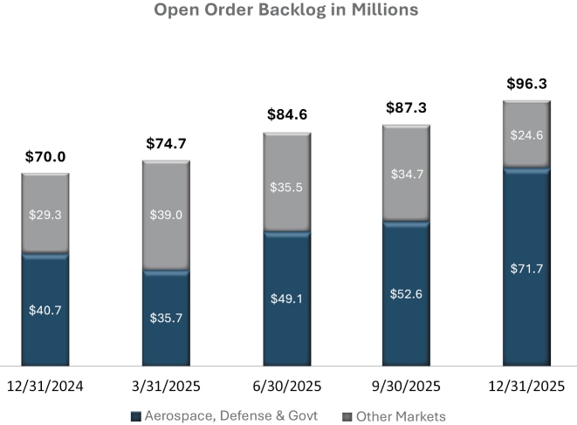
107
Revenue by Market
For our CMC and EMP divisions, we track our revenue and customers for both divisions across five key markets. We develop sales strategies for each and incentivize our sales resources to profitably grow our business. The following tables demonstrate revenues by markets for the years ended December 31, 2025 and 2024.
Year Ended December 31, 2025 Compared to Year Ended December 31, 2024
| Year Ended December 31, | ||||||||||||||||||||||||
| ($ in thousands) | 2025 | % of Revenue | 2024 | % of Revenue | $ Change | % Change | ||||||||||||||||||
| Aerospace, Defense & Government | $ | 83,598 | 41.5 | % | $ | 69,621 | 36.6 | % | $ | 13,977 | 20.1 | % | ||||||||||||
| Industrial | 66,828 | 33.1 | % | 66,111 | 34.7 | % | 717 | 1.1 | % | |||||||||||||||
| Medical | 37,326 | 18.5 | % | 38,239 | 20.1 | % | (913 | ) | (2.4 | )% | ||||||||||||||
| Semiconductor & Electronics | 8,109 | 4.0 | % | 9,392 | 4.9 | % | (1,283 | ) | (13.7 | )% | ||||||||||||||
| Energy | 5,775 | 2.9 | % | 7,077 | 3.7 | % | (1,302 | ) | (18.4 | )% | ||||||||||||||
| Total | $ | 201,636 | 100 | % | 190,440 | 100 | % | $ | 11,196 | 5.9 | % | |||||||||||||
Aerospace, Defense and Government
Aerospace, Defense and Government revenues increased as a percentage of our business from 36.6% to 41.5%, or $14.0 million, in the year ended December 31, 2025, as compared to the prior year. Growth was driven by increased sales to larger defense programs including the Hellfire, Javelin, Patriot, KC-135 Stratotanker and AIM-9x Sidewinder. Commercial aerospace revenues grew with increases in isothermal forging die production for one of the world’s leading aerospace manufacturers as well as several other aerospace manufacturers.
Most of our products for Aerospace, Defense and Government customers are made to customer specifications. This creates additional value for our customers; however, this market can be affected by international and U.S. federal government spending. We are subject to variations in the DoW budget and spending levels, shifts in funding for research at national laboratories around the world, changes in policy positions or priorities at the U.S Government or international agencies, alteration in the domestic and global political and economic environment, increased instability and the evolving nature of the global and national security threat environment. Changes in these budget and spending levels, policies, or priorities, which are subject to U.S. domestic and foreign geopolitical risks and threats, may impact our defense businesses. We believe that our business is well positioned to supply the products needed to support future defense spending priorities, including those based on the 2025 National Security Strategy document, the 2024 U.S. National Security related budget and the National Defense Authorization Act (“NDAA”). We are also poised to benefit from the related Future Years Defense Program and other resources and programs needed to support the DoW’s strategy of shoring up the supply chain and hardening operations against trade risk, boycotts and market manipulation by our adversaries. We expect commercial aerospace to continue to grow, with satellite and commercial aviation both projected to experience substantial growth over the next five years.
Industrial
Industrial revenues decreased as a percentage of our business from 34.7% to 33.1%, but they increased by $0.7 million, for the year ended December 31, 2025, as compared to the prior year. We saw higher sales of industrial microwave systems for tempering and drying; however, this was offset by a reduction in a wide array of tungsten and molybdenum products including powder, sheet, bar, plate, and ingots used in a wide variety of applications. This market is sensitive to raw material pricing changes and subject to international competition from the PRC.
108
Medical
Medical revenues decreased as a percentage of our business from 20.1% to 18.5%, or $0.9 million, for the year ended December 31, 2025, as compared to the prior year. This increase was driven by dual sourcing efforts by one medical wire customer and partially offset by an increase with another customer specializing in radiation resistant parts and shielding. While there can be no assurance of future orders, we are continuing our research and development efforts and capital investments into various high-performance wires, including medical wires, as we focus on expanding our revenues in the market. Our products also support medical detection and treatment components for imaging and oncology, isotope production materials, shielding, medical foam and polymer production equipment and x-ray filtering.
Semiconductor and Electronics
Semiconductor and Electronics revenues decreased as a percentage of our business from 4.9% to 4.0%, or $1.3 million, for the year ended December 31, 2025, as compared to the prior year primarily due to one customer’s loss of business from competitive pricing pressure. We do not believe that this change is material, sustaining or indicative of any particular trend. Our products support semiconductor manufacturing equipment and components including extreme ultraviolet lithography components, metal-organic chemical vapor deposition grids, ion implantation components, heat sinks and studs, high reliability diodes and high-density plasma generation components.
Energy
Energy revenues decreased as a percentage of our business from 3.7% to 2.9%, or $1.3 million, for the year ended December 31, 2025, as compared to the prior year. The reduction in sales is reflective of our products supporting the ongoing operations of existing nuclear energy installations, and energy research, as the need for our products in both of these uses is generally inconsistent. While there can be no assurance that we will succeed in obtaining future orders, we believe the nuclear energy market provides an opportunity for us to generate more consistent revenue streams in the longer term, as additional nuclear reactors are built, given that our products are commonly used in reactor builds. Our products include nuclear fuel boats and containers for nuclear fuel processing components, shielding, plasma generation components, microwave delivery components for fusion and fusion research, hydrogen and green hydrogen, carbon capture and fossil fuels processing.
Shipments by Geography and Material and Type
For our CMC and EMP divisions, we track our shipments of products by geography and material type. It is important to note that this tracking is based on physical shipments and is not reconciled back to revenue timing adjustments associated with ASC 606, Revenue from Contracts with Customers. These metrics are intended to provide relative versus absolute changes and are therefore expressed as percentages versus dollars. We use these metrics to help navigate the impacts of global supply chain disruptions and capital allocation.
Shipments by Geography
Shipments based on major geographic territory as a percent of total shipments for the year ended December 31, 2025, as compared to the prior year period saw an increase in Europe from 9% to 12% driven by increased CMC sales with a Medical Imaging customer. Gross shipments into the Americas did not grow at the same rate as Europe and therefore reduced from 87% of total for the year ended December 31, 2024 to 83% for the year ended December 31, 2025.
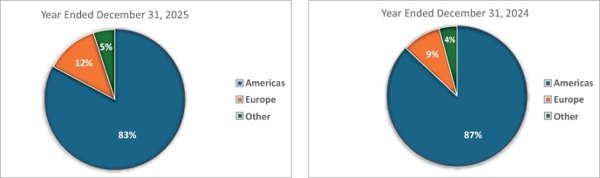
109
Shipments by Type of Materials and Services
Shipment composition based on the type of materials and services as a percent of total shipments for the year ended December 31, 2025, as compared to the prior year, saw an increase in molybdenum from 58% to 60%, driven by increased revenues in the Aerospace, Defense and Government market, as previously discussed in the revenue analysis above. Shipments of tungsten products as a percent of total shipments stayed flat at 16% for the year ended December 31, 2025, compared to the prior year as the increase in tungsten raw material price did not begin to noticeably affect mix of shipments until early 2026. Microwave products saw an increase from 13% to 15%, driven by sales in both the Aerospace, Defense and Government and Industrial system markets. Other materials and services saw a decrease from 13% to 9%, driven by growing demand in the Aerospace, Defense and Government market which shifted our mix toward molybdenum, tungsten and microwave products.
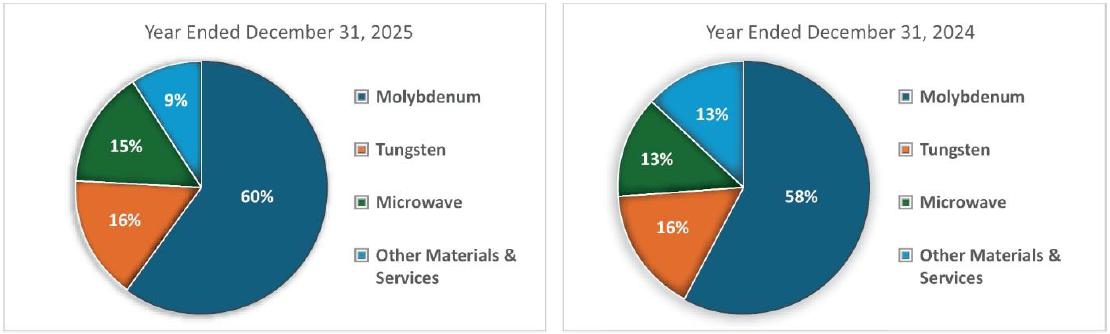
Cost of Goods Sold and Gross Profit
Costs of goods sold for the year ended December 31, 2025 increased $10.5 million, or 7.0%, compared to the prior year.
EMP saw an increase in cost of goods sold for the year ended December 31, 2025 of $1.7 million, or 9.1%, associated with an increase of $3.7 million, or 14.1%, in revenue compared to the prior year, resulting in an increase of $2.0 million, or 26.0%, in gross profit between the year ended December 31, 2025 and the prior year. This helped increase the division’s gross profit margin from 29.3% for the year ended December 31, 2024, to 32.4% for the year ended December 31, 2025.
CMC cost of goods sold for the year ended December 31, 2025 increased $8.8 million, or 6.7%, associated an increase of $7.5 million, or 4.6%, in revenue compared to the prior year period, resulting in a decrease of $1.2 million, or 3.8%, in gross profit between the year ended December 31, 2025 and the prior year. This increase in costs of goods sold, which was predominately offset by an associated increase in revenue, slightly reduced overall gross profit margin from 19.9% for the year ended December 31, 2024 to 18.3% for the year ended December 31, 2025. This negative influence on gross profit margin was driven by two primary factors. First, during the four months ended April 30, 2025, both the order pattern and mix of products were impacted by the global supply chain disruptions in the tungsten and molybdenum markets, leading to a mix of products with lower value add and lower margin.
Secondarily, on July 16, 2025, as a result of a catastrophic failure of the local utility’s transformer, our CMC Euclid, Ohio facility experienced shipping delays from July through September 2025. The Euclid facility returned to normal operations at the beginning of 2026. While we believe this delay in shipments had a material impact on revenue, gross profit, gross profit margin and net income for the second half of 2025, it is not possible to measure with specificity which orders were delayed by this event.
Additional cost of goods sold was incurred due to the utility failure in the amount of $1.0 million. This accounted for 50 basis points of gross profit margin erosion and an erosion of 60 basis points for the CMC division. For the purpose of this comparison, we have reflected these impacts in the tables presented in “Adjusted Gross Profit” below.
110
Adjusted Gross Profit and Adjusted Gross Profit Margin
Adjusted Gross Profit and Adjusted Gross Profit Margin are non-GAAP measurements. We define Adjusted Gross Profit as total revenue less adjusted cost of goods sold, which we define as cost of goods sold less costs related to one-time non-recurring, non-inventory related expenses that under U.S. GAAP are categorized as costs of goods sold. Adjusted Gross Profit Margin represents Adjusted Gross Profit as a percentage of total revenue. We include these measures as supplemental disclosures because they are primary metrics used by management to evaluate revenue and cost of sales performance.
| For the Year Ended December 31, | ||||||||
| ($ in thousands) | 2025 | 2024 | ||||||
| Revenue | $ | 201,636 | $ | 190,440 | ||||
| Cost of goods sold | 160,617 | 150,161 | ||||||
| Gross profit | $ | 41,019 | $ | 40,279 | ||||
| Gross profit margin | 20.3 | % | 21.2 | % | ||||
| Disruption related costs(1) | $ | 1,013 | $ | — | ||||
| Adjusted cost of goods sold | 159,604 | 150,161 | ||||||
| Adjusted gross profit | $ | 42,032 | $ | 40,279 | ||||
| Adjusted gross profit margin | 20.8 | % | 21.2 | % | ||||
| (1) | In July 2025, our Euclid, Ohio facility experienced a utility failure disrupting operations. The facility fully returned to normal operations at the beginning of 2026. |
EMP Adjusted Gross Profit and Adjusted Gross Profit Margin
| For the Year Ended December 31, | ||||||||
| ($ in thousands) | 2025 | 2024 | ||||||
| Revenue | $ | 29,680 | $ | 26,018 | ||||
| Cost of goods sold | 20,070 | 18,393 | ||||||
| Gross profit | $ | 9,610 | $ | 7,625 | ||||
| Gross profit margin | 32.4 | % | 29.3 | % | ||||
| Adjusted cost of goods sold | $ | 20,070 | $ | 18,393 | ||||
| Adjusted gross profit | $ | 9,610 | $ | 7,625 | ||||
| Adjusted gross profit margin | 32.4 | % | 29.3 | % | ||||
CMC Adjusted Gross Profit and Adjusted Gross Profit Margin
| For the Year Ended December 31 | ||||||||
| ($ in thousands) | 2025 | 2024 | ||||||
| Revenue | $ | 171,956 | $ | 164,422 | ||||
| Cost of goods sold | 140,547 | 131,768 | ||||||
| Gross profit | $ | 31,409 | $ | 32,654 | ||||
| Gross profit margin | 18.3 | % | 19.9 | % | ||||
| Disruption related costs | $ | 1,013 | $ | — | ||||
| Cost of goods sold | 139,534 | 131,768 | ||||||
| Adjusted gross profit | $ | 32,422 | $ | 32,654 | ||||
| Adjusted gross profit margin | 18.9 | % | 19.9 | % | ||||
111
General and Administrative Expenses
General and administrative expenses increased $2.5 million, or 15.2%, for the year ended December 31, 2025, compared to the prior year. The increase was partially a result of approximately $1.5 million related to stock-based compensation incurred in connection with stock-based awards granted during the year ended December 31, 2025. Additionally, the increase was partially attributable to $2.6 million in additional corporate costs related to third party accounting and legal expenses in preparation for our initial public offering and an additional $1.4 million in increased staffing across the organization to support our initial public offering and public company reporting and growth in our EMP division. These increases were partially offset by a $2.3 million reduction in general and administrative expenses from our CMC division driven by insourcing of general and administrative expenses functions, elimination of transition services provided by H.C. Starck post-acquisition and the impact of a one-time reorganization bonus expense during the year ending December 31, 2024.
Research and Development
Research and development expenses decreased $0.3 million, or 9.3%, for the year ended December 31, 2025, compared to the prior year. The reduction is a result of lower material and consumable usage in development activities. These expenditures are inconsistent throughout the year and can vary year by year.
Sales and Marketing
Sales and marketing expenses increased $0.7 million, or 12.3%, for the year ended December 31, 2025, compared to the prior year. This increase was due to the expansion of our sales team in support of our strategy and growth, in particular increased sales staffing and commissions in support of growth within our EMP division.
Interest Expense
A more favorable interest rate environment and the reduction of interest-bearing principal decreased our interest expense for the year ended December 31, 2025 by $0.5 million, or 16.1%, compared to prior year. The reduction was attributable to retirement of interest-bearing debt and a more favorable interest rate environment.
Interest Expense — Related Party
Related party interest expense increased $0.1 million, or 4.4%, for the year ended December 31, 2025, compared to the prior year, attributable to increased borrowings under the CEO Line of Credit and the Poly Labs Note Payable (as defined below), slightly offset by a partial repayment of the Great Falls Term Loan (as defined below) during the year ended December 31, 2025.
Other Income, Net
Other income, net increased by less than $0.1 million, or 12.1%, for the year ended December 31, 2025, compared to the prior year, driven by gains recognized related to the change in the fair value of marketable securities, partially offset by the change in the fair value of our interest rate collar derivatives.
112
Critical Materials and Components Results
Year Ended December 31, 2025 Compared to Year Ended December 31, 2024
| Year Ended December 31, | ||||||||||||||||||||||||
| ($ in thousands) | 2025 | % of Revenue | 2024 | % of Revenue | $ Change | % Change | ||||||||||||||||||
| Revenue | $ | 171,956 | 100.0 | % | $ | 164,422 | 100.0 | % | $ | 7,534 | 4.6 | % | ||||||||||||
| Cost of goods sold | 140,547 | 81.7 | % | 131,768 | 80.1 | % | 8,779 | 6.7 | % | |||||||||||||||
| Gross profit | 31,409 | 18.3 | % | 32,654 | 19.9 | % | (1,245 | ) | (3.8 | )% | ||||||||||||||
| Operating expenses: | ||||||||||||||||||||||||
| General and administrative | 8,718 | 5.1 | % | 11,018 | 6.7 | % | (2,300 | ) | (20.9 | )% | ||||||||||||||
| Research and development | 2,110 | 1.2 | % | 2,439 | 1.5 | % | (329 | ) | (13.5 | )% | ||||||||||||||
| Sales and marketing | 4,593 | 2.7 | % | 4,301 | 2.6 | % | 292 | 6.8 | % | |||||||||||||||
| Total operating expenses | 15,421 | 9.0 | % | 17,758 | 10.8 | % | (2,337 | ) | (13.2 | )% | ||||||||||||||
| Operating income | 15,988 | 9.3 | % | 14,896 | 9.1 | % | 1,092 | 7.3 | % | |||||||||||||||
| Other expense, net: | ||||||||||||||||||||||||
| Interest expense | 2,172 | 1.3 | % | 2,176 | 1.3 | % | (4 | ) | (0.2 | )% | ||||||||||||||
| Interest expense – related party | 1,522 | 0.9 | % | 1,717 | 1.0 | % | (195 | ) | (11.4 | )% | ||||||||||||||
| Other (income) expense, net | (19 | ) | — | % | 70 | — | % | (89 | ) | (127.1 | )% | |||||||||||||
| Total other expense, net | 3,675 | 2.2 | % | 3,963 | 2.3 | % | (288 | ) | (7.3 | )% | ||||||||||||||
| Income from continuing operations before taxes | 12,313 | 7.1 | % | 10,933 | 6.8 | % | 1,380 | 12.6 | % | |||||||||||||||
| Income tax benefit | — | — | % | — | — | % | — | — | % | |||||||||||||||
| Income from continuing operations | $ | 12,313 | 7.1 | % | $ | 10,933 | 6.8 | % | $ | 1,380 | 12.6 | % | ||||||||||||
Revenues
Revenues for the year ended December 31, 2025 increased $7.5 million, or 4.6%, compared to the prior year, driven by increases in key missile programs, Javelin and Hellfire, along with increased demand for isothermal forging die production with multiple world leading aerospace manufacturers. Tariff-related pricing disruptions caused delays in higher value sales during the first four months of 2025, suppressing both revenue and gross margin during that period. We saw revenue and margin recovery over the balance of the year, with a higher mix of revenue from the Aerospace, Defense and Government market across the aforementioned programs, as these customers were less affected compared to other markets.
Cost of Goods Sold
CMC cost of goods sold for the year ended December 31, 2025 increased $8.8 million, or 6.7%, compared to the prior year, driven by the aforementioned tariff disruptions, leading to a lower value mix of product sales in the first four months of the year and a $1.0 million increase in costs associated with the utility failure at our Euclid, Ohio facility. Operations recovered fully at the beginning of 2026.
General and Administrative Expenses
CMC general and administrative expenses for the year ended December 31, 2025 decreased $2.3 million, or 20.9%, compared to the prior year. The decrease was primarily attributable to the insourcing of general and administrative functions, elimination of transition services that had been provided by H.C. Starck in 2024 following our acquisition of certain locations of their operations in 2023 and the impact of a one-time reorganization bonus expense during the year ending December 31, 2024.
113
Research and Development
CMC research and development expenses for the year ended December 31, 2025 decreased $0.3 million, or 13.5%, compared to the prior year period. The decrease was primarily due to timing and volumes of material used in development activities. Modest fluctuations in these expenses are normal for this division, and we do not expect CMC research and development expenses to continue to decline as a general matter in the future.
Sales and Marketing
CMC selling and marketing expenses for the year ended December 31, 2025 increased $0.3 million, or 6.8%, compared to the prior year. The increase was driven by increased sales staffing and commissions in support of growth, contributing to the 4.6% revenue growth at the CMC division.
Interest Expense
CMC interest expense for the year ended December 31, 2025 did not meaningfully change compared to the prior year as the impact of increased borrowings was offset by favorable changes in the interest rate environment.
Interest Expense — Related Party
CMC related party interest expense for the year ended December 31, 2025 decreased $0.2 million, or 11.4%, compared to the prior year, due to the repayment of certain indebtedness during 2025.
Other (Income) Expense, Net
CMC other (income) expense, net for the year ended December 31, 2025 did not meaningfully change compared to the prior year.
Engineered Microwave Products Results
Year Ended December 31, 2025 Compared to Year Ended December 31, 2024
| Year Ended December 31, | ||||||||||||||||||||||||
| ($ in thousands) | 2025 | % of Revenue | 2024 | % of Revenue | $ Change | % Change | ||||||||||||||||||
| Revenue | $ | 29,680 | 100.0 | % | $ | 26,018 | 100.0 | % | $ | 3,662 | 14.1 | % | ||||||||||||
| Cost of goods sold | 20,070 | 67.6 | % | 18,393 | 70.7 | % | 1,677 | 9.1 | % | |||||||||||||||
| Gross profit | 9,610 | 32.4 | % | 7,625 | 29.3 | % | 1,985 | 26.0 | % | |||||||||||||||
| Operating expenses: | ||||||||||||||||||||||||
| General and administrative | 5,038 | 17.0 | % | 4,453 | 17.1 | % | 585 | 13.1 | % | |||||||||||||||
| Research and development | 1,247 | 4.2 | % | 1,263 | 4.9 | % | (16 | ) | (1.3 | )% | ||||||||||||||
| Sales and marketing | 1,494 | 5.0 | % | 1,190 | 4.6 | % | 304 | 25.5 | % | |||||||||||||||
| Total operating expenses | 7,779 | 26.2 | % | 6,906 | 26.6 | % | 873 | 12.6 | % | |||||||||||||||
| Operating income | 1,831 | 6.2 | % | 719 | 2.7 | % | 1,112 | 154.7 | % | |||||||||||||||
| Other expense, net: | ||||||||||||||||||||||||
| Interest expense | 371 | 1.3 | % | 527 | 2.0 | % | (156 | ) | (29.6 | )% | ||||||||||||||
| Interest expense – related party | 234 | 0.8 | % | 216 | 0.8 | % | 18 | 8.3 | % | |||||||||||||||
| Other income, net | (92 | ) | (0.3 | )% | (268 | ) | (1.0 | )% | (176 | ) | (65.7 | )% | ||||||||||||
| Total other expense, net | 513 | 1.8 | % | 475 | 1.8 | % | 38 | 8.0 | % | |||||||||||||||
| Income from continuing operations before taxes | 1,318 | 4.4 | % | 244 | 0.9 | % | 1,074 | 440.2 | % | |||||||||||||||
| Income tax benefit | (45 | ) | (0.2 | )% | (135 | ) | (0.5 | )% | (90 | ) | (66.7 | )% | ||||||||||||
| Income from continuing operations | $ | 1,363 | 4.6 | % | $ | 379 | 1.4 | % | $ | 984 | 259.6 | % | ||||||||||||
114
Revenue
EMP revenues for the year ended December 31, 2025 increased $3.7 million, or 14.1%, compared to the prior year, driven primarily by increased revenues supporting high energy physics programs with national laboratories, the Patriot missile program and High-Power Microwave systems.
Cost of Goods Sold
EMP cost of goods sold for the year ended December 31, 2025 increased $1.7 million, or 9.1%, compared to the prior year, primarily attributable to sales growth resulting in an increase of $2.0 million in gross profit. This helped increase the division’s gross profit margin from 29.3% for the year ended December 31, 2024, to 32.4% for the year ended December 31, 2025.
General and Administrative Expenses
EMP general and administrative expenses for the year ended December 31, 2025 increased $0.6 million, or 13.1%, compared to the year ended December 31, 2024, to support of the division’s 14.1% growth in sales.
Research and Development
EMP research and development expenses for the year ended December 31, 2025 did not meaningfully change compared to the prior year.
Sales and Marketing
EMP sales and marketing expenses for the year ended December 31, 2025 increased $0.3 million, or 25.5%, compared to the prior year, driven primarily by increased sales staffing in support of current and future growth and commissions in support of the division’s strong 14.1% sales growth between the two periods.
Interest Expense
EMP interest expense for the year ended December 31, 2025 decreased $0.2 million, or 29.6%, compared to the prior year due to the repayment of certain indebtedness during 2025.
Interest Expense — Related Party
EMP related party interest expense for the year ended December 31, 2025 did not meaningfully change compared to the prior year.
Other Income, Net
EMP other income, net did not meaningfully change compared to the prior year.
Corporate and Other
Year Ended December 31, 2025 Compared to Year Ended December 31, 2024
Activity related to Corporate and Other for the years ended December 31, 2025 and 2024 is as follows:
| Year Ended December 31, | $ | % | ||||||||||||||
| ($ in thousands) | 2025 | 2024 | Change | Change | ||||||||||||
| Operating expenses | $ | 5,745 | $ | 1,402 | $ | 4,343 | 309.8 | % | ||||||||
Operating expenses for the year ended December 31, 2025 increased $4.3 million, or 309.8%, compared to the prior year, primarily attributable to additional expenses associated with preparation for our initial public offering, including additional staffing and professional advisory fees, including legal and accounting support, and stock-based compensation related to grants in anticipation of our initial public offering.
115
Discontinued Operations
As noted above (see “— Recent Divestitures”), Poly Labs is a manufacturer of polyurethane molded components. In response to an inquiry from the City of Lewiston, Maine and in an effort to rescue the business from closure during the COVID outbreak, A&A acquired the Poly Labs assets in on November 2, 2020 for $2.9 million. After the acquisition, A&A rescued the operations, saved the attendant jobs and fulfilled preexisting customer obligations and last time buys. On May 30, 2024, the business engaged in a sale leaseback arrangement for the majority of its real property (included among the assets acquired as part of the acquisition in 2020) for $6.1 million.
In August 2024, A&A engaged a broker to begin actively marketing the business for sale recognizing the lack of strategic fit with the balance of the portfolio companies which currently reside within our CMC and EMP divisions, but no sale of the remaining Poly Labs business was consummated. Subsequently, A&A distributed its interest in Poly Labs to its shareholders on October 1, 2025 and recorded activities of Poly Labs as discontinued operations. Accordingly, the results of Poly Labs in current and prior periods have been classified as discontinued operations in our consolidated financial statements and excluded from our results of continuing operations.
Activity related to Poly Labs for the years ended December 31, 2025 and 2024 is as follows:
| Year Ended December 31, | $ | % | ||||||||||||||
| ($ in thousands) | 2025(1) | 2024 | Change | Change | ||||||||||||
| Revenue | $ | 4,042 | $ | 11,295 | $ | (7,253 | ) | (64.2 | )% | |||||||
| Cost of goods sold | 5,196 | 7,468 | (2,272 | ) | (30.4 | )% | ||||||||||
| Gross profit | (1,154 | ) | 3,827 | (4,981 | ) | (130.2 | )% | |||||||||
| Operating expenses | 1,288 | 1,608 | (320 | ) | (19.9 | )% | ||||||||||
| Operating income | (2,442 | ) | 2,219 | (4,661 | ) | (210.0 | )% | |||||||||
| Other income, net | (44 | ) | (3,495 | ) | (3,451 | ) | (98.7 | )% | ||||||||
| (Loss) income from discontinued operations | $ | (2,398 | ) | $ | 5,714 | $ | (8,112 | ) | (142.0 | )% | ||||||
| (1) | Reflects results of operations of Poly Labs through October 1, 2025. |
Information for the year ended December 31, 2025 includes results only through October 1, 2025, the date on which the previously mentioned distribution of ownership of Poly Labs was made to the shareholders of A&A. As a result, the table above in effect compares nine months of financial results for the period ended September 30, 2025 to twelve months for the year ended December 31, 2024. Included in the results for the year ended December 31, 2024 is the gain on sale of real estate of $3.7 million related to a sale lease back arrangement of property owned by Poly Labs.
Key Performance Indicators and Non-GAAP Financial Measures
We measure our business, monitor results of operations and ensure proper allocation of capital using the following key performance indicators and non-GAAP financial measures: (i) Revenue, (ii) Backlog, (iii) Gross Profit, (iv) Gross Profit Margin, (v) Adjusted EBITDA from Continuing Operations, (vi) Adjusted EBITDA Margin from Continuing Operations, (vii) Net (Loss) Income, and (viii) Adjusted Net Income, and (ix) Adjusted Net Income Per Share. We believe the non-GAAP financial measures presented in this Prospectus will help investors understand our financial condition and operating results and assess our future prospects. We believe these non-GAAP financial measures, each of which are discussed in greater detail below, are important supplemental measures because they exclude unusual or non-recurring items as well as non-cash items that are unrelated to or may not be indicative of our ongoing operating results. Further, when read in conjunction with our U.S. GAAP results, these non-GAAP financial measures provide a baseline for analyzing trends in our underlying businesses and can be used by management as a tool to help make financial, operational and planning decisions. We may use non-GAAP financial metrics in certain management compensation plans, debt covenants, internal budgetary decision making, and other resource allocation decisions. Finally, these measures are often used by analysts and other interested parties to evaluate companies in our industry by providing more comparable measures that are less affected by factors such as capital structure.
116
Our reconciliation of Gross Profit and Gross Profit Margin to Adjusted Gross Profit and Adjusted Gross Profit Margin are included elsewhere in this Prospectus. See “— Year Ended December 31, 2025 Compared to Year Ended December 31, 2024 — Adjusted Gross Profit” above.
The following table summarizes our reconciliation of income (loss) from continuing operations to Adjusted EBITDA and our Adjusted EBITDA Margin for the year ended December 31, 2025, for our divisions, with discontinued operations excluded from the results of continuing operations (in thousands, except percentages):
| For the Year Ended December 31, 2025 | ||||||||||||||||
| ($ in thousands, except %) | CMC | EMP | Corporate & other | Total | ||||||||||||
| Revenue | $ | 171,956 | $ | 29,680 | $ | — | $ | 201,636 | ||||||||
| Income (loss) from continuing operations | $ | 12,313 | $ | 1,363 | $ | (5,736 | ) | $ | 7,940 | |||||||
| Income (loss) from continuing operations % | 7.2 | % | 4.6 | % | n/m | 3.9 | % | |||||||||
| Adjustments to income (loss) from continuing operations: | ||||||||||||||||
| Income tax benefit | $ | — | $ | (45 | ) | $ | — | $ | (45 | ) | ||||||
| Interest expense(1) | 3,694 | 605 | 111 | 4,410 | ||||||||||||
| Depreciation and amortization | 4,926 | 1,122 | — | 6,048 | ||||||||||||
| Acquisition and transaction costs(2) | 214 | 226 | — | 440 | ||||||||||||
| Corporate costs associated with the offering(3) | — | — | 2,580 | 2,580 | ||||||||||||
| Stock-based compensation(4) | 1,149 | — | 302 | 1,451 | ||||||||||||
| Other(5) | 1,013 | — | — | 1,013 | ||||||||||||
| Adjusted EBITDA | $ | 23,309 | $ | 3,271 | $ | (2,743 | ) | $ | 23,837 | |||||||
| Adjusted EBITDA Margin | 13.6 | % | 11.0 | % | n/m | 11.8 | % | |||||||||
n/m = not meaningful
| (1) | Interest expense includes both third-party interest expense and related party interest expense. |
| (2) | The adjustment for acquisition and transaction costs is to remove charges incurred in connection with any transaction, including mergers, acquisitions, refinancing, amendment or modification to indebtedness, and dispositions, in each case, regardless of whether consummated. |
| (3) | Corporate costs associated with the offering include third-party expenses related to enhancing our accounting controls and procedures, incremental audit costs, recruitment of executive team and legal expenses. |
| (4) | Stock-based compensation includes expenses associated with restricted stock grants made in support of our initial public offering and the Reorganization. |
| (5) | Other includes non-recurring costs associated with a utility failure at our CMC facility in Euclid, Ohio. |
117
The following table summarizes our reconciliation of income (loss) from continuing operations to Adjusted EBITDA and our Adjusted EBITDA Margin for the year ended December 31, 2024 for our divisions, with discontinued operations excluded from the results of continuing operations (in thousands, except percentages):
| Year Ended December 31, 2024 | ||||||||||||||||
| ($ in thousands) | CMC | EMP | Corp | Total | ||||||||||||
| Revenue | $ | 164,422 | $ | 26,018 | $ | — | $ | 190,440 | ||||||||
| Income (loss) from continuing operations | $ | 10,933 | $ | 379 | $ | (1,594 | ) | $ | 9,718 | |||||||
| Income (loss) from continuing operations % | 6.6 | % | 1.5 | % | n/m | 5.1 | % | |||||||||
| Adjustments to income (loss) from continuing operations: | ||||||||||||||||
| Income tax benefit | $ | — | $ | (135 | ) | $ | — | $ | (135 | ) | ||||||
| Interest expense(1) | 3,893 | 743 | 200 | 4,836 | ||||||||||||
| Depreciation and amortization | 4,139 | 1,224 | — | 5,363 | ||||||||||||
| Acquisition and transaction costs(2) | 361 | 120 | — | 481 | ||||||||||||
| Other(3) | 987 | — | — | 987 | ||||||||||||
| Adjusted EBITDA | $ | 20,313 | $ | 2,331 | $ | (1,394 | ) | $ | 21,250 | |||||||
| Adjusted EBITDA Margin | 12.4 | % | 9.0 | % | n/m | 11.2 | % | |||||||||
n/m = not meaningful
| (1) | Interest expense includes both third-party interest expense and related party interest expense. |
| (2) | The adjustment for acquisition and transaction costs is to remove charges incurred in connection with any transaction, including mergers, acquisitions, refinancing, amendment or modification to indebtedness, and dispositions, in each case, regardless of whether consummated. |
| (3) | Other includes restructuring and severance costs associated with a reorganization within our CMC division. |
We recognize that these non-GAAP financial measures have limitations and that other companies may calculate non-GAAP financial measures differently and may use their non-GAAP financial measures under different circumstances or for different purposes, thereby affecting their comparability from company to company. In order to address these and the other limitations discussed below, management does not consider these measures in isolation from or as alternatives to the comparable financial measures determined in accordance with U.S. GAAP. Investors should review the reconciliations below and should not rely on any single financial measure to evaluate our business.
We define these non-GAAP financial measures as:
| ● | Adjusted Net Income. We define adjusted net income as net income less stock-based compensation related to our IPO and one-time non-recurring costs such as tax impacts of the Reorganization, discontinued operations, the costs associated with the IPO, certain acquisition and transaction costs, severance and restructuring costs, and other non-recurring costs and the income tax effect of such adjustments, as applicable. |
| ● | Adjusted Net Income Per Share (basic and diluted). Adjusted Net Income Per Share is calculated by dividing Adjusted Net Income by weighted average shares outstanding (basic and diluted). |
| ● | Adjusted EBITDA. We define Adjusted EBITDA as our net income from continuing operations plus interest expense, income taxes, depreciation and amortization, and, as applicable for each period, stock-based compensation expense. Adjusted EBITDA also excludes certain non-recurring costs such as the costs associated with the IPO, certain acquisition and transaction costs, severance and restructuring costs, and other non-recurring costs. |
| ● | Adjusted EBITDA Margin. Adjusted EBITDA Margin is calculated by dividing Adjusted EBITDA by revenue. |
| ● | Adjusted Gross Profit. We define Adjusted Gross Profit as total revenue less adjusted cost of goods sold, which we define as cost of goods sold less costs related to one-time non-recurring, non-inventory related expenses that under U.S. GAAP are categorized as costs of goods sold. This measure was not disclosed for the three and six months ended July 3, 2026 and June 30, 2025, as there were no items that met these criteria for the periods presented. |
| ● | Adjusted Gross Profit Margin. Adjusted Gross Profit Margin is calculated by dividing Adjusted Gross Profit by total revenue. This measure was not disclosed for the three and six months ended July 3, 2026 and June 30, 2025, as there were no items that met these criteria for the periods presented. |
118
Although we use Adjusted Gross Profit, Adjusted Gross Profit Margin, Adjusted EBITDA, and Adjusted EBITDA Margin as measures to assess the performance of our business and for the other purposes set forth above, the use of non-GAAP financial measures as analytical tools has limitations, and you should not consider any of them in isolation, or as a substitute for analysis of our results of operations as reported in accordance with U.S. GAAP. Some of these limitations are:
| ● | Adjustments to Gross Profit and Gross Profit Margin, while non-recurring, do often require cash and if material in nature, could materially negatively affect cash flows; |
| ● | Adjusted EBITDA and Adjusted EBITDA Margin do not reflect the significant interest expense, or the cash requirements, necessary to service interest payments on our indebtedness; |
| ● | Although depreciation and amortization are non-cash charges, the assets being depreciated and amortized will often have to be replaced in the future, and the cash requirements for such replacements are not reflected in Adjusted EBITDA and Adjusted EBITDA Margin; |
| ● | Adjusted EBITDA and Adjusted EBITDA Margin exclude the cash expense we have incurred to integrate acquired businesses into our operations, which is a necessary element of certain of our acquisitions; |
| ● | Omission of the substantial amortization expense associated with our intangible assets further limits the usefulness of Adjusted EBITDA and Adjusted EBITDA Margin; and |
| ● | Adjusted EBITDA and Adjusted EBITDA Margin do not include the payment of taxes, which is a necessary element of our operations. |
Because of these limitations, Adjusted Gross Profit, Adjusted Gross Profit Margin, Adjusted EBITDA and Adjusted EBITDA Margin should not be considered as measures of cash available to us to invest in the growth of our business. Adjusted Gross Profit, Adjusted Gross Profit Margin, Adjusted EBITDA, and Adjusted EBITDA Margin are not measurements of financial performance under U.S. GAAP, and they should not be considered as alternatives to net income, income from continuing operations or cash flow from continuing operations determined in accordance with U.S. GAAP.
Critical Accounting Policies and Estimates
Our consolidated financial statements and the related notes included elsewhere in this Prospectus are prepared in accordance with GAAP. The preparation of consolidated financial statements requires us to make estimates and assumptions that affect the reported amounts of assets, liabilities, revenue, and expenses, and the related disclosure of contingent assets and liabilities. We base our estimates on historical experience and various other assumptions we believe to be reasonable under the circumstances. The results of these estimates form the basis for making judgments about the carrying values of assets and liabilities that are not readily apparent from other sources. Actual results could differ from these estimates under different assumptions or circumstances. While our significant accounting policies are described in more detail in the notes to our consolidated financial statements appearing elsewhere in this Prospectus, we believe the following critical accounting policies require the use of significant estimates and judgments in the preparation of our consolidated financial statements.
Revenue Recognition
We recognize revenue in a manner which depicts the transfer of promised goods or services to customers in an amount reflecting the consideration to which we expect to be entitled in exchange for those goods or services.
Most of our revenue is recognized at the point in time control transfers to our customer based on predetermined shipping terms. Revenue is recognized over time under certain contracts for highly customized products that have no alternative use and in which the contract specifies we have enforceable right to payment for our costs, plus a reasonable margin.
For products recognized over time, the transfer of control is measured using the input method, which measures progress toward completion as costs are incurred and estimates of costs to complete such contracts. Significant judgment is used to estimate total costs at completion. Unforeseen events and circumstances can alter the estimate of the costs and potential benefits associated with a particular contract. Changes in job performance, job conditions, estimated profitability, and final contract settlements may result in revisions to costs and income. We recognize changes in contract estimates on a cumulative “catch-up” basis in the period in which the changes are identified. Such changes in contract estimates can result in the recognition of revenue in the current period for performance obligations which were satisfied or partially satisfied in a prior period. Changes in contract estimates may also result in the reversal of previously recognized revenue if the current estimate differs from the previous estimate. Losses on contracts are fully recognized in the period in which the losses become determinable.
119
Inventory Valuation
Inventory includes material, direct labor and related manufacturing overhead, and are stated at the lower of cost, determined on a first-in, first-out basis and average cost, or net realizable value determined as the estimated selling prices in the ordinary course of business, less reasonably predictable costs of completion, disposal and transportation.
We adjust the carrying value of inventory for the estimated difference between the cost of inventory and the estimated net realizable value based upon assumptions about future demand and selling price. We also analyze our inventory levels on each reporting date for excess and obsolete inventory. Our analysis requires judgment and is based on factors including, but not limited to, recent historical activity, anticipated or forecasted demand for our products, competitiveness of product offerings, and market conditions. If estimates of customer demand diminish further or market conditions become less favorable than we project, we may need to make additional inventory adjustments, subject to judgment and estimation.
Stock-Based Compensation Expense
We record stock-based compensation expense for stock-based awards issued to our employees based on our estimate of the fair value of the stock-based awards at the grant date. We estimate the fair value of our stock-based awards based on the fair value of our common stock. See “Note 2 - Summary of Significant Accounting Policies - Stock-Based Compensation” within our unaudited consolidated financial statements as of October 2, 2026 and for the three and nine month periods ended October 2, 2026, and September 30, 2025, respectively, included elsewhere in this Prospectus.
For stock-based awards that include a service-based vesting condition, we recognize the expense ratably over the requisite service period. For stock-based awards that include a performance-based vesting condition, we recognize the expense when it is probable that the performance-based vesting condition will be satisfied and the award has satisfied other vesting conditions, if any. Forfeitures are recognized as they are incurred. Refer to “- Critical Accounting Policies and Significant Judgements and Estimates - Common Stock Valuations” below for additional detail on the valuation methodology to determine the fair value of our common stock.
Common Stock Valuations
Prior to the completion of our initial public offering, there was no public market for our common stock. As such, the estimated fair value of our equity was determined at each grant date by our board of directors, with input from management, based on the information known to us on the grant date and upon a review of any recent events and their potential impact on the estimated per share fair value of our common stock. As part of these fair value determinations, our board of directors obtained and considered valuation reports prepared by an independent third-party valuation specialist in accordance with the guidance outlined in the American Institute of Certified Public Accountants Technical Practice Aid, Valuation of Privately-Held-Company Equity Securities Issued as Compensation. The value of our common stock was estimated using income and market valuation approaches. The assumptions underlying these valuations included projected future revenue and cash flows, discount rates, market multiples, selection of comparable companies, the lack of marketability of our common stock and probability of possible future events and represented our best estimates at the time they were made, which involves inherent uncertainty and the application of judgment. Changes to the key assumptions and estimates used in the valuations could have resulted in materially different fair values of our common stock at each valuation date.
Following the closing of our initial public offering, it was no longer necessary for our board of directors to estimate the fair value of our common stock in connection with the accounting for stock-based awards we grant, as the fair value of our common stock is determined based on the closing price of our common stock as reported on the date of grant.
Valuation of Forward Instruments
We measure the forward instruments at fair value at each reporting date, with changes in fair value recognized in earnings. See “Note 2 — Summary of Significant Accounting Policies” and “Note 15 —Blue Moon Metals Inc. Transactions” within our unaudited consolidated financial statements as of October 2, 2026 and for the three and nine month periods ended October 2, 2026, and September 30, 2025, respectively, included elsewhere in this Prospectus.
The Forward was measured as a single instrument comprised of common shares and warrants, net of the aggregate subscription price payable at closing. Fair value for the underlying BM Shares was determined using the quoted closing price of third-party common shares in an active market, multiplied by the quantity to be received, less the aggregate subscription price. The fair value of the underlying Blue Moon Warrants is estimated using a Black-Scholes option pricing model with observable inputs, including the quoted price and volatility of third-party common shares and the risk-free rate.
The forward instrument to purchase the common shares under the Masan SHA (the “Masan Forward”), outstanding from September 23, 2026 until the settlement, was measured as the excess of the quoted closing price of the common share underlying the Masan SHA, translated at the period-end VND/USD rate, over the purchase price. The measurement of the Masan Forward relies on a quoted price in an active market and a contractual purchase price, it does not require a valuation model or significant unobservable inputs.
120
Valuation and Classification of Equity-Classified Instruments
We evaluate warrants, rights and other instruments issued in connection with financing and other transactions including the Penny Warrant and the TEG Warrants, to determine whether they are classified as liabilities or in equity, and we measure those classified in equity at fair value at issuance. Equity-classified instruments are not remeasured after issuance. Proceeds from transactions in which multiple instruments are issued are allocated among the instruments on a relative fair value basis. See “Note 14 — DoW Investment Agreement” and “Related Transactions” and “Note 15 — Blue Moon Metals Inc. Transactions” within our unaudited condensed consolidated financial statements as of October 2, 2026 and for the three and nine month periods ended October 2, 2026, and September 30, 2025, respectively, included elsewhere in this Prospectus.
We estimate the fair value of the Warrants, the Tranche Right, the TEG Warrants, and the Class A Preferred Stock using a combination of the Monte Carlo simulation model and an implied (back-to-solve) approach. Inputs include the fair value of our common stock, discount rate, expected volatility, expected term, the risk-free interest rate, and the probability and timing of exercise. Significant judgment is used to estimate these inputs, particularly volatility, the discount rate, and the probability and timing of exercise. If our conclusions on classification change, or the estimates change, we may be required to remeasure certain instruments at fair value through earnings or to change the amount of accretion, subject to judgment and estimation.
Recent Accounting Pronouncements
See “Note 3 - Recently Adopted and Recently Issued Accounting Pronouncements” within our unaudited consolidated financial statements as of October 2, 2026 and for the three and nine month periods ended October 2, 2026 and September 30, 2025, respectively, included elsewhere in this Prospectus for any recently adopted accounting pronouncements and recently issued accounting pronouncements not yet adopted.
Liquidity and Capital Resources
As of October 2, 2026, we had $105.7 million in cash, $124.7 million in restricted cash, $6.6 million in marketable securities, and approximately $18.1 million in available debt facility capacity. As of December 31, 2025, our continuing operations had $1.8 million in cash, $0.2 million in marketable securities, and $26.1 million in available debt capacity.
Our principal historical liquidity requirements have been for organic growth, acquisitions, capital expenditures, servicing indebtedness, and working capital needs. As of the date of this Prospectus, the Company has committed to the following material transactions: (i) the OSRAM Acquisition, which will be funded from proceeds from the IPO, and (ii) the Springer Project, which will be funded from the DOW Transactions, the proceeds from this offering, and additional financing, as needed.
We anticipate over the next 12 months we will meet our liquidity needs, including debt servicing, through the proceeds from this offering, proceeds from the IPO, funding from the DOW Transactions, cash generated, available cash balances, and borrowings from our line of credit facilities discussed below. We fund our investing activities primarily from cash provided by our operating and financing activities. As we continue to expand our business, including any acquisitions we may make, we may in the future require additional working capital for increased costs.
Indebtedness
The following table summarizes our indebtedness, excluding forgivable loans, as of October 2, 2026:
| ($ in thousands) | October 2, 2026 | |||
| Line of Credit Facilities: | ||||
| Wells Fargo Line of Credit | $ | 27,377 | ||
| Auburn Savings Loan | 766 | |||
| Term Loans: | ||||
| Wells Fargo Term Loan | 6,281 | |||
| First BankProv Term Note | 1,369 | |||
| United Federal Credit Union Note | 678 | |||
| Other Equipment Loans | 31 | |||
| Total Indebtedness | $ | 36,502 | ||
121
The following provides additional details on our material indebtedness, excluding the Other Equipment Loans, Symphony Line of Credit and Symphony Term Loans (see Note 12 - Debt within the notes to our unaudited consolidated financial statements included elsewhere in this Prospectus for details on those loans), as of October 2, 2026:
Wells Fargo LOC
On November 6, 2023, Elmet Tech entered into a $40.0 million revolving credit facility with Wells Fargo Bank (the “Wells Fargo LOC”) pursuant to an Amended and Restated Credit Agreement (the “Wells Fargo Credit Agreement”). The Wells Fargo LOC accrues interest monthly based on a floating rate, as defined by the lender, and is subject to periodic adjustments based on prevailing market conditions.
As of October 2, 2026 and December 31, 2025, outstanding borrowings under the Wells Fargo LOC were approximately $27.4 million and $20.5 million, respectively. As of October 2, 2026 and December 31, 2025, the applicable interest rates were 7.75% and 5.92%, respectively, on the $27.4 million and $10.0 million outstanding as of each period and 0.00 % and 7.75% on the remaining outstanding amount of approximately $0.0 million and $10.5 million as of October 2, 2026 and December 31, 2025, respectively. The Wells Fargo LOC consists of two different borrowing tranches with different applicable rates, and therefore there may be multiple rates for the same period, depending on the overall outstanding balance. As of October 2, 2026, availability to borrow under the Wells Fargo LOC was approximately $12.5 million. The Wells Fargo LOC matures on November 6, 2028.
Elmet Tech is required to pay customary fees associated with the credit facility, including commitment and administrative fees. In addition, the Wells Fargo LOC contains customary conditions regarding Elmet Tech’s borrowing, including events of default and covenants. Covenants include restrictions on Elmet Tech’s ability to incur indebtedness, grant liens, dispose of assets, make investments, bail or consign inventory or engage in transactions with affiliates (each such restriction subject to certain exceptions), and require us to maintain a consolidated Fixed Charge Coverage Ratio (as such term is defined in the Wells Fargo Credit Agreement) of not less than 1.05 to 1.00, as measured on a month-end basis. The obligations under the Wells Fargo LOC are secured by liens on substantially all of the assets of Elmet Tech, Elmet Coldwater and Elmet Euclid. We were in compliance with all covenants as of the date of this Prospectus.
Domestic March 2020 Line of Credit
On March 2, 2020, Microwave Techniques entered into a $3.0 million demand line of credit with BankProv (formerly known as The Provident Bank and now known as Needham Bank after its merger in November 2025) (the “Domestic March 2020 Line of Credit”) to finance domestic receivables and inventory. Amounts under the Domestic March 2020 Line of Credit are secured by certain assets of Microwave Techniques and are guaranteed by Microwave Techniques. The Domestic March 2020 Line of Credit accrued interest monthly based on a floating rate equal to the prime rate as reported in the Wall Street Journal, which was equal to 7.00% as of October 2, 2026 and December 31, 2025.
The Domestic March 2020 Line of Credit was originally set to expire in February 2025. On January 30, 2025, Microwave Techniques entered into an amendment to the Domestic March 2020 Line of Credit, increasing the Domestic March 2020 Line of Credit from $3.0 million to $4.0 million and extending the maturity date from February 2025 to February 2026. On January 30, 2026, Microwave Techniques entered into a second amendment, which further extended the maturity date from February 2026 to April 2, 2026. All other key terms of the original Domestic March 2020 Line of Credit agreement remained consistent.
On March 31, 2026, we entered into a third amendment of the Domestic March 2020 Line of Credit to remove the stated maturity. Following the third amendment, the Domestic March 2020 Line of Credit is due on demand.
As of October 2, 2026, the entire balance of the Domestic March 2020 Line of Credit was repaid and there was no outstanding balance. As of December 31, 2025, the outstanding balance was approximately $3.3 million. As of October 2, 2026, availability to borrow under the Domestic March 2020 Line of Credit was the full principal sum of up to $4.0 million.
Microwave Techniques was required to pay customary fees associated with the credit facility, including commitment and administrative fees. The Domestic March 2020 Line of Credit contained customary conditions, events of default and financial covenants, including leverage ratio requirements, which we were in compliance with as of the date of this Prospectus.
122
CEO Line of Credit
On January 1, 2023, A&A entered into a $2.0 million line of credit note with Peter V. Anania, our Chief Executive Officer and Chairman (the “CEO Line of Credit”). On October 1, 2025, A&A and our Chief Executive Officer and Chairman entered into an amendment which increased the total amount available to borrow on the CEO Line of Credit from $2.0 million to $2.5 million. The CEO Line of Credit accrued interest monthly on the outstanding balance based on a stated interest rate of 9.00%.
As of December 31, 2025, the outstanding principal balance of the CEO Line of Credit was approximately $1.8 million. The CEO Line of Credit was subject to customary conditions, including events of default, which we were in compliance with as of the date of repayment.
The original maturity date of the CEO Line of Credit was January 1, 2026. On January 1, 2026, we amended the CEO Line of Credit to extend the maturity date from January 1, 2026 to the earlier of: (i) the closing of an initial public offering, or (ii) July 1, 2026. In connection with the amendment, we agreed to pay an extension fee of $0.2 million at maturity in addition to the outstanding principal and accrued, unpaid interest.
The CEO Line of Credit was repaid in full on May 1, 2026 with proceeds from the IPO.
Auburn Savings Loan
On December 26, 2024, Elmet Tech entered into a $0.8 million construction loan with Auburn Savings Bank, FSB (“Auburn Savings Bank”) pursuant to a Commercial Note Agreement (the “Auburn Savings Loan”). Once drawn, the Auburn Savings Loan accrues interest monthly at an initial rate of 7.00% for the first five years, which will be adjusted every fifth anniversary of January 25, 2026, to the Federal Home Loan Bank’s 5/20 amortizing advance rate plus 3.00%. The maturity date of the Auburn Savings Loan is December 25, 2046.
As of October 2, 2026 and December 31, 2025, there was $0.8 million of outstanding borrowings under the Auburn Savings Loan. As of October 2, 2026, there was no availability to borrow under the Auburn Savings Loan, as the principal amount was borrowed.
The obligations under the Auburn Savings Loan are secured by a lien on certain real estate assets and guaranteed by a consolidated subsidiary. In addition, the Auburn Savings Loan is subject to customary conditions, including events of default, of which we were in compliance with as of the date of this Prospectus. The Auburn Savings Loan will be converted to a term loan at the completion of the related construction.
Foreign March 2020 Line of Credit
On March 2, 2020, Microwave Techniques entered into a $1.0 million demand line of credit with BankProv (the “Foreign March 2020 Line of Credit”) to finance foreign receivables. Amounts under the Foreign March 2020 Line of Credit were secured by certain assets of a consolidated subsidiary and were guaranteed by a consolidated subsidiary. The Foreign March 2020 Line of Credit accrued interest monthly based on a floating rate equal to the prime rate as reported in the Wall Street Journal, which was 7.00% as of October 2, 2026 and December 31, 2025. As of October 2, 2026, the entire balance was repaid and there was no outstanding balance. As of December 31, 2025, the outstanding balance was $0.2 million. As of October 2, 2026, the availability to borrow under the Foreign March 2020 Line of Credit was the full principal of $1.0 million.
On January 30, 2025, and on January 30, 2026, we entered into two separate amendments to the Foreign March 2020 Line of Credit. The first amendment entered into during January 2025 extended the maturity date from February 2025 to February 2026, which was subsequently extended to April 2026 as executed under the second amendment entered into during January 2026.
On March 31, 2026, we entered into an additional amendment of the Foreign March 2020 Line of Credit to remove the stated maturity. Following this amendment, the Foreign March 2020 Line of Credit is due on demand.
Microwave Techniques was required to pay customary fees associated with the credit facility, including commitment and administrative fees. The Foreign March 2020 Line of Credit contained customary conditions on events of default and financial covenants, including leverage ratio requirements, which we were in compliance with as of the date of this Prospectus.
123
Auburn Savings LOC
On April 14, 2025, Elmet Tech entered into a $0.6 million line of credit facility with Auburn Savings Bank pursuant to a Demand Commercial Line of Credit Agreement (the “Auburn Savings LOC”). The Auburn Savings LOC accrues interest monthly at the prime rate as published by The Wall Street Journal plus 0.50%. The effective interest rate as of October 2, 2026 and December 31, 2025 was 7.50%.
As of October 2, 2026, there were no outstanding balance owed and the amount available to borrow under the Auburn Savings LOC was the full principal of $0.6 million. As of December 31, 2025, the outstanding borrowings were $0.1 million. The Auburn Savings LOC does not have a maturity date but is due on demand at Auburn Savings Bank’s discretion or upon an event of default as defined in the Auburn Savings LOC.
The obligations under the Auburn Savings LOC are secured by a lien on certain real estate assets and guaranteed by Poly Labs Solar LLC. In addition, the Auburn Savings LOC is subject to customary conditions, including events of default, which we were in compliance with as of the date of this Prospectus.
Term Loans
Great Falls Term Loan
On November 6, 2023, Elmet Tech entered into a secured $20.0 million term note with Great Falls Property, LLC (the “Great Falls Term Loan”), which is owned by George Schott, one of our principal stockholders. The Great Falls Term Loan accrued interest monthly based on a floating rate equal to the prime rate as reported by the Wall Street Journal plus a spread of 1.00%, with a floor of 9.50%. As of December 31, 2025, approximately $15.0 million was outstanding under the Great Falls Term Loan. The maturity date of the Great Falls Term Loan was November 6, 2028; however, on April 28, 2026, the Great Falls Term Loan was repaid in full with proceeds from the IPO.
The Great Falls Term Loan was secured by the real estate associated with our Coldwater and Euclid facilities, held by Elmet Coldwater and Elmet Euclid, respectively, and contained conditions on events of default resulting in acceleration of payment in full of the principal and interest outstanding at the time of the event of default, which we were in compliance with as of the date of this Prospectus.
Wells Fargo Term Loan
On November 6, 2023, Elmet Tech entered into a secured $8.7 million term loan with Wells Fargo Bank pursuant to an Amended and Restated Credit Agreement (the “Wells Fargo Term Loan”). The Wells Fargo Term Loan accrues interest monthly based on a floating rate, as defined by the lender, and is subject to periodic adjustments based on prevailing market conditions. Under the Wells Fargo Term Loan, we make payments of principal monthly. During the year ended December 31, 2024, we modified the Wells Fargo Term Loan and borrowed an additional $2.0 million.
As of October 2, 2026 and December 31, 2025, the outstanding balance under the Wells Fargo Term Loan was approximately $6.3 million and $7.7 million, respectively. As of October 2, 2026 and December 31, 2025, the applicable interest rates were 6.44% and 6.62%, respectively, on the portion of outstanding principal entered into during November 2023, and 8.75% and 8.50%, respectively, on the $2.0 million incremental borrowings entered into during December 2024. During the nine months ended October 2, 2026 and September 30, 2025, the Company made aggregate principal repayments of $1.4 million and $1.2 million, respectively. The Wells Fargo Term Loan matures on November 6, 2028.
The Wells Fargo Term Loan contains customary conditions regarding our borrowing, including events of default and covenants. Covenants include restrictions on certain consolidated subsidiaries’ ability to incur indebtedness, grant liens, dispose of assets, make investments, bail or consign inventory or engage in transactions with affiliates (each such restriction subject to certain exceptions), and require us to maintain a consolidated Fixed Charge Coverage Ratio (as such term is defined in the Wells Fargo Credit Agreement) of not less than 1.05 to 1.00, as measured on a month-end basis. The obligations under the Wells Fargo Term Note are secured by substantially all of the assets of a consolidated subsidiary. We were in compliance with all covenants as of the date of this Prospectus.
124
First BankProv Term Note
On March 2, 2020, a consolidated subsidiary entered into a secured $6.5 million term note with BankProv (the “First BankProv Term Note”). Amounts under the First BankProv Term Note are secured by certain assets of the consolidated subsidiary and are guaranteed by the consolidated subsidiary. The First BankProv Term Note accrued monthly interest at 4.79% until March 31, 2026, and accrues at a fixed 6.50% thereafter. As of October 2, 2026 and December 31, 2025, the outstanding balance of the First BankProv Term Note was approximately $1.4 million and $1.7 million, respectively.
On March 31, 2026, we amended the First BankProv Term Note to extend the maturity date from March 2, 2027 to March 1, 2033. In connection with the amendment, the interest rate increased to a fixed rate of 6.50% and the repayment schedule was amended, whereby we are required to make interest-only payments for a period of twelve months commencing April 1, 2026, followed by principal payments over a six-year amortization period.
The First BankProv Term Note contains conditions on the consolidated subsidiary’s borrowing, including events of default and covenants. Covenants include restrictions on the consolidated subsidiary’s ability to incur indebtedness, grant liens, dispose of assets, make investments or loans, and strategic transactions (each such restriction subject to certain exceptions), and require the consolidated subsidiaries to maintain several financial covenants, including a leverage ratio. We were in compliance with all obligations under the First BankProv Term Note as of the date of this Prospectus.
United Federal Credit Union Note
On September 23, 2024, Elmet Tech entered into a secured $1.6 million term note with United Federal Credit Union (the “United Federal Credit Union Note”). Amounts under the United Federal Credit Union Note are secured by a solar project at Elmet Coldwater LLC, which now serves as a real estate holding company for properties used by our CMC division. The United Federal Credit Union Note accrues monthly interest based on a stated interest rate of 9.00% and principal payments began in until March 2025. As of October 2, 2026 and December 31, 2025, the outstanding balance under the United Federal Credit Union Note was $0.7 million and $1.1 million, respectively. The United Federal Credit Union Note has a maturity date of September 10, 2027.
The United Federal Credit Union Note contains customary conditions on borrowing, including events of default. Upon an event of default, the lender would be entitled to exercise customary remedies, including acceleration of amounts due and enforcement of any applicable rights against the borrower. We were in compliance with all obligations under the United Federal Credit Union Note as of the date of this Prospectus.
AAI Note
On January 2, 2026, in connection with the Reorganization, we entered into a $2.4 million promissory note (the “AAI Note”) with AAI, which is controlled by our CEO, related to outstanding obligations between us and AAI. The AAI Note was due and payable on the earlier of demand by us or January 1, 2027, and accrued interest at a rate of 6.00% per annum. As of October 2, 2026, the balance was paid in full and the note was terminated.
Poly Labs Note Payable (Due to Poly Labs)
Following our distribution of Poly Labs (see Note 5 - Discontinued Operations within the notes to our unaudited consolidated financial statements included elsewhere in this Prospectus), AAI had an outstanding note payable owed to Poly Labs of approximately $1.7 million (the “Poly Labs Note Payable”). Prior to the distribution of Poly Labs, the Poly Labs Note Payable was eliminated in consolidation. The Poly Labs Note Payable accrued interest monthly based on a stated interest rate of 10.00% and had a maturity date of January 31, 2026. As of December 31, 2025, the outstanding balance under the Poly Labs Note Payable was $0.5 million. On January 19, 2026, the Poly Labs Note Payable was repaid in full and terminated.
125
October 2023 Term Loans
On October 6, 2023, we entered into two separate unsecured term loans with investors of AAI, with aggregate gross proceeds of approximately $0.5 million (the “October 2023 Term Loans”). The October 2023 Term Loans accrued interest monthly based on a stated fixed interest rate of 8.00%. In April 2025, AAI amended one of the October 2023 Term Loans to add a conversion feature to enable the holder to convert the outstanding principal and accrued interest into membership units of AAI upon certain liquidity events, including an initial public offering. On December 29, 2025, the holder of this October 2023 Term Loan waived his right to convert the term loan into AAI membership units. The maturity dates of the October 2023 Term Loans ranged from October 2026 to October 2027. As of December 31, 2025, approximately $0.5 million was outstanding related to the October 2023 Term Loans. In connection with the Reorganization, the October 2023 Term Loans were repaid in full, terminated and replaced by the AAI Note.
Cash Flows
The following table summarizes our consolidated cash flows from continuing operations for the nine months ended:
| Nine Months Ended | ||||||||
| ($ in thousands) | October 2, 2026 | September 30, 2025 | ||||||
| Net cash (used in) provided by operating activities from continuing operations | $ | (60,727 | ) | $ | 1,422 | |||
| Net cash used in investing activities from continuing operations | (6,255 | ) | (5,872 | ) | ||||
| Net cash provided by financing activities from continuing operations | 295,719 | 1,858 | ||||||
| Effects of exchange rate changes on cash from continuing operations | (72 | ) | 98 | |||||
| Net change in cash and restricted cash from continuing operations | $ | 228,665 | $ | (2,494 | ) | |||
Operating Activities
Net cash used in operating activities from continuing operations was $60.7 million for the nine months ended October 2, 2026, driven primarily by changes in net working capital of $84.3 million, partially offset by net income from continuing operations of $3.5 million and non-cash adjustments to income from continuing operations of $20.1 million. The change in net working capital was a result of an $85.5 million increase in inventories, a net cash outflow of $5.8 million related to the timing of billing and cash receipts from customers, an increase of $4.5 million in prepaid expenses and other current assets, and a net cash outflow of $0.9 million from changes in other operating assets and liabilities, partially offset by an increase in accounts payable of $4.7 million, and an increase in accrued expenses and other current liabilities of $7.7 million. Non-cash adjustments to income from continuing operations primarily consisted of stock-based compensation expense of $12.8 million, deferred income taxes of $3.1 million, an unrealized loss on forward instruments of $0.2 million, depreciation and amortization expense of $5.7 million, provision for excess and obsolete inventories of $2.4 million, non-cash operating lease expense of $0.7 million, and provision for credit losses of approximately $0.1 million, partially offset by a $2.2 million unrealized gain on fair market value of derivative assets, and a $2.7 million unrealized gain on marketable securities.
Net cash provided by operating activities from continuing operations was $1.4 million for the nine months ended September 30, 2025, driven primarily by net income from continuing operations of $6.4 million and non-cash adjustments to income from continuing operations of $7.2 million, partially offset by changes in net working capital of $12.2 million. The change in net working capital was a result of a $13.0 million increase in inventories, a decrease in accrued expenses and other current liabilities of $2.4 million, an increase of $1.2 million in prepaid expenses and other current assets, and a net cash outflow of $0.7 million from changes in other operating assets and liabilities, partially offset by a net cash inflow of $1.7 million related to the timing of billing and cash receipts from customers, and an increase in accounts payable of $3.4 million,. Non-cash adjustments to income from continuing operations primarily consisted of depreciation and amortization expense of $4.8 million, stock-based compensation expense of $0.8 million, non-cash lease expense of $0.7 million, provision for excess and obsolete inventories of $0.5 million, provision for credit losses of approximately $0.1 million, and other non-cash adjustments of $0.3 million.
126
Investing Activities
Net cash used in investing activities from continuing operations was $6.3 million for the nine months ended October 2, 2026, driven primarily by purchases of marketable securities of $1.4 million and purchases of property, plant and equipment of $8.9 million, which were partially offset by $4.0 million of cash received from government grants related to capital projects.
Net cash used in investing activities from continuing operations was $5.9 million for the nine months ended September 30, 2025, driven primarily by purchases of property, plant and equipment of $9.4 million, which were partially offset by $3.5 million of cash received from government grants related to capital projects.
Financing Activities
Net cash provided by financing activities from continuing operations was $295.7 million for the nine months ended October 2, 2026, driven primarily by proceeds from initial public offering of $125.4 million, gross proceeds from the DoW Transactions of $200.0 million, and proceeds from revolving credit facility of $177.7 million, partially offset by payments of principal on revolving credit facilities of $174.5 million, payments of principal on long-term debt – related party of $17.3 million, employee taxes paid on shares for tax-withholding purposes of $4.4 million, DoW Transactions capitalized costs of $6.9 million, payments on principal on long-term debt of $2.4 million, net payments of principal on revolving credit facilities - related party of $1.8 million, and net cash outflows from other financing activities of $0.1 million.
Net cash provided by financing activities from continuing operations was $1.9 million for the nine months ended September 30, 2025, driven primarily by proceeds from revolving credit facility of $15.5 million, partially offset by cash distributions paid to stockholders of $6.8 million, principal payments on long-term debt of $5.3 million, and net payments of principal on revolving credit facilities - related party of $1.4 million.
Material Cash Commitments
As of the date of this Prospectus, our material future cash commitments are to fund the OSRAM Acquisition, as described elsewhere in this Prospectus, fund the Masan SHA, as described elsewhere in this Prospectus, fund the Springer Transaction, as described elsewhere in this Prospectus, repay our current indebtedness obligations, as described above, and make payments under leases for our facilities. We have operating leases for our manufacturing facilities with lease terms that expire between November 2026 and February 2037. Many leases include one or more options to renew, but renewals are not assumed in the determination of the lease term due to uncertainty. For more information on our leases, see Note 10 - Leases within our unaudited consolidated financial statements included elsewhere in this Prospectus.
The following table summarizes our material cash commitments as of October 2, 2026 (in thousands):
| Fiscal Year, | Leases | Indebtedness | Masan SHA | Blue Moon Equity Subscription | Total | |||||||||||||||
| Remaining 2026 | $ | 565 | $ | 421 | $ | 124,710 | $ | 24,655 | $ | 150,351 | ||||||||||
| 2027 | 2,254 | 2,327 | 0 | — | 4,581 | |||||||||||||||
| 2028 | 2,253 | 32,006 | 0 | — | 34,259 | |||||||||||||||
| 2029 | 2,028 | 237 | 0 | — | 2,265 | |||||||||||||||
| 2030 | 1,790 | 253 | 0 | — | 2,043 | |||||||||||||||
| Thereafter | 10,667 | 1,258 | 0 | — | 11,925 | |||||||||||||||
| Total | $ | 19,557 | $ | 36,502 | $ | 124,710 | $ | 24,655 | $ | 205,424 | ||||||||||
Our material future cash commitments to fund the OSRAM Acquisition, as described elsewhere in this Report, fund the Springer Transaction, as described elsewhere in this Report, repay our current indebtedness obligations, as described above, and make payments under leases for our facilities.
127
Off-Balance Sheet Arrangements
As of October 2, 2026 and December 31, 2025, we did not have any off-balance sheet arrangements.
For the Years Ended December 31, 2025 and 2024
As of December 31, 2025, we had $1.8 million in cash, $0.2 million in marketable securities, and approximately $22.1 million in available debt facility capacity. As of December 31, 2024, our continuing operations had $3.6 million in cash, $0.1 million in marketable securities, and $26.1 million in available debt capacity.
Indebtedness
The following table summarizes our indebtedness, excluding forgivable loans, as of December 31, 2025:
| ($ in thousands) | December 31, 2025 | |||
| Line of Credit Facilities: | ||||
| Wells Fargo LOC | $ | 20,467 | ||
| Domestic March 2020 Line of Credit | 3,297 | |||
| CEO Line of Credit (Related Party) | 1,771 | |||
| Auburn Savings Loan | 766 | |||
| Foreign March 2020 Line of Credit | 166 | |||
| Auburn Savings LOC | 148 | |||
| Symphony Line of Credit | 45 | |||
| Term Loans: | ||||
| Great Falls Term Loan (Related Party) | 15,000 | |||
| Wells Fargo Term Loan | 7,684 | |||
| First BankProv Term Note | 1,688 | |||
| United Federal Credit Union Term Note | 1,144 | |||
| Poly Labs Note Payable (Due to Poly Labs) | 548 | |||
| October 2023 Term Loans | 500 | |||
| Other Equipment Loans | 188 | |||
| Symphony Term Loans | 41 | |||
| Total indebtedness | $ | 53,453 | ||
The following provides additional details on our material indebtedness, excluding the Other Equipment Loans, Symphony Line of Credit and Symphony Term Loans (see Note 12 — Debt within the notes to our consolidated financial statements included elsewhere in this Prospectus for details on those loans), as of December 31, 2025:
Line of Credit Facilities
Wells Fargo LOC
As of December 31, 2025 and 2024, outstanding borrowings under the Wells Fargo LOC were approximately $20.5 million and $11.5 million, respectively. As of December 31, 2025 and 2024, the applicable interest rates were 5.92% and 6.57%, respectively, on $10.0 million outstanding as of each period and 7.75% and 8.50% respectively, on the remaining outstanding amount of approximately $10.5 million and $1.5 million, respectively. As of December 31, 2025, availability to borrow under the Wells Fargo LOC was approximately $19.4 million.
128
Domestic March 2020 Line of Credit
As of December 31, 2025 and 2024, the outstanding balance under the Domestic March 2020 Line of Credit was $3.3 million and $3.0 million, respectively. As of December 31, 2025, the availability to borrow under the Domestic March 2020 Line of Credit was approximately $0.7 million.
CEO Line of Credit
As of December 31, 2025 and 2024, the outstanding principal balance of the CEO Line of Credit was approximately $1.8 million and $1.2 million, respectively. As of December 31, 2025, the availability to borrow under the CEO Line of Credit was approximately $0.7 million.
Auburn Savings Loan
As of December 31, 2025 and 2024, there was $0.8 million and $0.0 million of outstanding borrowings, respectively, under the Auburn Savings Loan. As of December 31, 2025, the amount available to borrow under the Auburn Savings Loan was $0.0 million.
Foreign March 2020 Line of Credit
As of December 31, 2025 and 2024, the outstanding balance under the Foreign March 2020 Line of Credit was $0.2 million and $0.1 million, respectively. As of December 31, 2025, the availability to borrow under the Foreign March 2020 Line of Credit was approximately $0.8 million.
Auburn Savings LOC
As of December 31, 2025 and 2024, the outstanding borrowings under the Auburn Savings LOC were $0.1 million and $0.0 million, respectively. As of December 31, 2025, the availability to borrow under the Auburn Savings LOC was approximately $0.5 million.
Term Loans
Great Falls Term Loan
As of December 31, 2025 and 2024, approximately $15.0 million and $16.5 million, respectively, was outstanding under the Great Falls Term Loan.
Wells Fargo Term Loan
As of December 31, 2025 and 2024, the outstanding balance under the Wells Fargo Term Loan was approximately $7.7 million and $9.3 million, respectively. As of December 31, 2025 and 2024, the applicable interest rates were 6.62% and 7.30%, respectively, on the portion of outstanding principal entered into during November 2023, net of aggregate principal repayments of $1.6 million and $1.3 million, respectively, and 8.50% and 9.25% on the $2.0 million incremental borrowings entered into during December 2024 net of aggregate principal repayments of $0.4 million and less than $0.1 million, respectively.
First BankProv Term Note
As of December 31, 2025 and 2024, the outstanding balance of the First BankProv Term Note was approximately $1.7 million and $3.0 million, respectively.
United Federal Credit Union Term Note
As of December 31, 2025 and 2024, the outstanding balance under the United Federal Credit Union Note was $1.1 million and $1.6 million, respectively.
129
Poly Labs Note Payable (Due to Poly Labs)
As of December 31, 2025 and 2024, the outstanding balance under the Poly Labs Note Payable was $0.5 million and $0.0 million, respectively.
October 2023 Term Loans
As of December 31, 2025 and 2024, approximately $0.5 million was outstanding related to the October 2023 Term Loans.
Cash Flows
The following table summarizes our consolidated cash flows from continuing operations for the years ended:
| Year Ended December 31, | ||||||||
| ($ in thousands) | 2025 | 2024 | ||||||
| Net cash provided by operating activities from continuing operations | $ | 13,512 | $ | 22,794 | ||||
| Net cash used in investing activities from continuing operations | (10,607 | ) | (6,147 | ) | ||||
| Net cash used in financing activities from continuing operations | (4,925 | ) | (16,641 | ) | ||||
| Effects of exchange rate changes on cash from continuing operations | 166 | (51 | ) | |||||
| Net change in cash from continuing operations | $ | (1,854 | ) | $ | (45 | ) | ||
Operating Activities
Net cash provided by operating activities from continuing operations was $13.5 million for the year ended December 31, 2025, driven primarily by income from continuing operations of $7.9 million and non-cash adjustments to income from continuing operations of $8.7 million, partially offset by a $3.1 million decrease related to changes in net working capital. Non-cash adjustments to income from continuing operations primarily consisted of depreciation and amortization expense of $6.0 million, stock-based compensation of $1.5 million, non-cash lease expense of $0.9 million and provisions for excess and obsolete inventories of $0.4 million, partially offset by $0.1 million in other non-cash adjustments. The change in net working capital was a result of a decrease in inventories of $13.5 million and a decrease in operating lease liabilities of $0.8 million, and a $0.5 million outflow related to immaterial changes in other account balances, partially offset by a net cash inflow related to the timing of billing and cash receipts from customers of $7.7 million, an increases in accounts payable of $1.8 million, and an increase in accrued expenses and other current liabilities of $2.2 million.
Net cash provided by operating activities from continuing operations was $22.8 million for the year ended December 31, 2024, driven primarily by income from continuing operations of $9.7 million, non-cash adjustments to income from continuing operations of $8.0 million, and $5.1 million from changes in net working capital. Non-cash adjustments to income from continuing operations primarily consisted of depreciation and amortization expense of $5.4 million, non-cash lease expense of $0.9 million, provisions for excess and obsolete inventories of $0.9 million and amortization of the inventory step-up related to a prior year acquisition of $0.8 million. The change in net working capital was a result of increases in accounts payable and accrued expenses of $5.3 million and a decrease in inventories of $1.5 million, partially offset by a net cash outflow related to the timing of billing and cash receipts from customers of $0.6 million, a decrease in operating lease liabilities of $0.8 million, and a $0.3 million outflow related to other operating assets and liabilities.
Investing Activities
Net cash used in investing activities from continuing operations was $10.6 million for the year ended December 31, 2025, driven primarily by purchases of property, plant and equipment of $15.7 million, which were partially offset by $5.3 million of cash received from government grants related to capital projects. We also had a cash outflow related to the purchase of Symphony, net of cash acquired of $0.2 million during the year ended December 31, 2025.
130
Net cash used in investing activities from continuing operations was $6.1 million for the year ended December 31, 2024, driven primarily by purchases of property, plant and equipment of $13.0 million, which were partially offset by $7.0 million of cash received from government grants related to capital projects. We also purchased $0.1 million of marketable securities during the year ended December 31, 2024.
Financing Activities
Net cash used in financing activities from continuing operations was $4.9 million for the year ended December 31, 2025, driven primarily by payments of principal on long-term debt of $6.2 million, cash distributions to stockholders for tax obligations of $7.2 million and payments of principal on long-term debt — related party of $4.2 million, partially offset by net proceeds from revolving credit facilities of $10.3 million, proceeds from long-term debt — related party of $1.5 million, net proceeds from revolving credit facilities — related party of $0.6 million, and cash contributions from stockholders of $0.3 million.
Net cash used in financing activities from continuing operations was $16.6 million for the year ended December 31, 2024, driven primarily by cash distributions to stockholders for tax obligations of $11.3 million, payments of principal on long-term debt of $3.1 million, net payments on revolving credit facilities of $4.2 million, payments of principal on long-term debt — related party of $1.5 million, the payment of $0.4 million of deferred consideration related to a prior period, and a net cash outflow of $0.2 million related to other immaterial activity during the year, partially offset by proceeds from long-term debt of $3.6 million and cash contributions from stockholders of $0.5 million.
Material Cash Commitments
The following table summarizes our material cash commitments as of December 31, 2025 (in thousands):
Year Ended December 31, | Leases | Indebtedness | Total | |||||||||
| 2026 | $ | 2,011 | $ | 10,074 | $ | 12,085 | ||||||
| 2027 | 2,006 | 2,770 | 4,776 | |||||||||
| 2028 | 2,001 | 39,897 | 41,898 | |||||||||
| 2029 | 1,772 | 21 | 1,793 | |||||||||
| 2030 | 1,529 | 22 | 1,551 | |||||||||
| Thereafter | 9,162 | 669 | 9,831 | |||||||||
| Total | $ | 18,481 | $ | 53,453 | $ | 71,934 | ||||||
Off-Balance Sheet Arrangements
As of December 31, 2025 and 2024, we did not have any off-balance sheet arrangements.
131
BUSINESS
Overview
We currently provide precision-engineered components and advanced high-power systems for growth markets. Our customers in these markets require advanced technology involving Critical Materials, such as tungsten, molybdenum and niobium and High-Power Microwave, such as high-level RF engineering, including plasma generation, radar, and other high-energy systems. See “—Recent Developments” for information on anticipated additions to our business. Our products and solutions are integral to the Aerospace, Defense and Government, Industrial, Medical, Semiconductor and Electronics and Energy industries. These are industries which require components capable of performing in extreme thermal, electromagnetic, and technical environments for vital use cases. Our fundamental mission is to strengthen U.S. domestic manufacturing capabilities to support the United States and its allies’ needs in both Critical Materials and advanced High-Power Microwave systems. We believe we are the leader and sole-source U.S. producer of many highly engineered Critical Materials products and a leading designer and manufacturer of High-Power Microwave components in the United States.
We own and operate a vertically integrated engineering-to-production system, with custom design, development, and processing expertise for Critical Materials and High-Power Microwave that is unmatched in our markets and the industries in which we compete. Our High-Power Microwave expertise capitalizes on our vertically integrated engineering-to-production system, enabling us to deliver microwave energy solutions with custom design and development expertise. Our Critical Materials engineering and production expertise enables us to custom design elegant solutions for some of the most challenging environments on the planet. We believe these capabilities provide a significant competitive advantage in our markets and the industries in which we compete.
We are proud to be the only U.S.-owned and U.S.-based manufacturer of highly engineered tungsten and molybdenum products through our CMC division. We control the powder production, pressing, sintering, forming, milling and engineering of tungsten and molybdenum oxide to the finished engineered product. Our CMC products support many of the most critical programs on land, sea and air of the DoW. Our engineering expertise in our EMP division has enabled us to provide products and services to a wide variety of existing and emerging programs also supporting the DoW and space sector leaders like Lockheed Martin, Raytheon, Teledyne and NASA. Our products are widely used in over 95 national lab programs, including benchmark research and development facilities such as Fermi and Los Alamos and many others around the world. Because of the common relationship among some of the products we offer, we are regularly able to incorporate our Critical Materials and our High-Power Microwave components in the same defense programs and high-powered energy research facilities throughout the United States, United Kingdom and Europe. Examples of such dual-CMC and EMP programs include the U.S. Patriot Missile system, which incorporates molybdenum components in the missile and waveguide radar components in the tracking vehicle, and leading fusion reactors, which include tungsten shielding and specialty microwave components to power the fusion ignition process.
Our comprehensive in-house design and manufacturing capabilities are supported by an approximately 95-person multi-disciplined technical team comprised of:
| Discipline | # of Team Members |
Tenure** | ||
| Mechanical Engineers & Technicians | 50 | Average Tenure: ~10 years | ||
| Electrical Engineers & Technicians | 13 | Average Tenure: ~16 years | ||
| Radio Frequency Engineers and Technicians | 16 | Average Tenure: ~10 years | ||
| Expert Metallurgists* | 9 | Average Tenure: ~ 15+ years | ||
| Research & Development Scientists* | 7 | Average Tenure: ~25+ years | ||
| Total | 95 | Total Team Average Tenure: ~15+ years |
| * | Highly critical and uncommon |
| ** | Tenure is based upon original hire date at the facility in which the team member works, even if later acquired by the Company. |
132
Our customers benefit from the specialized expertise, know-how and product design we have developed in both engineered high-temperature, high-density Critical Materials and High-Power Microwave technology. Our specific capabilities provide our customers with a value proposition which allows these customers to simplify their supply chain, increase their speed to market and maintain competitive cost structures. Our engineering expertise and established track record position us to serve customers who need a systems solution required to withstand extreme environments and meet stringent performance requirements. These customers rely on us to deliver technical design and scaled manufacturing of integrated systems to meet these standards. Given the critical nature of the components and solutions we provide, we engage with customers early in their design cycle to develop difficult-to-replicate solutions, using our specialized processes and equipment, creating a competitive advantage.
We leverage our vertical integration and engineering capabilities to provide our products and services to five high-growth, strategically critical U.S. and global end-markets, which require components capable of performing in extreme thermal, electromagnetic, and mechanical environments including: Aerospace, Defense and Government, Industrial, Medical, Semiconductor and Electronics and Energy.
We are a Delaware corporation with headquarters in Portland, Maine and founded on September 13, 2024. On January 2, 2026, we completed the Reorganization, as a result of which we now wholly own our two primary operating subsidiaries, Elmet Tech and Microwave Techniques. Unless otherwise specified, the following description of our business does not include the business of Poly Labs, which was distributed to the shareholders of A&A on October 1, 2025. See “— Reorganization” below and “Management’s Discussion and Analysis of Financial Condition and Results of Operations — Reorganization” above.
Recent Developments
Our Strategic Transformation
In September 2026, we entered into a series of transactions that we believe fundamentally expand the scale and scope of our platform. Collectively, the DoW Transactions, the Springer Transactions, the Masan Investment, the DLA Offtake Agreement, the formation of Elmet Refining & Trading and the OSRAM Acquisition (each as discussed below) are intended to enhance our position as the only U.S.-owned, vertically integrated manufacturer of tungsten and molybdenum materials and products and transform our Company into an integrated mine-to-component platform across the U.S. and Europe. The DoW Transactions provide growth capital, the Springer Transactions and related offtake agreements will help secure raw material supply and processing capacity, and the DLA Offtake Agreement provides long-term demand visibility. Together with our expanded manufacturing footprint in the U.S. and Europe, we believe these initiatives will enhance our ability to supply critical products to our defense, semiconductor, medical and industrial customers.
133
We expect these transactions to:
| ● | Expand domestic manufacturing capacity: The DoW Transactions are intended to fund more than $165 million of capacity and infrastructure investment across our Lewiston, Maine; Coldwater, Michigan; and Euclid, Ohio facilities, including an expected five-fold increase in tungsten powder production capacity, which is the key input for our downstream CMC products. Additionally, the investment is anticipated to enable expanded capacity for critical DoW programs including Patriot PAC, PrSM, Phalanx, SLAP, rocket components and F-35 programs, as well as expanded capacity for tungsten wire products and tungsten heavy alloy balance weights. See “– Department of War Transactions.” |
| ● | Establish independent U.S. midstream conversion capacity: Through the joint venture with Blue Moon and EQ, we intend to upgrade and restart the Springer APT plant, which would be the first independent APT plant in the United States that is not foreign-owned or tungsten-carbide focused. We expect the Springer mine and mill to restart production in the fourth quarter of 2027 and the APT facility to begin operations in the second half of 2028. Once operational, we expect the APT plant to have an annual APT conversion capacity of approximately 4,000 tons per year. Feedstock from this facility will help secure our internal usage needs and be supplied to strategic external domestic customers. See “– Springer Project.” |
| ● | Secure and diversify feedstock: Our refining and trading division, along with our equity investment in each of Blue Moon and Masan, concentrate supply arrangements with EQ Resources and Blue Moon, offtake agreement with Tungsten West, and tungsten prepayment facility to Blue Moon (each as discussed below), are intended to enable us to source and allocate tungsten across allied geographies and reduce our exposure to a market in which China controls more than 85% of global supply and has imposed export restrictions that have driven tightening supply and price volatility. We also expect greater control over input costs for our core business lines. “– Recent Developments.” |
| ● | Anchor long-term demand: The DLA Offtake Agreement provides a five-year base ordering period with an additional two-year option period, a $150 million minimum offtake commitment and a $2.0 billion ceiling, which we believe backstops refining volumes, de-risks the Springer investment and positions us ahead of the anticipated missile and munitions replenishment cycle. See “– DLA Offtake Agreement.” |
| ● | Establish an integrated European base: The OSRAM Acquisition is expected to add a fully integrated tungsten and molybdenum manufacturing platform in Schwabmünchen, Germany, to be consolidated within our CMC division. With this approximately 26,800 square meter facility, we expect to serve the European defense primes and other fusion, semiconductor, automotive, medical and industrial customers in rebuilding their supply chains for tungsten, an EU-designated critical raw material with limited European processing capacity today. |
| ● | Preserve capital structure flexibility: The Class A Preferred Stock (as defined below) issued in connection with the DoW Transactions has a 5.5% paid-in-kind dividend that requires no scheduled cash payments, and cannot be redeemed by the holder before September 14, 2036, except following certain default or liquidation events. We retain the right to redeem it at any time. The investment also contains a mechanism whereby the value of the Penny Warrant (as defined below) will partially reduce the preferred liquidation preference as our common stock appreciates, aligning DoW’s returns with common stockholders. Funding is drawn against project spend rather than in a single lump sum, aligning capital deployment with construction and qualification milestones. See “– Department of War Transactions.” |
We expect the initial phase of our transformation to focus on enhancing our existing facilities through modernization of infrastructure and expanded production capacity and securing long-term tungsten supply through the various offtake agreements discussed above and below. The second phase we expect to focus on the Springer Project, developing an independent U.S.-based APT facility and expanding our vertically-integrated capabilities.
Our capacity to benefit from the foregoing transactions as currently contemplated are subject to certain risks and uncertainties. See “Risk Factors – Risks Related to Our Business, Strategy and Industry” below for a detailed discussion of these risks.
Department of War Transactions
On September 11, 2026, we entered into the Investment Agreement with the DoW providing for an equity investment in the Company and related investor rights. We expect to receive an approximate package of investments and commitments from DoW of up to $450 million to expand and modernize our tungsten mining, processing, and manufacturing capabilities, including the planned upgrade and restart of the Springer APT plant and associated tungsten mine in Nevada, as well as to increase midstream processing capacity and expand and upgrade general infrastructure across our Coldwater, Lewiston and Euclid facilities.
134
Critical materials, such as tungsten, are some of the most strategically important components in advanced technology systems spanning commercial, industrial, and defense applications. However, global production of tungsten is highly concentrated in China. We intend to use this investment to build on our operational foundation to catalyze domestic production, strengthen U.S. supply chain resiliency, and secure critical supply chains for high-growth industries.
We currently plan on allocating the up to $450 million of capital from the DoW, of which $200 million was funded on September 14, 2026 (the “the Initial Closing Date”) and the remainder of which remains subject to the conditions described below, in the following manner: (i) approximately $165 million will be put towards upgrading and expanding our existing CMC facilities to expand production capacity for tungsten powder and components supporting key defense programs; (ii) approximately $100 million will be put toward the Masan Investment to help strengthen our long term strategic collaboration for tungsten conversion capacity; (iii) approximately $75 million will be put towards the JV Entity to restart the Springer APT plant; (iv) approximately $75 million will be put towards an investment in Blue Moon and commercial agreements related to the Springer Project; and (v) approximately $35 million will be put toward fees, expenses and miscellaneous costs.
The Investment Agreement contemplates the concurrent execution of a number of additional agreements, and the Investment Agreement and the DoW Transaction Documents. The DoW Transactions closed on the Initial Closing Date.
Investment Agreement
Pursuant to the Investment Agreement, we agreed to sell and issue, and the DoW has agreed to purchase and acquire, up to an aggregate of $450 million of shares of Class A Preferred Stock (as defined below) in a private placement, which will consist of (i) an initial issuance of 200,000 shares of Class A Preferred Stock and the Warrants to purchase up to 7,567,341 shares of the Company’s common stock, for a purchase price of $200 million and (ii) additional issuances (each, a “Tranche”) of up to 50,000 shares of Class A Preferred Stock per Tranche at a purchase price of $1,000 per share of Class A Preferred Stock, respectively, for an additional aggregate of up to 250,000 shares of Class A Preferred Stock, at an aggregate purchase price of up to $250 million across all Tranches (the “Total Subsequent Funding Commitment Amount”). Beginning six months following the Initial Closing Date, each Tranche will be available for purchase by the DoW during a six-month Commitment Period, with successive Tranches becoming available at six-month intervals. The issuance of each Tranche shall be subject to (i) the delivery by us of at least thirty (30) days’ prior written notice to the DoW prior to the applicable funding date (a “Subsequent Issuance Notice”), (ii) a minimum funding amount of $25,000,000 per Subsequent Issuance Notice, (iii) specification of the number of shares of Class A Preferred Stock to be issued and the intended use of the proceeds of such funding, and (iv) the satisfaction or waiver by the DoW in its sole discretion of certain closing conditions set forth in the Investment Agreement, including certain use-of-proceeds-specific conditions, and other customary closing conditions. If we do not exercise our right to draw the full amount of the Total Subsequent Funding Commitment Amount during the aggregate Commitment Period, any portion of the Total Subsequent Funding Commitment Amount not drawn shall be forfeited.
The Investment Agreement contains certain representations, warranties and covenants of each of us and the DoW, including covenants by us related to use of proceeds in connection with funding of specified projects agreed upon by us and the DoW (the “Projects”).
Class A Redeemable Preferred Stock
On the Effective Date, pursuant to the terms of the Investment Agreement, we issued and sold to the DoW 200,000 shares of our Class A Preferred Stock, and filed the related Class A Certificate of Designations with the Secretary of State of the State of Delaware to establish and fix the terms thereof. The Class A Preferred Stock has an initial stated value of $1,000 per share. Shares of Class A Preferred Stock accrue cumulative dividends at a rate of 5.5% per year, compounding quarterly and payable solely in-kind through an increase to the stated value of each share of Class A Preferred Stock.
The Class A Preferred Stock is entitled to vote together with the holders of our common stock as a single class on all matters submitted to a vote of the holders of our common stock. The aggregate number of votes to which the Class A Preferred Stock shall be entitled as a class shall, as of the Initial Closing Date, equal 19.9% of the total voting power of all voting securities of the Company outstanding as of the Initial Closing Date (determined immediately after giving effect to the issuance of the Class A Preferred Stock and the Warrants as if such Warrants had been exercised in full for shares of our common stock at the Initial Closing Date) (the “Voting Cap”).
135
For so long as the DoW, or the DoW Investors, beneficially own any shares of Class A Preferred Stock, the holders of outstanding shares of Class A Preferred Stock, voting separately as a single class, shall have the exclusive right to (i) appoint and elect the Independent Director to our Board of Directors, who, subject to applicable law, rules and regulations, will also serve on our Audit Committee and Compensation Committee and (ii) separately designate the DoW Board Observer to attend all meetings of our board of directors (and any committees thereof) in a non-voting observer capacity, subject to certain requirements and exceptions.
Please see “Description of Capital Stock – Class A Redeemable Preferred Stock” for a detailed description of our Class A Preferred Stock.
Warrants
On the Initial Closing Date, as required under the Investment Agreement, the Company issued the Penny Warrant to the DoW. The Penny Warrant is exercisable by the initial holder thereof at any time and from time to time after the date that is twelve (12) months after the Initial Closing Date for a period of ten (10) years from the Initial Closing Date for up to 5,675,506 shares of our common stock, at an initial exercise price of $0.001 per share. The number of shares to be issued under the terms of the Penny Warrant is subject to adjustment in connection with certain transactions, including payments of stock dividends on our common stock, and stock splits and combinations of our common stock (each, an “Adjustment”). Any exercise of the Penny Warrant (including any mandatory exercise) will reduce the Liquidation Preference of the Class A Preferred Stock as provided in the Class A Certificate of Designations and discussed in “Description of Capital Stock – Class A Redeemable Preferred Stock.”
On the Initial Closing Date, the Company also issued the Strike Price Warrant to the DoW. The Strike Price Warrant is exercisable by the initial holder thereof at any time and from time to time after the date that is twelve (12) months after the Initial Closing Date for a period of ten (10) years from the Initial Closing Date for up to 1,891,835 shares of Common Stock, at an initial exercise price of $15.92 per share, representing the last-reported sale price of our common stock on the last trading day prior to execution of the Investment Agreement and consistent with the Nasdaq “Minimum Price” requirement. The exercise price of the Strike Price Warrant and the number of shares issuable under the Strike Price Warrant are subject to adjustment in connection with an Adjustment.
The Warrants are subject to mandatory exercise, on a cashless basis, upon expiration, a Liquidation Event, a Change of Control (as defined in the Class A Certificate of Designations), or, at our election, any time following September 14, 2029, if our common stock’s volume weighted average price (“VWAP”) exceeds 400% of the exercise price of the Strike Price Warrant for 20 consecutive trading days. We must provide 20 calendar days’ prior notice, allowing the holder to exercise for cash.
Any portion of the Warrants that remains unexercised upon their expiration shall be automatically exercised by means of a “cashless” exercise as set forth in the Warrants. No fractional shares of common stock are to be issued upon the exercise of the Warrants. In lieu of a fractional share of common stock, we will, upon exercise, pay a cash adjustment in respect of such final fraction in an amount equal to such fraction multiplied by the last reported sale price of our common stock.
Subject to applicable laws, the Warrants may not be offered for sale, sold, transferred, assigned, pledged or disposed of without our consent (not to be unreasonably withheld, conditioned or delayed), subject to certain exceptions.
Except as provided in the Warrants, the holder of a Warrant, solely in its capacity as holder of a Warrant, does not have the rights of a holder of our common stock, including any voting rights, prior to the issuance to the holder of the common stock which it is then entitled to receive upon the due exercise of a Warrant.
136
Registration Rights Agreement
On the Initial Closing Date, as required under the Investment Agreement, we entered into the Registration Rights Agreement with the DoW. The Registration Rights Agreement provides that we will, among other things, prepare and file with the SEC a resale registration statement (a “Shelf Registration Statement”) on Form S-3, or if not available to us, on another appropriate form, including Form S-1, or an amendment or supplement to an existing registration statement on Form S-3, for the shares of common stock into which the Warrants are exercisable. The deadline for us to file the Shelf Registration Statement with the SEC is 60 days after the Initial Closing Date.
Pursuant to the Registration Rights Agreement, the DoW will have certain “demand” and “piggyback” registration rights and indemnification rights customary for transactions of this type, and we will under certain circumstances have the right to defer the registration and/or suspend the use of a registration statement or prospectus.
Investor Rights Agreement
On the Initial Closing Date, as required by the Investment Agreement, the Company also entered into the Investor Rights Agreement with the DoW.
The Investor Rights Agreement provides, among other things, that we will provide the DoW, or any DoW Investors, so long as the DoW Investors continue to own any Class A Preferred Stock and/or at least 25% of the Warrants (or the common stock issued upon exercise of the Warrants) (the “Minimum Ownership Condition”), the right to purchase all or any portion of new equity securities of our or any of our subsidiaries, prior to the issuance and sale of such securities, under the same terms and conditions such securities would be offered to other purchasers, subject to certain exceptions and limitations. We must provide the DoW Investors with written notice at least sixty (60) days prior to the proposed issuance. In addition, without limiting the DoW’s right of first offer set forth above, for so long as the DoW Investors continue to satisfy the Minimum Ownership Condition, if the Company issues, sells, or authorizes the issuance or sale of any new equity securities of the Company or any of the Company’s subsidiaries, the Company shall offer the DoW within sixty (60) days prior to such issuance, the right to purchase up to their Percentage Interest (as defined in the Investor Rights Agreement) of such new securities, to enable the DoW Investors to maintain their then current holdings percentage determined on a fully diluted as-converted basis following such issuance. If the DoW Investors exercise such right of first offer or preemptive rights, as applicable, and their participation would result in their aggregate voting power of the Company to exceed 19.9%, we shall, within sixty (60) calendar days of such date, use commercially reasonable efforts to obtain stockholder approval, if required, to issue the securities in excess of 19.9% in accordance with the requirements of Nasdaq.
Pursuant to the Investor Rights Agreement, prior to our offering any product(s) produced or derived by, associated with, attributable to or otherwise regarding us from certain projects agreed upon between us and the DoW (the “Project Products”) to any other party, the DoW Investors shall have the exclusive right to negotiate for the purchase, acquisition or exclusive offtake of such products (a “Product Contract”) at arm’s length and pricing terms consistent with then-prevailing market conditions, subject to certain exceptions. If the DoW Investors elect not to exercise their rights to Project Products, the Company will satisfy rated orders in accordance with 15 C.F.R Part 700 and will allocate and sell all remaining Project Products in accordance with the following order of priority, each as defined in the Investor Rights Agreement: (i) first, to the United States Defense Primes; (ii) second, the suppliers of the Defense Industrial Base; (iii) third, to U.S. Businesses; (iv) fourth, to U.S. Allies; and (v) fifth, to any other Person that is not a Restricted Entity (as such term is defined in the Investor Rights Agreement). We may sell Project Products to a lower priority tier in the event that (a) no higher-priority requester has submitted a purchase request within 30 days of capacity availability or (b) a higher-priority requester has submitted an offer, and a lower-priority requester subsequently offers superior commercial terms. None of the foregoing restrictions will preclude us from sales to any non-Restricted Entity so long as we have sufficient capacity to satisfy its obligations under any Product Contract.
137
For so long as the DoW Investors continue to satisfy the Minimum Ownership Condition, without the prior written consent of the DoW, we and our subsidiaries shall not, among other actions: (i) voluntarily liquidate, dissolve or wind-up the Company or any of its subsidiaries; (ii) authorize, create or issue any additional equity securities, or any securities convertible into or exercisable for any equity securities, of the Company having rights, preferences or privileges senior to, or in parity with the Class A Preferred Stock; (iii) change the authorized number of directors of our board of directors (or the number of votes provided to each director); (iv) enter into any transactions with an affiliate of ours pursuant to which we shall make any payment, sell, lease, transfer, or dispose of any of this properties or assets to, or purchase any property or assets from, or enter or amend any transaction or arrangement with, or for the benefit of, such affiliate of ours involving aggregate value in excess of $120,000; (v) dispose of, license, transfer, abandon, or fail to maintain, prosecute or defend any material technology or intellectual property, subject to customary exceptions for ordinary-course customer licenses, strategic transactions approved by our board of directors, and non-material intellectual property or technology; (vi) declare, pay, or make any (a) dividends or distributions on any common stock or other equity securities (other than the Class A Preferred Stock), and (b) repurchases, redemptions, or other acquisitions of common stock or other equity securities; (vii) change the authorized number of shares of Class A Preferred Stock; (viii) create, incur, assume, or suffer to exist any Indebtedness (as defined in the Investor Rights Agreement), other than Permitted Indebtedness (as defined in the Investor Rights Agreement) subject to certain net leverage ratio criteria; (ix) make any loan or advance to, or own any stock or other securities of, any subsidiary or other corporation, partnership, or other entity unless it is a wholly-owned subsidiary of ours following such transaction; (x) make any loan or advance to any person, including, any employee or director except advances and similar expenditures in the ordinary course of business or under the terms of our equity incentive plan or successor plan; (xi) affect any Change of Control (as defined in the Investor Rights Agreement); or (xii) make any Restricted Payments (as defined in the Investor Rights Agreement), each subject to certain exceptions, conditions and exempt issuances.
Furthermore, the Investor Rights Agreement restricts us, without the DoW’s prior written approval, from being owned or controlled by, transferring property to, or otherwise doing business with any Restricted Entity, subject to specified exceptions. We and our subsidiaries must also maintain commercially reasonable compliance procedures and use reasonable best efforts to maintain a shareholder rights plan or similar arrangement designed to prevent a Restricted Entity, or a group including a Restricted Entity, from acquiring 10% or more of our outstanding common stock.
At any time after the DoW Investors no longer own any Class A Preferred Stock but continue to own at least 25% of the Warrants (or the common stock issued upon exercise of the Warrants), the DoW will have the right to (i) designate for nomination to the board of directors one independent third-party director, who meets certain qualification as set forth in the Investor Rights Agreement and (ii) designate one additional representative to attend all meetings of the board of directors (and any committees thereof) in a non-voting observer capacity, subject to certain requirements and exceptions. For so long as the DoW Investors have a right to designate an Independent Director, the board of directors (or any committee thereof) will appoint the Independent Director for membership on our Audit Committee and Compensation Committee in accordance with Nasdaq rules and SEC rules and regulations. If the Independent Director is not permitted by Nasdaq rules and SEC rules and regulations to be a member of the Audit Committee or the Compensation Committee, the Independent Director shall attend all meetings of the Audit Committee or the Compensation Committee, as applicable, in a strictly non-voting observer capacity. The removal of the DoW Board Observer will only be permitted upon the written request of the DoW. The removal of the Independent Director will only be permitted in accordance with our Second Amended and Restated Certificate of Incorporation and Delaware law.
Additionally, the Investor Rights Agreement allows the DoW Investors or an Authorized Government Official to submit an Activation Notice to us exercising its ability to, on commercially reasonable, arm’s-length terms, including pricing terms substantially consistent with then-prevailing market conditions, designate up to one hundred percent (100%) of production capacity of the Projects, and to the extent reasonably necessary to satisfy such requirement, the corresponding production, processing, storage, loading, transportation coordination, inventory management and deliver capacity associated with the applicable Projects (collectively, the “Emergency Allocation Right”). An Activation Notice is only permitted to be issued if an Authorized Government Official (as defined in the Investor Rights Agreement) determines in writing that the Project Products are required to support national defense, war, armed conflict, military contingency operations, industrial mobilization, emergency preparedness, or response to a national emergency, and that exercise of the Emergency Allocation Right is necessary or advisable to ensure timely availability of the applicable Project Products.
The receipt of an Activation Notice supersedes our obligations to third-party customers with respect to the affected production capacity of the Projects, except to the extent prohibited by applicable law, provided that (1) we use our best efforts to obtain any exemption, license, or waiver required to eliminate such prohibition and promptly notifies the DoW Investors of any such prohibition and the actions being taken to remove it; (2) we cease entering into new commitments that would conflict with the volumes specified in the Activation Notice; (3) we take all actions reasonably necessary to redirect, defer, unwind, cancel, swap, or reassign previously committed volumes so as to maximize delivery to the DoW Investors or its designee(s); (4) we prioritize performance for the DoW Investors in all production, storage, handling, and logistics scheduling; (5) we do not assert that conflicting commercial commitments excuse performance to the extent such commitments were entered into contrary to the Investor Rights Agreement; and (6) we provide an initial response acknowledging the Activation Notice within 24 hours and a preliminary implementation plan within 3 Business Days. Our obligations under the Investor Rights Agreement shall not be conditioned upon, or delayed by, our acknowledgment or provision of an implementation plan.
138
Furthermore, the DoW Investors, subject to certain qualifiers, will reimburse us reasonable and documented out-of-pocket costs incurred as a direct result of an Activation Notice. We may request up to $250,000 for any single expense or up to $2,500,000 in aggregate per issued activation notice. In the event that resulting out-of-pocket expense are in excess of either of the aforementioned amount we may request additional reimbursements to be approved by an Authorized Government Official, which approval may or may not be granted.
Restricted Entity Compliance Plan
On September 14, 2026, we entered into the Plan with Continental Stock Transfer & Trust Company, as rights agent. In connection therewith, the board of directors declared a dividend of one preferred share purchase right (“Right”) for each outstanding share of our common stock. The dividend is payable on September 24, 2026, to stockholders of record as of the close of business on such date (the “Record Date”). In addition, one Right will automatically attach to each share of common stock issued between the Record Date and the Distribution Date (as defined below). The terms used in this section but not otherwise defined herein shall have the meaning ascribed to such terms in the Plan.
The board of directors adopted the Plan in connection with the entry into by us of the DoW Transaction Documents, pursuant to which, among other things, we agreed to use its reasonable best efforts to maintain in effect the Plan or a substantially similar arrangement to prevent any Restricted Entity (as defined in the Investor Rights Agreement) from acquiring beneficial ownership of 10% or more of our outstanding common stock.
Other than with respect to Restricted Entities, the Plan does not impact the ability of any person from acquiring shares of our common stock or making offers to acquire, merge or combine with us.
The following is a general description of the terms of the Rights, the Class B Preferred Stock (as defined below) and the Plan. This description is qualified in its entirety by the full text of the Class B Certificate of Designations and the Plan.
The Rights. The Board of Directors authorized the issuance of one Right with respect to each share of common stock outstanding on the Record Date. The Rights will initially trade with, and will be inseparable from, the common stock. The Rights will accompany any new shares of common stock issued after the Record Date until the earlier of the Distribution Date, the Redemption Date or the Expiration Date of the Rights, as described below.
Exercise Price. Each Right will allow its holder to purchase from our one one-thousandth of a share of Class B Preferred Stock, for $86.00 per share, subject to adjustment under certain conditions (the “Purchase Price”), once the Rights become exercisable. Please see “Description of Capital Stock – Class B Junior Participating Preferred Stock” for a detailed description of our Class B Preferred Stock.
Exercisability. The Rights will not be exercisable until:
| ● | 10 business days after the public announcement that a Restricted Entity has become an “Acquiring Person” (as defined in the Plan) by obtaining beneficial ownership of 10% or more of the outstanding common stock, or, if earlier; |
| ● | 10 business days (or a later date determined by the board of directors before any person or group becomes an Acquiring Person) after a Restricted Entity Commences (as defined in the Plan) a tender or exchange offer which, if completed, would result in that person or group becoming an Acquiring Person. |
139
The date when the Rights become exercisable is referred to as the “Distribution Date.” Until the Distribution Date, our common stock certificates or, in the case of uncertificated shares, notations in the book-entry account system, will evidence the Rights. Until the Distribution Date (or earlier redemption, exchange, termination or expiration of the Rights), the surrender for transfer of any certificates for common stock or book-entry shares will also constitute the transfer of the associated Rights. After the Distribution Date, the Rights will separate from the common stock and be evidenced by Right certificates that we will mail to all eligible holders of common stock. Any Rights held by an Acquiring Person will be void and may not be exercised.
Consequences of a Person or Group Becoming an Acquiring Person.
| ● | Flip In. If a person or group becomes an Acquiring Person, all holders of Rights except the Acquiring Person or any associate or affiliate thereof may, upon exercise of a Right, purchase for the Purchase Price shares of common stock with a market value of two times the Purchase Price, based on the market price of the common stock prior to such acquisition. If we do not have a sufficient number of shares of common stock available, we may, under certain circumstances, substitute Class B Preferred Stock or other securities or property for the common stock into which the Rights would have otherwise been exercisable. |
| ● | Exchange. After a person or group becomes an Acquiring Person, the Board of Directors may extinguish all or a portion of the Rights by exchanging one share of common stock, or such greater number as shall be sufficient to ensure that immediately following such exchange, the beneficial ownership of each Acquiring Person, together with its Affiliates and Associates, shall be less than 10% of the outstanding common stock, for each Right, other than Rights held by the Acquiring Person. |
Springer Project
Springer Project Binding Letter Agreement
On September 11, 2026, we entered into the Springer Agreement with Blue Moon, BM US, and EQ, regarding a series of strategic transactions associated with Blue Moon’s Springer Tungsten Complex, located in Pershing County, Nevada. The transactions contemplated under the Springer Agreement include: (i) the formation of the JV Entity among the Springer Parties to restart, expand and operate the APT Plant, (ii) an equity investment by us into Blue Moon, (iii) our receipt of board representation in both Blue Moon and the JV Entity; (iv) a supply agreement for EQ and Blue Moon tungsten concentrate offtakes to the Springer APT Plant at market pricing, (v) a tungsten prepayment facility provided by us to Blue Moon, to be repaid through a credit against sales of concentrate from Springer, and (vi) a site sharing agreement between Blue Moon and the JV Entity, covering the land, buildings, utilities, water, and services arrangements between the JV Entity and Blue Moon. The Springer Parties expect to close the Springer Transactions within twelve calendar months from the date of the Springer Agreement.
The successful execution and consummation of the Springer Transactions are subject to numerous factors and conditions discussed under “General” below. The currently contemplated terms of the definitive agreements relating to the Springer Transactions are as follows:
APT Plant Joint Venture
The Springer Parties intend to form the JV Entity to restart, expand and operate the APT Plant, with us initially owning a 70% equity interest in the JV Entity, Blue Moon owning 20%, and EQ owning the remaining 10% interest. In connection with the JV Entity formation, Blue Moon will cause BM US to grant an irrevocable and exclusive 99-year use and operating agreement to use and operate the APT Plant, all equipment and associated infrastructure contributed to the JV Entity at a value to be determined in the definitive agreement. We will provide an initial capital contribution of approximately $75 million to the JV Entity to bring the APT Plant into a fully operational posture and EQ will contribute its industry know-how, including overseeing engineering and project management, provision of ore sorting technology and certain off-take commitments. In the case of cost overrun in excess of the $75 million contributed by us, we and EQ will contribute up to an addition $25 million, in proportion to their respective JV Entity ownership interests, after which the Springer Parties will contribute as needed on a pro-rata ownership basis. The initial board of directors for the JV Entity will be comprised of seven members, including four directors chosen by us, two directors chosen by Blue Moon, and one director chosen by EQ. We will operate and control the JV Entity.
140
Equity Investment in Blue Moon
Pursuant to the Springer Agreement, we agreed to purchase, and Blue Moon has agreed to issue and sell, new equity in Blue Moon comprised of 3,500,000 units (the “Units”), within forty-five (45) calendar days of September 14, 2026, with each Unit to be comprised of one BM Share and one common share purchase warrant (“BM Warrant”) at a price per unit of CAD 10.00 (the “BM Investment”). On October 16, 2026, we entered into a subscription agreement with Blue Moon (the “BM Purchase Agreement”) to give effect to the BM Investment. As part of the BM Investment, the Company and Blue Moon also entered into the BM Investor Rights Agreement (as defined below).
The BM Purchase Agreement contains certain representations, warranties and covenants of each of the Company and Blue Moon, including covenants by Blue Moon related to the use of proceeds in connection with the development of Springer and with respect to Material Properties and Mining Rights (as defined in the BM Purchase Agreement). The closing of the BM Investment occurred on October 16, 2026. Pursuant to applicable U.S. and Canadian securities laws, the BM Shares, the BM Warrants and the BM Shares issuable upon exercise of the BM Warrants will be subject to certain restrictions on transfer, including, but not limited to, a prohibition on sales, transfers and trades in Canada or for the benefit of a Canadian resident until February 16, 2027, four months from the date of the issuance of the Units.
Proceeds of the BM Investment will be limited to use solely in connection with the development of the projects being undertaken at Springer, with all mine and mill proceeds to be earmarked for tungsten development purposes only. Blue Moon will not apply any portions of the BM Investment proceeds to activities unrelated to Springer without our prior written consent. We will have audit rights to confirm Blue Moon’s compliance with the use of proceeds restrictions.
BM Investor Rights Agreement and Board Representation
On October 16, 2026, as required by the BM Purchase Agreement, the Company also entered into the BM Investor Rights Agreement with Blue Moon. The BM Investor Rights Agreement provides, among other things, that Blue Moon will provide us with participation rights (the “Participation Right”) in the event Blue Moon issues any equity, voting or convertible securities (an “Offering”). Pursuant to the Participation Right, we will be granted the opportunity to participate in an Offering on substantially the same terms and conditions as well as purchase price offered to potential subscribers, subject to certain ownership limitations. We will hold the Participation Right so long as we hold at least forty percent (40%) of the equity it purchased in the BM Investment (the “Ownership Condition”).
Additionally, the Investor Rights Agreement provides us with a “Top-Up Right,” in connection with the issuance of BM Shares on the conversion, exercise or exchange of convertible securities or pursuant to any other contract, agreement or understanding that provides for the issuance of BM Shares, excluding contracts and agreements pursuant to which we have the right to exercise our Participation Right (a “Dilutive Issuance”). Should a Dilutive Issuances occur that result in an aggregate reduction of our ownership percentage of Blue Moon of at least 1.0%, we will be provided an opportunity to purchase additional BM Shares to restore our ownership percentage we would have had but for such Dilutive Issuances, adjusted for any non-exercise or deferral of our Participation Right. The purchase price of any BM Shares offered to us pursuant to the Top-Up Right will equal the volume-weighted average trading price of BM Shares on the TSX Venture Exchange or other exchange on which the BM Shares are listed for trading for the five (5) trading days prior to the date on which Blue Moon delivers a Top-up Notice (as defined in the BM Investor Rights Agreement) to us.
Furthermore, we have the right to designate a nominee to serve on the board of directors of Blue Moon Board. Blue Moon has agreed to take all necessary steps to appoint our initial nominee within ten (10) days of the date of the Investor Rights Agreement. We will maintain the right to designate a nominee to the Blue Moon Board at any meeting of Blue Moon shareholders, and our nominee will be reasonably considered for inclusion on one or more of the committees of the Blue Moon Board, for so long as the Ownership Condition is met. Finally, should our nominee resign, fail to be elected or if the seat is otherwise vacant, we will be entitled to appoint a non-voting board observer.
EQ and Blue Moon Offtake Agreements
Each of Blue Moon and EQ will enter into the Blue Moon Offtake Agreement and the EQ Offtake Agreement, respectively to govern the purchase of tungsten concentrate by the JV Entity. The Blue Moon Offtake Agreement will obligate the JV Entity to use its best efforts to take the Springer Concentrate.
Tungsten Prepayment Facility
As part of the BM Investment, we will provide Blue Moon’s group with a prepayment facility in the aggregate principal amount of approximately $50 million (the “Tungsten Prepayment Facility”), to be funded in two tranches as follows: (i) BM Tranche 1, shall be funded at the closing of the Tungsten Prepayment Facility; (ii) BM Tranche 2, will be funded upon completion of milestones to be set forth in the definitive agreements, aligned with Blue Moon’s readiness covenants relating to Springer’s mine, mill, and flotation circuit, and, if test work is favorable, ore sorting progress. BM Tranche 2 will be funded only upon satisfactory completion of the construction milestones applicable to BM Tranche 1, as mutually determined by the Springer Parties. The Tungsten Prepayment Facility will be repaid through a twenty-five percent (25%) credit against sales of Springer Concentrate until the outstanding balances of BM Tranche 1 and BM Tranche 2 have both been fully retired, and no interest shall accrue on amounts outstanding thereunder except in the event of default. Security on the Tungsten Prepayment Facility will be covered by a dedicated bank account and over Springer Concentrate.
141
In connection with the Tungsten Prepayment Facility, we agreed to issue Blue Moon warrants to purchase an aggregate of $25 million of shares of our common stock (the “Elmet Warrants”) within five business days of September 14, 2026 with a strike price equal to the greater of a five-day VWAP as of September 21, 2026, or the Nasdaq minimum price as determined under Nasdaq Rule 5635 at the time of issuance. On September 21, 2026, we entered into a securities purchase agreement with Blue Moon, pursuant to which the Elmet Warrants were issued. The Elmet Warrants are exercisable for up to an aggregated of 1,166,970 shares of our common stock and have an initial exercise price of $21.423 per share. The Elmet Warrants will expire three years from the date of issuance and will become exercisable starting six months from the date of issuance.
Springer Site Plan
The Springer Agreement contemplates the BM Group maintaining complete ownership and operation of the mine and mill at Springer, including holding all permits to operate at the site. The BM Group will additionally retain ownership of certain ancillary assets on behalf of the JV Entity, including, but not limited to, utilities interconnections, water rights, and tailings facilities. Blue Moon and the JV Entity will enter into a site master plan (the “Site Master Plan”), which will provide for, among other things, land allocation, buildings, roads and logistics, utilities and interconnections, water supply and storage, waste and tailings, lay down and receiving areas, solar, natural gas and other power generation, a potential scrap processing plant, and future expansion plans. The Site Master Plan will be subject to the approval of all Springer Parties and will govern the development of Springer. The costs of preparation of the Site Master Plan will be shared between the JV Entity and Blue Moon based on the relative percentage of the APT Plant and its associated facilities to the entirety of Springer.
General
The Springer Agreement additionally contained customary representations and warranties of the Springer Parties and will remain binding on the Springer Parties until the earliest of (i) execution and delivery of the definitive documentation for the Springer Transactions, (ii) mutual written agreement of the Springer Parties to terminate the Springer Agreement, (iii) the definitive documentation for the Springer Transactions having not been executed by the applicable Outside Date (as such term is defined in the Springer Agreement), and (iv) a material breach by any Springer Party of its obligations under the Springer Agreement that remains uncured for a thirty (30) day period following written notice thereof. The closing of the Springer Transactions (the “Springer Closing”) is conditioned upon several factors, including receipt of applicable third party and regulatory approvals, the accuracies of the representations and warranties of the Springer Parties as of the applicable Springer Closing, the performance of each of the Springer Parties under the Springer Agreement in all material respects, the satisfactory completion of due diligence by the Springer Parties, the negotiation and execution of the definitive documentation for the Springer Transactions, and the absence of a material adverse effect (as such term is defined in the Springer Agreement) having occurred with respect to a Springer Party that is continuing as of the date of the Springer Closing.
DLA Offtake Agreement
On September 11, 2026, we, through our wholly owned subsidiary, Elmet Technologies LLC, entered into the DLA Offtake Agreement with The United States Defense Logistics Agency relating to an exclusive offtake arrangement for tungsten ores and concentrates and sodium tungstate. Pursuant to the DLA Offtake Agreement, we will sell, upon the DLA’s request, a minimum of $150 million worth of tungsten ore and concentrate and sodium tungstate over the course of a five-year base ordering period, subject to an additional two-year option period, with such option being exercised at the DLA’s discretion. Delivery orders will be submitted to us through a request-for-proposal process, with each order subject to our review and acceptance. Each order will then be delivered to the DLA within 48 months of the issuance of each respective delivery order. Upon the procurement of the Minimum Offtake Amount, the DLA, in its sole discretion, may purchase up to a maximum of $1.85 billion worth of additional tungsten ore and concentrate and sodium tungstate throughout the ordering period.
The DLA has the right to determine the source of the tungsten ore and concentrate and sodium tungstate, for which certain pre-determined sources have been agreed upon. The tungsten material supplied is required to meet certain material and packaging specifications and will be subject to certain sampling and testing requirements prior to procurement of the tungsten material to the DLA.
142
Formation of Elmet Refining & Trading
On September 14, 2026, we announced the formation of our refining and trading division, a new operating division responsible for coordinating sourcing, processing and delivering material across our expanding global network. We intend for the division to manage our APT conversion capacity, administer our mine offtake agreements, including the DLA Offtake Agreement and TW Offtake Agreement, and pursue a diversified and resilient feedstock portfolio through equity investments and long-term offtakes with allied producers. We believe the division represents a key step in establishing an integrated platform to source, refine, trade and allocate tungsten across allied geographies, and connects our upstream feedstock arrangements to downstream demand from our Critical Materials Components division. The division will hold our interest in the JV Entity formed to upgrade and restart the Springer APT plant, which we expect would be the first independent APT plant in the United States that is not foreign-owned or tungsten-carbide focused. See “– Springer Project” and “– DLA Offtake Agreement” above and “– Tungsten West Offtake Agreement” below.
Tungsten West Offtake Agreement
On September 22, 2026, through Elmet Tech, we entered into the TW Offtake Agreement with Drakelands and Tungsten West, relating to a strategic offtake arrangement of tungsten concentrate. Under the TW Offtake Agreement, we will purchase an annual target quantity of tungsten concentrate of 1,000 metric tonnes from Drakelands, beginning in the calendar year 2027. Until Drakelands has produced a minimum target of tungsten concentrate over a twelve-month period that meets certain product specifications, we are entitled to receive not less than 50% of all tungsten concentrate produced by Drakelands that meets the product specifications. Additionally, at Drakelands’ request, we will process up to an additional amount of tungsten concentrate per annum for the United Kingdom Government or its nominee, or for entities requiring tungsten for use in the United Kingdom.
As part of the TW Offtake Agreement, for a period of sixty (60) days from the date of the TW Offtake Agreement, we will have the exclusive rights to supply tungsten concentrate produced from Drakelands material to the DLA pursuant to the DLA Offtake Agreement. Furthermore, Drakelands tungsten concentrate product will be given priority for supply by us to the DLA until the commissioning of the Springer APT Plant.
The TW Offtake Agreement will remain in effect until December 31, 2034, subject to extension by mutual agreement of the parties or unless otherwise terminated earlier by written notice in accordance with its terms.
Masan Investment
Masan SPA
On September 23, 2026, we entered into the Masan SPA with Masan Horizon pursuant to which Masan Horizon agreed to issue and sell, and we agreed to purchase, a 4.99% interest in the total issued and outstanding voting ordinary shares of Masan, a public company incorporated in Vietnam and controlled subsidiary of Masan Horizon, or 55,138,174 ordinary shares (the “Masan Shares”) of Masan for an aggregate purchase price of approximately $124,750,000 (the “Masan Purchase Price”) pursuant to a put-through transaction on the UPCoM in accordance with applicable trading rules and regulations. The Masan Investment was conducted in VND based on the converted VND amount of the Masan Purchase Price. Masan’s ordinary shares are currently registered for trading on the UPCoM under the trading code “MSR.”
The Masan SPA included customary representations, warranties and covenants by us and Masan Horizon. The representations, warranties and covenants contained in the Masan SPA were made only for the purposes of such agreement and as of the specific dates, were solely for the benefit of the parties to such agreement and may be subject to limitations agreed upon by the contracting parties. The closing of the Masan Investment occurred on October 1, 2026 (the “Masan Closing Date”), and was subject to the satisfaction or waiver of certain closing conditions, including, but not limited to, the execution of certain commercial agreements between the parties, the receipt of applicable regulatory and trading market approvals, the accuracies of the representations and warranties of the parties as of the applicable Masan Closing Date, the performance of each of the parties under the Masan SPA in all material respects, the execution of all definitive documentation for the Masan Investment, and the absence of a material adverse effect (as such term is defined in the Masan SPA) having occurred with respect to a party that is continuing as of the time immediately prior to the first put-through order is entered in connection with the Masan Investment. The settlement of the Masan Shares and payment of the Masan Purchase Price occurred on October 5, 2026.
143
Masan SHA
On September 23, 2026, we also entered into the Masan SHA with Masan Horizon pursuant to which the parties memorialized certain of our rights in connection with the Masan Investment.
We are entitled to all dividends and other distributions declared, paid or made by Masan in respect of the Masan Shares on or after the Settlement Date, in accordance with our percentage shareholding in Masan; provided, however, that the parties acknowledged that we will not participate in the interim dividends for the 2026 financial year declared by Masan. For each of the three (3) financial years following the financial year in which the Masan Closing Date falls, Masan Horizon will procure that Masan targets a dividend payout ratio of up to eighty percent (80%).
For so long as the Elmet Investors, hold at least eighty percent (80%) of the Masan Shares, subject to the Retention Threshold, we will have the right to nominate the Elmet Director for appointment to the Masan Board of Directors for whom Masan Horizon will make all reasonable efforts to ensure the Elmet Director is appointed to the Masan Board of Directors at the first annual general meeting of shareholders of Masan held after the Masan Closing Date or at any other general meeting of shareholders of Masan held before that annual general meeting. During the period commencing on the Masan Closing Date and ending on the date on which the Elmet Director is appointed to the Masan Board of Directors, Masan Horizon will ensure the Elmet Director, or the Elmet Observer, may attend all meetings of the Masan Board of Directors in a non-voting observer capacity, subject to certain requirements and exceptions.
If at any time the Retention Threshold is no longer satisfied, the Masan SHA ceases to be in full force and effect, or we are in material breach of the Masan SHA which is not remedied within the applicable cure period, at Masan Horizon’s request, we will procure that the Elmet Director immediately resign as a member of the Masan Board of Directors and such nomination right will terminate. However, if at any time the Retention Threshold is no longer satisfied, but the Elmet Investors continue to hold, in aggregate, at least fifty percent (50%) of the Masan Shares originally acquired pursuant to the Masan SPA and we are not in material breach of the Masan SHA, then we will remain entitled to designate one individual as the Elmet Observer to attend the meetings of the Masan Board of Directors in a non-voting observer capacity, subject to certain requirements and exceptions.
Pursuant to the Masan SHA, and subject to certain exceptions, the Elmet Investors have agreed not to transfer any Masan Shares, without the prior written consent of Masan Horizon, for a period of eighteen (18) months following the Masan Closing Date. In addition, for a period commencing on the Masan Closing Date and ending on the date falling six (6) months after the Masan Closing Date, we will not enter into any transaction or series of transactions with any third party comprising a sale of Masan’s ordinary shares at a valuation lower than the valuation of Masan applicable to the Masan Investment, subject to certain exceptions.
For so long as the Retention Threshold is satisfied, if Masan Horizon or Masan propose to enter into a Restricted Transaction (as defined in the Masan SHA), we will have the right to participate in such Restricted Transaction by matching the terms, subject to certain conditions and exceptions. Provided that Masan Horizon or Masan completes a Restricted Transaction for which we did not exercise our right to participate, then (i) all lock-up and transfer restrictions applicable to the Masan Shares held by the Elmet Investors will cease to apply, to the extent permissible under applicable law, and (ii) we will have the option, exercisable by written notice to Masan Horizon within thirty (30) days of completion of the relevant Restricted Transaction, to terminate any relevant commercial agreement entered into between the parties or their affiliates in accordance with their terms.
144
Furthermore, if Masan proposes to issue new securities at a price per Masan Share lower than the purchase price per Masan Share in the Masan Investment within eighteen (18) months following the Masan Closing Date, then we will have the right to acquire up to such portion of the new securities of Masan offered in such proposed offering equal to our ownership percentage of the then issued and outstanding ordinary shares of Masan, subject to certain exceptions.
Pursuant to the Masan SHA, the parties shall establish a joint committee (the “Masan Offtake Rights Committee”) comprised of two (2) representatives appointed by each of us and Masan, or such other equal number as the parties may agree in writing, which will serve solely an advisory function with no decision-making authority. The Masan Offtake Rights Committee will coordinate volumes, scheduling, quality specifications, logistics and approved customers solely in respect of volumes subject to the offtake and conversion arrangements under the commercial agreements entered into between the parties.
The Masan SHA will terminate upon the occurrence of any of the following: (i) termination of the Masan SPA prior to the Masan Closing Date, (ii) Masan being dissolved, liquidated or wound up, (iii) either us or Masan Horizon ceasing to hold any equity securities of Masan, (iv) a liquidation event with respect to either us or Masan Horizon, (v) by mutual written agreement of us and Masan Horizon or (vi) if necessary to comply with applicable securities laws, trading market rules and regulations or the requirements of any securities exchange in connection with a listing of the ordinary shares of Masan.
We also entered into certain additional commercial agreements, including offtake agreements, with Masan Horizon for the supply of tungsten concentrate and blue tungsten oxide on the Masan Closing Date. These agreements, together with the Masan SHA and Masan SPA, are intended to create a multi-year commercial framework and formalize our already long-standing commercial relationship with Masan, and are expected to provide for dedicated allocations of tungsten concentrate and blue tungsten oxide for our manufacturing purposes as well as for sales to strategic Noarth American customers through our newly established refining and trading division, and for Masan to receive a best efforts supply of tungsten ore from our other offtake arrangements.
OSRAM Acquisition
On September 3, 2026, we, through our wholly owned subsidiary, Elmet Tech, entered into an Asset Purchase Agreement with OSRAM GmbH, a German limited liability company (Gesellschaft mit beschränkter Haftung or GmbH) duly organized and existing under the laws of the Federal Republic of Germany, pursuant to which Elmet Tech agreed to purchase substantially all of the assets and rights associated with the OSRAM’s metal production operations located in Schwabmünchen, Germany, pertaining to the OSRAM’s manufacturing and distribution of, among other things, metal pre-materials and metal products from tungsten and molybdenum metals required for various forms of lighting solutions, such as metal powders, rods, heavy wire, fine wire, electrodes and other formed parts, and assume certain of the OSRAM’s liabilities, including employee and pension liabilities, and contractual relationships exclusively entered into or pertaining to the OSRAM Business (the “OSRAM Assumed Liabilities”), as such terms are set forth in the Purchase Agreement. The purchase price will be determined at the OSRAM Closing pursuant to the purchase price formula and adjustment provisions as set forth in the Purchase Agreement, which generally consists of the aggregate of (i) a fixed amount of negative €18 million, (ii) plus certain pension assets, (iii) minus the amount of the defined benefit obligation for certain pension liabilities, (iv) minus a restructuring prepayment in the amount of €1 million, (v) plus the amount, if any, by which the Working Capital (as defined in the Purchase Agreement) of the OSRAM Business on the OSRAM Effective Date exceeds €3.875 million, (vi) minus the amount, if any, by which the Working Capital of the OSRAM Business on the OSRAM Effective Date falls below €3.875 million.
The Purchase Agreement contains certain representations, warranties and covenants of each of Elmet Tech and OSRAM, including covenants by OSRAM relating to the operation of the OSRAM Business prior to the OSRAM Closing. Elmet Tech will not acquire the real property on which the OSRAM Business is operated in the OSRAM Acquisition, and OSRAM will retain ownership of such real property and continue to operate, on the same premises, the portion of its business that is not being sold pursuant to the OSRAM Acquisition.
Each of Elmet Tech and OSRAM has agreed to indemnify the other for certain losses arising out of breaches of fundamental representations and covenants and for certain losses arising out of retained liabilities or assumed liabilities, as applicable, subject to customary limitations.
The consummation of the OSRAM Acquisition is subject to the satisfaction or waiver of customary closing conditions, including required regulatory and anti-trust approvals and the absence of any law or judgment preventing the OSRAM Closing. Each party’s obligation to consummate the OSRAM Acquisition is also subject to the accuracy of the other party’s representations and warranties contained in the Purchase Agreement (subject, with specified exceptions, to customary materiality standards) and the other party’s performance of its covenants and agreements in all material respects. The parties’ obligation to consummate the OSRAM Acquisition is also subject to a condition that, since the date of the Purchase Agreement, there has not been a “Material Adverse Change,” as defined in the Purchase Agreement. The parties have agreed to certain efforts and obligations to promptly obtain the antitrust and other regulatory approvals required for the OSRAM Acquisition.
145
Furthermore, the parties have agreed to the following additional closing conditions:
| ● | OSRAM will have conducted a separation of the OSRAM Business from the remainder of the OSRAM’s business that is being retained; |
| ● | OSRAM will initiate a certain reduction in the workforce operationally assigned to the OSRAM Business as of December 31, 2027, for which associated costs are borne by OSRAM; |
| ● | Elmet Tech must provide its signed CTA documents and independent expert confirmation that Elmet Tech’s CTA protects the pension benefits of the relevant OSRAM Business employees, whose employment relationships shall be transferred to Elmet Tech from OSRAM, at least as well as the OSRAM’s CTA; and |
| ● | Elmet Tech shall have ensured all OSRAM Business employees transferred in the OSRAM Acquisition are covered by collective bargaining and enter into a binding agreement with the works council of OSRAM. |
We expect to close the OSRAM Acquisition in the first quarter of our 2027 fiscal year.
Subject to the OSRAM Closing, OSRAM will grant Elmet Tech a vendor loan in the aggregate principal amount of €2,500,000, which shall bear no interest (the “Vendor Loan”) and provide funding of the Vendor Loan on the closing date of the OSRAM Acquisition. The Vendor Loan shall be repaid in two equal installment payments within twelve months of the OSRAM Effective Date, with the first installment due and payable six months following the OSRAM Effective Date and the second and final installment due and payable twelve months following the OSRAM Effective Date.
The Purchase Agreement provides withdrawal rights for Elmet Tech and OSRAM under certain circumstances, including, subject to certain conditions, an uncured material breach by the other party or if the OSRAM Acquisition is not consummated by June 30, 2027. If OSRAM withdraws from the Purchase Agreement due to Elmet Tech’s failure to consummate the OSRAM Acquisition under certain circumstances, Elmet Tech will be required to pay OSRAM liquidated damages of €1,350,000 in cash.
In connection with the OSRAM Acquisition, the parties also intend to enter into a framework contract manufacturing agreement and related project agreements, a lease agreement, a transitional services agreement and certain other ancillary agreements at the OSRAM Closing.
The Markets for Our Products and Services
We expect the global market for Critical Materials such as tungsten, molybdenum and niobium to grow substantially over the next decade. For our Critical Materials, such as tungsten and molybdenum, the PRC controls more than 85% of the current supply of tungsten and 45% of molybdenum. We have strategically positioned ourselves to minimize supply chain disruptions or embargoes from the PRC, so we have direct access to and control over these Critical Materials (see “— Sources and Availability of Raw Materials” below). By taking early advantage of multiple reshoring efforts by the United States, European Union and other strategic nations for these Critical Materials in our key industries, including through increased focus on purchasing U.S.-manufactured products and governmental grants, we have significantly reduced our risk of PRC-influenced Critical Material shortages. In February 2025, the PRC’s Ministry of Commerce and the General Administration of Customs jointly announced new export controls on a range of Critical Materials, including both tungsten and molybdenum. On October 26, 2025, the PRC’s Ministry of Commerce reiterated plans to continue stringent export license restrictions on tungsten into 2026 – 2027. The PRC subsequently reversed this position on November 10, 2025, and suspended the export restrictions for one year. On January 6, 2025, the PRC’s Ministry of Commerce imposed an additional ban on the export of all ‘dual-use’ items, including tungsten and molybdenum, to Japan for military applications. We believe the continuation of these export controls may further bifurcate the market and support accelerated growth for non-PRC product producers like us.
Critical Materials
Molybdenum
We believe the global molybdenum market can be broadly broken down into:
| ● | steel additives, which we estimate account for approximately 60 – 70% of the market; |
| ● | pure molybdenum metal and alloys, which we estimate account for approximately 20 – 25% of the market; and |
| ● | chemical compounds and catalysts, which we estimate account for approximately 5 – 10% of the market. |
Molybdenum represents the largest metal by revenue in our CMC division. Molybdenum market research reports indicate a total global market size for molybdenum products of between $4.5 and $5.0 billion in 2024. We currently focus on providing pure molybdenum metal, alloys and chemical compounds to customers in high-growth industries like Aerospace, Defense and Government and Medical. Market research predicts growth in the global molybdenum market at an annual rate of approximately 4.0% through the end of the decade (reaching $5.7 – $6.3 billion by 2030). As we do not serve the steel production market, we believe the market for our products represents over $1.25 billion in serviceable addressable market (“SAM”) today. Examples of molybdenum products we manufacture include isothermal forging dies for aerospace applications such as jet engines, shape charges for the Hellfire and Javelin missile systems, the Patriot missile, and nuclear fuel boats used to sinter pellets.
146
Tungsten
Tungsten is the second largest metal by revenue in our CMC division. Based on 2025 research, the global tungsten market including tungsten carbide, pure tungsten and tungsten alloys was estimated at between $5.0 – $5.5 billion, and according to Stellar Market Research was expected to grow at an annual rate between 6.7% to 8.0% through the end of the decade (reaching $7.0 – $8.0 billion by 2030). We believe these growth rates, as adjusted for recent price fluctuations, should continue. While we cannot predict the future price of tungsten, we expect an overall larger market opportunity on an absolute dollar basis with higher prices continuing as compared to the lower levels historically seen prior to 2025. Additionally, because of the PRC’s dominant position in the tungsten market and its past and threatened domestic export restrictions, the demand for non-PRC sourced tungsten is rapidly increasing, from which we also expect to benefit. Excluding tungsten carbide products which accounts for approximately 50% of the global market by our estimates, we believe the SAM for our current products and capabilities is approximately $2.5 billion. Our largest customers for tungsten products are in the Aerospace, Defense and Government industries. The primary demand for our tungsten materials and components is driven by the need for fragmentation in a variety of ordinance system, armor penetrating ammunitions, fine wire for thermal protection systems used in missile systems, balance weights in both military and commercial aircraft, fine wire for robotic surgery and defrosting aircraft windshields, foil shielding for medical devices and high reliability heat sinks for the Electronics industry.
Niobium
Niobium is a small but growing segment of our CMC division’s Critical Materials catalogue, but we consider niobium to be an important component of our service to our customers. Niobium is a strong and ductile metal with a high melting point and superconductive properties which is easier to machine than tungsten or molybdenum. Intel Market Research reports that the global niobium market was valued at $2.9 billion in 2024, and is projected to reach $4.6 billion by 2032. The niobium market is driven by demand in the Aerospace, Automotive and Energy industries. Ferroniobium accounts for over 85% of global niobium consumption as a micro-alloying element in high-strength low-alloy steel, and the demand for this metal is therefore tied to global steel production, particularly in infrastructure, construction, automotive and shipbuilding. Intel Market Research also projects that the niobium market will experience a compound annual growth rate of 7.0% through the end of the decade. This expected growth is being driven by factors beyond traditional steelmaking, including the demand for high-performance materials in aerospace and defense applications and niobium’s emerging role in electric vehicle batteries for fast-charging applications.
A niche within the broader niobium market is niobium C-103, a complex refractory alloy composed primarily of niobium, hafnium and titanium. While this alloy currently represents a small portion of the overall market volume, it holds a critical, high-value position. C-103 is specifically engineered for extreme high and low temperature applications where its light weight, excellent strength and resistance to both extreme heat and cryogenic temperatures are essential. Its primary uses are in advanced aerospace and defense applications, including rocket engines, jet engine afterburner flaps and hypersonic vehicle components. We play an important role in the production of C-103 through our extrusion services. Through our collaboration with Taniobis GmbH, a leading global producer of tantalum and niobium, we also sell and print C-103 powders. We are in the development stage of an advanced, lower-cost C-103 alternative called FS85, which could help drive broader aerospace adoption of advanced niobium alloys. We have several large customers for pure niobium mill products which we extrude, forge, and roll at our Ohio and Michigan facilities (see “— Facilities” below). We believe the market for niobium products is approximately $500 million today.
Extrusion and Rolling
We believe that extrusion and rolling materials for others, called “tolling” in the industry, represents a significant market opportunity for us. We are a “go-to” source for the processing of high-performance metals and alloys for third parties, who then use these materials in their defense, energy and industrial applications. Our processing equipment includes one of only two operating refractory metal 5,500-ton extrusion presses in the United States, a rotary forge, and hot rolling capabilities for plate, sheet and foil. These specialized production assets enable us to provide essential services to customers requiring the shaping of difficult-to-work Critical Materials in addition to tungsten and molybdenum, such as Inconel®, Monel®, beryllium, niobium, and the C-103 alloy. By offering these capabilities, we believe we are positioned to serve as a vital link in the supply chain for the U.S. military, including initiatives such as the collaboration with the U.S. Navy, the Maritime Industrial Base Program and BlueForge Alliance to develop and deploy assets utilizing these superalloys. These capabilities also permit us to provide specialized services to other metals companies that lack comparable in-house capacity.
This market is protected by a high barrier to entry due to the capital-intensive nature of the equipment and the specialized expertise required to process these materials for demanding applications in aerospace, defense and beyond. Because neither this specialized manufacturing equipment nor the expertise to operate it are widely available, we can provide a value-added service critical to our customers’ success.
147
High-Power Microwave
Based on The Business Research Company, the global total addressable market (“TAM”) for microwave devices is $7.5 – $8.0 billion when microwave products of all frequencies and markets are considered. We estimate our SAM related to the High-Power Microwave components and systems we produce is approximately 50% of the market and exceeds $3.5 billion globally. This SAM includes key segments, like food processing, radar, Defense, Medical, Semiconductors, plasma generation, green hydrogen production, fusion research and research and development, and is expected to grow at a compound annual growth rate of approximately 8.0% through the end of the decade.
We believe our product portfolio, ranging from core building blocks like circulators and high-power RF loads to complex assemblies and high-power generators, positions us to serve as a critical partner across diverse sectors including the Aerospace, Defense and Government, Industrial, Medical, and Energy industries. These industries rely heavily on High-Power Microwave systems, where our products are essential.
Our Competitive Strengths
Sole U.S.-owned Supplier of Highly Engineered Critical Materials Components for a Wide Range of Essential Industries
We are a leading producer of highly engineered Critical Materials components and High-Power Microwave products, supplying critical components and systems which underpin performance and reliability in essential industries. Our products and services are critical to multiple industries including the Aerospace, Defense and Government industry, which often require a U.S.-based supplier due to potential national security concerns. Our operations are organized to control production from start to finish and promote highly consistent quality, non-PRC sourced tungsten and molybdenum supply chain security, and cost efficiency. The markets we participate in are highly fragmented, and our positioning as a U.S.-based supplier creates a competitive advantage. With increasing emphasis on secure supply chains and advanced materials, we believe our differentiated capabilities and strategic positioning will enable us to capture sustained growth opportunities. The PRC dominates global tungsten supply producing approximately 80% of tungsten concentrate and a significant share of molybdenum while at the same time imposing escalating export controls on both these materials since February 2025. On October 26, 2025, the PRC’s Ministry of Commerce reiterated plans to continue stringent export license restrictions on tungsten into 2026 – 2027. The PRC subsequently reversed this position on November 10, 2025 and suspended the export restrictions for one year. On January 6, 2026, the PRC’s Ministry of Commerce imposed an additional ban on the export of all ‘dual-use’ items, including tungsten and molybdenum, to Japan for military applications. The oscillating export restrictions and subsequent suspension of these restrictions highlight the continuing market instability which we intend our direct sourcing strategy to mitigate.
Vertically-Integrated and Scaled Operations Supported by a Dedicated Engineering Team
Our manufacturing operations for both Critical Materials and High-Power Microwave products are vertically integrated, enabling us to support our customers from engineering to production. Our technical expertise positions us to serve customers who need us to deliver scaled manufacturing of highly engineered components for the most demanding applications. Our dedicated team of multi-disciplinary engineers, who support our comprehensive in-house design and manufacturing capabilities, work collaboratively with customers early in their design cycles. Early participation and cooperation with customers often leads to the creation of difficult-to-replicate solutions, which then become integrated into our customers’ underlying processes, making us the “supplier of record” for certain projects and providing a strong barrier to entry for our current or would-be competitors.
148
Difficult-to-Replicate Asset Base Paired with Specialized Production Capabilities
Between our CMC and EMP divisions, we operate six facilities totaling more than 600,000 square feet, which are dedicated to engineering, design, testing and manufacturing. Over the last few decades, our CMC division, through Elmet Tech, and our EMP division, through Microwave Techniques, have each developed their manufacturing base as one of their most important assets. Given the significant amount of investment required to create our manufacturing base as well as the scale of our operations, the cost to replicate what we own and operate creates a high barrier to entry, especially for U.S. competitors. We estimate that replicating and implementing our manufacturing base would require significant time and capital investment, with an estimated replacement value in excess of $1 billion. Our CMC and EMP divisions offer specialized services critical to key customers and give us a path to winning in a competitive environment. For example, the 5,500-ton extrusion press in our Coldwater facility is only one of two operating refractory metal presses in the United States capable of shaping the types of difficult-to-work materials that are essential to the U.S. military’s supply chain. We also have a spare, currently not operating, extrusion press in storage at our Coldwater facility. Within our EMP division, we are the only U.S.-owned and operated provider of 200kW magnetron microwave generating apparatuses, which are essential to our industrial processing customers. Combined, we believe our established manufacturing base and specialized production capabilities create a significant competitive advantage.
Experienced Management Team with Proven History of Executing Successful Mergers and Acquisitions
Our leadership team has a strong track record of pursuing growth and driving long-term value through strategic acquisitions and investments. Since 2000, we have successfully acquired and integrated seven different businesses in the Critical Materials and High-Power Microwave technology sectors. These acquisitions have added production capabilities and technologies which complement our product offerings and expand our market reach and exposure. Our acquisitions have played an integral role in shaping our business, and we expect to continue evaluating strategic opportunities in the future. We believe our track record, expertise and strategy help us supplement organic growth and maintain our competitive positioning as a leading provider of mission-critical components and materials for essential industries.
Our Attractive End Markets
Aerospace, Defense and Government
Critical Materials and High-Power Microwave components play a critical role in missiles and missile systems. Our products are impacted by broader defense spending, which is influenced by the geopolitical climate and security concerns. Conflicts in Ukraine, the Middle East, and other regions have heightened geopolitical tensions, driving an increase in global military spending. Between 2015 and 2024, military spending globally increased 37% from approximately $2.0 trillion to $2.7 trillion. Calendar year 2025 represented the single largest increase in global military spending since the end of the Cold War. In calendar year 2025, multiple countries increased their defense budgets to modernize their forces and replenish munition stockpiles. For example, in February 2026, the U.S. Congress passed The Fiscal Year 2026 Defense Appropriations Act, which includes approximately $839 billion allocated for new defense spending, an increase of 8% from fiscal year 2022. Of this, approximately $13 billion was allocated to enhance U.S. missile defense systems, where our products and solutions play a significant role. Our products are incorporated into at least seven key U.S. missile systems or related land-based missile support systems, including the PAC-3 and Trident II (D-5) missile systems. The European Union also increased their defense spending appropriations by 45% from €262 billion in 2022 to approximately €381 billion in 2025.
Our Critical Materials play a vital role in the Aerospace industry. Tungsten and molybdenum’s shielding ability, strength, high melting points and durability enable a product to be used in various aerospace components for rockets and satellites, from electromagnetic pulse and heat shields to propulsion motors. The Aerospace industry is experiencing rapid growth because of increased demand for reliable and high-speed communication networks in space, involving both satellites and rockets. Major commercial space companies such as Space Exploration Technologies Corp and Blue Origin Enterprises, LP have invested billions of dollars to develop reliable broadband networks using low Earth orbit (“LEO”) satellites launched from larger rockets and we believe this trend will continue. According to a March 2025 report by Goldman Sachs, over the next five years, satellite operators are projecting the launch of approximately 70,000 LEO satellites for various applications, representing an increase in total LEO satellites of approximately 600% from year-end 2024 totals. This growth could represent a significant advantage for suppliers of Critical Materials and High-Power Microwave components.
149
Industrial
High-Power Microwave systems play an important role in multiple industries such as food processing, chemicals and plastics. At the most basic level, these machines heat and dry different types of materials. In the food processing industry, industrial microwave systems are used in various applications including cooking food, drying grains and pasteurizing liquids. These are critical processes helping to preserve food quality and improving food safety. In the chemicals industry, industrial microwave systems are used in multiple processes including drying, curing, heating, reacting, sintering and catalyzing. These processes are relevant for several products such as inks, resins, foams, coatings, polymers, adhesives and composites, which are critical to a wide range of other industries. In the plastics industry, industrial microwave systems are used to break down plastic waste into valuable byproducts. These byproducts can then be used by manufacturers to create new products from recycled plastic. We expect demand for our industrial microwave systems to grow with increased U.S. industrial activity associated with reshoring, as well as renewed focus on sustainability and efficiency in process technologies provided by our products.
Medical
Critical Materials, including tungsten and molybdenum, are used in widely distributed and specialized medical equipment, such as X-ray machines and CT scanners. Our Critical Materials products provide high-density shielding without the negative risks of lead contamination. These imaging tools are instrumental in the diagnosis of potentially life-threatening or debilitating illnesses. Our High-Power Microwave components are also used in oncology treatments, including those that incorporate equipment containing linear accelerators for external beam radiation or other linear particle accelerator systems. KPMG forecasts the medical device industry to steadily grow at a rate of 5% over the next five years, reaching $800 billion in total sales by 2030. According to the National Library of Medicine, approximately one in three of all adults globally suffer from multiple chronic conditions. In the United States alone, the National Institute for Health Care Management Foundation estimates that approximately 60% of Americans live with at least one chronic disease. Multiple U.S. government agencies, including the Centers for Disease Control and the U.S. Food and Drug Administration, have also reported a steady increase in the prevalence of chronic diseases and expect this trend to continue. Two of the most common chronic diseases in the world are heart disease and cancer, both of which often require specialized medical equipment to diagnose. These diagnostic tools typically contain Critical Materials like tungsten and molybdenum in several key components due to their unique qualities. Given the increased percentages of aging Americans and the rising prevalence of chronic diseases, and due to the lack of viable alternatives, we believe the Medical industry will continue to grow and use our Critical Materials and High-Power Microwave products in their diagnostic and treatment equipment.
Semiconductors and Electronics
Of the Critical Materials, tungsten and molybdenum are essential to semiconductor manufacturing and the broader electronics market. Both of these metals are used in components for front-end processing equipment in the semiconductor manufacturing process, covering ion implantation, metal-organic chemical vapor deposition, chemical vapor deposition (“CVD”), physical vapor deposition, and molecular-beam epitaxy tools. Hundreds of processing steps are required in the semiconductor manufacturing process, many of which occur within reactors exposed to harsh thermal and chemical conditions. Some of our High-Power Microwave components are part of plasma generating systems used in cleaning various CVD chambers and Etch system pumping lines in the semiconductor manufacturing process. As a result, the performance characteristics of equipment components are incredibly important. Tungsten and molybdenum’s high melting points and superior corrosion resistance enable systems that incorporate components made from these Critical Materials to withstand extreme environments, resulting in increased system uptime and reduced preventative maintenance. Due to the computing power required for new technologies, particularly artificial intelligence, the Semiconductor market continues to grow at an exponential pace. Following decades of decline in U.S. manufacturing capacity, federal and state government incentives and research investments have led to a renewed commitment from the public sector in strengthening U.S. leadership in the Semiconductor sector. As part of the broad revitalization effort of the U.S. chip ecosystem, in the twelve months leading up to July 2025, companies have invested more than half-a-trillion dollars in domestic semiconductor development and production. This massive investment is expected to triple U.S. chipmaking capacity by 2032. Overall, we believe the need for new semiconductor chips required to support advanced technologies and additional U.S. semiconductor manufacturing capacity coming online over the next several years will further drive demand for microwave generated plasma cleaning systems and both molybdenum and tungsten metals.
150
Energy
Processing nuclear fuel requires special materials which can shield against radiation and withstand high temperatures and corrosion damage. Molybdenum has a high density and melting point and is corrosion resistant, making it an ideal material for containers used in nuclear fuel sintering, which is a high-temperature process which turns uranium oxide powder into fuel pellets. Fuel pellets from the nuclear fuel sintering process are used in fuel rods which power nuclear reactors. The United States is currently the world’s largest producer of nuclear power. The projected expansion of data centers, including those supporting artificial intelligence development, and electrification across multiple industries has been widely reported. To keep pace with future power demands and reach net-zero emissions by 2050, the United States is actively investing in new nuclear capacity. Morgan Stanley estimates global investments in nuclear energy components, from fuel rods to the construction of nuclear power plants, will reach $2.2 trillion through 2050, up from initial forecasts of $1.5 trillion. To meet the needs of data centers, multiple nuclear reactors in the United States are being restarted. New data centers will require significant power, which has also resulted in major technology companies signing agreements with utility companies to supply nuclear power for their data centers. As a result, we expect the renewed focus on nuclear energy to drive demand for our molybdenum products.
Additionally, microwave components and tungsten play an important role in fusion energy. Tungsten’s high melting point and thermal conductivity make it a key material in fusion energy research. Tungsten has the highest melting point of any pure metal, allowing it to withstand the intense heat of the fusion process. It is used as the primary material for the inner walls of fusion reactors as they are exposed to ultra-high temperature plasma. Some of our High-Power Microwave components are critical to fusion reactors because microwaves are used to heat plasma to extreme temperatures. The intense performance requirements for these types of systems mandate that these components be highly engineered. The anticipated expansion of nuclear power to feed the rapid growth in new data centers has also spurred the pursuit of fusion-based technologies as a clean, sustainable energy source. The United States has seen significant private investment in fusion research during 2025, as nearly 30 developers are actively researching and developing commercially viable technologies. In the twelve months leading up to July 2025 alone, the fusion industry raised more than $2.5 billion in both private and public funding, which is the second highest annual fusion funding amount recorded. Some of the largest technology companies on the planet, including Google LLC and Microsoft Corporation, are investing billions of dollars in fusion research as they explore additional potential sources of power for their data center projects. For example, in June 2025, Google LLC partnered with Commonwealth Fusion Systems LLC (“Commonwealth”) to purchase 200 megawatts of power from Commonwealth’s first proposed commercial fusion plant, which is enough energy to power 200,000 average American homes. We believe the significant investments being made in fusion research will drive increasing demand for our tungsten products and High-Power Microwave components.
Our Growth Strategy
We are the sole U.S.-owned vertically integrated producer of tungsten and molybdenum in many of the programs in the market segments we serve. In addition to the fundamental products we produce and processes we control, such as through extrusion and rolling, we are one of a handful of companies in the United States capable of Critical Materials and RF engineering, manufacturing, capacity and range of capabilities required to support multiple demanding applications. Our inclusion in over 125 current defense programs including aircraft, missiles, electronics and extruded products for submarine components underscores our strategic importance. We believe the accelerating U.S. reshoring efforts and increasing defense spending by the DoW supports our growth prospects.
Our growth strategy is built on three tiers: (i) capitalize on the development and infrastructure we own and operate; (ii) use our technology to develop critical products and services for our customers in response to their needs; and (iii) identify select acquisitions which supplement the expertise we currently possess for the markets we serve. We provide products and services for the high temperature, high power and uniquely engineered material needs of our customers and their end users.
151
Capitalizing On Development and Infrastructure
We believe that we are well placed to take advantage of current economic and geopolitical tailwinds through our substantial investments in research and development in our key industries. With the encouragement of the DoW, in the last six years, we have invested more than $46.1 million into upgrading our manufacturing capabilities. The U.S. government and other NATO governments have repeatedly articulated the current need to restock their supplies of various munitions and other military hardware. According to The Guardian, as of July 2025, the United States had only 25% of all Patriot missile interceptors needed for the Pentagon’s military plans. As of January 2026, the DoW also established a new acquisition model with Lockheed Martin to more than triple PAC-3 Missile Enhancement Segment production. On August 7, 2026, ABC news reported the war in Iran has depleted Patriot stockpiles by two thirds, THAAD by half and that inventories were low for PrSM. We believe this will lead to increased defense spending by these governments aggregating into billions of dollars. We have experience in providing critical components for these types of programs and have confidence we will be able to leverage our experience into similar new programs. Through our CMC division, we provide approximately $1,800 of molybdenum content per Patriot missile and $4 million of tungsten in the small prototype leading fusion reactor unit (larger units will contain three times the tungsten). Our supply of molybdenum content for Patriot missile production is expected to triple over the next several years. Our EMP division also supplies approximately $28,000 of waveguide radar components per Patriot missile tracking vehicle, and approximately $900,000 of specialty High-Power Microwave components per fusion reactor unit to power the ignition process. Accordingly, as the United States and other NATO governments restock their conventional military capacities and develop new defensive systems and as additional investments are made in nuclear energy reactors, we believe we are well-positioned to capture additional business.
We are currently included in approximately 125 different U.S. defense systems and our sales team is highly focused on working with the DoW and their contractors on new programs. We believe the increasingly complex research at national laboratories such as Fermi and Los Alamos and others focused on energy, pharmaceutical, fusion and high energy physics research presents other significant opportunities. The need to electrify manufacturing processes to reduce reliance on carbon-based energy is driving increased investments in equipment, such as High-Power Microwave generators, necessary to explore these alternative technologies. Both High-Power Microwave components and Critical Materials play a substantial role in fission and fusion energy, as well as other basic energy systems. For example, research is continuing to progress regarding the use of High-Power Microwave systems in connection with green hydrogen energy production. Our components are well placed to take advantage of projected growth in both traditional and cutting-edge energy research and production. We are already a trusted supplier to advanced research institutions, and many of our components are already integrated into the operations of their research efforts. Our experience with Critical Materials, essential to the exploration and exploitation of space, will also benefit us as space operations increase. These Critical Materials provide dense shielding material for the protection of the delicate microwave components on satellites and mission sensitive aerospace technology.
Leverage Our Expertise and Experience
Our expertise with molybdenum and tungsten has positioned us to leverage this experience with other Critical Materials. We have established a number of strategic relationships with non-PRC sources of highly sought after materials such as niobium, C-103, a high-performance niobium alloy comprised of niobium, hafnium and titanium, FS85, a high-strength niobium alloy comprised of niobium, tantalum, tungsten, and zirconium, and others. All these materials show significant promise in aerospace and other similar demanding applications. We believe our ability to source these materials, extrude them in large billet form, forge them into workable form factors, and expertly machine the forged materials creates a high barrier to entry for potential competitors. As these specialized materials become further integrated into aerospace, military and energy use, we believe we can meet future demand. We expect to be able to leverage the anticipated growth in the use of these materials by being able to increase production of our products, thereby driving both our sales and margins. For example, we believe that our flowable alloys and pure metal powders are an advantage that will provide another source of high value products as additive manufacturing, such as 3D metal printing, matures and becomes ubiquitous. Rare earth minerals and specialized magnets, which are incorporated into most microwave systems, are also growing markets where we believe our engineering experience and know-how gives us a competitive advantage. Our engineers have the expertise to help our customers design products and components using these materials and specialized magnets to tune their High-Power Microwave components, making them more efficient and reducing energy losses, providing custom engineered manufacturing solutions to meet our customers’ specific, and often first time, needs.
152
Continuing to Develop Specialized Technologies For Our Customers
Our research and design capabilities in both metallurgy and microwave technology enable us to build lasting relationships with our customer base. The customized solutions that we provide are difficult to replicate or reverse engineer, which establishes a degree of end user loyalty for, and reliance on, our products. Since our components are often integrated into customer designs, the commercial value of the components increases over time, which also promotes long-term growth and stability in our orderbook.
Our ability to design specific alloys for discrete functions is also a significant competitive strength. For example, our work in additive manufacturing has resulted in 20 U.S. and international patents and two pending patent applications grouped into six patent families addressing multiple aspects of successfully printing Critical Materials, such as tungsten, tungsten heavy alloy and other Critical Material-based alloys. Additive manufacturing using laser-based techniques requires a deep understanding of how Critical Materials melt and solidify. The printing parameters and alloy chemistry of successful alloys must be designed to minimize cracking and porosity which would degrade the physical properties of the material. By using materials science-based thermodynamic models and leveraging the more than seven decades of Critical Materials consolidation experience of our CMC division, we have designed experiments that have resulted in materials such as C-103 or FS85 meeting or exceeding the properties of traditionally processed materials. Likewise, our EMP division has developed an important improvement in current technology by reducing tile load failures in tile load components needed in heat distribution in High-Power Microwave systems. We have also successfully advanced the technology needed to produce 200 kilowatts of combined microwave generation, providing significant high-power options to the market.
Identifying and Integrating Select Acquisitions
We have successfully acquired and integrated a number of companies, and we believe we have a demonstrated track record of adding capabilities to supplement our expertise or fill in gaps. For example, in late 2023 we acquired H.C. Starck’s molybdenum and tungsten operations in the United States, supplementing our existing operations and vastly increasing our production capacity. Also, in 2023, we acquired Valvo in Hamburg, Germany, expanding our reach in 2.45 GHz, WR284 (R32), WR340 (R26), and WR430 (R22) waveguide components and technology, and also allowing us to expand sales and opportunities in the United Kingdom and European Union. In November 2025, we closed a small tuck-in acquisition of Symphony, adding engineering capabilities, a product line and new customer relationships in our EMP division. Most recently, we announced the anticipated acquisition from OSRAM GmbH (“OSRAM”) of its metal production operations located in Schwabmünchen, Germany. We have a rigorous strategy of finding complementary materials and products to build out our capabilities, particularly in serving our key customers and industries. We believe there are many opportunities available in the market for both Critical Materials and High-Power Microwave. Our metrics generally require any potential acquisition to add market scope and be positioned to increase margins and profitability once they are integrated into our operations. We will continue to seek out acquisitions to enable us to serve our existing customers and the expected needs of new customers.
153
Our Products and Services
Critical Materials
The Critical Materials we produce are commonly known as refractory metals. Refractory metals are the family of metals which have the qualities of immense heat resistance and density. Due to the heat resistance and extremely high melting point of these metals we start making them from powder form then sintering, swaging and hot working them into usable form factors. Sintering is the process which makes our powdered materials into a solid or mass by heating the materials and pressing them under 30,000 to 60,000 pounds per square inch. Swaging is a forging process in which the molybdenum and tungsten are altered using dies into which the item is forced or using hammers to consolidate the material. Our Critical Materials expertise covers a wide array of pure metals, including tungsten and molybdenum in their pure form, as well as alloys such as TZM (titanium zirconium and molybdenum), Mo-La (molybdenum and lanthanum), MoTa (molybdenum and tantalum), WHA (tungsten heavy alloy), WK (tungsten potassium), HCT (high quality potassium doped molybdenum), and niobium alloys.
We have the capacity to produce specialty and engineered powders, both flat and round mill products made from these refractory metals in a variety of sizes and form factors, and we have extensive machining capabilities which allow us to produce fully fabricated finished components. Our sourcing relationships and careful manufacturing process management for our high-quality metal powders are the foundation of these products.
Our Critical Materials products cover a wide range of uses for key industries, including but not limited to:
| ● | Powder and Alloys. Engineered alloys, additive manufacturing powders and plasma densified powders. |
| ● | Machined and Engineered Parts. Rocket nozzles, shielding, heat sinks and studs, diodes, munitions and shape charges, military penetrators, military fragmentation, aeronautical balance weights, nuclear processing boats and high reliability diodes. |
| ● | Plate and Rod. Shielding, vacuum furnace components and new battery technology. |
| ● | Fine Wire. Included in medical robots and aeronautical windshields. |
| ● | Tolling and Extrusion. Custom shapes, bars and tubes. |
154
Our engineering and operation teams, partner with our customers to create custom solutions to meet their often-demanding requirements. We believe providing our customers with direct access to our engineering teams is a key comparative advantage, allowing for a more efficient process which also results in higher customer satisfaction.
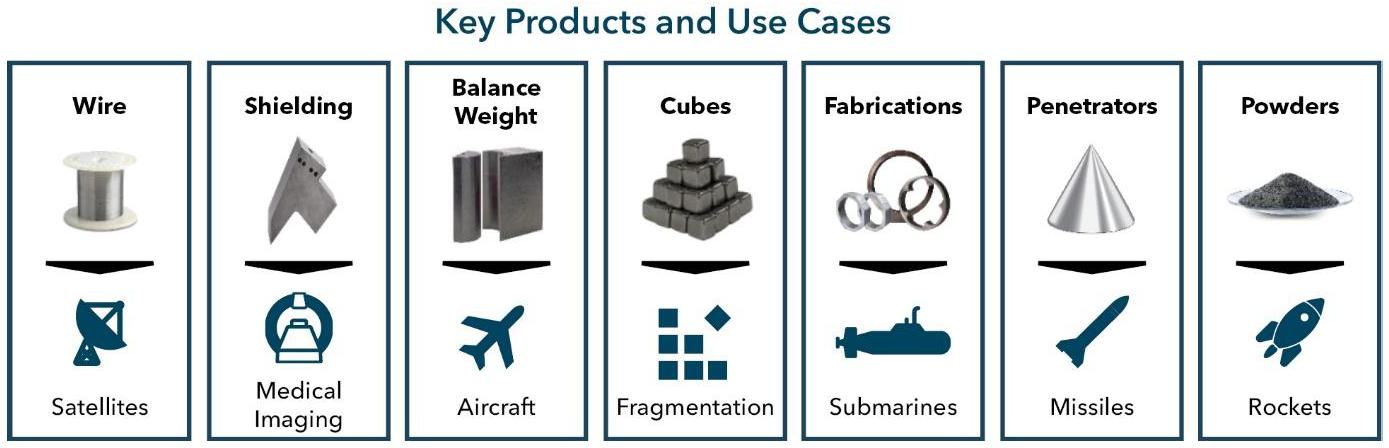
High-Power Microwave
We provide our microwave products in three primary categories:
| ● | Microwave and RF Components. Passive RF and microwave devices, frequencies using sizes mostly from WR90 (0.9 inches wide) to WR2300 (23.0 inches wide), solutions for demanding applications, standard and custom RF components, and waveguide, coaxial and UHV (ultrahigh vacuum) products. |
| ● | High-Power Solutions. Innovative solutions services, advanced research and development for new applications, high-power transmission equipment, components, assemblies and systems. |
| ● | Microwave Systems. 75kW to 200kW generators, single and multi-mode systems, continuous tunnels and batch ovens, solutions for tempering, heating and drying and industrial microwave processing expertise. |
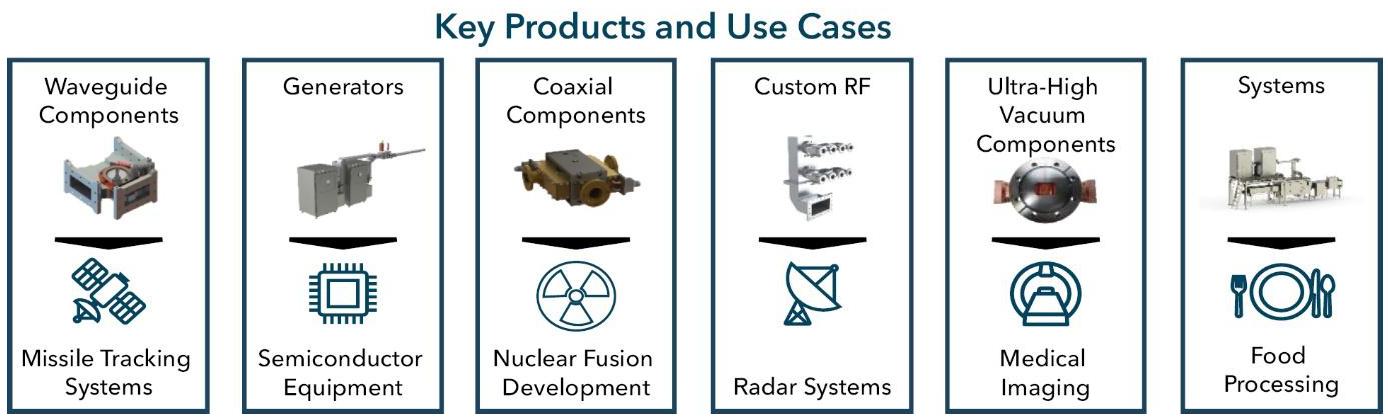
Sources and Availability of Raw Materials
Unlike many other businesses who deal in Critical Materials, we are not dependent on the PRC for our tungsten or molybdenum supplies; however, we are dependent on a limited number of large suppliers of our raw materials to maintain a non-PRC sourced supply (see “Risk Factors — We depend on a limited number of suppliers for our raw materials, and the loss of one or more of these suppliers could disrupt our operations, increase our costs, or otherwise adversely affect our business”). Approximately 85% of the world’s tungsten is currently mined in the PRC, which has recently begun to implement highly restrictive licensing and export controls on its tungsten products. In order to move away from PRC supply, starting in 2015, we began sourcing our tungsten concentrate from Masan Tungsten LLC (“MTC”) in Vietnam.
155
In addition, in 2024, we executed a mutually renewable five-year offtake agreement with EQ Resources Limited, an Australian-based mining company (“EQR”), for tungsten concentrate from its Saloro mine in Barruecopardo, Spain. This agreement provides us with a stable non-PRC-sourced supply of tungsten concentrate to use in our facilities. To further cement this relationship, we hold a very small ownership interest in EQR and have been granted options that are exercisable through November 2026 to purchase an additional interest in EQR that would not represent a material ownership position. If our demand cannot be met by MTC or EQR, we are able to purchase from various North American sources on the spot market. Currently, over 99% of our tungsten needs are sourced outside of the PRC.
Workable tungsten is created through a multistage process which results in blue tungsten oxide (“BTO”). Our tungsten concentrates from both MTC and EQR are processed into BTO at an MTC plant in Vietnam. Some of this BTO then is processed into pure tungsten power, or one of many alloys, at our Lewiston facility, and some is processed at an H.C. Starck plant in Sarina, Canada. We are currently installing a brand-new tungsten furnace in our Coldwater facility which we expect to be complete and begin manufacturing operations in the first quarter of 2027. This will allow us to process most of our BTO into pure tungsten powder in-house, rather than relying on third parties.
The process to convert molybdenum into workable material is similar to tungsten’s process. For our molybdenum needs, we receive a majority of our ammonium dimolybdate (“ADM”) from Freeport-McMoRan Inc.’s Climax mine in Colorado. We then reduce it into pure molybdenum or one of many alloys in our reduction furnaces in Maine and Michigan. The remainder of our ADM needs are supplied from Chile by Molymet, which also produces rhenium. We have long-term contracts with both Climax and Molymet for this supply. The other Critical Materials in our stable of products, including niobium, C-103 and FS85, are sourced with non-PRC partners, including Taniobis, with whom we recently signed a mutual Strategic Agreement.
While the PRC’s imposition of export controls and tariffs on tungsten and molybdenum do not directly affect the materials we buy, any restriction of global supply affects the availability of, and prices we pay for, our raw materials. Artificial shortages occurring from export restrictions or outright prohibitions increase the costs we pay for materials. Although we have an offtake agreement in place to stabilize our tungsten supply, this agreement is tied to global market prices and is affected by higher prices that arise from PRC policies limiting the supply of these refractory metal materials. As a result, continued and additional restrictions through PRC policies could substantially influence our costs. We were not affected by these policies in 2024, but we currently estimate the additional costs resulting from avoiding PRC restrictions and tariffs through direct sourcing will require us to increase borrowing and carrying costs in 2025. See “Risk Factors — Availability of, and volatility in the prices of, raw materials and energy prices and our ability to pass along increased costs to our customers could adversely affect our results of operations” and “Risk Factors — Geopolitical instability due to the ongoing military conflicts between Russia and Ukraine and in the Middle East and the increasingly strained relationship between the United States and the PRC have created a period of economic and capital market uncertainty. Our business, financial condition and results of operations could be materially adversely affected by any negative impact on the global economy and capital markets resulting from the conflicts in Ukraine and the Middle East or any other geopolitical tensions.” for a more detailed discussion of these risks.
Our EMP division uses aluminum, copper, brass, invar and other metals from distributors of various mill products in the United States and Germany, with the majority of mill products purchased from U.S. suppliers. We source ferrite materials primarily from U.S.-based suppliers. Approximately 70% of the magnets we use in our equipment come from PRC sources with the balance coming from European manufacturers. See “Risk Factors — Availability of, and volatility in the prices of, raw materials and energy prices and our ability to pass along increased costs to our customers could adversely affect our results of operations.” The majority of our microwave division’s electronics, which are used in the assembly of microwave systems, are also ordered from various catalog houses and/or manufacturers in the United States.
Customers
We have vast experience in designing, building and executing challenging projects and are known for these skills in the industries in which we operate. With decades of experience in Critical Materials, High-Power Microwave technology and vertical integration to control the manufacturing process, our customers rely on us to help them go from design to final manufacturing of their specific requirements. Our customer base includes diverse industrial users across our key industries ranging from global enterprises to mid-market organizations and government entities. For the year ended December 31, 2025, no one customer accounted more than 10% of our total revenue. See “Risk Factors — We are dependent on a limited number of large customers for current and future sales. The loss of any of these customers or the loss of market share by these customers could materially adversely affect our business, financial condition, results of operations and cash flows.”
156
We have multiple customers in all of the following industries:
| Commercial Aircraft | Nuclear and Nuclear Fuel Processing (Fission) | Metals and Mining | ||
| Commercial Space | Nuclear Fusion and Fusion Research | Food Processing | ||
| Commercial Radar | Hydrogen including Green Hydrogen | Lighting/LED applications | ||
| Defense Aircraft | Carbon Capture | Furnace shielding | ||
| Defense Space | Oil, Gas and Coal | Industrial Plasma — Diamonds, etc. | ||
| Defense Radar and Electronics | Semiconductor Capital Equipment OEM’s | Industrial Drying (Medical, Building Components) | ||
| Defense Rockets and Missiles | Non-DoW studs, heat sinks, battery parts, power semi | Private research and development supporting DoW and US and European energy projects | ||
| Defense Warheads and Munitions | Sputtering Targets | Universities | ||
| Defense Ships/Subs | Glass production | International Research Labs | ||
| Department of Energy Government Labs | Chemicals |
We supply components to a broad variety of defense contractors, national laboratories and semiconductor and medical equipment manufacturers, and our components are found in over 100 DoW defense projects, including the PAC-3, Trident II (D-5), Patriot, Aegis, Javelin and Hellfire missile systems, as well as over 95 government sponsored energy research facilities and national lab programs such as Fermi, Los Alamos and Oak Ridge National Laboratory.
Sales and Marketing
We primarily employ a direct sales model to sell into and expand within our customers’ organizations. Our 25-person sales force has extensive experience, industry knowledge and expertise in our target markets. Our Executive Vice President, Corporate Strategy directs our general sales strategy and marketing in coordination with the Chief Sales Officer at our CMC division and the Director of Sales for Components and the Director of Sales for Systems at our EMP division. Because of the highly technical nature of our products, our divisions employ engineers to work with or as a sales contact for our customers. For both our CMC and EMP division, the sales teams are divided into market segments, with each covering specific product or end markets. Our sales and marketing organization engages with prospective customers across multiple in-person virtual channels and engages with them using trade conferences, application guides, whitepapers, presentations and online content to familiarize them with our products and capabilities. Our marketing department is centralized at the parent level and develops all marketing materials for our operations, including all website development and optimization, ad placement and strategic direction. This provides consistency in messaging and thematic presentation.
Research and Development
We conduct research and development primarily for Defense, Medical, Semiconductor and Energy, and weather and surveillance applications. Our 28-person research team is comprised of engineers and metallurgists, including three individuals holding PhDs, and we consider our research team to be among our greatest strengths. Research and development efforts are generally focused on specific customer challenges but also include research and development of new products based on market analysis and customer demand. In 2025, we devoted approximately 1.7% of revenue to research and development. Each of our facilities has a research and development team that works closely with sales, process engineering and operations to support product development that matches the site’s core competencies. Although products span multiple sites requiring close collaboration between the site teams, our research and development team regularly reviews the projects, together with sales and marketing personnel, to verify that they align with our strategy and priorities.
157
Critical Materials and Manufacturing Technologies
We have eight engineers and metallurgists dedicated to pursuing the development of metal processing methods to achieve the appropriate mechanical properties necessary for each particular Critical Materials application. For our defense-related customers, we focus on research and development of tungsten, tantalum and molybdenum alloys for existing and new missile, satellite, ordinance and gun systems. In the Semiconductor market, we have developed processing methods resulting in ultra-pure molybdenum and tungsten materials with purity in excess of 99.999%. These advances support the continued size reduction of integrated circuit devices. For example, advanced chip foundries are increasing their use of molybdenum in their production because molybdenum can be deposited without a chemical barrier layer that takes up valuable space and because molybdenum has lower resistivity compared to copper or tungsten at the small sizes required for semiconductor production. For medical applications, we are developing improvements in the properties and microstructure of fine tungsten wire products used in the rapidly growing field of surgical robots.
Our research and development strategy is centered on both continuous product advancement and future commercial adoption. Examples of current research projects with long-term implications include:
| Industry/Type of Product | Research & Development Focus | ||
| Additive Manufacturing/3D printing | ● | Molybdenum-, tungsten- and rhenium-based powders | |
| ● | Tantalum and niobium-based parts | ||
| Defense and Munitions | ● | Tungsten heavy alloy cubes and spheres for fragmentation warheads and commercial ammunition | |
| ● | Saboted Light Armor Penetrator (SLAP) penetrators | ||
| Semiconductors | ● | 99.995% pure molybdenum sputtering targets | |
| ● | Pure tungsten tooling for quartz processing | ||
High-Power Microwave
Our EMP division has a 24-person engineering staff focused on continuing improvement of waveguide transmission lines and passive RF components across a wide frequency range and product portfolio, high-power magnetron generators and applicators as well as medium power RF components. Leveraging our robust engineering team, we work to expand our combined product line as well as to find niche products or customer requirements which present market opportunities. Our recent developments include: (i) using generator control systems and monitoring components for intelligent passive components; (ii) designing passive components to complement and extend generator system performance and capability; and (iii) utilizing thermal analysis tools to extend the power range of historic product lines.
Intellectual Property
Our Intellectual Property (“IP”), including patents, copyrights, trademarks, and trade secrets, is important to our business, and we actively seek opportunities to leverage our IP portfolio to promote our business interests. Our expertise and decades of engineering experience provide the competitive edge we rely upon to execute our business plan. Accordingly, we maintain stringent controls over our trade secrets and view these trade secrets as the critical component of what enables us to perform in each segment in which we operate. We also actively seek to monitor and protect our global IP rights and deter unauthorized use of our IP and other assets. Protecting IP rights can be complex because of the absence of consistent international standards and laws.
158
We believe we have a rigorous patent review process and pursue and maintain patents in the United States and other countries where we believe pursuing and maintaining patent protection is in our best commercial interests. The laws of some foreign countries do not protect IP rights to the same extent as U.S. laws. Currently, we are pursuing patent applications for 3D printing (additive manufacturing) of Critical Materials and for High-Power Microwave technology applications. Because of our rapid innovation and product development and the comparatively slow pace of patenting processes, our products could be obsolete before the related patents expire or are granted. However, we believe the duration and scope of those patents we do file are sufficient to support our business. As a whole, we do not believe our business is not dependent on any one particular patent or IP right. We currently hold issued patents in six patent families comprised of approximately 20 patents relating to additive manufacturing. While we do not believe our patents are currently material to our business, we believe our patents related to additive manufacturing may hold potential future value due to the potential reductions in cost and increased productivity that could result from additive manufacturing processes. We also have two pending patent applications for High-Power Microwave technology applications which we also believe are promising. Most recently, in September 2025, Elmet Tech was awarded U.S. Patent No. 12,359,290 for Tungsten Heavy Alloy Powders for additive manufacturing. This technology addresses challenges in producing highly pure, flowable powders that retain their shape and properties under extreme processing conditions. Key features include tailored alloy compositions, improved powder morphology and superior densification.
We periodically register federal trademarks, service marks and trade names which distinguish our product brand names in the market. We also monitor these marks for their proper and intended use. In addition to our patent portfolio, we have procedures in place to protect the trade secret processes and formulas we have developed to produce our specialty products.
We rely on non-disclosure and confidentiality agreements to protect our confidential and proprietary information, including business strategies, unpatented inventions, trade secrets, designs, and process technology. We closely monitor our confidential and proprietary information and make it available only to those employees whose responsibilities require access to the data.
Rights in trademarks, service marks and trade names do not have expiration dates. Of those rights, we have four federal trademarks registered at the U.S. Patent and Trademark Office. The registrations have technical expiration dates, but each is renewable indefinitely.
Our Technology
Our products require the application of sophisticated technological techniques in metallurgy, electronics, RF engineering and mechanical engineering. Critical Materials use technologies including powder metallurgy, powder production, consolidation such as compaction, sintering, 3D printing and arc melting. We also apply and test various thermomechanical processing methods including extrusion, forging, swaging, rolling and wire drawing to develop new products and manufacturing process improvements. Iterative and careful control of these processes results in material which meet the very specific chemical, mechanical and physical properties required by the end customer application. We use computational modeling and design software to aid in the efficient application of the downstream fabrication technologies we employ to produce the final product.
In the design of our High-Power Microwave components and products, we use the latest RF, thermal, stress and magnetic simulation tools to effectively develop robust designs for new or emerging technologies. We develop proprietary methods and equipment to maintain our status as the sole supplier of microwave components for defense contractors and national laboratories for certain projects or a premier supplier for certain custom or high reliability microwave components and assemblies, including certain precision waveguide, flexible waveguide, high vacuum applications and high-power RF and microwave products.
Competition
The market for our products is highly fragmented, with a very small number of scaled competitors. As a result, we have very few direct competitors which provide the breadth of products, solutions and expertise we are able to offer our customers. However, given the market fragmentation, we face competition from different competitors across individual products and applications. Competition within our product offerings ranges from divisions of large public corporations to small, privately held companies with singular capabilities that lack infrastructure and capacity to scale. In each of the industries in which we compete, our competitive position is defined by our capabilities, strategic focus on high-value applications and our status as a U.S.-based, vertically integrated manufacturer.
Critical Materials
Our primary non-PRC competitor for Critical Materials is Plansee SE (“Plansee”), a large, global corporation headquartered in Austria. Plansee is a strong competitor due to its scale and international presence. Plansee operates a large U.S. tungsten powder facility and a fabrication facility and imports most of its pure tungsten and pure molybdenum mill products from Austria. We believe key distinctions between us and Plansee are our engineering expertise and our U.S. ownership. As re-shoring accelerates, our engineering expertise and ability to create highly engineered solutions in the United States makes us a preferred vendor on DoW projects, due to our vertical integration and because we are U.S.-owned. The recent focus on rebuilding the manufacturing infrastructure in the United States also allows us to take advantage of direct government funding for both development and installation of state-of-the-art manufacturing capacity.
159
The other competition we face is from a collection of small resellers of low-cost PRC materials and parts. These sources are facing recent geopolitical shifts and government regulations. The NDAA has banned the purchase of tungsten from the PRC, Russia, North Korea, and Iran for all DoW applications. In December 2025, through the enactment of the National Defense Authorization Act for Fiscal Year 2026 (“FY26 NDAA”), Congress expanded the statutory prohibition on procuring strategic materials from “covered nations.” This amendment adds molybdenum to the existing list of restricted materials, which already includes tungsten, tantalum and certain rare earth magnets, that the DoW is barred from sourcing from the PRC, Russia, North Korea and Iran. This designation underscores the critical nature of molybdenum in national security applications and reinforces the requirement for defense contractors to validate “conflict free,” allied supply chains for this material. These regulatory changes, combined with tariffs and the PRC’s recent export controls on these materials, have dramatically limited the ability of many competitors to source tungsten and molybdenum from the PRC, leaving a gap in the U.S. market for a reliable, domestic supplier of tungsten and molybdenum products and manufacturing capabilities. For example, since January 2025, tungsten and molybdenum sourced from the PRC and the European Union have been subject to varying tariff rates, including cumulative rates as high as approximately 51.5% and 16.5%, respectively. While the recent U.S. Supreme Court opinion regarding certain tariffs imposed under the International Emergency Economic Powers Act may have the effect of reducing tariff rates, we believe this dynamic presents a strong, long-term competitive advantage, given our existing tungsten and molybdenum sourcing relationships and U.S.-based manufacturing capabilities.
We face very limited competition in rolling, forging, and extruding metals like niobium and beryllium. Our 5,500-ton extrusion press is a significant asset in the United States, with few comparable private-sector alternatives. Special Metals Corporation, a division of Precision Castparts Corporation, has a similar press, but it is primarily used for the internal production of its own products.
High-Power Microwave
The High-Power Microwave market is highly specialized and fragmented. Competition varies by specific product, but our competitive advantage lies in offering comprehensive solutions. There is no single large entity that dominates the High-Power Microwave segment. Rather, we face a few specialized competitors for each product category:
| Product Type | Competitor | |||
| ● | Circulators, loads, and isolators | ● | AFT GmbH | |
| ● | Waveguide and rotary joints | ● | Spinner GmbH | |
| ● | DoD radar sector | ● | Microtech, Inc. and Space Machine & Engineering Corp. | |
| ● | Large microwave broadcast coax | ● | Dielectric LLC | |
| ● | Tuners | ● | S-Team s r. o. (Slovakia) | |
| ● | 915MHz linear power supply generators | ● | Amtek, Inc. (United States) and Sairem- France | |
While these competitors may offer a single product line, few, if any, offer the complete suite of components, systems, and engineering consulting services that we do. In addition, our focus on larger waveguide sizes (above WR90) differentiates us from a crowded field of competitors focused on smaller, lower-power components. This product breadth and technical expertise, enable us to be able to serve as a sole-source partner for customers with complex development challenges, from concept to full system implementation, and we believe this integrated approach creates a significant barrier to entry and fosters deep, long-term customer relationships.
Government Grants
We have been successful in obtaining approximately $46.1 million in U.S. government support over the last six calendar years to enhance our Critical Materials capital infrastructure with the goal of returning Critical Materials production to the United States. Over the last six years, we have secured government-backed grants from a number of DoW-related programs, including Industrial Base Analysis and Sustainment, U.S. Army Manufacturing and Technology, the Defense Logistics Agency Small Business Innovation Programs and the Department of the Navy Supplier Development Fund. Since 2019, the grants we received from U.S. government programs have supported expenditures in the following areas:
| ● | The development of new manufacturing processes for tungsten and tungsten alloy components in support of DoW products. These relate to a six-ton press line, furnace upgrade and powder blender. |
| ● | The purchase of equipment for a large swager, medium swager, precision lathe, optical inspection, infrastructure upgrades and proposed automation to support two programs for armor penetrating rods and rocket nozzles. |
| ● | The expansion of fragmentation capacity and capability by adding two presses of up to ten tons; the expansion of pressing capability and capacity through the addition of a larger press (less than 20 tons) to expand shapes and sizes and associated tooling; and the development of automation of material handling and post pressing. |
160
| ● | The development of alloys, hiring of dedicated resources, procurement of assets, material and production of low volume products, specifically powder and spherical fragments to expand production and capacity for tungsten fragments, complete a performance matrix to evaluate material compositions and technical characteristics, and research and document increased performance of tungsten carbide with the integration of nano-sized particles. |
| ● | The development of tungsten supply chain resiliency and surge capacity by mitigating high risk processes and focusing on preparedness to meet the demands of material requirements for products used in hypersonic munition applications. |
| ● | The development of competitive, high-volume munition production lines and internalization of a heat treatment process. |
| ● | The development of extrusion techniques and capacity to expand the Navy’s supply chain around Inconel® and Monel®. |
Government Regulation
U.S. Government Contracts
Because the U.S. government is the largest end user of some of our customers’ products and services, representing a substantial majority of our total defense sales, we are exposed to many of the same regulatory schemes as our customers. U.S. government contracts are subject to termination by the U.S. government, either for convenience or for default in the event of our customer’s failure to perform under the applicable contract. In the case of a termination for convenience, we would normally be entitled to reimbursement for our allowable costs incurred, termination costs and a reasonable profit. If terminated by the U.S. government as a result of our customer’s default, we could be liable for payments made to us for undelivered goods or services, additional costs the government incurs in acquiring undelivered goods or services from another source, and any other damages it suffers. Due to flow-down requirements in the contracts of our customers we are often subject to the FAR, which sets forth policies, procedures, and requirements for the acquisition of goods and services by the U.S. government. Department-specific regulations which implement or supplement FAR requirements, such as the DoW’s Defense Federal Acquisition Regulation Supplement, and other applicable laws and regulations may also be applicable to our businesses. These regulations impose a broad range of requirements, many of which are unique to government contracting, including various procurement, import and export, security, contract pricing and cost, contract termination and adjustment, audit and product integrity requirements. A contractor’s failure to comply with these regulations and requirements could result in reductions to the value of contracts, contract modifications or termination, cash withholds on contract payments, forfeiture of profits, and/or the assessment of civil or criminal penalties and fines, and could lead to suspension or debarment, for cause, from U.S. government contracting or subcontracting for a period of time. See “Risk Factors — A portion of our revenue is derived from the sale of defense-related products through various contracts and subcontracts and are subject to risks related to the U.S. government. These contracts may be suspended, canceled or delayed, which could have an adverse impact on our revenues” for a further discussion of potential risks arising from government contracting.
Global Trade Regulation
We must comply with various laws and regulations relating to the export and import of products, services and technology from and into the United States and other countries having jurisdiction over our operations. In the United States, these laws and regulations include, among others, the EAR administered by the Commerce Department, ITAR and the AECA provisions administered by the State Department, embargoes and sanctions regulations administered by the U.S. Department of the Treasury, and import regulations administered by the U.S. Department of Homeland Security and the U.S. Department of Justice. Certain of our products, services, and technologies have military or strategic applications and are on the U.S. Munitions List of the ITAR, the Commerce Control List of the EAR, or are otherwise subject to the EAR and/or the U.S. Munitions Import List, and we are required to obtain licenses and authorizations from the appropriate U.S. government agencies before exporting these products out of the United States or importing these products into the U.S. Foreign policy of the United States or other licensing jurisdictions may affect the licensing process or otherwise prevent us from engaging in business dealings with certain individuals, entities, or countries. Any failure by us, our customers, or our suppliers to comply with these laws and regulations could result in civil or criminal penalties, fines, seizure of our products, adverse publicity, restrictions on our ability to engage in export or import transactions, or the suspension or debarment from doing business with the U.S. government. See “Risks Factors — We are subject to significant government regulation for U.S.-controlled goods and technologies, which may cause us to incur significant expenses to comply with new or more stringent governmental regulation and may subject us to regulatory actions, which may adversely impact our business, financial condition or results of operations” for a further discussion of potential risks arising from trade regulations.
Environmental Regulations
Our operations and facilities are subject to an extensive regulatory framework of federal, state, local and foreign environmental laws and regulations governing, among other things, discharges of pollutants into the air and water, the generation, handling, storage and disposal of hazardous materials and wastes and the investigation and remediation of certain materials, substances, and wastes. We are committed to monitoring our business’ environmental performance, and to ensuring the health and safety of our employees, and, as such, we continually make efforts to ensure our operations are in substantial compliance with all applicable environmental laws and regulations. Environmental laws and regulations may require us to investigate and remediate the effects of the release or disposal of materials at sites associated with past and present operations.
161
In conjunction with our acquisition of entities related to H.C. Starck Solutions in 2023 (See “— Corporate Structure and History”), which included manufacturing facilities in Coldwater, Michigan and Euclid, Ohio, we obtained environmental insurance to cover these properties for a period of ten years expiring in 2033, although we have not identified specific environmental hazards. At our Lewiston, Maine facility, certain historical environmental issues, primarily consisting of petroleum product releases, mercury and other hazardous substances resulting from 90 years of lighting production, were identified when we purchased the facility in 2015 (See “— Corporate Structure and History”). We understand many of the historical environmental issues were remediated prior to our purchase of the property. As part of our acquisition of the Lewiston facility, we became the beneficiary of certain agreements with Philips Lighting Company (n/k/a Signify North America Corp.) (“Philips”), the former owner of the site, providing that all environmental matters related to the Lewiston facility prior to our purchase are the responsibility of Philips. In conjunction with the 2022 Sale-Leaseback Transaction for the Lewiston facility (See “— Corporate Structure and History”), we also obtained environmental insurance for a ten-year period expiring in 2032. Based upon consideration of currently available information, we believe liabilities for environmental matters will not have a material adverse impact on our consolidated financial statements, but we cannot assure material environmental liabilities may not arise in the future. For further information on environmental-related risks, including climate change, see “Risk Factors — Any failure to comply with applicable environmental laws could result in significant liabilities or harm our reputation.” and “Risk Factors — Changes in the regulatory environment, including environmental, health and safety regulations, could subject us to increased compliance and manufacturing costs, which could have a material adverse effect on our business.”
Foreign Regulations
Through the operations of our EMP division in Germany, we may be subject to a range of German and European Union laws. These laws include, but are not limited to, laws governing labor relations (such as the Collective Bargaining Act), chemicals and substances compliance (including compliance with the REACH Regulation (EC No. 1907/2006)), waste management, packaging and circular economy principles (such as the German Packaging Act and German Circular Economy Act), product safety and technical compliance (including E.U. directives and the Product Safety Act), environmental permits and emissions controls (including the German Federal Immission Control Act (BlmSchG)), and energy efficiency standards (including the Energy Labelling Act). Because of our EMP facility’s presence in Germany, it must comply with these legal frameworks, as applicable. However, given the relatively limited size of our German operations, we do not believe our German operations being subject to these bodies of law, or incurring any costs associated with compliance with these laws, has a material impact on our Company.
Facilities
We maintain seven locations consisting of a total of eight facilities, seven of which are primarily manufacturing, warehousing or processing facilities and one is dedicated to executive and management office space. Between all of our locations, we have over 600,000 square feet dedicated to engineering, design, testing and manufacturing. Seven of our facilities are in the United States and one is in Hamburg, Germany.
Each of our manufacturing facilities supports “Centers of Excellence” described below for differing products and services we provide to our customers. We believe our existing facilities are sufficient to meet our operational needs for the foreseeable future. The table below provides additional information about our properties as of the date of this prospectus.
| Location | Size | Own/Lease | Business Focus | |||
| Coldwater, Michigan | 200,000 square feet (two main buildings) | Own | Critical Materials | |||
| Euclid, Ohio | 110,000 square feet | Own | Critical Materials | |||
| Lewiston, Maine | 210,000 square feet | Lease, expires February 28, 2037 | Critical Materials | |||
| Gorham, Maine | 60,000 square feet (two main buildings) | Leases, expire May 31, 2029 and November 30, 2030 | High-Power Microwave | |||
| Nashua, New Hampshire | 25,000 square feet | Lease, expires July 31, 2029 | High-Power Microwave | |||
| Hamburg, Germany | 6,000 square feet | Lease, can terminate with 6 months’ notice starting November 30, 2026 | High-Power Microwave | |||
| Portland, Maine | 9,947 square feet | Lease, expires June 30, 2036, with 2 successive 5 year extension options | Corporate, Executive and Administrative offices |
162
Critical Materials Components
Our CMC division conducts its operations at three facilities, with a total footprint over 500,000 square feet, spread across Coldwater, Michigan, Euclid, Ohio and Lewiston, Maine. Each operation is structured as a “Center of Excellence” model for process optimization with effective redundancy, and certain of our facilities have been certified to have special testing capabilities for critical U.S. defense programs. In our Centers of Excellence, we believe we have assembled subject matter experts in each of our manufacturing categories to drive improvement, promote best practices and innovation and concentrate production where it has the greatest impact. We have also structured the Centers of Excellence to allow for redundancies in most processes across the different sites. These redundancies provide surge capacity, and we believe we have factored in sufficient flexibility in the manufacturing capability of each plant so they can absorb additional demand when necessary without immediately incurring substantial additional capital investment.
Coldwater, Michigan — Powder, Forging, and Extrusion
We own our Coldwater facility of approximately 200,000 square feet, consisting of two main buildings and several outbuildings subject to a mortgage from Great Falls Property, LLC. See “Management’s Discussion and Analysis of Financial Condition and Results of Operations — Indebtedness.” This mortgage was satisfied with the proceeds of our initial public offering. Coldwater possesses important domestic production capabilities including a 5,500-ton extrusion press and an 800-ton rotary forge, which have the capability to produce and toll products as great as twenty-two (22) inches in diameter and reduce to a nominal two (2) inch diameter. The Coldwater location also has molybdenum powder reduction furnaces and a significant range of capability in sintering across pusher, batch, and induction furnaces. This makes the site the Center of Excellence for powder production as well as forged and extruded products, including the machining needed for these larger sizes. A recent investment in a modern tungsten reduction furnace is expected to be installed in Coldwater in the third quarter of 2026. As a result, we expect the predominant supply of our foundational materials for the portfolio will be supplied from this location in the future.
Euclid, Ohio — Rolling and Tungsten Heavy Alloy
We own our Euclid facility of approximately 110,000 square feet consisting of one main building and two outbuildings, subject to a mortgage from Great Falls Property, LLC. See “Management’s Discussion and Analysis of Financial Condition and Results of Operations — Indebtedness.” This mortgage was satisfied with the proceeds of our initial public offering. The Euclid facility is designed around plate, sheet and foil rolling. With six operating rolling mills, Euclid can produce a range of rolled mill products from three inches to one thousandth of an inch. Within this location, there is chemical post processing, laser and waterjet cutting, machining and fabrication. Euclid also specializes in near net shape metallurgical powder pressing. Working with a number of alloy compositions, material can be pressed and sintered to meet a wide range of material geometry and properties. Euclid also has a small machine shop to produce finished products such as balance weights for aircraft.
Lewiston, Maine — Full-Process Manufacturing — Wire and Machining
We lease our Lewiston facility of approximately 210,000 square feet consisting of one main building. The Lewiston location has the capability to fully produce molybdenum, tungsten, and related alloys from powder to finished products. With powder reduction furnaces, isostatic presses, sintering furnaces, swagers, drawing equipment, rolling mills, several custom assets, and a machine shop with a wide range of capabilities, the location can manufacture and sell product forms of between the nominal range of two inches down to wire of seven ten-thousandths (0.0007) of an inch.
163
Engineered Microwave Products
Our EMP division has locations in Gorham, Maine, Nashua, New Hampshire and Hamburg, Germany, with experience producing High-Power Microwave components, industrial microwave systems and RF solutions. With more than 35 years in the industry, our EMP division continues to evolve, pushing the boundaries of science through continuous engineering and product development, with a special focus in advancing microwave technology through research and development. Our EMP team is quality-driven, and customer-centric, which creates a dedicated partnership, and an ongoing resource for future microwave and RF projects. Using its three locations, some of which are certified for special testing capabilities for critical U.S. defense programs, our EMP division leverages redundant capacity across its sites with opportunity to expand to meet growing market demand. This segment also has a multi-year capitalization plan to invest in modern equipment and industrial automation, which will complement the talented workforce and expand its capacity. For example, the current plan includes capital purchases targeted to growth, such as the installation of a larger or second paint cure oven, a pulse generator and signal source, updated metrology instrumentation and a waveguide cutting saw.
Gorham, Maine — Component Manufacturing
We lease our Gorham, Maine campus of approximately 60,000 square feet consisting of two main buildings. One building is approximately 40,000 square feet of engineering office space, manufacturing, assembly and electrical testing. This building also houses a three-stage clean room for ultrahigh vacuum (“UHV”) assembly and packaging. We also lease the approximately 20,000 square foot building directly across the street to house our sales offices, painting, final inspection, crating and shipping operations. Also located in this building is another clean room with a vacuum brazing oven for larger UHV items and a “skunkworks” for new product development, research and development and ongoing training. In Gorham, the focus is the designing and manufacturing of microwave components, which includes but is not limited to calibration kits, circulators, couplers, filters, semi-flexible waveguide, loads, phase shifters, power combiners, rotary joints, rigid waveguide, proprietary seals, switches, tuners and windows. The manufacturing area of our Gorham facility consists of material storage, cutting/material preparation, machining, welding, soldering, brazing, riveting, punching, stamping, chemical coating, painting and testing. This enables the component side of the business to operate with strong vertical integration, including products for the systems operations in Nashua, New Hampshire. The Gorham locations operate five days per week with a first shift and a limited second shift four days a week. Under normal conditions, the business generally operates between 50% to 60% of total capacity, leaving sufficient capacity available for short-term increases in demand and the ability to increase the workforce to respond to future demand.
Nashua, New Hampshire — Systems Division
Our EMP division leases its Nashua, New Hampshire facility of approximately 25,000 square feet located on land owned by the Nashua Airport Authority. Nashua is the “Systems Division” of Microwave Techniques and, with the support of components from Gorham, has the internal capability to produce batch ovens, continuous tunnel ovens, boost heating systems, moisture removal dryers and standalone generator power sources. Nashua also offers spare parts and service programs including field service for existing systems.
Hamburg, Germany — European Operations
We lease our approximately 6,000 square foot facility in Hamburg, Germany. We manufacture microwave and RF circulators, isolators, loads, windows and other components for the European, United States and Asian markets at this location.
Human Capital
As of September 1, 2026, we employed approximately 578 employees and nine consultants. Of these employees, 568 were full-time and ten were part-time. As of that date, our workforce included 341 hourly employees and 237 salaried employees. Of our nine consultants, eight work on a part-time basis and are based out of our Coldwater, Michigan and Gorham, Maine facilities.
164
Workforce by Entity and Location
| Entity/Location | Total Employees | Hourly | Salaried | |||||||||
| Portland, ME | 29 | 4 | 25 | |||||||||
| Lewiston, ME | 184 | 102 | 82 | |||||||||
| Coldwater, MI | 129 | 101 | 28 | |||||||||
| Euclid, OH | 105 | 64 | 41 | |||||||||
| Gorham, ME | 86 | 48 | 38 | |||||||||
| Nashua, NH | 31 | 13 | 18 | |||||||||
| Hamburg, Germany | 14 | 9 | 5 | |||||||||
| Total | 578 | 341 | 237 | |||||||||
Roles and Capabilities
Our workforce spans production operators, machining and fabrication specialists, engineers, quality professionals, supply chain staff, environmental, health and safety personnel and administrative and corporate support. Hourly employees primarily perform direct manufacturing and support functions, while salaried employees include engineering, quality, operations leadership, sales, finance and human resource professionals.
Talent Attraction and Retention
We recruit talent from local and regional labor markets near our sites, supported by structured role profiles, assessments and multi-step interviews. We track time-to-fill, offer acceptance, and first-year retention to monitor recruiting effectiveness. We also use employee referrals and targeted outreach for hard-to-fill and leadership roles.
Pay, Benefits, and Incentives
We believe we provide competitive base pay and are implementing consistent pay structures across our businesses. Many roles are performance bonus eligible. Our benefits include medical, dental, vision, life, and disability insurance, paid time off, paid holidays and a 401(k) plan (including Roth) with employer contributions. We benchmark pay and benefits to remain competitive in our geographies. We have adopted the 2026 Plan for equity compensation for senior managers and mid-level managers. In addition, we expect to put in place an employee stock purchase plan allowing employees to purchase stock at a discount. See “Executive Compensation — Employee Benefit Plans” for more information on our 2026 Plan and anticipated employee stock purchase plan.
Learning and Development
We offer on-the-job training, cross-training, and compliance training in safety, quality and regulatory topics. For salaried and supervisory employees, we provide development opportunities in leadership, problem-solving and continuous improvement. As we grow, we plan to expand structured development programs, including front-line leader training and quality systems development.
Compliance with Employment Regulations
We are subject to U.S. federal employment laws and regulations with regard to any federal contracts on which we provide products or services, and we must comply with current applicable federal and state equal opportunity employer directives. We provide training to all employees, and incorporate discipline measures, in an effort to prohibit discrimination and harassment. We make employment decisions based on merit and business needs. We monitor hiring, promotion, and pay practices to support equity and compliance.
165
Employee Relations
We strive for transparent and direct communication with employees across all our locations. Our human resources team strives to apply consistent policies, resolve concerns promptly and partner with site leadership to maintain constructive employee relations. We believe we have good relations with our employees.
Collective Bargaining
Approximately 88 of our employees, in our Lewiston, Maine location, are represented by the Teamsters Union local 340 with a three-year collective bargaining agreement. We recently renegotiated this CBA, which expires on May 15, 2028. After the expiration of our CBA, the agreement remains in effect until terminated by either party by sixty days’ written notice. After termination, the union may authorize either a strike or a lock-out. Labor disputes could lead to a strike, lockout or other work stoppage by the employees covered by the CBA, and could have a material adverse effect on production at one of our facilities and, depending upon the length of such dispute or work stoppage, on our operating results. There can be no assurance that we will succeed in obtaining a new collective bargaining agreement to replace the current CBA when it expires on May 15, 2028. None of our other U.S. facilities are represented by a union or are parties to a collective bargaining agreement. For our hourly workers in our Hamburg, Germany location, we voluntarily abide by the rules and proclamations of the workers’ collective of Northern Germany. See “Risk Factors — We may be subject to work stoppages at our facilities or those of our principal customers and suppliers, which could seriously impact the profitability of our business.” and “Risk Factors — We provide benefits to active employees for our unionized workforce, including defined benefit pension plans, which could cause us to incur unplanned liabilities.”
Legal Proceedings
From time to time, we may be subject to or pursue legal proceedings, investigations and claims incidental to the conduct of our business. We are not a party to, nor are we aware of any legal proceedings, investigations or claims which, in the opinion of our management, are currently likely to have a material adverse effect on our business, financial condition or results of operations.
Seasonality
We do not believe that our sales or operations are seasonal.
Corporate History and Reorganization
We are a Delaware corporation with headquarters in Portland, Maine and founded on September 13, 2024, for the purpose of acquiring, owning and operating Elmet Tech and Microwave Techniques. On January 2, 2026, we completed a Reorganization of our corporate structure, as a result of which we now wholly own our two primary operating subsidiaries, Elmet Tech and Microwave Techniques (see “— Reorganization” below). Our principal executive offices are located at 280 Fore Street, Suite 301, Portland, ME 04101 and our phone number is 207-518-6791.
Anania & Associates
A&A was founded as Anania, Strand & Associates in 1987 and, after Mr. Strand left the company, reorganized in 1994, as A.S.A. II, Inc. A.S.A.II, Inc. was renamed in July 2001 as Anania & Associates. A&A has functioned as a funding and management platform for over 25 years, acquiring, managing and selling over 20 different enterprises. In 2008, A&A founded Anania & Associates Investment Company, LLC to enlarge its reach and raise private capital. A&A led AAI’s investments and has provided contract management services for both Elmet Tech and Microwave Techniques.
Elmet Tech and Subsidiaries
Elmet Technologies LLC was formed under the laws of the State of Maine on January 2, 2015. Elmet Technologies LLC was formed to acquire the assets of Elmet Technologies Inc. We completed the acquisition of the assets pursuant to a Secured Party UCC Article 9 sale, saving two U.S. manufacturing facilities which had been in operation since 1929, and the approximately 200 jobs associated with them, from closure. We later became the majority member of Elmet Tech in 2021. In 2023, the opportunity to acquire one of our largest competitors arose, and on November 23, 2023, we completed an acquisition of the equity interests of H.C. Stark Solutions Coldwater LLC and H.C. Starck Solutions Euclid LLC. These entities were renamed Elmet Coldwater LLC and Elmet Euclid LLC in 2024. As of June 30, 2024, all the operating assets of Elmet Coldwater and Elmet Euclid were transferred to Elmet Tech. Elmet Coldwater and Elmet Euclid now act as real estate holding companies. Poly Labs Solar LLC (now known as Elmet Solar) was acquired from its owners in July 2025 to develop a solar facility to deliver energy to the Lewiston facility. The solar facility was substantially completed in December 2025.
166
Microwave Techniques and Subsidiaries
Mega Industries Limited Liability Company was formed in 2000 to acquire the assets of Mega Industries, Inc. As part of a series of acquisitions, reorganizations and mergers the company was ultimately renamed Microwave Techniques LLC in 2020. In 2014, we acquired Micro Communications, Inc., which expanded our product line into a new line of broadcast switches and eliminated a low-cost competitor. In 2020, Microwave Techniques acquired Ferrite Microwave Technologies, which added significant capacity, expanded our circulator expertise and provided access to maintenance opportunities for all of Ferrite Microwave Technologies’ installed circulator equipment. On April 9, 2020, Mega Industries was renamed Microwave Techniques LLC. In 2021, we acquired the operating assets of Industrial Microwave Systems, which included its name and intellectual property related to microwave processing for liquids and drying of foam. We followed this acquisition with the acquisition of Valvo Bauelemente GmbH in Hamburg, Germany in 2023. The Valvo acquisition expanded our footprint into the European Union and expanded our product line into higher frequencies which we had previously not served. Our latest acquisition was the acquisition of Symphony Microwave Technologies LLC in November 2025, bringing several large customers and high-volume projects, including advanced microwave components for radar security solutions.
Reorganization
Prior to January 2, 2026, Peter V. Anania, our Chief Executive Officer and Chairman, was the President and majority stockholder of A&A, and through his personal holdings and the holdings of A&A, Mr. Anania was the holder of a majority of the voting interests of AAI. Prior to January 2, 2026, AAI was the majority holder of the membership interests of each of Elmet Tech and Microwave Techniques.
On October 1, 2025, A&A distributed its membership interests in Polymer Laboratories and Solutions LLC that it held to its stockholders (see “Management’s Discussion and Analysis of Financial Condition and Results of Operations — Recent Acquisitions and Divestitures — Recent Divestitures” and “Management’s Discussion and Analysis of Financial Condition and Results of Operations — Discontinued Operations” herein).
On January 2, 2026 (the following actions and transactions collectively termed the “Reorganization”):
| ● | AAI distributed the membership interests in Elmet Tech and Microwave Techniques that it held to A&A in redemption of A&A’s interests in AAI, which resulted in A&A becoming the direct, rather than indirect, owner of the Elmet Tech and Microwave Techniques membership interests previously held by AAI, as well as A&A no longer being a member of AAI; |
| ● | We adopted our amended and restated certificate of incorporation, which, among other things, bifurcated our common stock into two classes, Class A Common Stock, and Class B Common Stock, with the Class A Common Stock having one vote per share and the Class B Common Stock having 10,000 votes per share but no economic rights; |
| ● | We issued to Mr. Anania 466 shares of Class B Common Stock for an aggregate consideration of $25,000 (the “Subscription Agreement”); and |
| ● | We directly acquired all of the (i) outstanding membership interests of each of Elmet Tech and Microwave Techniques and (ii) the outstanding stock of A&A in exchange for, in each case, shares of Class A Common Stock pursuant to a Contribution Agreement among the Company, the members of Elmet Tech, the members of Microwave Techniques and the stockholders of A&A and the cancellation of all of A&A’s membership interests in Elmet Tech and Microwave Techniques. |
167
The diagram below depicts the material aspects of our current corporate structure:
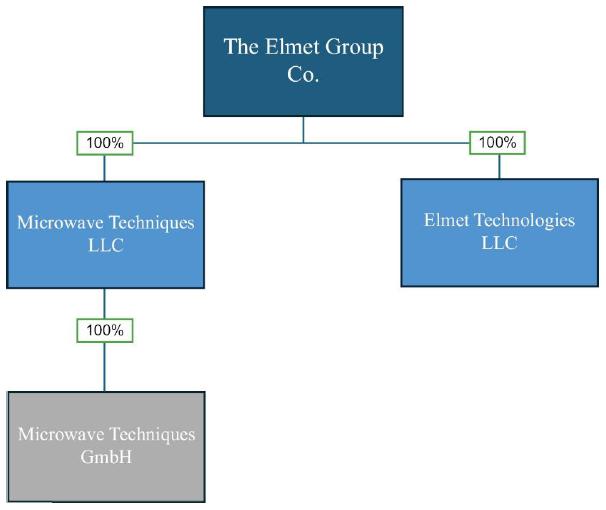
In connection with our initial public offering, we redeemed and canceled all outstanding shares of the Class B Common Stock and filed a second amended and restated certificate of incorporation which, among other things, consolidated and reclassified all Class A Common Stock and Class B Common Stock into a single class of common stock.
168
MANAGEMENT
Number and Terms of Office of Officers and Directors
Our board of directors consists of nine members. In accordance with our second amended and restated certificate of incorporation and amended and restated bylaws, our board of directors is divided into three classes with staggered three-year terms. At each annual meeting of stockholders, the successors to directors whose terms then expire will be elected to serve from the time of election and qualification until the third annual meeting following election. Our directors are divided among the three classes as follows:
| ● | The Class I directors are Peter Woodward, Mark Miklos, and Kathie Leonard, and their terms will expire at the annual meeting of stockholders to be held in 2027; |
| ● | The Class II directors are Brian Deveaux, Kimberly Anania, and Scott Knoll, and their terms will expire at the annual meeting of stockholders to be held in 2028; and |
| ● | The Class III directors are Peter V. Anania, John Chandler, and William Jacob Homiller, and their terms will expire at the annual meeting of stockholders to be held in 2029. |
We expect that any additional directorships resulting from an increase in the number of directors will be distributed among the three classes so that, as nearly as possible, each class will consist of one-third of the directors.
Our second amended and restated certificate of incorporation provides that, for so long as our board of directors is classified, no director may be removed without cause. The division of our board of directors into three classes with staggered three-year terms may delay or prevent a change of our management or a change in control. See “Risk Factors — Provisions in our charter documents and under Delaware law could discourage a takeover that stockholders may consider favorable and may lead to entrenchment of management.”
Our officers are appointed by the board of directors and serve at the discretion of the board of directors, rather than for specific terms of office. Our board of directors is authorized to appoint persons to the offices set forth in our amended and restated bylaws as it deems appropriate.
The information set forth in this section below gives effect to the consummation of the Reorganization.
169
Executive Officers and Directors
The following table sets forth certain information about our executive officers and directors as of the date of this prospectus.
| Name | Age | Position | ||
| Peter V. Anania | 70 | Chief Executive Officer and Chairman | ||
| Michael Steven Lee | 51 | Chief Financial Officer | ||
| Scott W. Knoll | 55 | Executive Vice President, Corporate Strategy and Director | ||
| Christian T. Chandler | 66 | Executive Vice President, General Counsel | ||
| Derek Fox | 46 | President, CMC Division | ||
| James William Detert | 67 | President, EMP Division | ||
| David Carpenter | 59 | Chief Human Resources Officer | ||
| Kimberly Monzeglio Anania | 53 | Director | ||
| John M. Chandler(1) | 65 | Director | ||
| Brian Thomas Deveaux(1) | 58 | Director | ||
| William Jacob Homiller | 56 | Director, President, ERT Division | ||
| Kathie Merrill Leonard(2)(3) | 74 | Director | ||
| Mark Andrew Miklos(2)(3) | 55 | Director and Vice Chairman | ||
| Peter Woodward(1) | 53 | Director |
| (1) | Member of the Audit Committee. |
| (2) | Member of the Compensation Committee. |
| (3) | Member of the Nominating and Corporate Governance Committee. |
Peter V. Anania serves as our Chief Executive Officer and Chairman and has held this position since our incorporation. Prior to the Reorganization, Mr. Anania served as President and majority stockholder of A&A which he founded in 1987, and President of Anania & Associates Investment Company, LLC, a private investment firm focused on privately held manufacturing businesses which he founded in January 2008. A&A provided Elmet, Elmet Tech and Microwave Techniques with management services prior to the Reorganization. In the nearly four decades since Mr. Anania founded A&A, Mr. Anania has been the Chief Executive Officer, President or founder of over 20 various manufacturing companies, many of which involved metals manufacturing and/or microwave concerns. Mr. Anania has additionally served on the board of directors of several companies, most recently including his service on the board of directors of Precision Optics Corporation, Inc. (NASDAQ: POCI) from October 2021 to March 2025 and of Alaris Holdings Ltd (JSE: ALH) from January 2019 to November 2021. Mr. Anania received a Master of Business Administration from the University of Southern Maine and a Bachelor of Science in Business Administration from the University of Maine at Orono. Mr. Anania also currently serves as a Corporator for Bangor Savings Bank. We believe Mr. Anania is qualified to serve as Chief Executive Officer and Chairman of our board of directors due to his deep origins within Elmet and the perspective and experience he brings as our Chief Executive Officer and Chairman.
Michael Steven Lee serves as our Chief Financial Officer. Prior to the Reorganization, Mr. Lee served as the Chief Financial Officer of A&A beginning in March 2025, which provided Elmet, Elmet Tech and Microwave Techniques with management services. Mr. Lee served as Chief Financial Officer at Naprotek, LLC, an electronics technology company, from September 2022 until joining A&A. Mr. Lee also served as Chief Financial Officer at Fiber Materials, Inc., an industrial technology company, from April 2018 to January 2020 and then as Divisional Chief Financial Officer at Fiber Materials, Inc. upon the acquisition of Fiber Materials, Inc. by Spirit AeroSystems, Inc., an aerostructure manufacturing company, from January 2020 to August 2022. Prior to joining Fiber Materials, Inc., Mr. Lee served in financial roles of increasing responsibility at Fairchild Semiconductor International, Inc., a semiconductor manufacturer, including most recently as Senior Director of Finance and Operations of the Standard Product Group, from 1995 to 2015. Mr. Lee received a Bachelor of Science in Accounting from the University of Southern Maine at Portland and an Associate of Science in Electromechanical Technology from Central Maine Technical College.
170
Scott W. Knoll serves as our Executive Vice President, Corporate Strategy and a member of our board of directors. Prior to the Reorganization, Mr. Knoll served as the Executive Vice President, Corporate Strategy and as a stockholder of A&A, which provided Elmet, Elmet Tech and Microwave Techniques with management services, as well as serving as a partner in A&A Investment Company, LLC since May 2014. Prior to joining Elmet, Mr. Knoll served as Director of Corporate Development and International Development at WEX Inc. (NYSE: WEX), a global commerce platform, from June 2010 to May 2014. Mr. Knoll started his career at Affinity Industries in October 1995, which was subsequently acquired by Lydall, Inc., a global manufacturer of specialty filtration and advanced materials solutions, in October 2001. At Lydall, Inc., Mr. Knoll served in positions such as Western Regional Manager, Asia Regional Manager and US Business Development Manager until his departure for North Atlantic Capital, a late stage venture capital firm focused on tech-enabled business service sectors, in June 2004, where he served as a principal until joining WEX Inc. in June 2010. Mr. Knoll received a Bachelor of Science in Management with a concentration in Finance from Purdue University. We believe Mr. Knoll is qualified to serve as a member of our board of directors due to the perspective and experience he brings as our Executive Vice President, Corporate Strategy, as well as his extensive experience in business development.
Christian T. Chandler has served as our Executive Vice President, General Counsel since our founding and served as a member of our board of directors from July 2025 to April 2026. Prior to the Reorganization, Mr. Chandler additionally served as General Counsel and Executive Vice President of Corporate Development of A&A, which provided Elmet, Elmet Tech and Microwave Techniques with management services, since January 2024. Since November 2016, Mr. Chandler has additionally served as the President of Turning Acquisitions LLC (d/b/a Wells Wood Turning & Finishing), an industrial wood turning mill company of which Mr. Chandler is also the co-owner. Mr. Chandler began his career as a judicial law clerk for the Hon. Magistrate Judge David Cohen in the United States District Court for the District of Maine in 1989 before joining Curtis Thaxter Stevens Broder & Micoleau LLC (“Curtis Thaxter”) as an associate in 1990, where he was responsible for corporate and commercial law transactions and litigation. Mr. Chandler became a Member of Curtis Thaxter in 1997 and continued in such capacity until his departure from the firm in 2016. Mr. Chandler received a Bachelor of Arts in History from Kenyon College and a Juris Doctorate from University of Maine School of Law. We believe Mr. Chandler is qualified to serve as a member of our board of directors due to the perspective he brings as our General Counsel and his extensive experience advising businesses from a legal perspective on transactional and litigation matters. Mr. Chandler has informed our board of directors of his intent to retire from his position with our Company at the end of calendar year 2026.
Derek Fox serves as the President of the CMC division, which position he has held since April 2025. Mr. Fox previously served as Elmet Tech’s Chief Financial Officer from November 2015 to March 2025 and as Corporate Controller from May 2011 to August 2012. Mr. Fox additionally held the positions of Finance Director at LabNetwork, a global eCommerce platform for research chemicals and reagents, from January 2015 to November 2015 and Finance Director of Fiber Materials, Inc., an industrial technology company, from August 2012 to January 2015. Mr. Fox also served in various financial roles, including Financial Planning and Analysis Manager for Global Manufacturing and Supply Chain and Supply Chain Controller, at Fairchild Semiconductor from May 2005 until May 2011. Mr. Fox currently serves as the Vice Chair of the board of directors of the Manufacturers Association of Maine. Mr. Fox received a Bachelor of Science from the University of New Hampshire in Business Administration.
James William Detert serves as the President of the EMP division, which position he has held since December 2023. Prior to joining Elmet, Mr. Detert served as Managing Director at mWave Industries LLC, a manufacturer specialized in microwave antenna solutions, from June 2020 to December 2023. Mr. Detert additionally served in several capacities at Molnlycke Health Care (“Molnlycke”), an internationally renowned developer and manufacturer of wound-care and surgical products, from 2010 to 2019, including as Director of U.S. Manufacturing and Business Development Director of the Americas. Mr. Detert also served as President and Chief Executive Officer of Rynel, Inc. (“Rynel”), a developer and manufacturer of specialty foams used in agriculture, personal care and medical care, from 1997 to 2010, when Molnlycke acquired Rynel. Mr. Detert received a Master of Business Administration from Dartmouth College and a Bachelor of Science of Mechanical Engineering and Bachelor of Arts in Psychology from Tufts University.
171
David Carpenter serves as our Chief Human Resources Officer, which position he has held since August 2025. Prior to joining Elmet, Mr. Carpenter served in several progressively senior human resources leadership roles at Securitas Security Services USA, Inc., a global security solutions company, from April 2012 until April 2025, most recently serving as Vice President of Human Resources and Talent Acquisition. In these roles, Mr. Carpenter led enterprise-wide initiatives spanning human resources operations, compensation design, workforce transformation and large-scale systems implementations. Mr. Carpenter received a Master of Arts in Leadership Studies and a Bachelor of Arts in Management from North Central College.
Kimberly Monzeglio Anania has been a member of our board of directors since April 2026. Ms. Anania has served as the Founder, President and Chief Executive Officer of KMA Human Resources Consulting, LLC (“KMA HR Consulting”), a human resource consulting firm, since 2007. Through KMA HR Consulting, Ms. Anania has provided human resources consulting services for us since May 2023. Ms. Anania served as Chair of the board of directors of Make-A-Wish Foundation of Maine, a nonprofit organization, from 2016 to 2022 and as a board member of Friends of Casco Bay, a nonprofit organization, from 2013 to 2017. Ms. Anania has also served on the board of directors of Atlantic Federal Credit Union Foundation since 2023 and on the Development Committee of Ronald McDonald House of Maine since 2022. Ms. Anania received a Bachelor of Arts in American Studies and History from Muhlenberg College. We believe Ms. Anania is qualified to serve as a member of our board of directors due to her experience as an executive, advisor and member of several boards of directors.
John M. Chandler has been a member of our board of directors since April 2026. Mr. Chandler spent his entire career at BerryDunn, an accounting and consulting firm, from January 1987 to June 2022. Mr. Chandler served in financial and executive roles of increasing responsibility over his career at BerryDunn, including the roles of Chief Executive Officer and Managing Principal from July 1999 to June 2021. Mr. Chandler has served as a member of the Fryeburg Academy Board of Trustees since 2012, including roles as Chair of the Investment Committee and member of the Finance Committee. Mr. Chandler has also served as a board member, Treasurer and Chair of the Audit and Risk Committee from June 2021 to December 2023. Mr. Chandler received a Bachelor of Science in Business Management from the University of Southern Maine and was a licensed Certified Public Accountant in the State of Maine. We believe Mr. Chandler is qualified to serve as a member of our board of directors and our audit committee financial expert due to his financial expertise and extensive experience serving as an executive of an established accounting and consulting firm.
Brian Thomas Deveaux has been a member of our board of directors since April 2026. Mr. Deveaux has served as the Chief Executive Officer of Hussey Seating Company, a world-renowned spectator seating manufacturer, since July 2023 and President since July 2022. Mr. Deveaux previously served as Hussey Seating Company’s Chief Financial Officer from January 2017 to June 2023, until his appointment as Chief Executive Officer. Prior to joining Hussey Seating Company, Mr. Deveaux was a partner and co-founder of Leaders LLC, a mergers and acquisitions advisory firm, from June 1996 to January 2017, served as Chief Operating Officer and Chief Financial Officer of Seabrook International, a manufacturer of surgical instruments for Fortune 500 companies from April 1998 to April 2001, and held several management positions in operations at Bath Iron Works Corporation, a subsidiary of General Dynamics Corporation (NYSE: GD) from July 1990 to June 1996. Mr. Deveaux has served on the Executive Committee of the board of directors of the Manufacturers Association of Maine since September 2018 and had previously served on the board of directors of The Susan L. Curtis Foundation from July 2016 to December 2024, the United Way of York County from July 2004 to July 2007, and Literacy Volunteers of Maine from May 2003 to December 2009. Mr. Deveaux received a Bachelor of Arts in Math and Economics from Bowdoin College. We believe Mr. Deveaux is qualified to serve as a member of our board of directors due to his extensive leadership, executive and financial experience.
William Jacob Homiller has been a member of our board of directors since April 2026 and has served as president of our ERT division since November 2026. Mr. Homiller currently serves as the Chief Executive Officer of CarbiCrete Inc. (“CarbiCrete”), a Montreal-based carbon removal technology company, which position he has held since joining the company in February 2024. Prior to joining CarbiCrete, Mr. Homiller served as President and Chief Executive Officer of H.C. Starck from April 2020 through our acquisition of H.C. Starck in late 2023. Mr. Homiller also served in senior global leadership roles with A.W. Chesterton Company as Senior Vice President of Global Business Management and Chief Sales Officer from September 2015 to April 2020, as well as with Cabot Corporation from April 2004 to July 2015. Mr. Homiller received a Master of Business Administration with a concentration in Operations from The Wharton School, a Master of International Studies from The University of Pennsylvania and a Bachelor of Arts in Economics from Tufts University. We believe Mr. Homiller is qualified to serve as a member of our board of directors due to his extensive experience as a C-Suite executive and knowledge and expertise in the manufacturing industry.
172
Kathie Merrill Leonard has been a member of our board of directors since April 2026. Ms. Leonard has served as founder and Chief Executive Officer of Auburn Manufacturing, Inc., a manufacturer of extreme heat- and fire-resistant textile products for industrial and defense-related applications, since 1979. Ms. Leonard has served as a member on several boards, including the Maine Community College System Board of Trustees from 2020 to 2024, the Lewiston/Auburn Economic Growth Council from 2010 to 2017 and the Central Maine Healthcare Board of Directors from 2001 to 2003. Ms. Leonard received an Honorary Doctor of Science in Business Administration from Thomas College, and an Associate of Arts in Technology Writing from St. Petersburg College and studied Business Administration at the University of Maine. We believe Ms. Leonard is qualified to serve as a member of our board of directors due to her great depth of knowledge and experience regarding the manufacturing and defense industries and experience as an executive and company developer.
Mark Andrew Miklos has been a member of our board of directors since April 2026. Mr. Miklos has served as an Executive Partner of Edgewater Capital Partners since July 2025. Prior to joining Edgewater Capital Partners, Mr. Miklos served as Vice President and Senior Vice President at Spirit AeroSystems, Inc., an aerostructure manufacturing company, from January 2020 to November 2024, as Chief Executive Officer of Fiber Materials, Inc., an industrial technology company, from April 2017 to January 2020, and served in roles of increasing responsibility at Morgan Advanced Materials, including Vice President of Sales and Marketing and General Manager, from September 2007 to March 2016. Mr. Miklos received a Bachelor of Science in Sociology from Baldwin Wallace University. We believe Mr. Miklos is qualified to serve as a member of our board of directors due to his robust experience and leadership in the financial and manufacturing industries.
Peter Woodward has been a member of our board of directors since April 2026. Mr. Woodward is the founder of MHW Capital Management, LLC, or MHW, a position he has held since September 2005. MHW specializes in large equity investments in public companies implementing operating strategies to significantly improve their profitability. In addition, Mr. Woodward has served as Chief Executive Officer of Innovative Power, LLC since December 2018 and Chief Executive Officer of MEC @ the Basement LLC since February 2020. Mr. Woodward served as the President, Chief Executive Officer and Director of Cartesian, Inc., a specialist consulting firm focused on the global telecommunications, media, and technology industries, from June 2015 to July 2018, and as the Managing Director for Regan Fund Management, LLC, a hedge fund group specializing in active equity investments in public companies and revitalizing their business plans, from June 1996 to August 2005. Mr. Woodward has served as Chairman of the Board of Directors and Chairman of the Audit Committee of TSS, Inc. (NASDAQ: TSSI) since January 2012, and as Chairman of the Board of Directors and Chairman of the Audit Committee of Precision Optical Corporation, Inc. (NASDAQ: POCI) since July 2014. Mr. Woodward received a Master of International Affairs with a concentration in International Economics and Finance from Columbia University and a Bachelor of Arts in Economics from Colgate University. Mr. Woodward is also a Chartered Financial Analyst. We believe Mr. Woodward is qualified to serve as a member of our board of directors due to his extensive financial and executive experience and prior experience servicing and advising public companies.
Director Independence and Committees of the Board of Directors
Director Independence
Based on information provided by each director concerning the director’s background, employment and affiliations, we have determined that Brian Deveaux, John Chandler, Kathie Leonard, Peter Woodward and Mark Miklos are “independent” directors under the Nasdaq listing standards, while Peter V. Anania, Scott Knoll and Kim Anania are not independent under such standards. Under Rule 5605(a)(2) of the Nasdaq Listing Rules, independent directors must comprise a majority of our board of directors as a public company within one year of listing. We have also determined that each of the three members of the Audit Committee is “independent” for purposes of Section 10A(m)(3) of the Exchange Act and the rules promulgated thereunder and under the Nasdaq listing standards. Further, the board of directors has determined that each of the members of both the Compensation Committee and the Nominating and Corporate Governance Committee is “independent” under the Nasdaq listing standards.
In making our independence determinations, our board of directors considered the current and prior relationships that each non-employee director has with our Company and all other facts and circumstances our board of directors deemed relevant in determining their independence, including the beneficial ownership of our capital stock by each non-employee director, and the transactions involving them described in the section titled “Certain Relationships and Related Party Transactions.”
173
Board of Directors Committees
We have three standing committees of the board of directors: the Audit Committee, Compensation Committee and Nominating and Corporate Governance Committee. Each of the board committees acts pursuant to a separate written charter adopted by our board of directors, each of which will is available on our website at https://www.theelmetgroup.com/. Our board of directors may at any time or from time to time appoint certain other committees in its sole discretion as it deems necessary or appropriate to carry out its functions.
Audit Committee
The Audit Committee consists of John Chandler (Chairman), Brian Deveaux, and Peter Woodward. The board of directors has determined that all of the members of the Audit Committee are “independent,” as defined by the Nasdaq listing standards and by applicable SEC rules. In addition, the board of directors has determined that John Chandler is an audit committee financial expert, as that term is defined by the SEC rules, by virtue of having the following attributes through relevant experience: (i) an understanding of generally accepted accounting principles and financial statements; (ii) the ability to assess the general application of such principles in connection with the accounting for estimates, accruals, and reserves; (iii) experience preparing, auditing, analyzing, or evaluating financial statements that present a breadth and level of complexity of accounting issues that are generally comparable to the breadth and complexity of issues that can reasonably be expected to be raised by the Company’s financial statements, or experience actively supervising one or more persons engaged in such activities; (iv) an understanding of internal controls and procedures for financial reporting; and (v) an understanding of audit committee functions.
Our Audit Committee oversees our corporate accounting and financial reporting process. Among other matters, the audit committee is responsible for:
| ● | appointing, compensating, retaining, evaluating, terminating, and overseeing our independent registered public accounting firm; |
| ● | discussing with our independent registered public accounting firm their independence from management; |
| ● | reviewing with our independent registered public accounting firm the scope and results of their audit; |
| ● | approving all audit and permissible non-audit services to be performed by our independent registered public accounting firm; |
| ● | overseeing the financial reporting process and discussing with management and our independent registered public accounting firm the interim and annual financial statements that we file with the SEC; |
| ● | reviewing and monitoring our accounting principles, accounting policies, financial and accounting controls, and compliance with legal and regulatory requirements; |
| ● | reviewing our policies on risk assessment and risk strategy and management, including risk policies and risk mitigation strategies by management; |
| ● | reviewing related party transactions; and |
| ● | establishing procedures for the confidential anonymous submission of concerns regarding questionable accounting, internal controls, or auditing matters. |
174
Compensation Committee
The Compensation Committee consists of Kathie Leonard (Chairman) and Mark Miklos. The board of directors has determined that each of the members of the Compensation Committee are “independent,” as defined by Nasdaq listing standards. The responsibility of the Compensation Committee is to review and approve the compensation and other terms of employment of our Chief Executive Officer and our other executive officers, including all of the executive officers named in the Summary Compensation Table under the heading “Executive Compensation” below (the “named executive officers”).
Our Compensation Committee oversees the policies relating to compensation and benefits of our officers and employees. Among other matters, the Compensation Committee is responsible for:
| ● | reviewing and approving, or recommending that our board of directors approve, the compensation of our Chief Executive Officer and other executive officers; |
| ● | appointing and overseeing any compensation consultants; |
| ● | reviewing and approving or making recommendations to our board of directors regarding our incentive compensation and equity-based plans; |
| ● | reviewing and making recommendations to our board of directors with respect to director compensation; |
| ● | reviewing and discussing annually with management our “Compensation Discussion and Analysis” disclosure if and to the extent then required by SEC rules; and |
| ● | preparing the compensation committee report if and to the extent then required by SEC rules. |
Nominating and Corporate Governance Committee
The Nominating and Corporate Governance Committee is comprised of Kathie Leonard and Mark Miklos. The committee members are independent under applicable Nasdaq rules and regulations. The Nominating and Corporate Governance Committee is responsible for, among other things:
| ● | identifying individuals qualified to become members of our board of directors, consistent with criteria approved by our board of directors; |
| ● | reviewing and making recommendations to our board of directors with respect to management succession planning; |
| ● | evaluating the overall effectiveness of our board of directors and its committees; and |
| ● | reviewing developments in corporate governance compliance and developing and recommending to our board of directors a set of corporate governance guidelines and principles. |
Compensation Committee Interlocks and Insider Participation
None of our officers currently serves, and in the past year has not served, as a member of the compensation committee of any entity that has one or more officers serving on our board of directors.
Family Relationships
Kimberly Anania, a director, is the sister-in-law of Peter V. Anania, our Chief Executive Officer and Chairman.
175
Code of Business Conduct and Ethics and Insider Trading Policy
Our board of directors has adopted a Code of Business Conduct and Ethics (the “Code of Ethics”) and an Insider Trading Policy. You can review these documents by accessing our public filings at the SEC’s web site at www.sec.gov. The Code of Ethics is also available on our website at https://www.theelmetgroup.com. In addition, a copy of the Code of Ethics will be provided without charge upon request from us. We intend to disclose any amendments to or waivers of certain provisions of our Code of Ethics in a Current Report on Form 8-K or on our website.
Limitation of Directors Liability and Indemnification
The Delaware General Corporation Law authorizes corporations to limit or eliminate, subject to certain conditions, the personal liability of directors to corporations and their stockholders for monetary damages for breach of their fiduciary duties. Our second amended and restated certificate of incorporation limits the liability of our directors to the fullest extent permitted by Delaware law. In addition, we have entered into, or will enter into, indemnification agreements with all of our directors and executive officers whereby we agree to indemnify those directors and officers to the fullest extent permitted by law, including indemnification against expenses and liabilities incurred in legal proceedings to which the director or officer was, or is threatened to be made, a party by reason of the fact that such director or officer is or was a director, officer, employee or agent of ours, provided that such director or officer acted in good faith and in a manner that the director or officer reasonably believed to be in, or not opposed to, our best interests.
We have director and officer liability insurance to cover liabilities our directors and officers may incur in connection with their services to us, including matters arising under the Securities Act. Our second amended and restated certificate of incorporation and amended and restated bylaws provide that we will indemnify our directors and officers who, by reason of the fact that he or she is or was one of our officers or directors of our Company, is involved in any action, suit or proceeding, whether civil, criminal, administrative or investigative related to their board role with us.
There is no pending litigation or proceeding involving any of our directors, officers, employees or agents in which indemnification will be required or permitted. We are not aware of any threatened litigation or proceeding that may result in a claim for such indemnification.
176
EXECUTIVE AND DIRECTOR COMPENSATION
This section discusses the material components of the executive compensation program for our executive officers who are named in the “Summary Compensation Table” below.
In 2025, our Chief Executive Officer and Chairman (who is our principal executive officer) and our two other named executive officers, and their positions were as follows:
| ● | Peter V. Anania, Chief Executive Officer and Chairman; |
| ● | Derek Fox, President of the CMC division; and |
| ● | Michael Steven Lee, Chief Financial Officer of the Company. |
Summary Compensation Table
The following table presents the compensation awarded to or earned by or paid to our named executive officers during the fiscal years ended December 31, 2025 and 2024:
| Name and Principal Position | Year | Salary ($)(1) | Bonus ($) | Stock Awards ($)(2) | Non-Equity Incentive Plan Compensation ($)(3) | Nonqualified Deferred Compensation Earnings ($) | All Other Compensation ($) | Total ($) | ||||||||||||||||||||||||
| Peter V. Anania | 2025 | 250,962 | — | — | — | — | $ | 60,069 | (9) | $ | 311,031 | |||||||||||||||||||||
| Chief Executive Officer and Chairman(4) | 2024 | 251,923 | — | — | — | — | 74,529 | (10) | 326,452 | |||||||||||||||||||||||
| Derek Fox | 2025 | 323,635 | — | 2,298,850 | 177,277 | — | 93,075 | (11) | 2,892,837 | |||||||||||||||||||||||
| President of our CMC Division(5) | 2024 | 284,964 | 788,527 | (7) | — | 185,009 | — | 86,295 | (12) | 1,344,795 | ||||||||||||||||||||||
| Michael Steven Lee(6) | 2025 | 240,000 | 40,000 | (8) | 1,409,975 | 96,000 | — | 5,885 | (13) | 1,791,860 | ||||||||||||||||||||||
| Chief Financial Officer | 2024 | — | — | — | — | — | — | — | ||||||||||||||||||||||||
| (1) | Amounts reflect the base salary actually paid to each named executive officer in the fiscal years ended December 31, 2025 and 2024. |
| (2) | Amounts reported represent the aggregate grant date fair value of restricted stock awards granted to our executive officers during 2025, under either our 2016 Plan or 2025 Plan computed in accordance with Financial Accounting Standards Board Accounting Standards Codification Topic 718, Compensation — Stock Compensation (“ASC Topic 718”), excluding the effect of estimated forfeitures. The assumptions used in calculating the grant date fair value of the restricted stock awards reported in these columns are set forth in the notes to our audited consolidated financial statements included elsewhere in this prospectus. These amounts will not reflect the actual economic value that may be realized by the named executive officers. |
177
| (3) | Amount reflects annual performance-based incentive cash compensation that were earned by each named executive officer based on the Company’s performance during the fiscal years ended December 31, 2025 and December 31, 2024. |
| (4) | Mr. Anania’s compensation received for 2025 and 2024 was in connection with his position as Chief Executive Officer of A&A and Chief Executive Officer of Elmet Tech. |
| (5) | Mr. Fox’s compensation received for 2025 was in connection with his position as President of our CMC division and for 2024 was in connection with his position as Chief Financial Officer of our CMC division (except for the bonus payment referenced in footnote 7 to this table). |
| (6) | Mr. Lee was hired on March 17, 2025 and compensation received for 2025 was in connection with his position as Chief Financial Officer of A&A. |
| (7) | Amount reflects the bonus paid to Mr. Fox in November 2024 for his promotion to President of our CMC division, which became effective as of March 2025. |
| (8) | Mr. Lee received a sign-on bonus in connection with his commencement of employment. |
| (9) | Amount in this column reflects an automobile allowance of $10,200, credit card points converted to cash of $27,508, personal credit card payments of $6,625 and personal expenses of Mr. Anania paid by the Company on his behalf of $15,736. |
| (10) | Amount in this column reflects an automobile allowance of $10,200, credit card points converted to cash of $29,791, personal credit card payments of $13,700 and personal expenses of Mr. Anania paid by the Company on his behalf of $20,838. |
| (11) | Amount reflects matching contributions to the 401(k) Plan (as defined below) of $14,000, board fees of $50,000, an automobile allowance of $10,800, company profit sharing contribution to the 401(k) Plan (as defined below) totaling $17,500, and personal expenses of Mr. Fox paid by the Company on his behalf of $775. |
| (12) | Amount reflects matching contributions to the 401(k) Plan (as defined below) of $11,073, board fees of $50,000, an automobile allowance of $10,800, company profit sharing contribution to the 401(k) Plan (as defined below) totaling $13,841, and personal expenses of Mr. Fox paid by the Company on his behalf of $581. |
| (13) | Amount reflects matching contributions to the A&A 401(k) plan of $5,885. |
Narrative to Summary Compensation Table
2025 Salaries
The named executive officers receive a base salary to compensate them for services rendered to our Company. The base salary payable to each named executive officer is intended to provide a fixed component of compensation reflecting the executive’s skill set, experience, role and responsibilities. The base salaries for Mr. Anania, Mr. Fox and Mr. Lee for 2025 were $250,962, $323,635 and $240,000, respectively.
2025 Bonuses
In March of 2025, Mr. Lee joined the company as CFO of A&A. As part of the hiring, Mr. Lee received a one-time discretionary bonus of $40,000.
2025 Non-Equity Incentive Plan Compensation
For 2025, Mr. Anania, being the primary shareholder of A&A, did not have a structured incentive compensation plan.
For 2025, Mr. Fox’s target bonus was 50% of his annual base salary. Eligibility was based upon the achievement of pre-determined performance goals of Elmet Tech for 2025, including goals related to successfully succeeding Mr. Anania as President of Elmet Tech, as well as financial goals of adjusted EBITDA and cash flow. Under the 2025 bonus program, participants were eligible to receive up to 170% of the participant’s target bonus opportunity. Based upon the attainment of applicable performance measures, his 2025 annual bonus was determined to be earned at approximately 110% of target.
For 2025, Mr. Lee’s target bonus was 40% of his annual base salary. Eligibility was based upon the achievement of pre-determined performance goals associated with preparation for our initial public offering, as well as financial goals of adjusted EBITDA. Based upon the attainment of applicable performance measures, his 2025 annual bonus was determined to be earned at approximately 100% of target.
178
2025 All Other Compensation
The named executive officers were eligible for certain other benefits as part of their employment during 2025, including matching 401(k) plan contributions paid by the Company, automobile allowances, payment of certain personal expenses, and profit sharing.
Equity Compensation
Equity Compensation Plans
Prior to the initial public offering, Elmet Tech maintained the 2016 Plan, and Elmet maintained the 2025 Plan, each in order to provide our service providers the opportunity to acquire a proprietary interest in our success. For additional information about the 2016 and 2025 Plans, please see “— Equity Incentive Plans” below. No further awards will be granted under either the 2016 Plan or the 2025 Plan.
We have adopted the 2026 Plan in order to facilitate the grant of cash and equity incentives to directors, employees (including our named executive officers) and consultants of our Company and certain of our affiliates and to enable us to obtain and retain the services of these individuals, which is essential to our long-term success. For additional information about the 2026 Plan, please see “— 2026 Equity Incentive Plan” below.
2025 Equity Grants
The following table sets forth the stock awards granted to our named executive officers in the 2025 fiscal year.
| Named Executive Officer | Type of Award | # Granted | ||||
| Peter V. Anania | N/A | — | ||||
| Derek Fox | Restricted Stock | 328,390 | (1) | |||
| Michael Steven Lee | Restricted Stock | 122,500 | (2) |
| (1) | Mr. Fox was granted 14,546 unvested restricted membership units of Elmet Tech under our 2016 Plan on April 1, 2025, which were subsequently converted to 328,390 unvested shares of restricted stock of the Company upon the Reorganization. All 328,390 shares of restricted stock vested on October 20, 2026. Until vested, the restricted stock may not be sold, assigned, transferred, pledged, hypothecated or otherwise disposed of, is subject to the risk of forfeiture, may not be voted, and shall accrue, but not receive, dividends. |
| (2) | Mr. Lee was granted 98,000 shares of restricted stock under our 2025 Plan on September 1, 2025, and 24,500 shares of restricted stock under our 2025 Plan on October 15, 2025. The 122,500 shares of restricted stock vest according to the following schedule: 73,500 shares vested upon the consummation of our initial public offering, 24,500 shares vest on March 17, 2027, and 24,500 shares vest on March 17, 2028, in each case subject to continued employment. Until vested, the restricted stock may not be sold, assigned, transferred, pledged, hypothecated or otherwise disposed of, is subject to the risk of forfeiture, may not be voted, and shall accrue, but not receive, dividends. |
Other Elements of Compensation
Retirement Plans
We currently maintain two 401(k) retirement savings plans (each, a “401(k) Plan”) for our employees, including our named executive officers, who satisfy certain eligibility requirements. Our named executive officers are eligible to participate in a 401(k) Plan on the same terms as other full-time employees who are eligible for each 401(k) Plan. The Code allows eligible employees to defer a portion of their compensation, within prescribed limits, on a pre-tax basis through contributions to a 401(k) Plan. Currently, one of our 401(k) Plans provides for discretionary matching contributions that vest over five years, and one provides for matching contributions of 100% of the first 3% of a participant’s compensation contributed to the 401(k) Plan and 50% of the next 2% contributed, in addition to discretionary matching contributions, and non-elective profit sharing contributions. We believe that providing a vehicle for tax-deferred retirement savings though our 401(k) Plans adds to the overall desirability of our executive compensation package and further incentivizes our employees, including our named executive officers, in accordance with our compensation policies.
179
Employee Benefits
All of our full-time employees, including our named executive officers, are eligible to participate in our health and welfare plans, including:
| ● | medical, dental and vision benefits; |
| ● | medical and dependent care flexible spending accounts; |
| ● | short-term and long-term disability insurance and accidental death and dismemberment insurance; and |
| ● | life insurance. |
No Tax Gross-Ups
We generally have not made gross-up payments to cover our named executive officers’ personal income taxes that may pertain to any of the compensation paid or provided by our Company.
Outstanding Equity Awards at Fiscal Year-End
The following table summarizes the number of shares of common stock underlying outstanding equity incentive plan awards for each named executive officer as of December 31, 2025. Each equity award listed in the following table was granted under either the 2016 Plan or the 2025 Plan (each as defined below).
| Option Awards | ||||||||||||||||||||
| Name | Grant Date | Number of Securities Underlying Unexercised Options (#) Exercisable | Number of Securities Underlying Unexercised Options (#) Unexercisable | Option Exercise Price ($) | Option Expiration Date | |||||||||||||||
| Peter V. Anania | — | — | — | — | — | |||||||||||||||
| Derek Fox(1) | April 1, 2022 | — | 310,420 | 0.91 | December 31, 2027 | |||||||||||||||
| Michael Steven Lee | — | — | — | — | — | |||||||||||||||
| (1) | As of December 31, 2025, Mr. Fox held 13,750 unit appreciation rights in Elmet Tech granted under the 2016 Plan with a base price of $20.50 per unit because the Reorganization had not yet occurred. All unit appreciation rights held by Mr. Fox were converted into stock appreciation rights (“SARs”) in The Elmet Group Co. with a base price of $0.91 upon the Reorganization. The numbers shown in this table represent what Mr. Fox would have held had the Reorganization happened prior to or on December 31, 2025 and Mr. Fox’s unit appreciation rights had been converted into stock appreciation rights of the Company. Mr. Fox’s stock appreciation award vests upon either (i) an initial public offering of the Company prior to December 31, 2026 or (ii) the sale of the Company for a purchase price in excess of $17,371,560, in each case subject to his continued employment. Mr. Fox’s award vested and settled in cash in connection with the closing of the Company’s initial public offering. |
180
| Stock Awards | ||||||||||||||||
| Name | Number of shares or units of stock that have not vested | Market value of shares or units of stock that have not vested | Equity incentive plan awards: Number of unearned shares, units or other rights that have not vested | Equity incentive plan awards: Market or payout value of unearned shares, units or other rights that have not vested | ||||||||||||
| Peter V. Anania | — | — | — | — | ||||||||||||
| Derek Fox | 328,390 | (1) | 2,298,850 | (3) | — | — | ||||||||||
| Michael Steven Lee | 122,500 | (2) | 1,409,975 | (3) | — | — | ||||||||||
| (1) | Mr. Fox was granted 14,546 unvested restricted membership units of Elmet Tech on April 1, 2025, which were subsequently converted to 328,390 unvested shares of restricted stock of the Company upon the Reorganization. All 328,390 shares of restricted stock vest on October 20, 2026, subject to continued employment. Until vested, the restricted stock may not be sold, assigned, transferred, pledged, hypothecated or otherwise disposed of, is subject to the risk of forfeiture, may not be voted, and shall accrue, but not receive, dividends. |
| (2) | Mr. Lee was granted 98,000 shares of restricted stock on September 1, 2025, and 24,500 shares of restricted stock on October 15, 2025. The 122,500 shares of restricted stock vest according to the following schedule: 73,500 shares vested upon the consummation of our initial public offering, 24,500 shares vest on March 17, 2027, and 24,500 shares vest on March 17, 2028, in each case subject to continued employment. Until vested, the restricted stock may not be sold, assigned, transferred, pledged, hypothecated or otherwise disposed of, is subject to the risk of forfeiture, may not be voted, and shall accrue, but not receive, dividends. |
| (3) | Amounts reported represent the aggregate grant date fair value of restricted stock awards granted to our executive officers during 2025, under either our 2016 Plan or 2025 Plan computed in accordance with ASC Topic 718, excluding the effect of estimated forfeitures. The assumptions used in calculating the grant date fair value of the restricted stock awards reported in these columns are set forth in the notes to our audited consolidated financial statements included elsewhere in this prospectus. These amounts will not reflect the actual economic value that may be realized by the named executive officers. |
Executive Compensation Arrangements
Existing Agreements
Peter V. Anania
As of December 31, 2025, Mr. Anania was not employed pursuant to an employment arrangement.
Derek Fox
As of December 31, 2025, Mr. Fox was not employed pursuant to an employment arrangement.
Michael Steven Lee
Mr. Lee is employed pursuant to an employment arrangement, effective January 13, 2025, with A&A, which became a subsidiary of the Company upon the consummation of the Reorganization (the “Lee Agreement”). Under the terms of the Lee Agreement, Mr. Lee commenced employment as A&A’s Chief Financial Officer on or about March 17, 2025, and the initial term of the Lee Agreement extends for 36 months, with the possibility of renewal for additional 12-month periods upon mutual agreement; otherwise, Mr. Lee’s employment would continue on an at-will basis. In connection with our initial public offering, the Lee Agreement was superseded and replaced by an Employment Letter with the Company, as described below.
Pursuant to the Lee Agreement, A&A pays Mr. Lee: (i) a base salary of $300,000 per annum, effective January 1, 2025, paid according to the company’s normal payroll schedule and subject to annual review by the President, (ii) an employment bonus of $40,000, payable within 30 days of commencement of the Lee Agreement, (iii) an annual bonus of up to 40% of his base salary, contingent on achieving company-set goals, which are not guaranteed, and (iv) a restricted stock grant in the expected amount of approximately 1% of the equity interests in the Company post-conversion, with the shares vesting: one-half on the earlier of an IPO or the third anniversary of employment (if still employed), one-fourth on the second anniversary of Mr. Lee’s employment commencement, and one-fourth on the third anniversary of Mr. Lee’s employment commencement, with full vesting upon a change of control. Mr. Lee is also eligible for additional long-term incentives.
181
If Mr. Lee is terminated without cause, dies, or becomes permanently disabled during the term (each an “Eligible Termination”), Mr. Lee is entitled to receive severance pay which is contingent on a release of claims. Mr. Lee will be entitled to receive six months’ base salary if his Eligible Termination occurs within the first 18 months of the term, or three months’ base salary thereafter, in each case in addition to continued contributions toward the costs of Mr. Lee’s health insurance premiums (as if he were an active employee) and payment of the premiums for life and disability insurance and other benefit programs that were in effect at the time of termination for the duration of the applicable base salary continuation period, and accrued obligations.
The Lee Agreement also includes post-termination, non-competition, non-solicitation, and confidentiality obligations that survive for 24 months post-termination (or indefinitely for confidentiality).
New Arrangements
General Description of New Employment Letters
The following is a general description of the employment letters (the “Employment Letters”) we entered into with certain of our executive officers, including our named executive officers, in connection with our initial public offering.
Mr. Anania will report to our board of directors and Mr. Fox and Mr. Lee will report to Mr. Anania. The Employment Letters specify each executive’s base salary and target bonus. Additionally, the employment letters specify that the executives will be eligible to (A) receive equity compensation awards, (B) participate in the Company’s executive severance policy, (C) participate in the Company’s executive change in control severance policy, and (D) participate in the Company’s employee benefit plans. The Employment Letters also require the executives to reaffirm any restrictive covenants that may be in effect.
Severance Plans
In connection with our initial public offering, we offered certain executive officers the ability to receive severance benefits under our Executive Severance Policy (the “Severance Policy”) or our Executive Change in Control Severance Policy (the “CIC Severance Policy” and together, the “Severance Policies”). The purpose of the Severance Policies is to provide a consistent framework for severance benefits for selected executives of the Company in the event of certain termination scenarios. The Severance Policies are expected to be “top hat plans” under the Employee Retirement Income Security Act of 1974, as amended.
Under the Severance Policies, executives with the title of “Director” and above who are selected by the Board of the Compensation Committee are eligible to participate. All benefits under the Severance Policies are subject to the covered executives’ execution and non-revocation of a release of claims.
Under the Severance Policy, upon a termination without “cause” (as defined in the Severance Policy), covered executives are entitled to the following:
| Benefit Component | CEO | Other Executives | ||
| Cash Severance | 1x Base Salary | 0.5x Base Salary | ||
| Prorated Annual Bonus | Actual performance | |||
| COBRA Continuation | Up to 12 months | Up to 6 months |
| Equity Treatment | Except as otherwise provided under the terms of an award agreement or equity plan: | |||
| ● | All unvested time-based equity awards will be forfeited as of the termination date; and | |||
| ● | Outstanding performance-based awards, including performance stock units, shall vest on a prorated basis and be paid based on actual performance, at the time determined under the applicable award agreement or plan. | |||
182
The cash severance is payable in substantially equal installments over the applicable severance period in accordance with the Company’s regular payroll practices. Prorated bonuses are payable at the same time annual bonuses are otherwise paid to similarly situated executives for the applicable performance year. Additionally, under the Severance Policy, covered executives receive the following benefits upon a termination due to death, disability, and retirement:
| Termination Event | Equity Treatment | |
| Death | Vesting of unvested equity awards as of the date of death, to the extent permitted under the applicable award agreement and equity plan | |
| Disability | Continued vesting of time-based equity awards on the original schedule, to the extent provided under the applicable equity award agreement and equity plan | |
| Retirement | Prorated vesting and payout of performance-based awards at the normal time of payout, based on actual performance, to the extent provided under the applicable award agreement and plan |
Under the CIC Severance Policy, upon a termination without “cause” (as defined in the Severance Policy) or a termination for “good reason” (as defined in the CIC Severance Policy), each within the period beginning on the date a change in control is consummated and ending on the first anniversary of such date, covered executives are entitled to the following:
| Benefit Component | All Covered Executives | |
| Cash Severance (Salary) | 1x Base Salary | |
| Cash Severance (Bonus) | 1x Target Bonus | |
| Prorated Annual Bonus | Prorated annual bonus for the year of termination, based on actual performance | |
| COBRA Continuation | Up to 12 months | |
| Time-Based Equity Awards | Full acceleration | |
| Performance Awards / PSUs | Vest and settle at target performance |
The cash severance is payable in a lump sum on the first administratively practicable date following the effective date of the covered executive’s release of claims, but in all events within 60 days following the termination. The prorated annual bonus is payable at the same time annual bonuses are otherwise paid to similarly situated executives for the applicable performance year.
The CIC Severance Policy also contains “best net” cutback language for purposes of Section 280G of the Code. The Severance Policies are administered by the Compensation Committee, and the Board or the Compensation Committee may amend, modify, suspend, or terminate the Severance Policies at any time. No covered executive is entitled to duplicate severance, bonus, benefits continuation, or equity treatment under the Severance Policies or any other plan or program maintained by the Company.
Director Compensation
During 2025, the directors of The Elmet Group Co. were Peter V. Anania, Scott Knoll and Christian T. Chandler. Mr. Anania’s compensation is set forth in the summary compensation table above, and the compensation paid to Mr. Knoll and Mr. Chandler during 2025 is set forth in the following table.
2025 Director Compensation
| Name(1)(2) | Fees Earned or Paid in Cash ($) | Stock Awards ($)(3) | Non-Equity Incentive Plan Compensation ($) | All Other Compensation ($)(4) | Total ($) | |||||||||||||||
| Scott W. Knoll | — | — | 50,000 | 265,950 | 315,950 | |||||||||||||||
| Christian T. Chandler | — | — | 30,000 | 207,720 | 237,720 | |||||||||||||||
| (1) | Mr. Anania also served as a director in 2025. His compensation is reported above in the summary compensation table. |
| (2) | Mr. Knoll and Mr. Chandler are also employees of the Company. As such, they did not receive any compensation for their service on our board in 2025. Mr. Chandler resigned from our board in connection with our initial public offering. |
| (3) | As of the end of 2025, Mr. Knoll held no outstanding option awards and no outstanding stock awards. As of the end of 2025, Mr. Chandler held no outstanding option awards and no outstanding stock awards. |
| (4) | All other compensation is comprised of compensation paid for services as employees of the Company. |
183
Director Compensation Agreements
Scott W. Knoll
Employment Agreement
Mr. Knoll is employed pursuant to an employment agreement effective January 1, 2017, with A&A, which became a subsidiary of the Company upon effectiveness of the Reorganization (the “Knoll Agreement”). The Knoll Agreement has a one-year term that automatically renews indefinitely unless either party gives the other at least sixty days prior written notice of nonrenewal. Pursuant to the Knoll Agreement, Mr. Knoll originally served as A&A’s Vice President of Corporate Development, and he now serves as Elmet’s Executive Vice President, Corporate Strategy and as a Director.
The Knoll Agreement entitles Mr. Knoll to receive an annual salary of $125,000 and the following bonuses: (i) a bonus of 38,877 shares of A&A’s common stock which was paid upon Mr. Knoll’s execution of the Knoll Agreement, (ii) a bonus of $50,000 paid in September 2017 for any and all deals transacted prior to the signing of the Knoll Agreement, (iii) a bonus of 2% of the acquisition price paid on any buy side transaction originated or led by Mr. Knoll which is completed and A&A is reimbursed for said bonus (a “Buy Side Bonus”), (iv) for buy side transactions upon which Mr. Knoll receives a Buy Side Bonus that are thereafter sold, a bonus of 3% of the proceeds received by AAI, minus the acquisition price, (v) if AAI’s portfolio company mWAVE Industries LLC (“mWAVE”) is sold prior to December 31, 2018, a bonus of 1% of the proceeds received by AAI, (vii) if Elmet Technologies LLC is sold, a bonus of 5% of the proceeds minus two times AAI’s investment in Elmet, (viii) for achievement by mWAVE during 2017 of operating net revenues in excess of $2,650,000 and EBITDA in excess of $350,000, a $10,000 bonus, (ix) starting in 2018, a bonus equal to $2,500 for each incremental 2.5% increase in the aggregate operating EBITDA of the portfolio companies owned by AAI for the entire twelve months of the calendar year, capped at $25,000 per year, provided that aggregate operating EBITDA is positive, and (x) also starting in 2018, Mr. Knoll has been eligible to receive a bonus equal to $2,500 for each incremental 2.5% increase in the aggregate operating net revenues of the portfolio companies owned by AAI for the entire twelve months of the calendar year, capped at $25,000 per year, provided the aggregate operating EBITDA for the portfolio companies owned by AAI is positive for the year. Additionally, A&A is required to reimburse Mr. Knoll for all reasonable expenses in accordance with its policies.
Either A&A or Mr. Knoll may terminate the Knoll Agreement without “cause” (as defined in the Knoll Agreement) upon thirty days’ written notice of such termination, and Mr. Knoll will only be entitled to the compensation he has accrued through the termination date. The Knoll Agreement includes standard trade secret and confidentiality restrictive covenants. In connection with our initial public offering, the Knoll Agreement was terminated and Mr. Knoll entered into an Employment Letter substantially similar to the agreement described above for our named executive officers.
Bonus Award Agreement
On September 9, 2026, we entered into a Supplemental Market Capitalization Cash Bonus Award Agreement (the “Bonus Award Agreement”) with Mr. Knoll, pursuant to which Mr. Knoll will be entitled to a special, one-time, performance-based cash bonus in recognition of his work developing and supporting strategic opportunities related to the DoW Transactions up to an aggregate of $3,000,000.
The cash bonus award will be based upon our average market capitalization over any consecutive ten trading day period between September 9, 2026 and April 23, 2027 (the “Measurement Period”). The cash bonus award shall be considered earned upon the end of the Measurement Period and is contingent upon Mr. Knoll’s continued employment with the Company through the end of the Measurement Period.
Christian T. Chandler
For his services to the Company as Executive Vice President, General Counsel, Mr. Chandler is entitled to receive an annual base salary of $175,000 and is eligible for an annual discretionary bonus. Additionally, Mr. Chandler is eligible to participate in the customary health, welfare and fringe benefit plans we provide to our employees and we pay 100% of Mr. Chandler’s health insurance premiums. Mr. Chandler did not receive compensation for his service as a member of our board of directors and is not employed pursuant to a formal written agreement. In connection with our initial public offering, Mr. Chandler entered into an Employment Letter substantially similar to the agreement described above for our named executive officers.
Mr. Chandler has informed our board of directors of his intent to retire from his position with our Company at the end of calendar year 2026.
184
Director Compensation Program
In connection with our initial public offering, our board of directors adopted and our stockholders approved a nonemployee director compensation program (the “Director Compensation Program”). The Director Compensation Program provides for annual retainer fees and long-term equity awards for each of our non-employee directors (each, an “Eligible Director”). The material terms of the Director Compensation Program are summarized below.
The Director Compensation Program consists of the following components:
Cash Compensation
| ● | Annual Retainer: $20,000 |
| ● | Annual Chairman Retainer: $20,000 |
| ● | Annual Vice Chairman Retainer: $10,000 |
| ● | Annual Committee Chair Retainer: |
| ● | Audit: $12,000 |
| ● | Compensation: $6,000 |
| ● | Nominating and Governance: $6,000 |
| ● | Annual Committee Member (Non-Chair) Retainer: |
| ● | Audit: $6,000 |
| ● | Compensation: $3,000 |
| ● | Nominating and Governance: $3,000 |
Annual cash retainers are paid in quarterly installments in arrears and are pro-rated for any partial calendar quarter of service.
Equity Compensation
| ● | Annual Grant: An Eligible Director who is serving on the board of directors as of the date of the annual meeting of the Company’s stockholders each calendar year beginning with calendar year 2027 will be granted, on such annual meeting date, a RSU award with a value of approximately $20,000 (each, an “Annual Grant”) under our 2026 Plan. Each Annual Grant will vest immediately upon issuance. |
| ● | Initial Grant: Each Eligible Director who is serving on the board of directors at the effectiveness of the registration statement of which this prospectus forms a part or initially elected or appointed to serve on the board of directors after the effectiveness of the registration statement of which this prospectus forms a part will automatically be granted a RSU award with a value equal to $20,000 (each, an “Initial Grant”) under our 2026 Plan. The Initial Grants to directors serving at the effectiveness of the registration statement will vest on December 31, 2026, subject to continued service as a director of such date. |
Compensation under our Director Compensation Program is subject to the annual limits on non-employee director compensation set forth in the 2026 Plan, as described below.
185
Incentive Plans
Amended and Restated 2016 Unit Appreciation Rights Plan
Our 2016 Plan was initially adopted by our subsidiary, Elmet Technologies LLC. We assumed the 2016 Plan in connection with the Reorganization and converted the outstanding awards to cover shares of our common stock. The material terms of the 2016 Plan (as amended and restated) are summarized below. This is a summary only and is qualified in its entirety by reference to the full terms and conditions of the 2016 Plan. In connection with our initial public offering, the Company terminated the 2016 Plan; however, all outstanding awards made under the 2016 Plan remained outstanding and subject to its terms.
Eligibility
Officers and key employees of the Company are eligible to SARs under the 2016 Plan.
Administration
The 2016 Plan was administered by a committee appointed by the board of directors of the Company (the “Committee”). The Committee had sole, full, and final authority in its discretion to (a) designate eligible officers and key employees to receive SARs, (b) determine the SARs to be granted, (c) determine the vesting schedule for SARs, (d) construe and interpret plan provisions and adopt, amend, and rescind rules and regulations for plan administration, (e) decide all questions of fact arising in the application of the plan, (f) require any additional provisions in letter agreements granting SARs (including noncompetition, nonsolicitation, and confidentiality provisions), (g) advise our board of directors with regard to the amount of the SAR pool, and (h) make all other determinations necessary or advisable for the administration of the 2016 Plan.
Share Reserve
As of the date of our initial public offering, 987,700 SARs had been issued under the 2016 Plan. The number of SARs that could be issued from the 2016 Plan was unlimited; however, the Company terminated the 2016 Plan in connection with the initial public offering. All of the issued SARs are in the same class and have the same base SAR value.
The SARs may be subject to certain adjustments in the event of certain changes in the capitalization of the Company (see “— Equitable Adjustments” below).
Types of Awards
The 2016 Plan provides only for the grant of SARs. Except as otherwise determined by the Committee, each SAR has a base value that is equal to the fair market value of the Company on a per share basis when issued. The SARs may be subject to vesting, as determined by the Committee in an award letter effectuating the grant of the SARs; however, so long as a participant is an employee of the Company upon a payment event, all outstanding unvested SARs will fully accelerate and vest prior to or as of the closing of the payment event.
The SARs issuable under the 2016 Plan were nontraditional in that they do not have an exercise feature. Instead, they settle upon the occurrence of (1) a payment event, which generally means the earliest to occur of (a) a merger or consolidation of the Company or a sale of all or substantially all of the assets to any purchasers who are not shareholders of the Company at the 2016 Plan’s effective date, in which the outstanding shares of the Company are exchanged for securities, cash, or other property of any other corporation or business entity, (b) an underwritten public offering of the Company’s equity securities pursuant to an effective Registration Statement filed under the Securities
Act, that is completed on or before December 31, 2026, or (c) the dissolution and winding up of the Company, or (2) the death of the participant. All the outstanding SARs under the 2016 Plan were settled in connection with our initial public offering.
Upon the death of a participant, whether or not the participant is an employee at the time of his or her death, the Company will make cash payments with respect to the participant’s vested SARs within 75 days of the appointment of a personal representative. The cash payments will be made over a period of five years in equal monthly installments.
186
Upon the occurrence of a payment event, the Company will make a cash payment or, at the Company’s election, a participant with outstanding vested SARs may receive a number of shares, units, securities of, or interests in the business entity resulting from the payment event equal to the number of vested SARs held by the participant times either the aggregate net proceeds paid to stockholders as a result of the payment event or the fair market value of a share of Company stock, in each case less the aggregate base price. Payments will be made within 75 days of the closing of the payment event.
Equitable Adjustments
If the Company determined it necessary to alter the number of SARs under the 2016 Plan due to a change in the capital structure of the Company, such modification would be made proportionately so that the aggregate base SAR value or initial calculation price after the modification is not less than the aggregate base SAR value or initial calculation price before the modification, in compliance with Code Section 409A and Treasury Regulation Section 1.409A-1(b)(5)(v).
Amendment and Termination
The Committee could amend or terminate the 2016 Plan at any time. All SARs granted under the 2016 Plan were subject in all respects to the provisions of the 2016 Plan as amended from time to time; provided, however, that no such amendment or termination could materially and adversely affect any right of a participant with respect to any SAR, including an unvested SAR, granted before the date of such action without the consent of such participant. Any SAR which was outstanding at the termination of the 2016 Plan survived any such termination in accordance with such SAR’s terms. In connection with the initial public offering, the 2016 Plan was terminated.
2025 Equity Incentive Plan
We adopted the 2025 Plan on April 1, 2025. The material terms of the 2025 Plan (as amended and restated) are summarized below. In connection with the initial public offering, the 2025 Plan was terminated and following such termination, no further awards can be made thereunder.
Termination
The 2025 Plan was scheduled to expire on the tenth anniversary of its effective date; however, upon the effectiveness of the 2026 Plan, the 2025 Plan terminated. All outstanding awards granted under the 2025 Plan remained outstanding, subject to the terms of the 2025 Plan and applicable award agreements.
Eligibility and Administration
Our employees, board of directors, and consultants were eligible to receive grants of nonqualified stock options, or NSOs, restricted shares, and stock appreciation rights, or SARs. Only our employees could receive grants of incentive stock options, or ISOs. The 2025 Plan is administered by the Compensation Committee of our board of directors. Subject to the provisions of the 2025 Plan, our board of directors has the authority and discretion to take any actions it deems necessary or advisable for the administration of the 2025 Plan.
Limitation on Awards and Shares Available
An aggregate of 300,000 shares of our common stock were authorized for issuance under the 2025 Plan. Up to 20,000 of these shares were permitted to be issued as an ISO. In the event that (a) all or any portion of any award granted or offered under the 2025 Plan can no longer under any circumstances be exercised or (b) any shares are reacquired by us which were initially subject to an award agreement, the shares allocable to the unexercised portion of such award or the shares so reacquired would again be available for issuance under the 2025 Plan until the termination of the 2025 Plan, which occurred in connection with our initial public offering.
187
Awards
The 2025 Plan provided for the grant of stock options, including ISOs and NSOs, restricted stock, and SARs. The terms of all awards under the 2025 Plan must be set forth in award agreements, which must detail all terms and conditions of the awards, including any applicable vesting and payment terms and post-termination exercise limitations. A brief description of each award type follows.
| ● | Stock Options. Stock options provide for the purchase of shares of our common stock in the future at an exercise price set on the grant date. ISOs, by contrast to NSOs, may provide tax deferral beyond exercise and favorable capital gains tax treatment to their holders if certain holding period and other requirements of the Code are satisfied. The per share exercise price of a stock option may not be less than 100% of the fair market value of the underlying share on the date of grant (or 110% in the case of ISOs granted to a person who owns more than 10% of the total combined voting power of all classes of outstanding common stock of the Company, its parent, or any of its subsidiaries). The term of a stock option may not be longer than ten years (or five years in the case of ISOs granted to a person who owns more than 10% of the total combined voting power of all classes of outstanding shares of our common stock, its parent, or any of its subsidiaries). |
| ● | SARs. SARs entitle the recipient to shares, cash or a combination thereof, equal to the value of the appreciation in the company’s stock price over the exercise period, which will be at least equal to the fair market value of the underlying share on the grant date. The term of each SAR may not exceed ten years from the date of grant. |
| ● | Restricted Shares. Restricted shares are share awards that vest in accordance with terms and conditions established by the administrator. Restricted share grantees generally will have the rights and privileges of a stockholder as to such shares, including the right to vote and receive cash dividends. Restricted shares may or may not be subject to a purchase price. Restricted share purchase agreements may provide the Company with a repurchase right in the event of the grantee’s termination of service, which right expired immediately prior to our initial public offering. |
Change in Control/IPO
The 2025 Plan provided that, unless otherwise provided in a particular award agreement, the vesting of all outstanding awards under the 2025 Plan will accelerate automatically, effective as of immediately prior to the consummation of a change in control or initial public offering of the Company’s common stock, except in the case of a change in control if the outstanding awards are to be assumed by the acquiring or successor entity or new awards of comparable value are to be issued in exchange for awards granted under the 2025 Plan. As a result, the vesting of awards for approximately 173,500 shares that were issued under the 2025 Plan occurred at the closing of our initial public offering.
Plan Amendment and Termination
Our board of directors could amend, suspend, or terminate the 2025 Plan at any time. No amendment could be made which substantially affected or impaired the rights of any participant under an outstanding award agreement without such participant’s consent or will cause the 2025 Plan or any award granted under it to violate Code Section 409A. The 2025 Plan has been terminated in connection with the closing of our initial public offering. Following such termination, no further awards can be made under the 2025 Plan.
2026 Equity Incentive Plan
As discussed above, in connection with our initial public offering, we terminated the 2016 Plan and 2025 Plan and no further awards will be made under those plans. Also in connection with our initial public offering, we adopted the 2026 Plan. The following is a summary only and is qualified in its entirety by reference to the full text of the 2026 Plan.
Eligibility
The Administrator of the 2026 Plan (as defined below) may grant awards to any director, employee or consultant of the Company or its subsidiaries. Only employees are eligible to receive incentive stock options.
Administration
The 2026 Plan is administered by the board of directors or one or more committees or subcommittees of the board of directors, which will be comprised, unless otherwise determined by the board of directors, solely of not less than two members who will be non-employee directors (a “2026 Plan Committee”), or any officer that has been delegated administrative authority pursuant to the 2026 Plan for the duration such delegation is in effect (collectively, the “Administrator”). The Administrator, is initially the board of directors with respect to awards to non-employee directors and the Compensation Committee of our board of directors with respect to other participants. The Administrator will have the authority to make all determinations and interpretations under, prescribe all forms for use with, and adopt rules for the administration of the 2026 Plan, subject to the 2026 Plan’s express terms and conditions. The Administrator will also set the terms and conditions of all awards under the 2026 Plan, including any vesting and vesting acceleration conditions.
188
Share Reserve
The maximum aggregate number of shares of the Company’s common stock (the “2026 Plan Shares”) that may be issued under the 2026 Plan is the sum of (A) 3,461,717 shares of our common stock, or 12.0% of our issued and outstanding shares of common stock as of the consummation of our initial public offering, plus (B) an increase commencing on January 1, 2027, and continuing annually on each anniversary thereafter through and including January 1, 2036, equal to the lesser of (i) 3.0% of the 2026 Plan Shares outstanding on the last day of the immediately preceding calendar year and (ii) such smaller number of 2026 Plan Shares as determined by the board of directors or a 2026 Plan Committee.
The maximum aggregate number of 2026 Plan Shares that may be issued upon the exercise of incentive stock options is 3,461,717 shares of our common stock, or 12.0% of our issued and outstanding shares of common stock as of the consummation of our initial public offering.
2026 Plan Shares issuable under the 2026 Plan may be authorized, but unissued, or reacquired shares. 2026 Plan Shares underlying any awards under the 2026 Plan that are settled in cash, forfeited, canceled, repurchased, held back upon exercise of an option or settlement of an award to cover the exercise price or tax withholding satisfied without the issuance of stock or otherwise terminated (other than by exercise) will be added back to the shares available for issuance under the 2026 Plan, although shares shall not again become available for issuance as incentive stock options. Additionally, shares issued as “substitute awards” (as defined in the 2026 Plan) will not count against the 2026 Plan’s share limit, except substitute awards that are incentive stock options will count against the incentive stock option limit.
The 2026 Plan Share reserve described herein may be subject to certain adjustments in the event of certain changes in the capitalization of the Company (see “— Equitable Adjustments” below).
Annual Limitation on Awards to Non-Employee Directors
The 2026 Plan contains a limitation whereby the value of all awards under the 2026 Plan and all other cash compensation paid by the Company to any non-employee director may not exceed $1,000,000 for the first calendar year a non-employee director is initially appointed to the Board, and $750,000 in any other calendar year.
Types of Awards
The 2026 Plan provides for the grant of stock options, stock appreciation rights, restricted stock, restricted stock units, performance awards, dividend equivalent awards, and other stock- or cash-based awards (collectively, “awards”).
Stock Options. The 2026 Plan permits the granting of both options intended to qualify as incentive stock options under Section 422 of the Code and options that do not so qualify. Options granted under the 2026 Plan will be nonqualified options if they fail to qualify as incentive stock options or exceed the annual limit on incentive stock options. Incentive stock options may only be granted to employees of the Company and its subsidiaries. Nonqualified options may be granted to any persons eligible to receive awards under the 2026 Plan.
The exercise price of each option will be determined by the Administrator, but for each share subject to such option, the exercise price may not be less than 100% of the fair market value of one share of the Company’s common stock on the date of grant or, in the case of an incentive stock option granted to a 10% or greater stockholder, 110% of such share’s fair market value. The term of each option will be set by the Administrator and may not exceed ten (10) years from the date of grant (or five (5) years for an incentive stock option granted to a 10% or greater stockholder). The Administrator will determine at what time or times each option may be exercised, including the ability to accelerate the vesting of such options.
189
Stock Appreciation Rights. The Administrator may award stock appreciation rights subject to such conditions and restrictions as it may determine. Stock appreciation rights entitle the recipient to 2026 Plan Shares or cash, equal to the value of the appreciation in the Company’s stock price over the exercise price, as set by the Administrator and which for each share subject to a stock appreciation right will be at least equal to the fair market value of a share of the Company’s common stock on the grant date. The term of each stock appreciation right will be set by the Administrator and may not exceed ten years from the date of grant. The Administrator will determine at what time or times each stock appreciation right may be exercised, including the ability to accelerate the vesting of such stock appreciation rights.
Restricted Stock. A restricted stock award is an award of 2026 Plan Shares that vests in accordance with the terms and conditions established by the Administrator. The Administrator will determine the persons to whom grants of restricted stock awards are made, the number of restricted shares to be awarded, the price (if any) to be paid for the restricted shares, the time or times within which awards of restricted stock may be subject to forfeiture, the vesting schedule and rights to acceleration thereof, and all other terms and conditions of restricted stock awards. Unless otherwise provided in the applicable award agreement, a participant generally will have the rights and privileges of a stockholder as to such restricted shares, including without limitation the right to vote such restricted shares and the right to receive cash dividends, if applicable.
Restricted Stock Units. Restricted stock units are the right to receive 2026 Plan Shares at a future date in accordance with the terms of such grant upon the attainment of certain conditions specified by the Administrator. Restrictions or conditions could include, but are not limited to, the attainment of performance goals, continuous service with the Company or its subsidiaries, the passage of time or other restrictions or conditions. The Administrator determines the persons to whom grants of restricted stock units are made, the number of restricted stock units to be awarded, the time or times within which awards of restricted stock units may be subject to forfeiture, the vesting schedule, and rights to acceleration thereof, and all other terms and conditions of the restricted stock unit awards. The value of the restricted stock units may be paid in 2026 Plan Shares, cash, other securities, other property, or a combination of the foregoing, as determined by the Administrator.
The holders of restricted stock units will have no voting rights. Prior to settlement or forfeiture, restricted stock units awarded under the 2026 Plan may, at the Administrator’s discretion, provide for a right to dividend equivalents.
Performance Awards. The Administrator has the authority to grant stock options, stock appreciation rights, restricted stock, or restricted stock units as a performance award, which means that such awards vest at least in part upon the attainment of one or more specified performance criteria. For each performance period, the Administrator will have the sole authority to select the length of such performance period, the types of performance awards to be granted, the performance criteria that will be used to establish the performance goals, and the level(s) of performance which shall result in a performance award being earned. At any time, the Administrator may adjust or modify the calculation of a performance goal for a performance period, to appropriately reflect any circumstance or event that occurs during a performance period and that in the Administrator’s sole discretion, warrants adjustment or modification. Depending on the type of performance award granted, the previously discussed terms and conditions will also apply to a performance award.
Performance criteria for a performance award may be based on the attainment of specific levels of performance of the Company (and/or one or more subsidiaries, divisions, business segments or operational units, or any combination of the foregoing) and may include, without limitation, any of the following: (i) net earnings or net income (before or after taxes); (ii) basic or diluted earnings per share (before or after taxes); (iii) revenue or revenue growth (measured on a net or gross basis); (iv) gross profit or gross profit growth; (v) operating profit (before or after taxes); (vi) return measures (including, but not limited to, return on assets, capital, invested capital, equity, or sales); (vii) cash flow (including, but not limited to, operating cash flow, free cash flow, net cash provided by operations and cash flow return on capital); (viii) financing and other capital raising transactions (including, but not limited to, sales of the Company’s equity or debt securities); (ix) earnings before or after taxes, interest, depreciation and/or amortization; (x) gross or operating margins; (xi) productivity ratios; (xii) share price (including, but not limited to, growth measures and total shareholder return); (xiii) expense targets; (xiv) margins; (xv) productivity and operating efficiencies; (xvi) customer satisfaction; (xvii) customer growth; (xviii) working capital targets; (xix) measures of economic value added; (xx) inventory control; (xxi) enterprise value; (xxii) sales; (xxiii) debt levels and net debt; (xxiv) combined ratio; (xxv) timely launch of new facilities; (xxvi) client retention; (xxvii) employee retention; (xxviii) timely completion of new product rollouts; (xxix) cost targets; (xxx) reductions and savings; (xxxi) productivity and efficiencies; (xxxii) strategic partnerships or transactions; and (xxxiii) personal targets, goals or completion of projects. Any one or more of the performance criteria may be used on an absolute or relative basis to measure the performance of the Company and/or one or more subsidiaries as a whole or any business unit(s) of the Company and/or one or more subsidiaries or any combination thereof, or any of the above performance criteria may be compared to the performance of a selected group of comparison or peer companies, or a published or special index that the Administrator deems appropriate, or as compared to various stock market indices.
190
Dividend Equivalents. An award of dividend equivalents entitles the holder to be credited with an amount equal to all dividends paid on one share of the Company’s common stock while the holder’s tandem award is outstanding. Dividend equivalents may be paid currently or credited to an account for the participant, settled in cash or 2026 Plan Shares, and subject to the same restriction on transferability and forfeitability as the award with respect to which the dividend equivalents are granted.
Other Stock- or Cash-Based Awards. Other stock-based awards may be granted either alone, in addition to, or in tandem with, other awards granted under the 2026 Plan and/or cash awards made outside of the 2026 Plan. The Administrator shall have authority to determine the service providers to whom and the time or times at which other stock-based awards shall be made, the amount of such other stock-based awards, and all other conditions of the other stock-based awards including any dividend and/or voting rights. The Administrator may grant cash awards in such amounts and subject to such performance or other vesting criteria and terms and conditions as the Administrator may determine.
Repricing
Notwithstanding anything to the contrary in the 2026 Plan, unless a repricing is approved by shareholders, in no case may the Administrator (i) amend an outstanding option or stock appreciation right to reduce the exercise price of the award, (ii) cancel, exchange, or surrender an outstanding option or stock appreciation right in exchange for cash or other awards for the purpose of repricing the award, or (iii) cancel, exchange, or surrender an outstanding option or stock appreciation right in exchange for an option or stock appreciation right with an exercise price that is less than the exercise price of the original award.
Equitable Adjustments
In the event of a merger, consolidation, recapitalization, stock split, reverse stock split, reorganization, split-up, spin-off, combination, repurchase or other change in corporate structure affecting the Shares, the Administrator will adjust (i) the number and class of shares which may be delivered under the 2026 Plan (or number and kind of other securities or other property); (ii) the number, class and price (including the exercise or strike price of options and stock appreciation rights) of shares subject to outstanding awards, (iii) any applicable performance criteria, performance period, and other terms and conditions of outstanding performance awards, and (iv) the 2026 Plan’s numerical limits.
Change in Control
In the event of any change in control (as defined in the 2026 Plan), any outstanding award shall be treated in accordance with the applicable award agreement. If the applicable award agreement does not specify the treatment of the award in a change in control, the award shall be treated as determined by the Administrator in its sole discretion, and the Administrator shall not be obligated to treat all outstanding awards similarly.
Term
The 2026 Plan became effective on the consummation of our initial public offering, and, unless terminated earlier, the 2026 Plan will continue in effect for a term of ten (10) years.
Amendment and Termination
Our Board may amend, alter, suspend or terminate the 2026 Plan at any time. No amendment or termination of the 2026 Plan will materially impair the rights of any participant, unless mutually agreed otherwise between the participant and the Company. Approval of the stockholders shall be required for any amendment, where required by applicable law, as well as (i) to increase the number of shares available for issuance under the 2026 Plan and (ii) to change the persons or class of persons eligible to receive awards under the 2026 Plan.
191
Recoupment Policy
All awards granted under the 2026 Plan, all amounts paid under the 2026 Plan, and all 2026 Plan Shares issued under the 2026 Plan shall be subject to reduction, recoupment, clawback, or recovery by the Company in accordance with applicable laws and with Company policy.
Form S-8
The Company filed a registration statement on Form S-8 (File No. 295393) covering the 2026 Plan Shares issuable under the 2026 Plan.
Material United States Federal Income Tax Considerations
The following is a general summary under current law of the material U.S. federal income tax considerations related to awards and certain transactions under the 2026 Plan, based upon the current provisions of the Code and regulations promulgated thereunder. This summary deals with the general federal income tax principles that apply and is provided only for general information. It does not describe all federal tax consequences under the 2026 Plan, nor does it describe state, local, or foreign income tax consequences or federal employment tax consequences. The rules governing the tax treatment of such awards are quite technical, so the following discussion of tax consequences is necessarily general in nature and is not complete. In addition, statutory provisions are subject to change, as are their interpretations, and their application may vary in individual circumstances. This summary is not intended as tax advice to participants, who should consult their own tax advisors.
The 2026 Plan is not qualified under the provisions of Section 401(a) of the Code and is not subject to any of the provisions of the Employee Retirement Income Security Act of 1974, as amended. The Company’s ability to realize the benefit of any tax deductions described below depends on the Company’s generation of taxable income as well as the requirement of reasonableness and the satisfaction of the Company’s tax reporting obligations.
Incentive Stock Options. No taxable income is generally realized by the optionee upon the grant or exercise of an incentive stock option. If Shares issued to an optionee pursuant to the exercise of an incentive stock option are sold or transferred after two years from the date of grant and after one year from the date of exercise, then generally (i) upon sale of such shares, any amount realized in excess of the option exercise price (the amount paid for the shares) will be taxed to the optionee as a long-term capital gain, and any loss sustained will be a long-term capital loss, and (ii) neither the Company nor its subsidiaries will be entitled to any deduction for federal income tax purposes; provided that such incentive stock option otherwise meets all of the technical requirements of an incentive stock option. The exercise of an incentive stock option will give rise to an item of tax preference that may result in alternative minimum tax liability for the optionee.
If the Shares acquired upon the exercise of an incentive stock option are disposed of prior to the expiration of the two-year and one-year holding periods described above (a “disqualifying disposition”), generally (i) the optionee will realize ordinary income in the year of disposition in an amount equal to the excess (if any) of the fair market value of the Shares at exercise (or, if less, the amount realized on a sale of such Shares) over the option exercise price thereof, and (ii) the Company or its subsidiaries will be entitled to deduct such amount. Special rules will apply where all or a portion of the exercise price of the incentive stock option is paid by tendering Shares.
If an incentive stock option is exercised at a time when it no longer qualifies for the tax treatment described above, the option is treated as a nonqualified option. Generally, an incentive stock option will not be eligible for the tax treatment described above if it is exercised more than three months following termination of employment (or one year in the case of termination of employment by reason of disability). In the case of termination of employment by reason of death, the three-month rule does not apply.
Nonqualified Options. No income is generally realized by the optionee at the time a nonqualified option is granted. Generally, (i) at exercise, ordinary income is realized by the optionee in an amount equal to the difference between the option exercise price and the fair market value of the Shares issued on the date of exercise, and the Company or its subsidiaries receive a tax deduction for the same amount, and (ii) at disposition, appreciation or depreciation after the date of exercise is treated as either short-term or long-term capital gain or loss depending on how long the Shares have been held. Special rules will apply where all or a portion of the exercise price of the nonqualified option is paid by tendering Shares. Upon exercise, the optionee will also be subject to Social Security taxes on the excess of the fair market value of the Shares over the exercise price of the option.
192
Stock Appreciation Rights, Restricted Stock, Restricted Stock Units, Dividend Equivalent Awards and Other Stock- and Cash-Based Awards. The current federal income tax consequences of other awards authorized under the 2026 Plan generally follow certain basic patterns: (i) stock appreciation rights are taxed and deductible in substantially the same manner as nonqualified options; (ii) nontransferable restricted stock subject to a substantial risk of forfeiture results in income recognition equal to the excess of the fair market value of the Shares over the price paid, if any, only at the time the restrictions lapse (unless the recipient elects to accelerate recognition as of the date of grant through a Section 83(b) election); and (iii) restricted stock units, dividend equivalents, and other stock- or cash-based awards are generally subject to tax at the time of payment. The Company or its subsidiaries generally should be entitled to a federal income tax deduction in an amount equal to the ordinary income recognized by the participant at the time the participant recognizes such income.
The participant’s basis for the determination of gain or loss upon the subsequent disposition of Shares acquired from a stock appreciation right, restricted stock, restricted stock unit, dividend equivalent award, or other stock-based award will be the amount paid for such Shares plus any ordinary income recognized when the Shares were originally delivered, and the participant’s capital gain holding period for those shares will begin on the day after they are transferred to the participant.
Performance Awards. The tax consequences of performance awards will generally mirror those of the underlying award type, each of which is discussed above.
Parachute Payments. The vesting of any portion of an award that is accelerated due to the occurrence of a change in control (such as a sale event) may cause all or a portion of the payments with respect to such accelerated awards to be treated as “parachute payments” as defined in the Code. Any such parachute payments may be non-deductible to either the Company or its subsidiaries, in whole or in part, and may subject the recipient to a non-deductible 20% federal excise tax on all or a portion of such payment (in addition to other taxes ordinarily payable).
Section 409A. The foregoing description assumes that Section 409A of the Code does not apply to an award under the 2026 Plan. In general, stock options and stock appreciation rights are exempt from Section 409A if the exercise price per share is at least equal to the fair market value per share of the underlying stock at the time the option or stock appreciation right was granted. Restricted stock awards are not generally subject to Section 409A. Restricted stock units are subject to Section 409A unless they are settled within two and one-half months after the end of the later of (1) the end of the Company’s fiscal year in which vesting occurs or (2) the end of the calendar year in which vesting occurs. If an award is subject to Section 409A and the provisions for the exercise or settlement of that award do not comply with Section 409A, then the participant would be required to recognize ordinary income whenever a portion of the award vested (regardless of whether it had been exercised or settled). This amount would also be subject to a 20% federal tax and premium interest in addition to the federal income tax at the participant’s usual marginal rate for ordinary income.
2026 Employee Stock Purchase Plan
Our board of directors recently approved the adoption of the 2026 Employee Stock Purchase Plan (the “ESPP”) which was approved at our special meeting of stockholders held on October 19, 2026. The material terms of the ESPP are summarized below.
Share reserve. The initial maximum aggregate number of Shares that may be purchased under the ESPP will be equal to the sum of (A) 400,000 Shares, plus (B) an annual increase to be added on the first day of each fiscal year, commencing on January 1, 2027 and continuing for each fiscal year until, and including, January 1, 2036, equal to the lesser of (i) 1% of the issued and outstanding shares of all classes of Company common stock outstanding on such date, and (ii) a number of Shares determined by the Board (collectively, the “2026 ESPP Share Reserve”). No more than 50,000,000 Shares may be issued under the ESPP.
Administration. The Board or a committee appointed by the Board will administer the ESPP subject to the terms and conditions of the ESPP (the “Administrator”). Among other things, the Administrator will have the authority to determine eligibility for participation in the ESPP, designate separate offerings under the ESPP, and construe, interpret and apply the terms of the ESPP.
Eligibility. Employees eligible to participate in any offering pursuant to the ESPP generally include any employee who is employed by the Company or its subsidiaries at the beginning of the applicable offering period. However, any employee who owns (or is deemed to own as a result of attribution) 5% or more of the total combined voting power or value of all classes of the Company’s capital stock, or the capital stock of one of the Company’s qualifying subsidiaries in the future, or who will own such amount as a result of participation in the ESPP, will not be eligible to participate in the ESPP. The Administrator may impose additional restrictions on eligibility from time to time as set forth in the ESPP.
193
Offering Periods; Enrollment. Under the ESPP, eligible employees will be offered the option to purchase Shares at a discount over a series of offering periods. No offering period may be longer than 12 months and each offering period will be determined by the Administrator. New participants may enroll by submitting an enrollment form prior to the start of an offering period. Once an employee is enrolled, participation will be automatic in subsequent offering periods. An employee’s participation automatically ends upon a termination of employment for any reason, and an employee may withdraw from an offering period at any time without affecting his or her eligibility to participate in future offering periods.
Offerings; payroll deductions. Under the ESPP, eligible employees will be offered the option to purchase Shares at a discount over a series of offering periods by accumulating funds through payroll deductions of between one percent (1%) and fifteen percent (15%) of the employee’s compensation. The default purchase price for Shares purchased under the ESPP will be ninety percent (90%) (or such other amount determined by the Administrator, provided that the purchase price may not be less than eighty-five percent (85%)) of the lesser of the fair market value of the Shares on (i) the first business day of the applicable offering period and (ii) the date of purchase. However, no participant may purchase more than that number of Shares equal to that whole number determined by multiplying $2,083 by the number of full months in the Plan Period (as defined in the ESPP) divided by the closing price as published in the Wall Street Journal (or another source selected by the Administrator) on the offering commencement date. The Administrator, in its discretion, may set a lower maximum amount of Shares which may be purchased. In addition, no participant will have the right to purchase our Shares in an amount, when aggregated with purchase rights under all of the Company’s employee stock purchase plans that are also in effect in the same calendar years, that has a fair market value of more than $25,000, determined as of the first day of the applicable offering period, for each calendar year in which that right is outstanding.
Subject to certain limitations, the number of Shares that a participant purchases in each offering period is determined by dividing the total amount of payroll deductions withheld from the participant’s compensation during the offering period by the purchase price. In general, if an employee ceases to be a participant in the ESPP, the employee’s option to purchase Shares under the ESPP will be automatically terminated, and the amount of the employee’s accumulated payroll deductions or other contributions will be refunded.
Adjustments upon recapitalization. If the number of outstanding Shares is changed by a stock dividend, recapitalization, stock split, reverse stock split, subdivision, combination, reclassification, or similar change in our capital structure without consideration, then the Administrator will proportionately adjust the number and class of Shares that are available under the ESPP, the purchase price and number of Shares any participant has elected to purchase under the ESPP, as well as the maximum number of Shares which may be issued to participants under the ESPP.
Reorganization Events. If we experience a “Reorganization Event” (as defined in the ESPP), the Administrator may take any one or more of the following actions regarding options outstanding during an offering on such terms as the Administrator determines: (i) provide that options shall be assumed, or substantially equivalent options shall be substituted, by the acquiring or succeeding corporation (or an affiliate thereof), (ii) provide that all outstanding options shall be terminated immediately prior to the consummation of such Reorganization Event and that all such outstanding options shall become exercisable to the extent of accumulated payroll deductions as of a date specified by the Administrator, (iii) provide that all outstanding options will be cancelled as of a date prior to the effective date of the Reorganization Event and that all accumulated payroll deductions will be returned to participating employees on such date, (iv) change the last day of the offering period to be the date of the consummation of such Reorganization Event and make or provide for a cash payment to each employee, (v) provide that, in connection with a liquidation or dissolution of the Company, options will convert into the right to receive liquidation proceeds (net of the option price thereof), and (vi) any combination of the foregoing.
Transferability. Rights under the ESPP are not transferable other than by will or the laws of descent and distribution.
Amendment; termination. The Board may, at any time and from time to time, amend or suspend the ESPP or any portion thereof, except that (a) if the approval of any such amendment by the stockholders of the Company is required by Section 423 of the Code, such amendment will not be effected without such approval, and (b) in no event may any amendment be made that would cause the ESPP to fail to comply with Section 423 of the Code. The ESPP may be terminated at any time by the Board, and upon such termination, all amounts in the accounts of participating employees will be promptly refunded.
Policies and Practices Related to the Grant of Certain Equity Awards Close in Time to the Release of Material Nonpublic Information
We currently grant equity awards to our employees at the discretion of the Compensation Committee and the board of directors. We do not have a written policy regarding the timing of the grant of equity awards, but we do not grant equity awards in anticipation of the release of material nonpublic information, nor do we time the release of material nonpublic information based on equity award grant dates.
194
PRINCIPAL STOCKHOLDERS
Based solely upon information made available to us, the following table sets forth information as of the date of this prospectus regarding the beneficial ownership of our common stock and Class A Preferred Stock by:
| ● | each person known by us to be the beneficial owner of more than 5% of our outstanding shares of common stock; |
| ● | each of our named executive officers and directors; and |
| ● | all our executive officers and directors as a group. |
The percentage ownership of our common stock before this offering shown in the table below is based upon 30,660,942 shares of common stock, 200,000 shares of Class A Preferred Stock and no shares of Class B Preferred Stock issued and outstanding as of the date of this prospectus.
Beneficial ownership is determined in accordance with the rules of the SEC and includes voting or investment power with respect to the securities. Except as otherwise indicated, each person or entity named in the table has sole voting and investment power with respect to all shares of our capital shown as beneficially owned, subject to applicable community property laws.
In computing the number and percentage of shares beneficially owned by a person, shares that may be acquired by such person (for example, upon the exercise of options or warrants) within 60 days of the date of this prospectus are counted as outstanding, while these shares are not counted as outstanding for computing the percentage ownership of any other person.
195
The address of each holder listed below, unless otherwise indicated, is 280 Fore Street, Suite 301, Portland, Maine 04101.
| Shares of Common Stock Beneficially Owned |
Shares of Class A Preferred Stock Beneficially Owned |
Total Voting |
||||||||||||||||||
| Name and Address of Beneficial Owner | Number | Percentage | Number | Percentage | Power | |||||||||||||||
| Directors and Named Executive Officers | ||||||||||||||||||||
| Peter V. Anania, Chief Executive Officer and Chairman(1) | 5,558,525 | 18.13 | % | 0 | 0 | % | 14.54 | % | ||||||||||||
| Michael Steven Lee, Chief Financial Officer(2) | 100,889 | * | 0 | 0 | % | * | ||||||||||||||
| Scott W. Knoll, EVP, Corporate Strategy and Director(3) | 1,493,413 | 4.87 | % | 0 | 0 | % | 3.91 | % | ||||||||||||
| Derek Fox, President of the CMC Division(4) | 631,526 | 2.06 | % | 0 | 0 | % | 1.65 | % | ||||||||||||
| Kimberly Anania, Director(5) | 38,751 | * | 0 | 0 | % | * | % | |||||||||||||
| Kathie Leonard, Director(6) | 6,429 | * | 0 | 0 | % | * | % | |||||||||||||
| John Chandler, Director(7) | 200,923 | * | % | 0 | 0 | % | * | % | ||||||||||||
| Brian Deveaux, Director(8) | 1,429 | * | % | 0 | 0 | % | * | % | ||||||||||||
| Peter Woodward,Director(9) | 1,429 | * | % | 0 | 0 | % | * | % | ||||||||||||
| W. Jacob Homiller, Director and President of the ERT Division(10) | 90,898 | * | 0 | 0 | % | * | ||||||||||||||
| Mark Miklos, Director(11) | 3,572 | * | 0 | 0 | % | * | ||||||||||||||
| All directors and executive officers as a group (14 persons) | 8,770,729 | 28.63 | % | 0 | 0 | % | 22.96 | % | ||||||||||||
| 5% or greater stockholders | ||||||||||||||||||||
| George Schott | 5,100,009 | 16.63 | % | 0 | 0 | % | 13.34 | % | ||||||||||||
| The Anania Trust II(12) | 1,627,956 | 5.31 | % | 0 | 0 | % | 4.26 | % | ||||||||||||
| Needham Investment Management LLC(13) | 2,639,416 | 8.61 | % | 0 | 0 | % | 6.90 | % | ||||||||||||
| U.S. Department of War(14)+ | 0 | 0 | % | 200,000 | 100 | % | 19.80 | % | ||||||||||||
| (1) | Mr. Anania’s beneficial holdings are comprised of 2,964,469 shares of common stock held directly, 152,122 shares of common stock held by Mr. Anania’s spouse, 813,978 shares of common stock held by The Anania Trust I, and 1,627,956 shares of common stock held by The Anania Trust II. Mr. Anania is the trust protector of The Anania Trust I and The Anania Trust II, with sole voting and dispositive power over the shares of our common stock held by each trust. |
| (2) | Mr. Lee directly holds 100,889 shares of common stock. The number of shares beneficially held by Mr. Lee above does not include 49,000 shares of unvested restricted stock and 33,750 unvested restricted stock units. |
| (3) | Mr. Knoll directly holds all 1,493,413 shares of common stock. The number of shares beneficially held by Mr. Knoll above does not include 35,357 unvested restricted stock units. |
| (4) | Mr. Fox directly holds 631,526 shares of common stock. The number of shares beneficially held by Mr. Fox above does not include 50,584 unvested restricted stock units. |
| (5) | Ms. Anania beneficial holdings are comprised of 7,000 shares of our common stock held directly, 30,322 shares of our common stock held by Ms. Anania’s spouse, and 1,429 RSUs which will vest within 60 days of the date of this prospectus. |
| (6) | Ms. Leonard directly holds 5,000 shares of our common stock as well as 1,429 RSUs which will vest within 60 days of the date of this prospectus. |
| (7) | Mr. J. Chandler holds 199,494 shares of our common stock as well as 1,429 RSUs which will vest within 60 days of the date of this prospectus. |
| (8) | Mr. Deveaux holds 1,429 RSUs which will vest within 60 days of the date of this prospectus. |
| (9) | Mr. Woodward holds 1,429 RSUs which will vest within 60 days of the date of this prospectus. |
| (10) | Mr. Homiller directly holds 89,469 shares of common stock and 1,429 restricted stock units which will vest within 60 days of the date of this prospectus. |
| (11) | Mr. Miklos directly holds 2,143 shares of our common stock as well as 1,429 restricted stock units that will vest within 60 days of the date of this prospectus. Mr. Miklos additionally holds 2,143 RSUs that will not vest within 60 days of the date hereof. |
| (12) | The Anania Trust II directly holds 1,627,956 shares of common stock. Mr. Anania is the trust protector of The Anania Trust II and possesses sole voting and dispositive power over the shares of common stock held by The Anania Trust II. |
| (13) | The information is based upon a Form 13G/A filed by Needham Investment Management L.L.C, Needham Asset Management, LLC, Needham Aggressive Growth Fund and George A. Needham. Each of Needham Investment Management L.L.C., Needham Asset Management, LLC and George A. Needham share voting and dispositive power with respect to 2,639,416 shares of common stock, while Needham Aggressive Growth Fund shares voting and dispositive power with respect to 2,044,400 shares of common stock. |
| (14) | The DoW directly holds 200,000 shares of Class A Preferred Stock. The DoW also holds the Penny Warrant to purchase up to 5,675,506 shares of common stock and the Strike Price Warrant to purchase up to 1,891,835 shares of common stock, which are not exercisable until September 14, 2027, and are therefore excluded from the shares of common stock beneficially owned. The address of the DoW is 1000 Defense Pentagon, Washington, DC 20301-1000. |
196
CERTAIN RELATIONSHIPS AND RELATED PARTY TRANSACTIONS
Other than compensation agreements and other arrangements which are described under “Executive Compensation” and the transactions described below, since January 1, 2023, there has not been, and there is not currently proposed, any transaction or series of similar transactions to which we were or will be a party in which the amount involved exceeded or will exceed the lesser of $120,000 or one percent of the average of our total assets at year-end for the last two completed fiscal years and in which any of our directors, executive officers or holders of more than 5% of our capital stock, or 5% securityholders, or an affiliate or family member thereof, had or will have a direct or indirect material interest.
The following are the related party transactions during the years ended December 31, 2023, 2024, and 2025 and the portion of 2026 though the effective date of the registration statement of which this prospectus forms a part. The related parties’ relationships with us are as follows:
| Related Party | Relationship with the Company | |
| Great Falls Property, LLC | Owned by George Schott, a holder of more than 5% of our common stock. | |
| George Schott | Holder of more than 5% of our common stock. | |
| Peter V. Anania | Chief Executive Officer and Chairman | |
| Christian T. Chandler | Executive Vice President, General Counsel and Director | |
| Michael Steven Lee | Chief Financial Officer | |
| Scott W. Knoll | Executive Vice President, Corporate Strategy and Director | |
| Derek Fox | President, CMC Division | |
| William Jacob Homiller | Director Nominee | |
| Mark Lamare | Holder of more than 5% of our common stock. | |
| Anania & Associates Investment Company, LLC | Holder of more than 5% of our common stock; Mr. Anania serves as the president of AAI and controls a majority of the voting equity of AAI. | |
| The Anania Trust I | Mr. Anania serves as the trust protector of the entity. | |
| The Anania Trust II | Holder of more than 5% of our common stock; Mr. Anania serves as the trust protector of the entity. | |
| Polymer Laboratories and Solutions LLC | Mr. Anania serves as the president and manager of the entity and owns the majority of the entity’s membership units. |
197
Reorganization
On January 2, 2026, we completed the Reorganization, whereby, pursuant to the Contribution Agreement, The Elmet Group Co. acquired all of the outstanding equity interests of Elmet Tech, Microwave Techniques, and A&A, in exchange for an aggregate of 18,841,986 shares of our Class A Common Stock and 466 shares of our Class B common stock (see “Management’s Discussion and Analysis of Financial Condition and Results of Operations — Reorganization” and “Business — Corporate History and Reorganization — Reorganization” included elsewhere in this prospectus).
Pursuant to the Contribution Agreement, the following related parties received shares of our Class A common stock in exchange for their respective equity interests in Elmet Tech, Microwave Techniques and/or A&A (see the section entitled “Principal Stockholders” included elsewhere in this prospectus for additional information regarding the beneficial holdings of our directors, executive officers, and significant shareholders):
| Related Party | Shares of our Class A Common Stock Received Pursuant to the Contribution Agreement | |||
| Peter V. Anania | 2,452,175 | |||
| Scott W. Knoll | 588,136 | |||
| Derek Fox | 455,674 | |||
| William Jacob Homiller | 89,469 | |||
| George Schott | 5,100,009 | |||
| Mark Lamare | 1,267,439 | |||
| Anania & Associates Investment Company, LLC | 5,396,719 | |||
| The Anania Trust I | 813,978 | |||
| The Anania Trust II | 1,627,956 | |||
| Total | 17,791,555 | |||
AAI Promissory Note
On January 1, 2026 and in connection with the transactions to be effected as part of the Reorganization, the Company entered into a $2.4 million promissory note with AAI for the payment of collective outstanding obligations between the Company and AAI. The AAI Note is due and payable on the earlier of demand by the Company or January 1, 2027, and accrues interest at a rate of 6% per annum. The outstanding and unpaid principal and interest due under the AAI Note was repaid upon the consummation of our initial public offering.
Management Agreements
Prior to the Reorganization, A&A provided certain management services to Elmet Tech and Microwave Techniques on behalf of AAI pursuant to certain management fee agreements. During the fiscal year ended December 31, 2023, the aggregate amount paid to AAI by Elmet Tech and Microwave for these services was $642,435. During the fiscal year ended December 31, 2024, the aggregate amount paid to AAI by Elmet Tech and Microwave for these services was $687,298. During the fiscal year ended December 31, 2025, the aggregate amount paid to AAI by Elmet Tech and Microwave for these services was $828,659. All of the foregoing amounts paid to AAI were subsequently paid to A&A under the terms of the management fee agreement between AAI and A&A, resulting in payments to A&A from AAI of $642,435, $687,298 and $828,659 for the fiscal years ending December 31, 2023, 2024 and 2025, respectively. See the section entitled “Executive Compensation” above for more information regarding the compensation of our named executive officers and directors.
198
Great Falls Term Loan
On November 6, 2023, Elmet Tech entered into a secured $20.0 million term note with Great Falls Property, LLC, which is owned by George Schott, a 25.34% stockholder of the Company. The Great Falls Term Loan accrues interest monthly based on a floating rate equal to the prime rate as reported by the Wall Street Journal plus a spread of 1.00%, with a floor of 9.50%. Since November 6, 2023, the largest amount outstanding, including accrued and unpaid interest, at any time under the Great Falls Term Loan was $20.2 million and the aggregate interest paid during the fiscal years ended December 31, 2023, 2024 and 2025 was $0.2 million, $1.7 million and $1.4 million, respectively. The maturity date of the Great Falls Term Loan was November 6, 2028. The Great Falls Term Loan was repaid in full with proceeds from our initial public offering. See “Management’s Discussion and Analysis of Financial Condition and Results of Operations — Indebtedness.”
President Line of Credit
On January 1, 2023, A&A entered into a $2.0 million line of credit note with Mr. Anania, our Chief Executive Officer and Chairman. The President Line of Credit was increased to $2.5 million on October 1, 2025. The President Line of Credit accrues interest monthly based on a stated interest rate of 9.00%. Since January 1, 2023, the largest amount outstanding, including accrued and unpaid interest, under the President Line of Credit at any time was $2.1 million and the aggregate interest accrued during the fiscal years ended December 31, 2023, 2024 and 2025 was $0.1 million, $0.2 million and $0.1 million, respectively.
The previous maturity date of the President Line of Credit was January 1, 2026. On January 1, 2026, A&A amended the President Line of Credit to extend the maturity date from January 1, 2026, to the earlier of (i) the closing of an initial public offering, or (ii) July 1, 2026. In connection with the amendment, A&A agreed to pay an extension fee of $0.2 million at maturity in addition to the outstanding principal and accrued, unpaid interest. The President Line of Credit was repaid with proceeds from the Company’s initial public offering. See “Management’s Discussion and Analysis of Financial Condition and Results of Operations — Indebtedness.”
General Counsel Compensation
In the years ended December 31, 2025 and 2024, Mr. Chandler received compensation of $237,720 and $168,414, respectively, in connection with his employment as Executive Vice President, General Counsel of our Company.
Distribution of Profits from A&A
A&A operated as a pass-through entity allocating the profits and losses of the related investment interests in AAI and Poly Labs to its shareholders. During the year ended December 31, 2023, distributions were made to cover related tax liabilities to Peter Anania in the amount of $274,150 and Scott Knoll in the amount of $32,945. During the year ended December 31, 2024, distributions were made to cover related tax liabilities to Peter Anania in the amount of $3,124,186 and Scott Knoll in the amount of $381,889. During the year ended December 31, 2025, distributions were made to cover related tax liabilities to Peter Anania in the amount of $1,459,516 and Scott Knoll in the amount of $175,393.
Michael Steven Lee Investment in AAI
On August 29, 2025, Mr. Lee purchased 4,977 non-voting Class B Units of AAI for an aggregate purchase price of $250,000. At the time of purchase, AAI was controlled by the Company. After giving effect to the Reorganization, AAI became a related party of the Company but is no longer controlled by the Company.
199
William Jacob Homiller Investment in Elmet Tech
As of January 1, 2024, Mr. Homiller purchased 3,963 membership units of Elmet Tech for an aggregate purchase price of approximately $250,000. As part of the Reorganization, and pursuant to the Contribution Agreement, Mr. Homiller’s membership units in Elmet Tech were exchanged for shares of the Company’s Class A common stock. See “Principal Stockholders” included elsewhere in this prospectus for additional information regarding Mr. Homiller’s beneficial holdings.
Poly Labs Note Payable
Following A&A’s distribution of membership interest in Poly Labs (see “— Reorganization” and “Management’s Discussion and Analysis of Financial Condition and Results of Operations — Discontinued Operations” above), AAI had an outstanding note payable owed to Poly Labs of approximately $1.7 million. Upon the Poly Labs distribution, a majority of its membership interest were held by our President, Peter V. Anania, and trusts controlled by Mr. Anania, and our Executive Vice President, Scott W. Knoll. The Poly Labs Note Payable accrued interest monthly based on a stated interest rate of 10.00%. As of December 31, 2025 and 2024, the outstanding balance under the Poly Labs Note Payable was $0.5 million and $0.0 million, respectively. The Poly Labs Note Payable had a maturity date of January 31, 2026. The Poly Labs Note Payable was repaid in full on January 19, 2026.
March 2022 Term Note
On March 22, 2022, the Company entered into a $0.4 million unsecured term note with George Schott (the “March 2022 Term Note”). The March 2022 Term Note initially accrued interest monthly based on a stated interest rate of 5.00% until the March 2022 Term Note was amended in January 2024, after which it accrued interest at a rate of 7.00%. Since January 1, 2023, the largest amount outstanding under the March 2022 Term note at any time was $0.4 million. During the years ended December 31, 2023 and 2024 the Company recognized less than $0.1 million, and less than $0.1 million of interest expense, respectively. In June 2024, the amount owed under the March 2022 Term Note of approximately $0.4 million was settled in full, and the March 2022 Term Note was terminated.
Policies and Procedures with Respect to Related Party Transactions
Pursuant to the audit committee charter, our audit committee is responsible for reviewing and approving transactions with related parties. A related party includes directors, executive officers, beneficial owners of 5% or more of any class of the Company’s voting securities, immediate family members of any of the foregoing persons, and any entities in which any of the foregoing is an executive officer or is an owner of 5% or more ownership interest.
If a transaction involving an amount in excess of $120,000 has been identified as a related party transaction, including any transaction that was not a related party transaction when originally consummated or any transaction that was not initially identified as a related party transaction prior to consummation, information regarding the related party transaction will be reviewed by the Company’s audit committee, which will determine whether to approve the transaction.
In considering related party transactions, the Company’s audit committee will take into account the relevant available facts and circumstances including, but not limited to:
| ● | the related party’s interest in the related party transaction; |
| ● | the approximate dollar value of the amount involved in the related party transaction; |
| ● | the approximate dollar value of the amount of the related party’s interest in the transaction without regard to the amount of any profit or loss; |
| ● | whether the transaction was undertaken in the ordinary course of business of the Company; |
| ● | whether the transaction with the related party is proposed to be, or was, entered into on terms no less favorable to the Company than terms that could have been reached with an unrelated third party; |
| ● | the purpose of, and the potential benefits to the Company of, the transaction; and |
| ● | any other information regarding the related party transaction or the related parties in the context of the proposed transaction that would be material to investors in light of the circumstances of the particular transaction. |
In determining whether to approve, ratify or reject a related party transaction, the audit committee will review all relevant information available to it about such transaction, and it will approve or ratify the related party transaction only if it determines that, under all of the circumstances, the transaction is in, or is not inconsistent with, the best interests of our Company.
200
DESCRIPTION OF CAPITAL STOCK
General
As of the date of this prospectus, our capital stock consists of (i) 540,000,000 authorized shares of common stock, par value $0.001 per share, and (ii) 20,000,000 authorized shares of preferred stock, par value $0.001 per share. The following description summarizes the material terms of our capital stock. Because it is only a summary, it may not contain all the information that is important to you.
Common Stock
As of the date of this prospectus, we have 30,660,942 shares of common stock issued and outstanding, held by approximately 75 stockholders of record and excluding 409,446 shares of unvested restricted stock, 664,847 shares underlying unvested restricted stock units, 8,882,168 shares underlying outstanding warrants, and 2,951,156 shares of our common stock reserved for issuance under our 2026 Plan. Holders of our common stock are entitled to one vote for each share held on all matters submitted to a vote of stockholders and are not entitled to cumulative voting rights.
Holders of our common stock are entitled to receive ratably such dividends, if any, as may be declared by our board of directors out of funds legally available therefor, subject to any preferential distribution rights of third parties. Upon our liquidation, dissolution or winding up, the holders of our common stock are entitled to receive ratably our net assets available after the payment of all debts and other liabilities.
Holders of our common stock have no preemptive, subscription, redemption or conversion rights. There are no redemption or sinking fund provisions applicable to the common stock. All of the outstanding shares of our common stock are fully paid and nonassessable. The rights, preferences and privileges of holders of our common stock are subject to, and may be adversely affected by, the rights of the holders of any indebtedness of our Company.
Preferred Stock
Our second amended and restated certificate of incorporation gives the board of directors the power to issue shares of preferred stock in one or more series without stockholder approval. The board of directors will have the discretion to determine the designations, rights, qualifications, preferences, privileges, and restrictions, including voting rights, conversion rights, redemption privileges and liquidation preferences, of each series of preferred stock. The purpose of authorizing the board of directors to issue preferred stock and determine its rights and preferences is to eliminate delays associated with a stockholder vote on specific issuances. The issuance of preferred stock, while providing desirable flexibility in connection with possible acquisitions and other corporate purposes, could have the effect of making it more difficult for a third party to acquire, or could discourage a third party from acquiring, a majority of our outstanding voting stock.
Class A Redeemable Preferred Stock
On September 14, 2026, we filed a Class A Certificate of Designation, designating 450,000 shares of Class A Redeemable Preferred Stock. The Class A Preferred Stock has an initial stated value of $1,000 per share. Shares of Class A Preferred Stock accrue cumulative dividends at a rate of 5.5% per year, compounding quarterly and payable solely in-kind through an increase to the stated value of each share of Class A Preferred Stock. The Class A Preferred Stock does not restrict the payment of cash dividends by us; provided, however, that we are prohibited from paying cash dividends pursuant to the Investor Rights Agreement. Additionally, the holders of Class A Preferred Stock shall be entitled to receive accruing PIK Dividends in preference to any dividend on the common stock or any other Junior Securities (as defined in the Class A Certificate of Designations) at the Dividend Rate on the then-current stated value of each outstanding share of Class A Preferred Stock.
In the event of (i) a bankruptcy, liquidation, winding up or dissolution of the Company (ii) the sale, license, lease or transfer of substantially all of the Company’s assets, (iii) a consolidation or merger or (iv) a Change of Control (as defined in the Class A Certificate of Designations) (each of clauses (i) through (iv), a “Liquidation Event”), holders of the Class A Preferred Stock are entitled to be paid out of our assets legally available therefor and to the extent permitted by Delaware law, a cash amount per share of Class A Preferred Stock equal to the then-current stated value, plus any accrued and uncompounded dividends, to, but not including, the date of such Liquidation Event, subject to the rights of any senior securities of the Company (such amount, the “Liquidation Preference”). The Class A Preferred Stock shall rank senior to all classes of the Company’s common stock with respect to the distribution of assets upon such Liquidation Event.
201
Upon exercise of the Penny Warrant (as discussed below), the economic value of the Penny Warrant will be determined based on the 30-trading-day volume-weighted average price of the common stock, and a portion of such value will be applied to reduce the Liquidation Preference of the Class A Preferred Stock based on the applicable level of appreciation in the common stock price from the Initial Closing Date (the “Shared Upside Penny Warrant Recognition Mechanism”). As the economic value attributable to the Penny Warrant increases, the corresponding reduction in the Liquidation Preference upon exercise thereof likewise increases. The applicable reduction percentage of the Liquidation Preference ranges from 0% to 65%, as set forth in the Penny Warrant.
Any reduction of the Liquidation Preference pursuant to this mechanism shall be allocated pro rata among the then-outstanding shares of Class A Preferred Stock and shall be applied only to the extent of the then-outstanding Liquidation Preference.
Upon a Liquidation Event, upon the occurrence and during the continuance of an Event of Default (as defined in the Class A Certificate of Designations), or at any time after September 14, 2036, each holder of Class A Preferred Stock may elect, in its sole discretion, to require the Company to redeem all, or a portion of, its outstanding shares of Class A Preferred Stock (a “Redemption”) at a price per share equal to the then applicable Liquidation Preference as of the applicable redemption date, giving effect to any reduction pursuant to the Shared Upside Penny Warrant Recognition Mechanism (as described above and as set forth in the Class A Certificate of Designations) (the “Redemption Price”). Additionally, we have the right to redeem the Class A Preferred Stock at any time and from time to time, in part or in whole, on a pro rata basis at a price per share equal to the then applicable Redemption Price.
The Class A Preferred Stock is entitled to vote together with the holders of common stock as a single class on all matters submitted to a vote of the holders of common stock. The aggregate number of votes to which the Class A Preferred Stock shall be entitled as a class shall, as of September 14, 2026, equal 19.9% of the total voting power of all voting securities of the Company outstanding as of the Initial Closing Date (determined immediately after giving effect to the issuance of the Class A Preferred Stock and the Strike Price Warrant and Penny Warrant as if such Warrants had been exercised in full for shares of common stock at the Initial Closing Date). The aggregate voting power of the Class A Preferred Stock shall be adjusted (and reduced) proportionally, from time to time, to the extent any Warrants are exercised for shares of common stock, so that the aggregate voting power represented by the Class A Preferred Stock, together with the shares of common stock issued upon exercise of the Warrants, does not exceed the Voting Cap. Upon any redemption of the Class A Preferred Stock by the Company, the Company will take all actions within its control necessary to grant the holders of Class A Preferred Stock equivalent voting rights to preserve the aggregate voting position of such holders immediately prior to such redemption, taking into account the Strike Price Warrant and Penny Warrant then held by such holders.
For so long as the DoW Investors, beneficially own any shares of Class A Preferred Stock, the holders of outstanding shares of Class A Preferred Stock, voting separately as a single class, shall have the exclusive right to (i) appoint and elect one individual to our Board and (ii) separately designate one additional representative to attend all meetings of the Board of Directors (and any committees thereof) in a non-voting observer capacity, subject to certain requirements and exceptions. For so long as the DoW Investors have a right to designate the Independent Director, the Board (or any committee thereof) shall appoint the Independent Director for membership on the Audit Committee and Compensation Committee of the Company in accordance with Nasdaq rules and SEC rules and regulations. If the Independent Director is not permitted by Nasdaq rules and SEC rules and regulations to be a member of the Audit Committee or the Compensation Committee, the Independent Director shall attend all meetings of the Audit Committee or the Compensation Committee, as applicable, in a strictly non-voting observer capacity. The removal of the Independent Director or the DoW Board Observer shall be only upon the written request of the DoW.
202
Class B Junior Participating Preferred Stock
The Class B Preferred Stock will only be issued pursuant to the Restricted Entity Compliance Plan. See “Business—Recent Developments—Restricted Entity Compliance Plan.” If issued, each one one-thousandth of a share of Class B Preferred Stock:
| ● | will not be redeemable. |
| ● | will entitle the holder to quarterly dividend payments equal to the dividend paid on one share of common stock. |
| ● | will entitle the holder upon liquidation to receive either $1.00 or an amount equal to the payment made on one share of common stock, whichever is greater. |
| ● | will have one vote and vote together with the common stock, except as required by law. |
| ● | if shares of common stock are exchanged via merger, consolidation, or a similar transaction, will entitle the holder to a payment equal to the payment made on one share of common stock. |
| ● | the value of one one-thousandth interest in a share of Class B Preferred Stock should approximate the value of one share of common stock. |
Transfer Agent and Registrar
The transfer agent and registrar of our common stock is Continental Stock Transfer & Trust Company. The transfer agent and registrar’s address is 1 State Street, 30th Floor, New York, NY 10004.
Delaware Law and Certain Charter and Bylaw Provisions
Delaware Anti-Takeover Law. We are subject to Section 203 of the Delaware General Corporation Law. Section 203 generally prohibits a public Delaware corporation from engaging in a “business combination” with an “interested stockholder” for a period of three years after the date of the transaction in which the person became an interested stockholder, unless:
| ● | prior to the date of the transaction, the board of directors of the corporation approved either the business combination or the transaction which resulted in the stockholder becoming an interested stockholder; |
| ● | upon consummation of the transaction that resulted in the stockholder becoming an interested stockholder, the interested stockholder owned at least 85% of the voting stock of the corporation outstanding at the time the transaction commenced, excluding specified shares; or |
| ● | at or subsequent to the date of the transaction, the business combination is approved by the board of directors and authorized at an annual or special meeting of stockholders, and not by written consent, by the affirmative vote of at least 66 2/3% of the outstanding voting stock which is not owned by the interested stockholder. |
203
Section 203 defines a “business combination” to include:
| ● | any merger or consolidation involving the corporation and the interested stockholder; |
| ● | any sale, lease, exchange, mortgage, pledge, transfer or other disposition of 10% or more of the assets of the corporation to or with the interested stockholder; |
| ● | subject to exceptions, any transaction that results in the issuance or transfer by the corporation of any stock of the corporation to the interested stockholder; |
| ● | subject to exceptions, any transaction involving the corporation that has the effect of increasing the proportionate share of the stock of any class or series of the corporation beneficially owned by the interested stockholder; or |
| ● | the receipt by the interested stockholder of the benefit of any loans, advances, guarantees, pledges or other financial benefits provided by or through the corporation. |
In general, Section 203 defines an “interested stockholder” as any person that is:
| ● | the owner of 15% or more of the outstanding voting stock of the corporation; |
| ● | an affiliate or associate of the corporation who was the owner of 15% or more of the outstanding voting stock of the corporation at any time within three years immediately prior to the relevant date; or |
| ● | the affiliates and associates of the above. |
Under specific circumstances, Section 203 makes it more difficult for an “interested stockholder” to effect various business combinations with a corporation for a three-year period, although the stockholders may, by adopting an amendment to the corporation’s second amended and restated certificate of incorporation or amended and restated bylaws, elect not to be governed by this section, effective 12 months after adoption.
Our second amended and restated certificate of incorporation and amended and restated bylaws do not exclude us from the restrictions of Section 203. We anticipate that the provisions of Section 203 might encourage companies interested in acquiring us to negotiate in advance with our board of directors since the stockholder approval requirement would be avoided if a majority of the directors then in office approve either the business combination or the transaction that resulted in the stockholder becoming an interested stockholder.
Second Amended and Restated Certificate of Incorporation and Amended and Restated Bylaws. Our second amended certificate of incorporation and amended and restated bylaws contain provisions that could have the effect of discouraging potential acquisition proposals or tender offers or delaying or preventing a change of control of our Company, such as:
| ● | vacancies on our board of directors, including newly created directorships, may be filled only by a majority vote of directors then in office; |
| ● | special meetings of stockholders may only be called by our board of directors or a majority of holders of our common stock; |
| ● | restrictive requirements (including advance notification of stockholder nominations and proposals) on how special meetings of stockholders may be called by our stockholders; |
| ● | not providing stockholders with the ability to cumulate their votes; and |
| ● | only our board of directors or a super-majority of our stockholders (66 2/3%) may amend our amended and restated bylaws. |
These provisions affect your rights as a stockholder since they permit our board of directors to make it more difficult for common stockholders to replace members of the board of directors or undertake other significant corporate actions. Because our board of directors is responsible for appointing the members of our management team, these provisions could in turn affect any attempt to replace our current management team.
204
Exclusive Forum
Our second amended and restated certificate of incorporation and our amended and restated bylaws provide that, unless we consent in writing to the selection of an alternative forum, the Court of Chancery of the State of Delaware is the sole and exclusive forum for (1) any derivative action or proceeding brought on our behalf, (2) any action asserting a claim of breach of a fiduciary duty owed by any of our directors, officers, other employees, or stockholders to us or our stockholders, (3) any action asserting a claim against the Company or any director or officer of the Company arising pursuant to any provision of the Delaware General Corporation Law, our second amended and restated certificate of incorporation, or our amended and restated bylaws, or (4) any other action asserting a claim against the Company or any director or officer of the Company that is governed by the internal affairs doctrine; provided that, for the avoidance of doubt, the forum selection provision that identifies the Court of Chancery of the State of Delaware as the exclusive forum for certain litigation, including any “derivative action,” will not apply to suits to enforce a duty or liability created by the Securities Act, the Exchange Act, or any other claim for which the federal courts have exclusive jurisdiction. Furthermore, our second amended and restated certificate of incorporation and our amended and restated bylaws will also provide that, unless we consent in writing to the selection of an alternative forum, the federal district courts of the United States shall be the exclusive forum for the resolution of any complaint asserting a cause of action arising under the Securities Act. Although we believe these provisions benefit us by providing increased consistency in the application of Delaware law or the Securities Act, as applicable, for the specified types of actions and proceedings, the provisions may have the effect of discouraging lawsuits against us or our directors and officers. Alternatively, if a court were to find any of the forum selection provisions contained in our second amended and restated certificate of incorporation or amended and restated bylaws to be inapplicable or unenforceable, we may incur additional costs associated with having to litigate such action in other jurisdictions, which could have an adverse effect on our business, financial condition, results of operations, cash flows, and prospects and result in a diversion of the time and resources of our employees, management, and board of directors.
Elimination of Monetary Liability for Officers and Directors
Our second amended and restated certificate of incorporation incorporates certain provisions permitted under the Delaware General Corporation Law relating to the liability of directors. The provisions eliminate a director’s liability for monetary damages for a breach of fiduciary duty, including gross negligence, except in circumstances involving certain wrongful acts, such as the breach of director’s duty of loyalty or acts or omissions, which involve intentional misconduct or a knowing violation of law. These provisions do not eliminate a director’s duty of care. Moreover, these provisions do not apply to claims against a director for certain violations of law, including knowing violations of federal securities law. We believe that these provisions will assist us in attracting and retaining qualified individuals to serve as directors.
Indemnification of Officers and Directors
Our second amended and restated certificate of incorporation and amended and restated bylaws contain provisions to indemnify the directors, officers, employees or other agents to the fullest extent permitted by the Delaware General Corporation Law. These provisions may have the practical effect in certain cases of eliminating the ability of stockholders to collect monetary damages from directors. We are or will be also a party to indemnification agreements with each of our directors. We believe that these provisions will assist us in attracting and retaining qualified individuals to serve as our directors.
Disclosure of Commission Position on Indemnification for Securities Act Liabilities
Insofar as indemnification for liabilities arising under the Securities Act may be permitted to our directors, officers and controlling persons pursuant to the foregoing provisions, we have been informed that in the opinion of the SEC such indemnification is against public policy as expressed in the Securities Act and is, therefore, unenforceable.
Listing
Our common stock is listed on the Nasdaq Capital Market under the symbol “ELMT.”
205
SHARES ELIGIBLE FOR FUTURE SALE
Future sales of substantial amounts of our common stock in the public market could adversely affect prevailing market prices. Sales of substantial amounts of common stock in the public market after the restrictions lapse could adversely affect the prevailing market price for our common stock as well as our ability to raise equity capital in the future.
Rule 144
In general, under Rule 144 as currently in effect, any person who is not an affiliate of ours and has held their shares for at least six months, as measured by SEC rules, including the holding period of any prior owner other than one of our affiliates, may sell shares without restriction, provided current public information about us is available. In addition, under Rule 144, any person who is not an affiliate of ours and has held their shares for at least one year, as measured by SEC rules, including the holding period of any prior owner other than one of our affiliates, would be entitled to sell an unlimited number of shares immediately upon the closing of this offering without regard to whether current public information about us is available. A person who is an affiliate of ours and who has beneficially owned restricted securities for at least six months, as measured by SEC rule, including the holding period of any prior owner other than one of our affiliates, is entitled to sell a number of restricted shares within any three-month period that does not exceed the greater of:
| ● | 1% of the number of shares of our common stock then outstanding, which will equal approximately 306,609 shares immediately after the date of this prospectus; and |
| ● | the average weekly trading volume of our common stock on Nasdaq during the four calendar weeks preceding the filing of a notice on Form 144 with respect to the sale. |
Sales of restricted shares under Rule 144 held by our affiliates are also subject to requirements regarding the manner of sale, notice and the availability of current public information about us. Rule 144 also provides that affiliates relying on Rule 144 to sell shares of our common stock that are not restricted shares must nonetheless comply with the same restrictions applicable to restricted shares, other than the holding period requirement.
206
Rule 701
Under Rule 701, shares of our common stock acquired upon the exercise of currently outstanding options or pursuant to other rights granted under our stock plans may be resold, by:
| ● | persons other than affiliates, subject only to the manner-of-sale provisions of Rule 144; and |
| ● | our affiliates, subject to the manner-of-sale and volume limitations, current public information and filing requirements of Rule 144, in each case, without compliance with the six-month holding period requirement of Rule 144. |
Equity Incentive Plans
We have filed a registration statement on Form S-8 (File No. 333-295353) under the Securities Act to register the shares of our common stock that are issuable pursuant to our Equity Incentive Plans (see “Executive Compensation — Equity Incentive Plans”). Accordingly, shares registered thereunder will be available for sale in the open market following their effective dates, subject to Rule 144 volume limitations, if applicable.
MATERIAL U.S. FEDERAL INCOME TAX CONSEQUENCES TO NON-U.S. HOLDERS
The following discussion is a summary of the material U.S. federal income tax consequences to Non-U.S. Holders (as defined below) of the purchase, ownership and disposition of our common stock issued pursuant to this offering, but does not purport to be a complete analysis of all potential tax effects or considerations that may be relevant for Non-U.S. Holders. The effects of other U.S. federal tax laws, such as estate and gift tax laws, and any applicable state, local or non-U.S. tax laws are not discussed. This discussion is based on the Internal Revenue Code of 1986, as amended, Treasury Regulations promulgated thereunder, judicial decisions, and published rulings and administrative pronouncements of the Internal Revenue Service (the “IRS”), in each case in effect as of the date hereof. These authorities may change or be subject to differing interpretations. Any such change or differing interpretation may be applied retroactively in a manner that could adversely affect a Non-U.S. Holder. We have not sought and will not seek any rulings from the IRS regarding the matters discussed below. There can be no assurance the IRS or a court will not take a contrary position to that discussed below regarding the tax consequences of the purchase, ownership and disposition of our common stock.
This discussion is limited to Non-U.S. Holders that hold our common stock as a “capital asset” within the meaning of Section 1221 of the Code (generally, property held for investment). This discussion does not address all U.S. federal income tax consequences relevant to a Non-U.S. Holder’s particular circumstances, including the impact of the Medicare contribution tax on net investment income and the alternative minimum tax. In addition, it does not address consequences relevant to Non-U.S. Holders subject to special rules, including, without limitation:
| ● | U.S. expatriates and former citizens or long-term residents of the United States; |
| ● | persons holding our common stock as part of a hedge, straddle or other risk reduction strategy or as part of a conversion transaction or other integrated investment; |
| ● | banks, insurance companies, and other financial institutions; |
| ● | brokers, dealers, or traders in securities; |
| ● | “controlled foreign corporations,” “passive foreign investment companies,” and corporations that accumulate earnings to avoid U.S. federal income tax; |
207
| ● | partnerships or other pass-through entities or arrangements treated as partnerships for U.S. federal income tax purposes (and investors therein); |
| ● | tax-exempt organizations or governmental organizations; |
| ● | persons deemed to sell our common stock under the constructive sale provisions of the Code; |
| ● | persons who hold or receive our common stock pursuant to the exercise of any employee stock option or otherwise as compensation; |
| ● | Taxpayers subject to special accounting rules under Section 451(b) of the Code; |
| ● | tax-qualified retirement plans; and |
| ● | “qualified foreign pension funds” as defined in Section 897(l)(2) of the Code and entities all of the interests of which are held by qualified foreign pension funds. |
If an entity treated as a partnership for U.S. federal income tax purposes holds our common stock, the tax treatment of a partner in the partnership will depend on the status of the partner, the activities of the partnership and certain determinations made at the partner level. Accordingly, partnerships holding our common stock and the partners in such partnerships should consult their own tax advisors regarding the U.S. federal income tax consequences to them.
THIS DISCUSSION IS FOR INFORMATIONAL PURPOSES ONLY AND IS NOT TAX ADVICE. INVESTORS SHOULD CONSULT THEIR TAX ADVISORS WITH RESPECT TO THE APPLICATION OF THE U.S. FEDERAL INCOME TAX LAWS TO THEIR PARTICULAR SITUATIONS AS WELL AS ANY TAX CONSEQUENCES OF THE PURCHASE, OWNERSHIP AND DISPOSITION OF OUR COMMON STOCK ARISING UNDER THE U.S. FEDERAL ESTATE OR GIFT TAX LAWS OR UNDER THE LAWS OF ANY STATE, LOCAL OR NON-U.S. TAXING JURISDICTION OR UNDER ANY APPLICABLE INCOME TAX TREATY.
Definition of a Non-U.S. Holder
For purposes of this discussion, a “Non-U.S. Holder” is any beneficial owner of our common stock that is neither a “U.S. person” nor an entity treated as a partnership for U.S. federal income tax purposes. A U.S. person is any person that, for U.S. federal income tax purposes, is or is treated as any of the following:
| ● | an individual who is a citizen or resident of the United States; |
| ● | a corporation created or organized under the laws of the United States, any state thereof or the District of Columbia; |
| ● | an estate, the income of which is subject to U.S. federal income tax regardless of its source; or |
| ● | a trust that (1) is subject to the primary supervision of a U.S. court and all substantial decisions of which are subject to the control of one or more “United States persons” (within the meaning of Section 7701(a)(30) of the Code), or (2) has a valid election in effect to be treated as a United States person for U.S. federal income tax purposes. |
Distributions
As described in “Dividend Policy,” we do not anticipate declaring or paying dividends to holders of our common stock in the foreseeable future. However, if we do make distributions of cash or property on our common stock, such distributions will constitute dividends for U.S. federal income tax purposes to the extent paid from our current or accumulated earnings and profits, as determined under U.S. federal income tax principles. Amounts not treated as dividends for U.S. federal income tax purposes will constitute a return of capital and first be applied against and reduce a Non-U.S. Holder’s adjusted tax basis in its common stock, but not below zero. Any excess will be treated as capital gain and will be treated as described under “— Sale or Other Taxable Disposition” below.
208
Subject to the discussion below regarding effectively connected income, dividends paid to a Non-U.S. Holder will be subject to U.S. federal withholding tax at a rate of 30% of the gross amount of the dividends (or such lower rate specified by an applicable income tax treaty, provided the Non-U.S. Holder furnishes a valid IRS Form W-8BEN or W-8BEN-E (or other applicable documentation) certifying qualification for the lower treaty rate). A Non-U.S. Holder that does not timely furnish the required documentation, but that qualifies for a reduced treaty rate, may obtain a refund of any excess amounts withheld by timely filing an appropriate claim for refund with the IRS. Non-U.S. Holders should consult their tax advisors regarding their entitlement to benefits under any applicable tax treaties.
If dividends paid to a Non-U.S. Holder are effectively connected with the Non-U.S. Holder’s conduct of a trade or business within the United States (and, if required by an applicable income tax treaty, the Non-U.S. Holder maintains a permanent establishment in the United States to which such dividends are attributable), the Non-U.S. Holder will be exempt from the U.S. federal withholding tax described above. To claim the exemption, the Non-U.S. Holder must furnish to the applicable withholding agent a valid IRS Form W-8ECI, certifying that the dividends are effectively connected with the Non-U.S. Holder’s conduct of a trade or business within the United States.
Any such effectively connected dividends will be subject to U.S. federal income tax on a net income basis at the regular rates applicable to U.S. persons. A Non-U.S. Holder that is a corporation also may be subject to a branch profits tax at a rate of 30% (or such lower rate specified by an applicable income tax treaty) on such effectively connected dividends, as adjusted for certain items. Non-U.S. Holders should consult their tax advisors regarding any applicable tax treaties that may provide for different rules.
Sale or Other Taxable Disposition
Subject to the discussions below described under “— Information Reporting and Backup Withholding” and “— Additional Withholding Tax on Payments Made to Foreign Accounts,” a Non-U.S. Holder will not be subject to U.S. federal income tax on any gain realized upon the sale or other taxable disposition of our common stock unless:
| ● | the gain is effectively connected with the Non-U.S. Holder’s conduct of a trade or business within the United States (and, if required by an applicable income tax treaty, the Non-U.S. Holder maintains a permanent establishment in the United States to which such gain is attributable); |
| ● | the Non-U.S. Holder is a nonresident alien individual present in the United States for 183 days or more during the taxable year of the disposition and certain other requirements are met; or |
| ● | our common stock constitutes a U.S. real property interest (“USRPI”) by reason of our status as a U.S. real property holding corporation (“USRPHC”) for U.S. federal income tax purposes at any time during the shorter of the five-year period ending on the date of such sale or other taxable disposition or the Non-U.S. Holder’s holding period for such securities sold or disposed of. |
Gain described in the first bullet point above generally will be subject to U.S. federal income tax on a net income basis at the regular rates applicable to U.S. persons. A Non-U.S. Holder that is a corporation also may be subject to a branch profits tax at a rate of 30% (or such lower rate specified by an applicable income tax treaty) on such effectively connected gain, as adjusted for certain items.
A Non-U.S. Holder described in the second bullet point above will be subject to U.S. federal income tax at a rate of 30% (or such lower rate specified by an applicable income tax treaty) on gain realized upon the sale or other taxable disposition of our common stock, which may be offset by certain U.S. source capital losses of the Non-U.S. Holder (even though the individual is not considered a resident of the United States), provided the Non-U.S. Holder has timely filed U.S. federal income tax returns with respect to such losses.
Generally, a corporation is a USRPHC only if the fair market value of its United States real property interests (as defined in the Internal Revenue Code) equals or exceeds 50% of the sum of the fair market value of its collective real property interests plus its other assets used or held for use in a trade or business. With respect to the third bullet point above, we believe we currently are not, and do not anticipate becoming, a USRPHC. Because the determination of whether we are a USRPHC depends, however, on the fair market value of our USRPIs relative to the fair market value of our non-U.S. real property interests and our other business assets, there can be no assurance we currently are not a USRPHC or will not become one in the future. Even if we are or were to become a USRPHC, gain arising from the sale or other taxable disposition of our common stock by a Non-U.S. Holder will not be subject to U.S. federal income tax if our common stock is “regularly traded,” as defined by applicable Treasury Regulations, on an established securities market and such Non-U.S. Holder owned, actually and constructively, 5% or less of our common stock throughout the shorter of the five-year period ending on the date of the sale or other taxable disposition or the Non-U.S. Holder’s holding period.
209
Non-U.S. Holders should consult their tax advisors regarding any applicable tax treaties that may provide for different rules.
Information Reporting and Backup Withholding
Payments of dividends on our common stock will not be subject to backup withholding, provided the Non-U.S. Holder certifies its non-U.S. status, such as by furnishing a valid IRS Form W-8BEN, W-8BEN-E, or W-8ECI, or otherwise establishes an exemption. However, information returns are required to be filed with the IRS in connection with any distributions on our common stock paid to the Non-U.S. Holder, regardless of whether such distributions constitute dividends or whether any tax was actually withheld. In addition, proceeds of the sale or other taxable disposition of our common stock within the United States or conducted through certain U.S.-related brokers generally will not be subject to backup withholding or information reporting so long as the applicable withholding agent receives the certification described above or the Non-U.S. Holder otherwise establishes an exemption. Proceeds of a disposition of our common stock conducted through a non-U.S. office of a non-U.S. broker that does not have certain enumerated relationships with the United States generally will not be subject to backup withholding or information reporting. However, for information reporting purposes, dispositions effected through a non-U.S. office of a U.S. broker or a foreign broker with substantial U.S. ownership or operations generally will be treated in a manner similar to dispositions effected through a U.S. office of a broker.
Copies of information returns that are filed with the IRS may also be made available under the provisions of an applicable treaty or agreement to the tax authorities of the country in which the Non-U.S. Holder resides or is established.
Backup withholding is not an additional tax. Any amounts withheld under the backup withholding rules may be allowed as a refund or a credit against a Non-U.S. Holder’s U.S. federal income tax liability, provided the required information is timely furnished to the IRS.
Additional Withholding Tax on Payments Made to Foreign Accounts
Withholding taxes may be imposed under Sections 1471 to 1474 of the Code, together with other U.S. Treasury and IRS guidance issued thereunder (such Sections commonly referred to as the Foreign Account Tax Compliance Act, or “FATCA”) on certain types of payments made to non-U.S. financial institutions and certain other non-U.S. entities. Specifically, a 30% withholding tax may be imposed on dividends on, or (subject to the proposed Treasury Regulations discussed below) gross proceeds from the sale or other disposition of, our common stock paid to a “foreign financial institution” or a “non-financial foreign entity” (each as defined in the Code), unless (1) the foreign financial institution undertakes certain diligence and reporting obligations, (2) the non-financial foreign entity either certifies it does not have any “substantial United States owners” (as defined in the Code) or furnishes identifying information regarding each substantial United States owner, or (3) the foreign financial institution or non-financial foreign entity otherwise qualifies for an exemption from these rules. If the payee is a foreign financial institution and is subject to the diligence and reporting requirements in (1) above, it must enter into an agreement with the U.S. Department of the Treasury requiring, among other things, that it undertake to identify accounts held by certain “specified United States persons” or “United States owned foreign entities” (each as defined in the Code), annually report certain information about such accounts, and withhold 30% on certain payments to non-compliant foreign financial institutions and certain other account holders. Foreign financial institutions located in jurisdictions that have an intergovernmental agreement with the United States governing FATCA may be subject to different rules.
Under applicable Treasury Regulations and administrative guidance, withholding under FATCA generally applies to payments of dividends on our common stock. While withholding under FATCA would have applied also to payments of gross proceeds from the sale or other disposition of our common stock beginning on January 1, 2019, proposed Treasury Regulations eliminate FATCA withholding on payments of gross proceeds entirely. Taxpayers generally may rely on these proposed Treasury Regulations until final Treasury Regulations are issued.
Prospective investors should consult their tax advisors regarding the potential application of withholding under FATCA to their investment in our common stock (or the entities through which they hold our common stock), including the process and deadlines for meeting the applicable requirements to prevent the imposition of this 30% withholding tax under FATCA.
210
PLAN OF DISTRIBUTION
We are registering the resale from time to time by the Selling Stockholder of up to 7,567,341 shares of common stock issuable upon the exercise of the Warrants.
The Selling Stockholder and any of their donees, pledgees, transferees, assignees and successors-in-interest may, from time to time, sell, transfer or otherwise dispose of any or all of the common stock covered hereby on Nasdaq or any other stock exchange, market or trading facility on which the securities are traded or in private transactions. These dispositions may be at fixed prices, at prevailing market prices at the time of sale, at prices relating to the prevailing market price, at varying prices determined at the time of sale or at negotiated prices. The Selling Stockholder will act independently of us in making decisions with respect to the timing, manner and size of each sale.
The Selling Stockholder may use any one or more of the following methods when disposing of securities:
| ● | ordinary brokerage transactions and transactions in which the broker-dealer solicits purchasers; |
| ● | block trades (which may include crosses) in which the broker-dealer will attempt to sell the securities as agent but may position and resell a portion of the block as principal to facilitate the transaction; |
| ● | purchases by a broker-dealer as principal and resale by the broker-dealer for its account; |
| ● | an exchange distribution in accordance with the rules of the applicable exchange and/or secondary distribution; |
| ● | directly to purchasers, including through specific bidding, auction or other process in privately negotiated transactions; |
| ● | underwritten offerings; |
| ● | settlement of short sales; |
| ● | in transactions through broker-dealers that agree with the Selling Stockholder to sell a specified number of such securities at a stipulated price per security; |
| ● | through the writing or settlement of options or other hedging transactions, whether through an options exchange or otherwise, including, without limitation, any securities sold, borrowed or purchased by a counterparty to a selling stockholder as a hedge to such transaction; |
| ● | through the distribution of the shares of common stock by the Selling Stockholder to its employees, partners (including limited partners), members or stockholders; |
| ● | through delayed delivery requirements; |
| ● | a combination of any such methods of sale; or |
| ● | any other method permitted pursuant to applicable law. |
The Selling Stockholder may, from time to time, pledge or grant a security interest in some or all of the shares of common stock owned by it and, if it defaults in the performance of their secured obligations, the pledgees or secured parties may offer and sell the shares of common stock, from time to time, under this prospectus, or under an amendment to this prospectus under Rule 424(b)(3) or other applicable provision of the Securities Act, amending the list of selling stockholders to include the pledgee, transferee, or other successors in interest as selling stockholders under this prospectus. The Selling Stockholder also may transfer the shares of common stock in other circumstances, in which case the transferees, pledgees or other successors in interest will be the selling beneficial owners for purposes of this prospectus.
211
Broker-dealers engaged by the Selling Stockholder may arrange for other brokers-dealers to participate in sales. Broker-dealers may receive commissions or discounts from the Selling Stockholder (or, if any broker-dealer acts as agent for the purchaser of securities, from the purchaser) in amounts to be negotiated, but, except as set forth in a supplement to this prospectus, in the case of an agency transaction not in excess of a customary brokerage commission in compliance with FINRA Rule 2121; and in the case of a principal transaction a markup or markdown in compliance with FINRA Rule 2121.
In connection with the sale of the securities or interests therein, the Selling Stockholder may enter into hedging transactions with broker-dealers or other financial institutions, which may in turn engage in short sales of the securities in the course of hedging the positions they assume. The Selling Stockholder may also sell securities short and deliver these securities to close out their short positions, or loan or pledge the securities to broker-dealers that in turn may sell these securities. The Selling Stockholders may also enter into option or other transactions with broker-dealers or other financial institutions or create one or more derivative securities which require the delivery to such broker-dealer or other financial institution of securities offered by this prospectus, which securities such broker-dealer or other financial institution may resell pursuant to this prospectus (as supplemented or amended to reflect such transaction).
There can be no assurance that a Selling Stockholder will sell any or all of the securities under this prospectus. Further, we cannot assure you that a Selling Stockholder will not transfer, distribute, devise or gift the securities by other means not described in this prospectus. In addition, any securities covered by this prospectus that qualify for sale under Rule 144 of the Securities Act may be sold under Rule 144 rather than under this prospectus. The securities may be sold in some states only through registered or licensed brokers or dealers. In addition, in some states the securities may not be sold unless they have been registered or qualified for sale or an exemption from registration or qualification is available and complied with.
The Selling Stockholder and any other persons participating in the sale of the securities will be subject to the Exchange Act. The Exchange Act rules include, without limitation, Regulation M, which may limit the timing of purchases and sales of any of the securities by the Selling Stockholder and any other person. In addition, Regulation M may restrict the ability of any person engaged in the distribution of the securities to engage in market-making activities with respect to the particular securities being distributed. This may affect the marketability of the securities and the ability of any person or entity to engage in market-making activities with respect to the securities.
With respect to those Registered Securities being registered pursuant to the Registration Rights Agreement and the Investment Agreement, we have agreed to indemnify or hold harmless each other and certain related persons against certain liabilities, including certain liabilities under the Securities Act. The selling securityholder may also indemnify any broker or underwriter that participates in transactions involving the sale of the securities against certain liabilities, including liabilities arising under the Securities Act.
For additional information regarding expenses of registration, see the section titled “Use of Proceeds.”
212
EXPERTS
The consolidated financial statements of The Elmet Group Co. as of and for the years ended December 31, 2025 and 2024, included in this Prospectus and Registration Statement, have been audited by RSM US LLP, an independent registered public accounting firm, as stated in their report thereon, which report expresses an unqualified opinion and includes an explanatory paragraph relating to a retrospectively reflected Common Control Reorganization Subsequent Event, and have been included in this Prospectus and Registration Statement in reliance upon such report and upon the authority of such firm as experts in accounting and auditing.
LEGAL MATTERS
Ellenoff Grossman & Schole LLP, New York, New York, is acting as counsel in connection with the registration of our common stock under the Securities Act, and as such, will pass upon the validity of the securities offered hereby.
WHERE YOU CAN FIND MORE INFORMATION
We have filed with the SEC a registration statement on Form S-1 under the Securities Act with respect to the shares of common stock offered hereby. This prospectus, which constitutes a part of the registration statement, does not contain all of the information set forth in the registration statement or the exhibits and schedules filed with the registration statement. For further information about us and the common stock offered hereby, we refer you to the registration statement and the exhibits filed with the registration statement. Statements contained in this prospectus regarding the contents of any contract or any other document that is filed as an exhibit to the registration statement are not necessarily complete, and each such statement is qualified in all respects by reference to the full text of such contract or other document filed as an exhibit to the registration statement. We also file annual, quarterly and current reports, proxy statements and other information with the SEC. You can read our SEC filings, including the registration statement, over the Internet at the SEC’s website at www.sec.gov.
We also maintain a website at https://www.theelmetgroup.com/, through which you may access these materials free of charge as soon as reasonably practicable after they are electronically filed with, or furnished to, the SEC. Information contained on or accessed through our website is not a part of this prospectus and the inclusion of our website address in this prospectus is an inactive textual reference only.
213
INDEX TO CONSOLIDATED FINANCIAL STATEMENTS
THE ELMET GROUP CO. AND SUBSIDIARIES
AS OF AND FOR THE YEARS ENDED DECEMBER 31, 2025 AND 2024
THE ELMET GROUP CO. AND SUBSIDIARIES
FOR THE THREE AND NINE MONTHS ENDED OCTOBER 2, 2026 AND SEPTEMBER 30, 2025
UNAUDITED CONSOLIDATED FINANCIAL STATEMENTS
F-1
REPORT OF INDEPENDENT REGISTERED PUBLIC ACCOUNTING FIRM
To the Stockholders and the Board of Directors of
The Elmet Group Co.
Opinion on the Financial Statements
We have audited the accompanying consolidated balance sheets of The Elmet Group Co. and its subsidiaries (the Company) as of December 31, 2025 and 2024, the related consolidated statements of operations, comprehensive income, changes in stockholders’ equity and cash flows for the years then ended, and the related notes to the consolidated financial statements (collectively, the financial statements). In our opinion, the financial statements present fairly, in all material respects, the financial position of the Company as of December 31, 2025 and 2024, and the results of its operations and its cash flows for the years then ended, in conformity with accounting principles generally accepted in the United States of America.
Subsequent Event — Common Control Reorganization
As discussed in Note 1 and Note 19 to the financial statements, on January 2, 2026, the Company effected a common control reorganization (the Reorganization), which resulted in the ownership interests of Anania & Associates being exchanged for shares of common stock of the Elmet Group Co. Following the Reorganization, Anania & Associates and its subsidiaries, except for Anania and Associates Investment Company LLC, are wholly owned by The Elmet Group Co. Accordingly, the impact of the Reorganization has been retrospectively reflected in the accompanying financial statements.
Basis for Opinion
These financial statements are the responsibility of the Company’s management. Our responsibility is to express an opinion on the Company’s financial statements based on our audits. We are a public accounting firm registered with the Public Company Accounting Oversight Board (United States) (PCAOB) and are required to be independent with respect to the Company in accordance with U.S. federal securities laws and the applicable rules and regulations of the Securities and Exchange Commission and the PCAOB.
We conducted our audits in accordance with the standards of the PCAOB. Those standards require that we plan and perform the audit to obtain reasonable assurance about whether the financial statements are free of material misstatement, whether due to error or fraud. The Company is not required to have, nor were we engaged to perform, an audit of its internal control over financial reporting. As part of our audits we are required to obtain an understanding of internal control over financial reporting but not for the purpose of expressing an opinion on the effectiveness of the Company’s internal control over financial reporting. Accordingly, we express no such opinion.
Our audits included performing procedures to assess the risks of material misstatement of the financial statements, whether due to error or fraud, and performing procedures that respond to those risks. Such procedures included examining, on a test basis, evidence regarding the amounts and disclosures in the financial statements. Our audits also included evaluating the accounting principles used and significant estimates made by management, as well as evaluating the overall presentation of the financial statements. We believe that our audits provide a reasonable basis for our opinion.
/s/ RSM US LLP
We have served as the Company’s auditor since 2025.
Boston, Massachusetts
November 13, 2026
F-2
THE ELMET GROUP CO.
CONSOLIDATED BALANCE SHEETS
(in thousands, except share data)
| December 31, 2025 |
December 31, 2024 |
|||||||
| Assets | ||||||||
| Current Assets: | ||||||||
| Cash | $ | $ | ||||||
| Marketable securities | ||||||||
| Accounts receivable, net | ||||||||
| Government grant receivables | ||||||||
| Related party receivables | ||||||||
| Unbilled revenue | ||||||||
| Inventories, net | ||||||||
| Prepaid expenses and other current assets | ||||||||
| Current assets – discontinued operations | ||||||||
| Total current assets | ||||||||
| Property, plant and equipment, net | ||||||||
| Operating lease right-of-use assets | ||||||||
| Intangible assets, net | ||||||||
| Goodwill | ||||||||
| Other assets | ||||||||
| Non-current assets – discontinued operations | ||||||||
| Total assets | $ | $ | ||||||
| Liabilities and Stockholders’ Equity | ||||||||
| Current Liabilities: | ||||||||
| Accounts payable | $ | $ | ||||||
| Accrued expenses and other current liabilities | ||||||||
| Operating lease liabilities, current portion | ||||||||
| Current portion of long-term debt – related party | ||||||||
| Current portion of long-term debt | ||||||||
| Deferred government grants | ||||||||
| Deferred revenue | ||||||||
| Current liabilities – discontinued operations | ||||||||
| Total current liabilities | ||||||||
| Operating lease liabilities, net of current portion | ||||||||
| Long-term debt, net of current portion | ||||||||
| Long-term debt, net of current portion – related party | ||||||||
| Other liabilities | ||||||||
| Non-current liabilities – discontinued operations | ||||||||
| Total liabilities | ||||||||
| Commitments and Contingencies (Note 17) | ||||||||
| Stockholders’ Equity: | ||||||||
| Preferred Stock - $ | ||||||||
| Class A Common Stock - $ | ||||||||
| Class B Common Stock - $ | ||||||||
| Additional paid-in capital | ||||||||
| Retained earnings | ||||||||
| Accumulated other comprehensive income (loss) | ( | ) | ||||||
| Total stockholders’ equity | ||||||||
| Total liabilities and stockholders’ equity | $ | $ | ||||||
The accompanying notes are integral to the consolidated financial statements.
F-3
THE ELMET GROUP CO.
CONSOLIDATED STATEMENTS OF OPERATIONS
(in thousands)
| Year Ended December 31, | ||||||||
| 2025 | 2024 | |||||||
| Revenue | $ | $ | ||||||
| Cost of goods sold | ||||||||
| Gross profit | ||||||||
| Operating expenses: | ||||||||
| General and administrative | ||||||||
| Research and development | ||||||||
| Sales and marketing | ||||||||
| Total operating expenses | ||||||||
| Operating income | ||||||||
| Other expense, net: | ||||||||
| Interest expense | ||||||||
| Interest expense – related party | ||||||||
| Other income, net | ( | ) | ( | ) | ||||
| Total other expense, net | ||||||||
| Income from continuing operations before taxes | ||||||||
| Income tax benefit | ( | ) | ( | ) | ||||
| Income from continuing operations | ||||||||
| (Loss) income from discontinued operations | ( | ) | ||||||
| Net income | $ | $ | ||||||
| Net income per share: | ||||||||
| Basic | $ | $ | ||||||
| Diluted | $ | $ | ||||||
| Weighted average shares outstanding: | ||||||||
| Basic | ||||||||
| Diluted | ||||||||
The accompanying notes are integral to the consolidated financial statements.
F-4
THE ELMET GROUP CO.
CONSOLIDATED STATEMENTS OF COMPREHENSIVE INCOME
(in thousands)
| Years Ended December 31, | ||||||||
| 2025 | 2024 | |||||||
| Net income | $ | $ | ||||||
| Other comprehensive income (loss): | ||||||||
| Foreign currency translation adjustments | ( | ) | ||||||
| Total other comprehensive income (loss) | ( | ) | ||||||
| Comprehensive income | $ | $ | ||||||
The accompanying notes are integral to the consolidated financial statements.
F-5
THE ELMET GROUP CO.
CONSOLIDATED STATEMENTS OF CHANGES IN STOCKHOLDERS’ EQUITY
(in thousands, except for share data)
| Class A Common Stock |
Class B Common Stock |
Additional Paid-In |
Retained | Accumulated Other Comprehensive |
Total
Stockholders’ |
|||||||||||||||||||||||||||
| Shares | Amount | Shares | Amount | Capital | Earnings | Income (Loss) | Equity | |||||||||||||||||||||||||
| Balance as of December 31, 2023 | $ | $ | $ | $ | $ | $ | ||||||||||||||||||||||||||
| Income from continuing operations | — | — | ||||||||||||||||||||||||||||||
| Income from discontinued operations | — | — | ||||||||||||||||||||||||||||||
| Stockholder distributions | — | — | ( | ) | ( | ) | ||||||||||||||||||||||||||
| Stockholder distributions – discontinued operations | — | — | ( | ) | ( | ) | ||||||||||||||||||||||||||
| Stockholder contributions | — | — | ||||||||||||||||||||||||||||||
| Currency translation adjustment | — | — | ( | ) | ( | ) | ||||||||||||||||||||||||||
| Balance as of December 31, 2024 | $ | $ | $ | $ | $ | ( | ) | $ | ||||||||||||||||||||||||
| Income from continuing operations | — | — | ||||||||||||||||||||||||||||||
| Loss from discontinued operations | — | — | ( | ) | ( | ) | ||||||||||||||||||||||||||
| Stockholder distributions | — | — | ( | ) | ( | ) | ||||||||||||||||||||||||||
| Stockholder contributions | — | — | ||||||||||||||||||||||||||||||
| Stockholder contribution – discontinued operations | — | — | ||||||||||||||||||||||||||||||
| Stockholder distributions – Poly Labs | — | — | ( | ) | ( | ) | ( | ) | ||||||||||||||||||||||||
| Stock-based compensation | — | — | ||||||||||||||||||||||||||||||
| Currency translation adjustment | — | — | ||||||||||||||||||||||||||||||
| Balance as of December 31, 2025 | $ | $ | $ | $ | $ | $ | ||||||||||||||||||||||||||
The accompanying notes are integral to the consolidated financial statements.
F-6
THE ELMET GROUP CO.
CONSOLIDATED STATEMENTS OF CASH FLOWS
(in thousands)
| Years Ended December 31, | ||||||||
| 2025 | 2024 | |||||||
| Cash flows from operating activities: | ||||||||
| Net income | $ | $ | ||||||
| (Loss) income from discontinued operations | ( | ) | ||||||
| Income from continuing operations | ||||||||
| Adjustments to reconcile net income to net cash provided by operating activities: | ||||||||
| Depreciation and amortization | ||||||||
| Stock-based compensation | ||||||||
| Stock-based compensation – related party | ||||||||
| Noncash operating lease expense | ||||||||
| Noncash interest expense | ||||||||
| Amortization of inventory step-up | ||||||||
| Provision for excess and obsolete inventories | ||||||||
| Partial forgiveness of note payable | ( | ) | ( | ) | ||||
| Change in fair value of interest rate collars | ( | ) | ( | ) | ||||
| Unrealized (gain) loss on marketable securities | ( | ) | ||||||
| Changes in operating assets and liabilities, net of effect of business acquired: | ||||||||
| Accounts receivable | ( | ) | ||||||
| Unbilled revenue | ( | ) | ||||||
| Inventories | ( | ) | ||||||
| Related party receivables | ( | ) | ||||||
| Prepaid expenses and other current assets | ( | ) | ||||||
| Other assets | ( | ) | ( | ) | ||||
| Accounts payable | ||||||||
| Accrued expenses and other current liabilities | ||||||||
| Operating lease liabilities | ( | ) | ( | ) | ||||
| Deferred revenue | ||||||||
| Other liabilities | ||||||||
| Net cash provided by operating activities from continuing operations | ||||||||
| Net cash used in operating activities from discontinued operations | ( | ) | ( | ) | ||||
| Net cash provided by operating activities | ||||||||
| Cash flows from investing activities: | ||||||||
| Purchases of property, plant and equipment, net of grant proceeds (see Note 7 – Government Grants) | ( | ) | ( | ) | ||||
| Acquisition, net of cash acquired | ( | ) | ||||||
| Purchases of marketable securities | ( | ) | ||||||
| Net cash used in investing activities from continuing operations | ( | ) | ( | ) | ||||
| Net cash (used in) provided by investing activities from discontinued operations | ( | ) | ||||||
| Net cash used in investing activities | ( | ) | ( | ) | ||||
| Cash flows from financing activities: | ||||||||
| Net proceeds from (payments of principal on) revolving credit facility | ( | ) | ||||||
| Payments of principal on long-term debt | ( | ) | ( | ) | ||||
| Cash distributions paid to stockholders | ( | ) | ( | ) | ||||
| Payments of principal on long-term debt – related party | ( | ) | ( | ) | ||||
F-7
THE ELMET GROUP CO.
CONSOLIDATED STATEMENTS OF CASH FLOWS — (Continued)
(in thousands)
| Years Ended December 31, | ||||||||
| 2025 | 2024 | |||||||
| Proceeds from long-term debt – related party | ||||||||
| Net proceeds from (payments of principal on) revolving credit facility – related party | ( | ) | ||||||
| Cash contributions from stockholders | ||||||||
| Payments of principal on finance leases | ( | ) | ( | ) | ||||
| Payments of deferred offering costs | ( | ) | ||||||
| Proceeds from long-term debt | ||||||||
| Settlement of deferred consideration | ( | ) | ||||||
| Net cash used in financing activities from continuing operations | ( | ) | ( | ) | ||||
| Net cash provided by (used in) financing activities from discontinued operations | ( | ) | ||||||
| Net cash used in financing activities | ( | ) | ( | ) | ||||
| Effects of exchange rate changes on cash | ( | ) | ||||||
| Net (decrease) increase in cash | $ | ( | ) | $ | ||||
| Cash at beginning of year | ||||||||
| Cash at end of year | $ | $ | ||||||
| Reconciliation of cash at beginning of year: | ||||||||
| Cash at beginning of year – continuing operations | $ | $ | ||||||
| Cash at beginning of year – discontinued operations | ||||||||
| Cash at beginning of year | $ | $ | ||||||
| Reconciliation of cash at end of year: | ||||||||
| Cash at end of year – continuing operations | $ | $ | ||||||
| Cash at end of year – discontinued operations | ||||||||
| Cash at end of year | $ | $ | ||||||
| Supplemental non-cash investing and financing activities: | ||||||||
| Stockholder distributions – Poly Labs (discontinued operations) | $ | $ | ||||||
| Purchases of property, plant and equipment included in accounts payable and accrued expenses | $ | $ | ||||||
| Deferred offering costs included in accounts payable and accrued expenses | $ | $ | ||||||
| Non-cash consideration issued in connection with business combination | $ | $ | ||||||
| Distributions declared but not yet paid to stockholders | $ | $ | ||||||
| Supplemental disclosure of cash flow information: | ||||||||
| Cash paid for interest | $ | $ | ||||||
| Right-of-use assets obtained in exchange for new operating lease liabilities related to lease modifications | $ | $ | ||||||
| Right-of-use assets obtained in exchange for new finance lease liabilities | $ | $ | ||||||
The accompanying notes are integral to the consolidated financial statements.
F-8
THE ELMET GROUP CO.
NOTES TO CONSOLIDATED FINANCIAL STATEMENTS
1. BUSINESS AND ORGANIZATION
Description of the Business
The accompanying consolidated financial statements include the accounts of The Elmet Group Co. and its consolidated subsidiaries (collectively the “Company”). The Company operates the following business units:
The Company’s Critical Materials Components (“CMC”) division, which operates under the name Elmet Technologies, has manufacturing facilities in Lewiston, Maine, Euclid, Ohio and Coldwater, Michigan, was established in 1929 and is a United States owned and operated, fully integrated manufacturer of critical refractory materials specializing in tungsten, molybdenum, and specialized alloys such as heavy tungsten, titanium-zirconium-molybdenum, HCT (potassium doped) molybdenum and lanthanated molybdenum. The CMC division’s products are primarily used in high-temperature, high-stress industrial and technological applications such as satellites, missiles, hypersonic weapons, submarines, advanced missile and drone fragmentation, nuclear fission, nuclear fusion development, aircraft, medical imaging, advanced electronics, semiconductor equipment, heat treatment furnaces, vacuum processing, and glass manufacturing industries. The CMC division’s offerings also include specialized precision machining and fabrication services of its metals.
The Company’s Engineered Microwave Products (“EMP”) division, which operates under the name Microwave Techniques, has manufacturing facilities in Gorham, Maine, Nashua, New Hampshire, and Hamburg, Germany. The EMP division provides a mix of highly engineered radio frequency (“RF”) systems, components and engineering services. The EMP division’s products include a wide range of RF generators, waveguides and coaxial components, ultra-high vacuum components, and industrial microwave systems. The EMP division products are primarily used in missile tracking systems, directed energy systems, nuclear fusion development, aircraft, radar systems, medical imaging, semiconductor equipment, vacuum processing, synthetic diamond manufacturing and high temperature material and food processing industries. The EMP division also provides engineered components to multiple national, collegiate and international physics laboratories in support of high energy research.
Polymer Laboratories LLC (“Poly Labs”) was a consolidated subsidiary which operated a manufacturing facility in Lewiston, Maine and manufactured highly engineered and molded polyurethane, self-skinning polyurethane, and small precise-pour polyurethane. Poly Labs was distributed to the Company’ stockholders on October 1, 2025 and is classified as discontinued operations within these consolidated financial statements. See Note 5 — Discontinued Operations for more details.
Reorganization
On January 2, 2026, the Company effected a reorganization (the “Reorganization”) whereby Anania & Associates and its noncontrolling interest holders contributed their ownership interests in Anania & Associates and its consolidated subsidiaries in exchange for shares of common stock in the Company. The Reorganization was a reorganization of entities under common control as Anania & Associates and the Company were controlled by the Company’s Chief Executive Officer (“CEO”) before and after the Reorganization. As a result, the Reorganization was accounted for in a manner similar to a pooling of interests with the assets and liabilities of Anania & Associates and its consolidated subsidiaries being carried over at their historical amounts. The historical consolidated financial statements of Anania & Associates were retrospectively recast to reflect the results as if the Company owned Anania & Associates and its consolidated subsidiaries as of January 1, 2024. In connection with the Reorganization, Anania & Associates Investment Company LLC (“AAI”), an immaterial subsidiary of Anania & Associates, was no longer controlled by the Company and was deconsolidated on January 2, 2026. In connection with the Reorganization, the Company’s tax status changed from an S-corporation to a C-corporation.
F-9
THE ELMET GROUP CO.
NOTES TO CONSOLIDATED FINANCIAL STATEMENTS
2. SUMMARY OF SIGNIFICANT ACCOUNTING POLICIES
Basis of Presentation
The accompanying consolidated financial statements have been prepared in accordance with accounting principles generally accepted in the United States of America (“GAAP”). Any references in these notes to applicable guidance are meant to refer to the authoritative United States generally accepted accounting principles as found in the Accounting Standards Codification (“ASC”) and Accounting Standards Updates (“ASU”) of the Financial Accounting Standards Board (“FASB”). The Company’s consolidated financial statements include the accounts of the Company, all entities that are wholly-owned by the Company and all entities in which the Company has a controlling financial interest but are not wholly-owned. All significant intercompany balances and transactions have been eliminated in consolidation. The consolidated financial statements are presented in United States dollars, which represent the Company’s reporting currency. Unless otherwise noted, dollars are in thousands.
Foreign Currency Translation
The financial statements of the Company’s foreign subsidiaries, where the local currency is the functional currency, are translated using exchange rates in effect at the end of the year for assets and liabilities and average exchange rates during the year for results of operations. The resulting foreign currency translation adjustment is included in stockholders’ equity as accumulated other comprehensive income (loss).
Foreign currency gains and losses resulting from transactions denominated in foreign currencies are reflected in general and administrative expense in the accompanying consolidated statements of operations. For the years ended December 31, 2025 and 2024, foreign currency gains and losses were immaterial.
Accounting Estimates
The preparation of these consolidated financial statements in conformity with GAAP requires management to make estimates and judgments that affect the amounts reported in the financial statements and accompanying notes. On an ongoing basis, the Company evaluates its estimates. Significant items subject to estimates and assumptions include those related to over time revenue recognition, the valuation of stock-based compensation, the valuation of inventory and related reserves, and the assessment of recoverability of goodwill.
Some of these estimates can be subjective and complex and, consequently, actual results may differ from these estimates under different assumptions or conditions. While for any given estimate or assumption made by the Company’s management there may be other estimates or assumptions that are reasonable, the Company believes that, given the current facts and circumstances present as of the date of these consolidated financial statements, it is unlikely that applying any such other reasonable estimate or assumption would materially impact the consolidated financial statements herein.
Cash
Cash represents cash held in banks, which are stated at cost, which approximate fair value. The Company may have bank balances in excess of federally insured amounts; however, the Company deposits its cash with high credit-quality institutions to minimize credit risk exposure. As of December 31, 2025 and 2024, included within cash was approximately $
Marketable Securities
Marketable securities are comprised of investments in equity securities. The Company records its marketable securities at fair value based on the quoted market prices of the securities. Gains and losses resulting from the change in fair value of marketable securities are included in other income, net in the consolidated statements of operations.
F-10
THE ELMET GROUP CO.
NOTES TO CONSOLIDATED FINANCIAL STATEMENTS
2. SUMMARY OF SIGNIFICANT ACCOUNTING POLICIES (cont.)
Accounts Receivable, net
Accounts receivable, net consists of amounts owed by commercial companies and government agencies. Accounts receivable is stated net of the allowance for credit losses.
Accounts receivable is carried at historical cost, less any write-offs and the allowance for credit losses. The Company records an allowance for credit losses for those accounts receivable balances considered to be uncollectible based upon management’s assessment of collectability, which considers historical write-off experience and any specific risks identified in customer collection matters. Bad debts are written off against the allowance. Additions to the allowance for credit losses are charged to bad debt expense within general and administrative expense in the accompanying consolidated statements of operations.
The following table summarizes the activity related to the Company’s allowance for credit losses during the years ended December 31, 2025 and 2024 (in thousands):
| Year ended December 31, 2025 | Year ended December 31, 2024 | |||||||
| Beginning balance | $ | $ | ||||||
| Write-offs of receivables | ( | ) | ||||||
| Increase in allowance for credit losses | ||||||||
| Ending balance | $ | $ | ||||||
The Company does not typically require collateral from its customers; however, certain customer contracts require milestone payments or prepayments. Although concentrations of credit risk exist with respect to certain customers, management believes this risk is mitigated through ongoing collection activity and credit evaluations performed on new and existing customers. Accounts receivable generally have contractual terms of
As of December 31, 2025, one customer accounted for more than 10% of the Company’s accounts receivable, net balance, representing approximately
Concentrations of Credit Risk
Credit risk is the risk of loss from amounts owed by customers and financial counterparties. Credit risk can occur at multiple levels; as a result of broad economic conditions, challenges within specific sectors of the economy, or from issues affecting individual companies. Financial instruments that potentially subject the Company to credit risk consist of cash, accounts receivable and unbilled revenue.
The Company performs ongoing credit evaluations of its customers and maintains an allowance for credit losses. Unbilled revenue includes amounts due from customers for performance obligations that have been satisfied but for which amounts have not been billed. The Company has historically not experienced any significant losses related to the collection of its accounts receivable or unbilled revenue.
Concentrations of Significant Vendors
The Company believes that potential exposure related to concentrations of risk with significant vendors is mitigated, as management considers alternative sources of supply to be readily available. For the year ended December 31, 2025, one vendor accounted for more than 10% of the Company’s total expenditures, and accounts payable to this vendor represented approximately
F-11
THE ELMET GROUP CO.
NOTES TO CONSOLIDATED FINANCIAL STATEMENTS
2. SUMMARY OF SIGNIFICANT ACCOUNTING POLICIES (cont.)
Inventories, net
Inventories include material, direct labor and related manufacturing overhead, and are stated at the lower of cost, determined on a first-in, first-out basis and average cost, or net realizable value determined as the estimated selling price in the ordinary course of business, less reasonably predictable costs of completion, disposal and transportation. The Company records inventory when it takes delivery and title to the product according to the terms of each supply contract.
The Company adjusts inventory carrying value for the estimated difference between the cost of inventory and the estimated net realizable value based upon assumptions about future demand and selling price. The Company also analyzes its inventory levels on each reporting date for excess and obsolete inventory. The Company’s analysis requires judgment and is based on factors including, but not limited to, recent historical activity, anticipated or forecasted demand for its products, competitiveness of product offerings, and market conditions. In doing so, the Company compares on-hand balances to anticipated usage using recent historical activity as well as judgements and estimates about anticipated or forecasted demand. If estimates of customer demand diminish further or market conditions become less favorable than those projected by the Company, additional inventory adjustments may be required, subject to judgement and estimation. At the point of a loss recognition, a new, lower cost basis for that inventory is established, and subsequent changes in facts and circumstances do not result in the restoration or increase in that newly established basis.
As of December 31, 2025 and 2024, inventory, net of reserves, consisted of the following (in thousands):
| December 31, 2025 | December 31, 2024 | |||||||
| Finished goods | $ | $ | ||||||
| Work-in-progress | ||||||||
| Raw materials | ||||||||
| Inventory, net | $ | $ | ||||||
As of December 31, 2025 and 2024, the Company had inventory reserves of approximately $
Property, Plant and Equipment, net
Property, plant and equipment are recorded at cost and depreciated over their estimated useful lives using the straight-line method. Repairs and maintenance costs are expensed as incurred, whereas major improvements are capitalized as additions to property and equipment.
The Company accounts for depreciation and amortization using the straight-line method to allocate the cost of property, plant and equipment over their estimated useful lives as follows:
| Estimated Useful Life (in Years) | ||
| Buildings | ||
| Building improvements | ||
| Machinery and equipment | ||
| Furniture, fixtures and vehicles | ||
| Leasehold improvements |
F-12
THE ELMET GROUP CO.
NOTES TO CONSOLIDATED FINANCIAL STATEMENTS
2. SUMMARY OF SIGNIFICANT ACCOUNTING POLICIES (cont.)
The Company reviews the estimated useful lives of its property, plant and equipment at the end of each reporting period, or whenever events or changes in circumstances indicate a review is warranted.
Government Grants
The Company has entered into multiple subcontract agreements with multiple contract administrators engaged by the U.S. Government, to perform prototype development, manufacturing process enhancements, and capital equipment build-outs in support of DoW programs. Under the terms of these agreements, the Company is reimbursed for qualifying costs incurred, including equipment, labor, materials, and manufacturing expenses, plus a nominal contractual profit margin. The Company accounts for these agreements as government grants.
Government grants are not recognized until there is reasonable assurance that the Company will comply with the conditions of the grant and the Company will receive the grant. Generally, government grants fall into two categories: grants related to assets and grants related to income.
Grants related to assets are government grants for the purchase of long-lived assets. The Company accounts for grants related to assets by reducing the carrying amount of the asset by the amount of the grant. The Company recognizes the grant in profit or loss over the life of the depreciable asset as a reduction to depreciation expense.
Grants related to income are any grants that are not considered grants related to assets. Grants related to income are recognized in profit or loss within revenue upon meeting the recognition criteria, as the Company’s operations continuously support such grant programs.
Business Combinations
The purchase price for each acquisition is allocated to the assets acquired and liabilities assumed primarily based on their estimated fair values at the date of acquisition. The excess of (i) the total consideration transferred over (ii) the fair value of the identifiable net assets of the acquiree is recorded as goodwill. If the consideration transferred is less than the fair value of the net assets of the acquiree, the difference is recognized directly in the consolidated statements of operations as a bargain purchase gain. During the measurement period, which can be up to one year from the acquisition date, the Company may record adjustments to the assets acquired and liabilities assumed. The consolidated financial statements include the results of operations of an acquired business after the completion of the acquisition.
Goodwill
Goodwill represents the excess of the purchase price of an acquired entity over the amounts assigned to assets and liabilities assumed, in a business combination. The Company’s goodwill is assigned entirely to
Goodwill is not amortized and must be tested for impairment at least annually, or more frequently if events or circumstances indicate that it may be impaired. During the year ended December 31, 2025, the Company voluntarily changed the goodwill impairment assessment date from December 31st to October 1st to better align with the Company’s internal forecasting and budgeting cycle. Goodwill is tested for impairment at the reporting unit level. The Company performs a qualitative assessment to determine whether further impairment testing is necessary. Factors considered include macroeconomic, industry and market conditions, cost factors that would have a negative effect on earnings and cash flows, legal and regulatory environment, historical financial performance and significant changes in the Company’s operations or brand. If the qualitative assessment indicates that it is more likely than not that an impairment exists, then a quantitative assessment is performed. In the quantitative assessment for goodwill, an assessment is performed to determine the fair value of the reporting unit. If the carrying value of the reporting unit exceeds the estimated fair value, an impairment charge is recognized in an amount equal to that excess.
As quoted market prices are not available for the Company’s reporting unit, the fair value of the reporting unit is determined using a discounted cash flow model (income approach). This method uses various assumptions that are specific to a reporting unit in order to determine the fair value. While the Company believes that estimates of future cash flows are reasonable, changes in assumptions could significantly affect valuations and result in impairments in the future. The most significant assumption involved in the Company’s determination of fair value is the cash flow projections of the reporting unit. If the estimates of future cash flows for the reporting unit may be insufficient to support the carrying value of the reporting unit, the Company will reassess its conclusions related to fair value and the recoverability of goodwill.
F-13
THE ELMET GROUP CO.
NOTES TO CONSOLIDATED FINANCIAL STATEMENTS
2. SUMMARY OF SIGNIFICANT ACCOUNTING POLICIES (cont.)
As of October 1, 2025 and December 31, 2024, the Company performed a quantitative impairment assessment and no impairment was recorded during either period.
Intangible Assets
Intangible assets acquired in a business combination are recognized separately from goodwill and are initially recognized at their fair value at the acquisition date. The Company determines the useful lives of identifiable intangible assets after considering the specific facts and circumstances related to each intangible asset. Factors considered when determining useful lives include the contractual term of any agreement related to the asset, the historical performance of the asset, the Company’s long-term strategy for using the asset, any laws or other local regulations which could impact the useful life of the asset, and other economic factors, including competition and specific market conditions. Intangible assets that are deemed to have definite lives are amortized.
Intangible assets consist primarily of patents, customer relationships, and trademarks, all of which are definite lived assets, see Note 9 — Goodwill and Intangible Assets for further information surrounding the useful lives of identified intangible assets.
Impairment of Long-Lived Assets
Long-lived assets consist primarily of property, plant and equipment, right-of-use assets and definite-lived intangible assets. The Company reviews the carrying amount of a long-lived asset or asset group when there is an indication of impairment. Impairment indicators include a significant decrease in the market price, a significant adverse change in the manner in which an asset or asset group is being used, a significant adverse change in legal factors or in the business climate, an accumulation of costs in excess of the amount originally expected for the acquisition or development of an asset or asset group, a current period operating or cash flow loss combined with a history of operating or cash flow losses or a projection or forecast that demonstrates continuing losses associated with the use of an asset or asset group, and/or a current expectation that, more likely than not, an asset will be sold or otherwise disposed of significantly before the end of its previously estimated useful life.
If indicators are present, the Company will perform a recoverability test by comparing the sum of the estimated undiscounted future cash flows attributable to the asset or asset group in question to the carrying amounts. If the undiscounted cash flows used in the test for recoverability are less than the asset or asset group’s carrying amount, the Company will determine the fair value of the asset or asset group and recognize an impairment loss if the carrying amount exceeds its fair value. No impairment charges related to long-lived assets were recorded for the years ended December 31, 2025 and 2024.
Debt Issuance Costs
The Company’s debt issuance costs include expenditures necessary to obtain debt financing. Debt issuance costs include legal and other loan costs incurred by the Company for its financing agreements. Debt issuance costs related to the Company’s debt are recorded as an offset to the related liability and amortized over the term of the applicable financing instruments over a straight-line basis, which approximates the effective interest method, over the estimated term of the debt (i.e., initial stated term plus the maturity extensions as all loans are expected to be extended and all contingencies for extension are expected to be met). As of December 31, 2025 and 2024, the unamortized debt issuance costs were approximately $
F-14
THE ELMET GROUP CO.
NOTES TO CONSOLIDATED FINANCIAL STATEMENTS
2. SUMMARY OF SIGNIFICANT ACCOUNTING POLICIES (cont.)
Deferred Offering Costs
Deferred offering costs represent legal, accounting and other costs directly attributable to the Company’s initial public offering. Deferred offering costs are included in prepaid expenses and other current assets on the Company’s consolidated balance sheets and will be deferred until the completion of the initial public offering, at which time they will be reclassified to additional paid-in capital as a reduction of the initial public offering proceeds. If the initial public offering is terminated or significantly delayed, the Company will expense all deferred offering costs to general and administrative expense. As of December 31, 2025, approximately $
Leases
The Company determines if an arrangement is or contains a lease at inception by assessing whether the arrangement contains an identified asset and whether it has the right to control the identified asset for a period of time in exchange for consideration. The Company has control of the asset if it has the right to direct the use of the asset and obtains substantially all of the economic benefits from the use of the asset throughout the period of use. As a practical expedient, the Company does not recognize a right-of-use (“ROU”) asset or lease obligation for leases with a lease term of 12 months or less.
ROU assets represent the Company’s right to use the underlying leased assets over the lease term, while lease liabilities represent the Company’s obligation to make lease payments under the lease arrangements. Lease liabilities are recognized at the lease commencement date based on the present value of future lease payments. Corresponding ROU assets are initially measured at the amount of the lease liability, adjusted for any lease payments made at or before lease commencement, less any lease incentives received and plus any initial direct costs incurred.
The Company classifies a lease as a finance lease when it meets any of the following criteria at the lease commencement date: (1) the lease transfers ownership of the underlying asset to the Company by the end of the lease term; (2) the lease grants the Company an option to purchase the underlying asset that the Company is reasonably certain to exercise; (3) the lease term is for the major part of the remaining economic life of the underlying asset (the Company considers a major part to be
As the implicit rate in the Company’s lease arrangements is generally not readily determinable, the Company uses its incremental borrowing rate at the lease commencement date to calculate the present value of lease payments. For any operating or finance leases, where the lease’s implicit rates were not readily available and the risk-free rate was not elected, the Company determined the incremental borrowing rate, which is based on the United States treasury rate that aligns with the applicable lease term plus a credit spread associated with the Company’s credit rating.
The lease terms may include options to extend or terminate the lease when it is reasonably certain the Company will exercise any such options. Lease contracts may include lease components and non-lease components. The Company has elected the practical expedient to combine lease and non-lease components. Lease payments can also include fixed payments, variable payments that depend on an index or rate known at the commencement date, and extension option payments or purchase options which the Company is reasonably certain to exercise.
Operating lease costs are recognized on a straight-line basis over the lease term as general and administrative expense within consolidated statements of operations. Finance lease ROU assets are amortized on a straight-line basis over the shorter of the lease term or the estimated useful life of the underlying asset and are included in general and administrative expense within the consolidated statements of operations, with the exception of interest expense related to finance leases, which is recognized using the effective interest method over the lease term, and is included in interest expense within the consolidated statements of operations.
F-15
THE ELMET GROUP CO.
NOTES TO CONSOLIDATED FINANCIAL STATEMENTS
2. SUMMARY OF SIGNIFICANT ACCOUNTING POLICIES (cont.)
Operating leases are included in operating lease right-of-use assets, operating lease liabilities, current portion, and operating lease liabilities, net of current portion in the Company’s consolidated balance sheets. Finance leases are not material and are included in other assets, accrued expense and other current liabilities, and other liabilities in the Company’s consolidated balance sheets.
Sale-and-leaseback transactions occur when the Company sells assets to a third-party and subsequently leases them back. The resulting leases that qualify for sale-and-leaseback accounting are evaluated and accounted for as an operating lease. A transaction that does not qualify for sale-and-leaseback accounting as a result of finance lease classification or the failure to meet certain revenue recognition criteria is accounted for as a financing transaction.
Revenue Recognition
The Company typically generates revenue from contracts with customers related to manufactured products, as described in Note 1 — Business and Organization. Revenue is recognized when control of the goods and services provided is transferred to the Company’s customers and in an amount that reflects the consideration the Company expects to be entitled to in exchange for those goods and services. The Company applies the following five-step framework:
Step 1: Identify the contract(s) with a customer:
A contract with a customer exists when (i) the Company enters into an enforceable contract with a customer that defines each party’s rights regarding the products to be transferred and identifies the payment terms related to those products, (ii) the contract has commercial substance and (iii) the Company determines that collection of substantially all consideration for products that are transferred is probable based on the customer’s intent and ability to pay the promised consideration. The Company’s contracts are typically in the form of a purchase order and/or a statement of work. For certain large customers, the Company may also enter into master service agreements that define general terms but are not customer commitments to purchase until coupled with a purchase order and/or statement of work. The Company applies judgment in determining the customer’s ability and intention to pay, which is based on a variety of factors including the customer’s historical payment experience or published credit and financial information pertaining to the customer.
Step 2: Identify the performance obligations in the contract:
Performance obligations promised in a contract are identified based on the products and services that will be transferred. A product or service is distinct if both a) the customer can benefit from the product or service either on its own or together with other resources that are readily available from third parties or from the Company, and b) is separately identifiable from other promises in the contract. To the extent a contract includes multiple promised products or services, the Company must apply judgment to determine whether the products or services meet the criteria to be distinct.
If these criteria are not met the promised products or services are accounted for as a combined performance obligation. Substantially all of the Company’s revenue is derived from the sale of manufactured products. The Company’s revenue contracts typically include one performance obligation: the delivery of a manufactured product.
The Company provides an assurance-based warranty on certain products that is not accounted for as a separate performance obligation. Warranty expense was not material for the years ended December 31, 2025 and 2024.
F-16
THE ELMET GROUP CO.
NOTES TO CONSOLIDATED FINANCIAL STATEMENTS
2. SUMMARY OF SIGNIFICANT ACCOUNTING POLICIES (cont.)
Step 3: Determine the transaction price:
The transaction price is determined based on the consideration to which the Company will be entitled in exchange for transferring products to the customer. The Company’s contracts are fixed-fee arrangements, agreed to at contract inception. The Company’s contracts may include variable consideration related to early pay discounts, sales returns or certain development-related contracts, which result in pricing based on actual hours incurred. To the extent the transaction price includes variable consideration, the Company estimates the amount of variable consideration that should be included in the transaction price utilizing either the expected value method or the most likely amount method depending on the nature of the variable consideration. Variable consideration is included in the transaction price if, in the Company’s judgment, it is probable that a significant future reversal of cumulative revenue under the contract will not occur. Variable consideration in the Company’s revenue contracts was not material during the years ended December 31, 2025 and 2024.
In most instances, payments are due net 30 to 90 days from the customer’s receipt of the invoice. This payment schedule aligns with standard commercial payment terms and does not significantly advance or delay payment in a way that would provide either party a significant financing benefit. Payments are neither explicitly nor implicitly structured to function as financing for the goods or services supplied under the contract. Based on these factors, there is no significant financing component in the Company’s contracts.
The Company has elected to record taxes collected from customers on a net basis and as a result sales taxes are excluded from the transaction price and therefore are not included in revenue or costs of revenue.
The Company has elected to account for shipping and handling activities as a fulfillment cost and includes any fees received for shipping and handling as part of the transaction price and recognizes revenue when the related performance obligation is satisfied.
Step 4: Allocate the transaction price to the performance obligations in the contract:
The Company allocates the transaction price to each performance obligation based on its relative standalone selling price (“SSP”), which represents the price the Company would charge to sell the promised good or service separately to a customer. The Company’s contracts typically include one performance obligation, and the allocation of transaction price is not necessary.
Step 5: Recognize revenue when (or as) the Company satisfies a performance obligation:
The Company satisfies performance obligations either over time or at a point in time as discussed in further detail below. Revenue is recognized at the time the related performance obligation is satisfied by transferring a promised product or service to a customer.
Revenue is recognized over time as work progresses when the Company is entitled to the reimbursement of costs plus a reasonable profit for work performed for which the Company has no alternative use. For these performance obligations that are satisfied over time, the Company generally recognizes revenue using an input method with revenue amounts being recognized proportionately as costs are incurred relative to the total expected costs to satisfy the performance obligation. The Company believes that costs incurred as a portion of total estimated costs is an appropriate measure of progress towards satisfaction of the performance obligation since this measure reasonably depicts the progress of the work effort.
Revenue for performance obligations that are not recognized over time are recognized at the point in time when control transfers to the customer. For performance obligations that are satisfied at a point in time, the Company evaluates the point in time when the customer can direct the use of, and obtain the benefits from, the products and services.
F-17
THE ELMET GROUP CO.
NOTES TO CONSOLIDATED FINANCIAL STATEMENTS
2. SUMMARY OF SIGNIFICANT ACCOUNTING POLICIES (cont.)
Contract Assets and Contract Liabilities
The Company’s contract assets and liabilities primarily relate to the timing differences between cash received from a customer in connection with contractual rights to invoicing and the timing of revenue recognition following completion of performance obligations. The Company’s accounts receivable balance is made up entirely of customer contract-related balances. Contract assets and contract liabilities are included in unbilled revenue and deferred revenue, respectively, on the consolidated balance sheets.
Contract Costs
The Company is required to capitalize certain costs to obtain customer contracts and costs to fulfill customer contracts. These costs consist primarily of sales commissions. Such costs are required to be amortized to expense on a systemic basis that is consistent with the transfer to the customer of the goods or services to which the asset relates. As a practical expedient, the Company recognizes any incremental costs to obtain a contract as an expense when incurred if the amortization period of the asset is one year or less. During the years ended December 31, 2025 and 2024, the Company did not capitalize any contract costs.
Shipping and Handling Costs
Amounts billed to customers related to shipping and handling are classified as revenue, and the Company’s shipping and handling costs are included in cost of goods sold within the consolidated statements of operations.
Cost of Goods Sold
Cost of goods sold includes the cost of materials, direct labor, and manufacturing overhead costs used in the manufacture of products sold to customers. Cost of goods sold also consists of personnel, facility costs associated with operating our laboratory testing on behalf of the customers, costs related to maintenance, servicing equipment, training customers at customer sites, freight, other direct costs, and overhead.
Research and Development Costs
Research and development costs are expensed as incurred. Research and development expenses consist of costs incurred in performing research and development activities, including activities associated with performing services under research revenue arrangements, costs associated with the manufacture of developing products and include salaries and benefits, research related facility and overhead costs, laboratory supplies, and contract services.
Advertising Expense
The costs of advertising, marketing, and media are expensed as incurred. For the years ended December 31, 2025 and 2024, the Company expensed approximately $0.5 million and $0.3 million, respectively, which were included in sales and marketing expense in the consolidated statements of operations.
Derivative Instruments
The Company uses derivative instruments to manage its interest rate risk related to variable rate debt facilities. The Company’s derivative instruments are recorded at fair value. The accounting for changes in fair value of derivatives depends upon whether or not the Company has elected to designate the derivative in a hedging relationship, and the derivative qualifies for hedge accounting. Under hedge accounting, changes in fair value for derivatives are recorded through other comprehensive income. When hedge accounting is not elected, changes in fair value for derivatives are recorded through the consolidated statements of operations.
The Company has
F-18
THE ELMET GROUP CO.
NOTES TO CONSOLIDATED FINANCIAL STATEMENTS
2. SUMMARY OF SIGNIFICANT ACCOUNTING POLICIES (cont.)
Fair Value Measurement
Financial instruments measured and reported at fair value are classified and disclosed in one of the following levels within the fair value hierarchy:
| Level 1 — | quoted prices are available in active markets for identical financial instruments as of the measurement date. The Company does not adjust the quoted price for these financial instruments. | |
| Level 2 — | quoted prices are available in markets that are not active or model inputs are based on inputs that are either directly or indirectly observable as of the measurement date. | |
| Level 3 — | pricing inputs are unobservable and include instances where there is minimal, if any, market activity for the financial instrument. These inputs require significant judgment or estimation by management or third parties when determining fair value and generally represent anything that does not meet the criteria of Levels 1 and 2. Due to the inherent uncertainty of these estimates, these values may differ materially from the values that would have been used had a ready market for these financial instruments existed. |
Under normal market conditions, the fair value of a financial instrument is the amount that would be received to sell an asset or transfer a liability in an orderly transaction between market participants at the measurement date (i.e., the exit price). Additionally, there is a hierarchical framework that prioritizes and ranks the level of market price observability used in measuring financial instruments at fair value. Market price observability is impacted by a number of factors, including the type of financial instrument and the characteristics specific to the financial instrument and the state of the marketplace, including the existence and transparency of transactions between market participants. Financial instruments with readily available active quoted prices or for which fair value can be measured from actively quoted prices generally will have a higher degree of market price observability and a lesser degree of judgment used in measuring fair value.
For certain financial instruments, including accounts receivable, unbilled receivables, accounts payable, accrued expenses, deferred consideration, deferred revenue, deferred government grants, current portion of long-term debt, and other current liabilities, the carrying amounts approximate their fair values as of December 31, 2025 and 2024. These assessments reflect the short-term nature of the instruments and market conditions as of the reporting date.
The Company’s equity marketable securities are classified as a Level 1 fair value measurement, as its valuation is based on quoted prices in active markets for identical instruments.
The fair value of the Company’s interest rate collars is determined by using widely accepted valuation techniques based on their maturity and observable market-based inputs, including interest rate curves. This measurement is considered a Level 2 measurement.
Contingent consideration related to acquisitions is recorded at fair value as a liability on the acquisition date and is remeasured at each reporting date, based on significant inputs not observable in the market, which represents a Level 3 measurement within the fair value hierarchy. The valuation of contingent consideration uses assumptions management believes would be made by a market participant. Management assesses these estimates on an ongoing basis as additional data impacting the assumptions becomes available. Changes in the fair value of contingent consideration related to updated assumptions and estimates are recognized within other income, net in the consolidated statements of operations.
F-19
THE ELMET GROUP CO.
NOTES TO CONSOLIDATED FINANCIAL STATEMENTS
2. SUMMARY OF SIGNIFICANT ACCOUNTING POLICIES (cont.)
Fair value of the Company’s long-term debt is based on quoted market prices or on rates available for debt with similar terms and maturities. Based upon interest rates currently available to the Company, the carrying value of the Company’s long-term debt approximates fair value.
Certain assets and liabilities are recognized or disclosed at fair value on a non-recurring basis, such as property, plant, and equipment, ROU assets, goodwill, and intangible assets. These assets are required to be assessed for impairment when events or circumstances indicated that the carrying value may not be recoverable, and at least annually for goodwill and identified-lived intangible assets. If an impairment charge is required, the asset is adjusted to fair value using Level 3 inputs.
The following table summarizes the classification between the three levels of the fair value hierarchy of the Company’s financial instruments measured/disclosed at fair value on a recurring basis as of December 31, 2025 (in thousands):
| Financial Statement Classification | Level 1 | Level 2 | Level 3 | Total Fair Value | ||||||||||||||
| Assets: | ||||||||||||||||||
| Equity securities | Marketable securities | $ | $ | $ | $ | |||||||||||||
| Total Assets | $ | $ | $ | $ | ||||||||||||||
| Liabilities: | ||||||||||||||||||
| Interest rate collar derivatives | Other liabilities | $ | $ | $ | $ | |||||||||||||
| Contingent consideration | Other liabilities | |||||||||||||||||
| Total Liabilities | $ | $ | $ | $ | ||||||||||||||
The following table summarizes the classification between the three levels of the fair value hierarchy of the Company’s financial instruments measured/disclosed at fair value on a recurring basis as of December 31, 2024 (in thousands):
| Financial Statement Classification | Level 1 | Level 2 | Level 3 | Total Fair Value | ||||||||||||||
| Assets: | ||||||||||||||||||
| Equity securities | Marketable securities | $ | $ | $ | $ | |||||||||||||
| Total Assets | $ | $ | $ | $ | ||||||||||||||
| Liabilities: | ||||||||||||||||||
| Interest rate collar derivatives | Other liabilities | $ | $ | $ | $ | |||||||||||||
| Total Liabilities | $ | $ | $ | $ | ||||||||||||||
There were no changes in valuation techniques, nor were there any transfers among the fair value hierarchy levels during the years ended December 31, 2025 and 2024.
F-20
THE ELMET GROUP CO.
NOTES TO CONSOLIDATED FINANCIAL STATEMENTS
2. SUMMARY OF SIGNIFICANT ACCOUNTING POLICIES (cont.)
Discontinued Operations
The Company categorizes the assets and liabilities of a disposal group, or business component, as discontinued operations once management commits to a plan to sell, the business segment is available for immediate sale, management has initiated a plan to sell at a price that is reasonable in relation to its fair value, management anticipates the sale will occur within one year, and it is unlikely that significant changes will be made to the plan to sell. For disposals other than by sale, such as abandonment or distribution, the results of operations of a business would not be recorded as a discontinued operation until the period in which the business is actually abandoned or distributed. The Company classifies such disposal group or business component as a discontinued operations, if the divested disposal group or business represents a strategic shift that has (or will have) a major effect on an entity’s operations and financial results. In addition, the disposal group or business component must be comprised of operations and cash flows that are clearly distinguished from the rest of the entity. The results of discontinued operations are aggregated and presented separately in the consolidated balance sheets, consolidated statements of operations, and consolidated statements of cash flows. Unless otherwise noted, the disclosures in these footnotes relate solely to continuing operations. Information regarding discontinued operations, including results of operations, assets, and liabilities held for sale, is presented separately in Note 5 — Discontinued Operations.
Income Taxes
Prior to the Reorganization, the Company was an S-corporation and the Company’s income and losses were passed through to its stockholders and reported on their individual tax returns. The Company is no longer subject to U.S. federal or state and local income tax examinations by tax authorities for the years before the year ended December 31, 2023.
The Company is subject to foreign income taxes in jurisdictions in which it conducts business. The Company files foreign income tax returns and pays applicable income taxes in Germany as a result of the operations of its consolidated foreign subsidiary. For the years ended December 31, 2025 and 2024, the Company’s foreign subsidiary recognized an income tax benefit of less than $
The Company does not believe it is reasonably possible that its unrecognized tax benefits would materially change in the next twelve months. As a result, no provision for income taxes is recorded in the accompanying consolidated financial statements.
The Company files income tax returns in the U.S. federal, state, foreign, and local jurisdictions. As of December 31, 2025 and 2024, there were no current examinations by tax authorities for federal, foreign, or state income taxes.
The Company’s policy has been to make distributions to its stockholders sufficient to cover their taxes related to Company taxable income. Stockholder distributions for taxes totaled approximately $
Stock-based Compensation
The Company issues certain stock-based awards to employees in the form of restricted stock, settled in Class A common stock of the Company, to employees as compensation for services rendered. The Company recognizes the stock-based compensation expense related to these stock-based awards within the consolidated financial statements based on their respective grant date fair values. For stock-based awards that include a service-based vesting condition, the Company recognizes the expense ratably over the requisite service period, which ranges from to
Because there has been no public market for the Company’s equity prior to the initial public offering and in accordance with the American Institute of Certified Public Accountants Accounting and Valuation Guide, Valuation of Privately- Held-Company Equity Securities Issued as Compensation, the Company has determined the fair value of the stock-based awards at the time of grant by considering a number of objective and subjective factors, including valuations performed by an independent third-party valuation specialist, comparable companies, operating and financial performance, the lack of liquidity of capital stock and general and industry specific economic outlook.
F-21
THE ELMET GROUP CO.
NOTES TO CONSOLIDATED FINANCIAL STATEMENTS
2. SUMMARY OF SIGNIFICANT ACCOUNTING POLICIES (cont.)
Net Income (Loss) Per Share
Net income (loss) per share is computed using the two-class method required for multiple classes of common stock and participating securities. The rights, including the liquidation and dividend rights and sharing of income, of Class A common stock and Class B common stock are identical, other than voting rights. As the liquidation and dividend rights and sharing of income are identical, the undistributed earnings are allocated on a proportionate basis and the resulting net income (loss) per share will therefore be the same for Class A common stock and Class B common stock on an individual or combined basis.
Basic net income (loss) per share is computed by dividing net income by the weighted average number of shares outstanding during the period without consideration of potentially dilutive common shares. Diluted net income (loss) per share reflects the potential dilution that could occur if securities or other contracts to issue shares of the Company’s common stock were exercised or converted into common stock or resulted in the issuance of common stock that then shared in the earnings of the Company unless inclusion of such shares would be anti-dilutive.
Commitments and Contingencies
The Company is subject to various commitments and contingencies arising in the normal course of business, including but not limited to legal and contractual matters. Liabilities are recorded when it is probable that a loss has been incurred and the amount can be reasonably estimated. Matters that do not meet these criteria are disclosed if the likelihood of loss is reasonably possible and the potential impact could be material. The Company also discloses significant contractual obligations, including leases and purchase commitments, with information regarding their nature and timing of future cash flows. Management continuously evaluates these matters and updates the financial statements as appropriate.
Risks and Uncertainties
The preparation of financial statements in conformity with GAAP requires management to make estimates and assumptions that affect the reported amounts of assets and liabilities and disclosures of contingent assets and liabilities at the date of the financial statements and the reported amounts of revenues and expenses during the reporting period. Actual results could materially differ from those estimates and would impact future results of operations and cash flows.
The Company’s business, industry and the economy are influenced by a number of general macroeconomic factors, including, but not limited to, inflationary pressures impacting the Company’s supply chain, reduced demand for the Company’s products related to unfavorable macroeconomic conditions triggered by developments beyond the Company’s control, including geopolitical dynamics and other events that trigger economic volatility. The Company actively monitors the impacts of the evolving macroeconomic and geopolitical landscape, including rapidly evolving conflicts, changes in tariff rates and global trade policies, on all aspects of its business. Sustained macroeconomic challenges could adversely impact the Company’s operations.
Several of the Company’s government contracts are being funded incrementally, and as such, are subject to the future authorization, appropriation, and availability of government funding. The Company has a history of successfully obtaining financing under incrementally funded contracts with the United States government and it expects to continue to obtain additional funding in the year ending December 31, 2026 and beyond as incremental funding is authorized and appropriated by the government.
F-22
THE ELMET GROUP CO.
NOTES TO CONSOLIDATED FINANCIAL STATEMENTS
3. RECENTLY ADOPTED AND RECENTLY ISSUED ACCOUNTING PRONOUNCEMENTS
From time to time, new accounting pronouncements are issued by the FASB or other standard setting bodies and adopted by the Company as of the specified effective date. The Company is considered to be an “emerging growth company” as defined in the Jumpstart Our Business Startups Act of 2012, as amended (the “Jobs Act”). The Jobs Act provides that an emerging growth company can take advantage of an extended transition period for complying with new or revised accounting standards. Thus, an emerging growth company can delay the adoption of certain accounting standards until those standards would otherwise apply to private companies. The Company has elected to avail itself of this extended transition period and, as a result, the Company will not be required to adopt new or revised accounting standards on the relevant dates on which adoption of such standards is required for other public companies.
Recently Adopted Accounting Pronouncements
In November 2023, the FASB issued Accounting Standards Update (“ASU”) 2023-07, Segment Reporting (Topic 280): Improvements to Reportable Segment Disclosures (“ASU 2023-07”). The ASU expands public entities’ segment disclosures by requiring disclosure of significant segment expenses that are regularly provided to a company’s chief operating decision maker (“CODM”) and included within each reported measure of segment profit or loss, an amount and description of its composition for other segment items, and interim disclosures of a reportable segment’s profit or loss and assets. This pronouncement is effective for fiscal years beginning after December 15, 2023, and interim periods within fiscal years beginning after December 15, 2024. The guidance is required to be applied on a retrospective basis, with all such required disclosures to be made with regard to all fiscal years presented in the financial statements. Early adoption is permitted. All disclosure requirements under ASU 2023-07 are also required for public entities with a single reportable segment. The Company adopted this guidance effective for its fiscal year ended December 31, 2024. See Note 18 — Segments for these disclosures.
In December 2023, the FASB issued ASU 2023-09, Improvements to Income Tax Disclosures. This new guidance requires additional disclosure with respect to specific categories in the rate reconciliation as well as require additional information for reconciling items that meet a certain quantitative threshold. The disclosure requirements will be applied on a prospective basis, with the option to apply them retrospectively. The standard is effective for annual periods beginning after December 15, 2024, with early adoption permitted. The Company adopted this standard for the year ended December 31, 2025. There was no impact of adopting this standard on the Company’s consolidated financial statements.
Recently Issued Accounting Pronouncements
In November 2024, the FASB issued ASU 2024-03, Income Statement — Reporting Comprehensive Income — Expense Disaggregation Disclosures (Subtopic 220-40): Disaggregation of Income Statement Expenses (“ASU 2024-03”), which requires disaggregated disclosure of income statement expenses. ASU 2024-03 does not change the expense captions an entity presents on the face of the income statement; rather, it requires disaggregation of certain expense captions into specified categories in disclosures within the footnotes to the financial statements. ASU 2024-03 is effective for public business entities for annual periods beginning after December 15, 2026, with early adoption permitted. The Company is currently evaluating the impact of this standard on its consolidated financial statements.
In December 2025, the FASB issued ASU 2025-10, Government Grants (Topic 832): Accounting for Government Grants Received by Business Entities (“ASU 2025-10”), which provides guidance on the recognition, measurement, presentation, and disclosure of government grants received by for-profit entities. The ASU defines government grants as transfers of monetary or nonmonetary assets from a government, excluding exchange transactions, and clarifies scope exclusions such as tax credits, below-market loans, and nonfinancial asset transactions. Under the guidance, grants related to asset acquisition are generally recognized as a reduction of the asset’s cost, while grants related to income are recognized in earnings once conditions are met, with appropriate classification in the statement of cash flows. Entities are required to disclose the nature of grants, significant terms and conditions, accounting policies adopted, and amounts recognized in the financial statements. ASU 2025-10 is effective for annual periods beginning after December 15, 2028, including interim periods, with early adoption permitted. The Company is currently evaluating the impact of this standard on its consolidated financial statements.
In April 2026, the FASB issued ASU. 2026-01, Equity (Topic 505): Initial Measurement of Paid-in-Kind Dividends on Equity-Classified Preferred Stock (“ASU 2026-01”). ASU 2026-01 requires an entity to initially measure paid-in-kind (“PIK”) dividends on equity-classified preferred stock, including preferred stock classified as temporary equity, using the PIK dividend rate stated in the preferred stock agreement, applied to the liquidation preference of the preferred stock. ASU 2026-01 is effective for annual reporting periods beginning after December 15, 2026, and interim reporting periods within those annual reporting periods, with early adoption permitted. An entity may apply the amendments on either a prospective basis or a modified retrospective basis for equity-classified preferred stock instruments outstanding as of the initial application date. The Company is currently evaluating the impact of adopting ASU 2026-01 on its consolidated financial statements, including the selection of a transition method.
F-23
THE ELMET GROUP CO.
NOTES TO CONSOLIDATED FINANCIAL STATEMENTS
4. ACQUISITIONS
Legacy Acquisitions
Prior to the year ended December 31, 2025, goodwill and intangible assets on the Company’s consolidated balance sheets primarily relate to the historical acquisitions of Valvo Bauelemente GmbH, H.C. Starck Solutions Euclid, LLC and H.C. Starck Solutions Coldwater, LLC, completed during the year ended December 31, 2023, Elmet Technologies, completed during the year ended December 31, 2021, and Poly Labs and Ferrite Microwave Technologies, completed during the year ended December 31, 2020.
In connection with historical business acquisitions, certain inventory was recorded at its fair value, resulting in an aggregate inventory step-up of approximately $
Symphony Acquisition
On November 14, 2025, the Company acquired
The acquisition has been accounted for as a business combination. The Company allocated the purchase price to the assets acquired and liabilities assumed at their estimated fair values as of the acquisition date. The excess of the purchase price paid by the Company over the estimated fair value of net assets acquired has been recorded as goodwill.
The following table summarizes the allocation of the purchase price based on the estimated fair values of the assets acquired and liabilities assumed in connection with the acquisition of Symphony (in thousands):
| Amount | ||||
| Cash | $ | |||
| Accounts receivable | ||||
| Inventories | ||||
| Customer relationships | ||||
| Accounts payable and accrued expenses | ( | ) | ||
| Current portion of long-term debt | ( | ) | ||
| Long-term debt, net of current portion | ( | ) | ||
| Total identifiable net assets acquired | ||||
| Goodwill | ||||
| Total net assets acquired | $ | |||
Transaction-related costs incurred related to the acquisition were immaterial and were expensed as incurred in general and administrative within the consolidated statement of operations for the year ended December 31, 2025.
F-24
THE ELMET GROUP CO.
NOTES TO CONSOLIDATED FINANCIAL STATEMENTS
4. ACQUISITIONS (cont.)
The fair value of contingent consideration included in consideration transferred was $
The deferred consideration of $
The Company recognized customer-related intangible assets of approximately $
Goodwill resulting from the acquisition is attributable to the value of the acquired workforce and expected synergies. Goodwill resulting from the acquisition was assigned to the Company’s EMP segment. The goodwill recognized is not deductible for tax purposes.
5. DISCONTINUED OPERATIONS
On October 1, 2025, the Company’s ownership interest in Poly Labs was distributed pro rata to the individual stockholders of the Company to focus financial and managerial efforts on the CMC and EMP divisions. Concurrently, the Company’s interest in a note payable of approximately $
The Company concluded that Poly Labs met the criteria to be classified as discontinued operations as of December 31, 2025, as the divestiture represented a strategic shift, had a major impact on the Company’s consolidated results and the Company disposed of Poly Labs during the period. The results of Poly Labs have been classified as discontinued operations in the consolidated financial statements, and the results for all periods presented have been recast to exclude Poly Labs from continuing operations.
Activity related to Poly Labs for the years ended December 31, 2025 and 2024, reflected in the consolidated financial statements, are as follows (in thousands):
| Year Ended December 31, 2025 | Year Ended December 31, 2024 | |||||||
| Revenue | $ | $ | ||||||
| Cost of goods sold | ||||||||
| Gross (loss) profit | ( | ) | ||||||
| Operating expenses: | ||||||||
| General and administrative | ||||||||
| Research and development | ||||||||
| Sales and marketing | ||||||||
| Total operating expenses | ||||||||
| Operating (loss) income | $ | ( | ) | $ | ||||
F-25
THE ELMET GROUP CO.
NOTES TO CONSOLIDATED FINANCIAL STATEMENTS
5. DISCONTINUED OPERATIONS (cont.)
| Year Ended December 31, 2025 | Year Ended December 31, 2024 | |||||||
| Other income, net: | ||||||||
| Interest expense | ||||||||
| Interest (income) expense – related party | ( | ) | ||||||
| Gain on sale-leaseback | ( | ) | ||||||
| Other income, net | ( | ) | ( | ) | ||||
| Total other income, net | ( | ) | ( | ) | ||||
| (Loss) income from discontinued operations | $ | ( | ) | $ | ||||
Following the Company’s distribution of Poly Labs on October 1, 2025, a note payable in the amount of $
Additionally, as of December 31, 2025, Poly Labs owed the Company $
As the Company distributed its ownership interest in Poly Labs on October 1, 2025, there were no assets or liabilities, other than those noted above, related to Poly Labs that were included within the consolidated balance sheet as of December 31, 2025.
The following table summarizes Poly Labs assets and liabilities that were classified as discontinued operations within the consolidated balance sheet as of December 31, 2024 (in thousands):
| December 31, 2024 | ||||
| Assets | ||||
| Current Assets: | ||||
| Cash | $ | |||
| Accounts receivable, net | ||||
| Unbilled revenue | ||||
| Inventories, net | ||||
| Prepaid expenses and other current assets | ||||
| Current assets – discontinued operations | ||||
| Property, plant and equipment, net | ||||
| Operating lease right-of-use assets | ||||
| Intangible assets, net | ||||
| Non-current assets – discontinued operations | ||||
| Total assets – discontinued operations | $ | |||
F-26
THE ELMET GROUP CO.
NOTES TO CONSOLIDATED FINANCIAL STATEMENTS
5. DISCONTINUED OPERATIONS (cont.)
| December 31, 2024 | ||||
| Liabilities | ||||
| Current Liabilities: | ||||
| Accounts payable | $ | |||
| Accrued expenses and other current liabilities | ||||
| Current portion of long-term debt | ||||
| Current liabilities – discontinued operations | ||||
| Operating lease liabilities, net of current portion | ||||
| Long-term debt, net of current portion | ||||
| Long-term debt, net of current portion – related party | ||||
| Non-current liabilities – discontinued operations | ||||
| Total liabilities – discontinued operations | $ | |||
6. REVENUE RECOGNITION
In general, the Company recognizes revenue at the point in time control transfers to its customer based on predetermined shipping terms. Revenue is recognized over time under certain contracts for highly customized products that have no alternative use and in which the contract specifies the Company has enforceable right to payment for its costs, plus a reasonable margin. For products recognized over time, the transfer of control is measured using the input method, which measures progress toward completion as costs are incurred based upon estimates of costs to complete such contracts. Losses on contracts are fully recognized in the period in which the losses become determinable. Revisions in profit estimates are reflected on a cumulative basis in the period in which the basis for such revision becomes known.
Disaggregation of Revenue
The following tables disaggregate the Company’s revenue by timing and by geographic location for the years ended December 31, 2025 and 2024 (in thousands):
| December 31, 2025 | ||||||||||||
| United States | Europe | Total | ||||||||||
| Revenue: | ||||||||||||
| Revenue – Point in time | $ | $ | $ | |||||||||
| Revenue – Over time | ||||||||||||
| Total revenue | $ | $ | $ | |||||||||
| December 31, 2024 | ||||||||||||
| United States | Europe | Total | ||||||||||
| Revenue: | ||||||||||||
| Revenue – Point in time | $ | $ | $ | |||||||||
| Revenue – Over time | ||||||||||||
| Other revenues | ||||||||||||
| Total revenue | $ | $ | $ | |||||||||
F-27
THE ELMET GROUP CO.
NOTES TO CONSOLIDATED FINANCIAL STATEMENTS
6. REVENUE RECOGNITION (cont.)
Contract Balances from Contracts with Customers
The Company records contract assets or contract liabilities on a contract-by-contract basis. The Company’s accounts receivable, contract assets and contract liabilities are summarized below (in thousands):
| December 31, 2025 | December 31, 2024 | December 31, 2023 | ||||||||||
| Accounts receivable, net | $ | $ | $ | |||||||||
| Unbilled revenue | $ | $ | $ | |||||||||
| Deferred revenue | $ | $ | $ | |||||||||
The increase in unbilled revenue during the year ended December 31, 2025 reflects the net impact of revenue recognized in excess of billings during the period. The decrease in unbilled revenue during the year ended December 31, 2024 reflects the net impact of billings in excess of revenue recognized during the period.
The increase in deferred revenue for the years ended December 31, 2025 and 2024 reflects the impact of billings in excess of revenue recognized during the periods.
The Company recognized revenue of approximately $
The Company did not recognize impairment losses on its contract assets during the years ended December 31, 2025 and 2024.
7. GOVERNMENT GRANTS
The Company has entered into multiple subcontract agreements with multiple contract administrators engaged by the United States Government, to perform prototype development, manufacturing process enhancements, and capital equipment build-outs in support of government programs. Under the terms of these agreements, the Company is reimbursed for qualifying costs incurred, including equipment, labor, materials, and manufacturing expenses, plus a nominal contractual profit margin. The Company accounts for these contracts as government grants.
The following table summarizes a roll forward of the deferred government grants for the years ended December 31, 2025 and 2024 (in thousands):
| Year ended December 31, 2025 | Year ended December 31, 2024 | |||||||
| Beginning balance | $ | $ | ||||||
| Cash received from government grants | ||||||||
| Grant receivable for capital expenditures | ||||||||
| Capital expenditures related to government grants | ( | ) | ( | ) | ||||
| Other revenue (see Note 6 – Revenue Recognition) | ( | ) | ||||||
| Ending balance | $ | $ | ||||||
F-28
THE ELMET GROUP CO.
NOTES TO CONSOLIDATED FINANCIAL STATEMENTS
7. GOVERNMENT GRANTS (cont.)
During the years ended December 31, 2025 and 2024, there was approximately $
8. PROPERTY, PLANT AND EQUIPMENT, NET
Property, plant and equipment, net consists of the following (in thousands):
| December 31, 2025 | December 31, 2024 | |||||||
| Machinery and equipment | $ | $ | ||||||
| Buildings and building improvements | ||||||||
| Land | ||||||||
| Furniture, fixtures and vehicles | ||||||||
| Leasehold improvements | ||||||||
| Property and equipment, gross | ||||||||
| Less: Accumulated depreciation | ( | ) | ( | ) | ||||
| Plus: Construction in-progress | ||||||||
| Property and equipment, net | $ | $ | ||||||
During the years ended December 31, 2025 and 2024, depreciation expense for continuing operations associated with property, plant and equipment, net was approximately $
9. GOODWILL AND INTANGIBLE ASSETS
Goodwill
The changes in the carrying amount of goodwill, which is assigned entirely to the Company’s EMP segment (see Note 18 — Segments), during the years ended December 31, 2025 and 2024 were as follows (in thousands):
| Amount | ||||
| Balance as of December 31, 2023 | $ | |||
| Foreign currency translation adjustment | ( | ) | ||
| Balance as of December 31, 2024 | ||||
| Symphony acquisition ( See Note 4 – Acquisitions) | ||||
| Foreign currency translation adjustment | ||||
| Balance as of December 31, 2025 | $ | |||
The Company had accumulated impairment losses as of December 31, 2025 or 2024.
F-29
THE ELMET GROUP CO.
NOTES TO CONSOLIDATED FINANCIAL STATEMENTS
9. GOODWILL AND INTANGIBLE ASSETS (cont.)
Intangible Assets
The gross carrying amount and accumulated amortization of the Company’s intangible assets consisted of the following as of December 31, 2025 (in thousands, except otherwise noted):
| Gross Carrying Value | Accumulated Amortization | Foreign Currency Translation Adjustment | Net Carrying Value | Weighted Average Remaining Amortization Period | ||||||||||||||
| Intangible assets: | ||||||||||||||||||
| Customer relationships | $ | $ | ( | ) | $ | $ | ||||||||||||
| Trademarks and patents | ( | ) | ||||||||||||||||
| Total intangible assets | $ | $ | ( | ) | $ | $ | ||||||||||||
The gross carrying amount and accumulated amortization of the Company’s intangible assets consisted of the following as of December 31, 2024 (in thousands, except otherwise noted):
| Gross Carrying Value | Accumulated Amortization | Foreign Currency Translation Adjustment | Net Carrying Value | Weighted Average Remaining Amortization Period | ||||||||||||||
| Intangible assets: | ||||||||||||||||||
| Customer relationships | $ | $ | ( | ) | $ | ( | ) | $ | ||||||||||
| Trademarks and patents | ( | ) | ||||||||||||||||
| Total intangible assets | $ | $ | ( | ) | $ | ( | ) | $ | ||||||||||
During the years ended December 31, 2025, and 2024, the Company recognized aggregate amortization expense of approximately $
As of December 31, 2025, estimated future amortization expense of finite-lived intangible assets is as follows (in thousands):
| Year Ended December 31, | Amount | |||
| 2026 | $ | |||
| 2027 | ||||
| 2028 | ||||
| 2029 | ||||
| 2030 | ||||
| Thereafter | ||||
| $ | ||||
10. LEASES
The Company enters into a variety of operating lease agreements through the normal course of its business, but primarily real estate leases to support its operations. The Company leases properties located in Portland, Maine, Lewiston, Maine, Gorham, Maine, Nashua, New Hampshire and Hamburg, Germany. The real estate lease agreements generally provide for fixed minimum rental payments and the payment of real estate taxes and insurance. The Company has lease terms that expire between November 2026 through February 2037.
Certain of these leases also include renewal options at the election of the Company to renew or extend the lease for an additional four to five years. These optional periods have not been considered in the determination of the right-of-use assets or lease liabilities associated with these leases as the Company did not consider it reasonably certain it would exercise the options.
F-30
THE ELMET GROUP CO.
NOTES TO CONSOLIDATED FINANCIAL STATEMENTS
10. LEASES (cont.)
The Company also enters into leases for equipment and service agreements, and other leases related to its manufacturing operations that are classified as finance leases that are not material.
The following table summarizes supplemental balance sheet information related to the Company’s operating leases (in thousands, unless otherwise noted):
| December 31, 2025 | December 31, 2024 | |||||||
| Operating lease right-of-use assets | $ | $ | ||||||
| Operating lease liabilities, current | $ | $ | ||||||
| Operating lease liabilities, non-current | ||||||||
| Total operating lease liabilities | $ | $ | ||||||
| Weighted-average remaining term | ||||||||
| Weighted-average discount rate | % | % | ||||||
For the years ended December 31, 2025 and 2024, the Company recognized approximately $
As of December 31, 2025, maturities of operating lease liabilities were as follows (in thousands):
| Year Ended December 31, | Amount | |||
| 2026 | $ | |||
| 2027 | ||||
| 2028 | ||||
| 2029 | ||||
| 2030 | ||||
| Thereafter | ||||
| Total operating lease payments | ||||
| Less: Imputed interest | ( | ) | ||
| Present value of future lease payments | $ | |||
Supplemental cash flow related to the Company’s operating leases were as follows (in thousands):
| Years Ended December 31, | ||||||||
| 2025 | 2024 | |||||||
| Lease expense recognized for operating leases | $ | $ | ||||||
| Cash paid for amounts included in the measurement of operating lease liabilities | $ | $ | ||||||
As of December 31, 2025 and 2024, the Company did not have any leases that had not yet commenced.
F-31
THE ELMET GROUP CO.
NOTES TO CONSOLIDATED FINANCIAL STATEMENTS
11. ACCRUED EXPENSES AND OTHER CURRENT LIABILITIES
A summary of accrued expenses and other current liabilities as of December 31, 2025 and December 31, 2024 is as follows (in thousands):
| December 31, 2025 | December 31, 2024 | |||||||
| Accrued compensation and employee benefits | $ | $ | ||||||
| Accrued accounts payable | ||||||||
| Accrued interest | ||||||||
| Accrued sales returns and allowances | ||||||||
| Other | ||||||||
| Total accrued expenses and other current liabilities | $ | $ | ||||||
Within accrued interest as of December 31, 2025 and 2024, there was approximately $
12. DEBT
The following table summarizes the components of long-term debt as of December 31, 2025 and 2024 (in thousands):
| December 31, 2025 | December 31, 2024 | |||||||
| Term Loans: | ||||||||
| Wells Fargo Term Loan | $ | $ | ||||||
| First BankProv Term Note | ||||||||
| United Federal Credit Union Term Note | ||||||||
| October 2023 Term Loans | ||||||||
| Other Equipment Loans | ||||||||
| FAME 2023 Loan | ||||||||
| Symphony Term Loans | ||||||||
| March 2022 Promissory Note | ||||||||
| Second BankProv Term Note | ||||||||
| Line of Credit Facilities: | ||||||||
| Wells Fargo Line of Credit | ||||||||
| Domestic March 2020 Line of Credit | ||||||||
| Auburn Savings Loan | ||||||||
| Foreign March 2020 Line of Credit | ||||||||
| Auburn Savings LOC | ||||||||
| Symphony Line of Credit | ||||||||
| Total debt | ||||||||
| Current portion of long-term debt | ( | ) | ( | ) | ||||
| Deferred issuance costs | ( | ) | ( | ) | ||||
| Total long-term debt, net of current portion | $ | $ | ||||||
F-32
THE ELMET GROUP CO.
NOTES TO CONSOLIDATED FINANCIAL STATEMENTS
12. DEBT (cont.)
The following table summarizes the components of long-term debt — related party as of December 31, 2025 and 2024 (in thousands):
| December 31, 2025 | December 31, 2024 | |||||||
| Related Party: | ||||||||
| Great Falls Term Loan | $ | $ | ||||||
| President Line of Credit | ||||||||
| Poly Labs Note Payable (Due to Poly Labs) | ||||||||
| Total related party debt | ||||||||
| Current portion of long-term debt – related party | ( | ) | ( | ) | ||||
| Total long-term debt, net of current portion – related party | $ | $ | ||||||
The following table presents the future principal payments due under the Company’s debt amounts, excluding forgivable loans and unamortized debt issuance costs, as of December 31, 2025 (in thousands):
| Year ended December 31, | Amount | |||
| 2026 | $ | |||
| 2027 | ||||
| 2028 | ||||
| 2029 | ||||
| 2030 | ||||
| Thereafter | ||||
| Total principal payments | $ | |||
Term Loans
As of December 31, 2025, the Company has borrowings under multiple term loans. The term loans contain certain restrictive and financial covenants. As of December 31, 2025 and 2024, the Company was in compliance with these covenants.
Wells Fargo Term Loan
On November 6, 2023, the Company entered into a secured $
The Wells Fargo Term Loan accrues interest monthly based on a floating rate, as defined by the lender, and are subject to periodic adjustments based on prevailing market conditions. During the years ended December 31, 2025 and 2024, the Company recognized approximately $
Under the Wells Fargo Term Loan, the Company makes monthly principal payments of approximately $
The Wells Fargo Term Loan has a maturity date of November 6, 2028.
F-33
THE ELMET GROUP CO.
NOTES TO CONSOLIDATED FINANCIAL STATEMENTS
12. DEBT (cont.)
As of December 31, 2025 and 2024, the outstanding balance related to the Wells Fargo Term Loan was approximately $
The Wells Fargo Term Loan contains financial covenants, including leverage ratio requirements.
First BankProv Term Note
On March 2, 2020, the Company entered into a secured $
The First BankProv Term Note accrues monthly interest based on a stated interest rate of
During the years ended December 31, 2025 and 2024, the Company paid aggregate principal payments of approximately $
On March 31, 2026, the Company amended the First BankProv Term Note to extend the maturity date from March 2, 2027 to March 1, 2033. In connection with the amendment, the interest rate increased to a fixed rate of
As of December 31, 2025 and 2024, the outstanding balance of the First BankProv Term Note was approximately $
The First BankProv Term Note contains financial covenants, including leverage ratio requirements.
United Federal Credit Union Term Note
On September 23, 2024, the Company entered into a secured $
The United Federal Credit Union Note accrues interest monthly based on a stated interest rate of
During the years ended December 31, 2025 and 2024, the Company paid aggregate principal payments of approximately $
The United Federal Credit Union Note has a maturity date of September 10, 2027.
As of December 31, 2025 and 2024, the outstanding balance related to the United Federal Credit Union Note was approximately $
F-34
THE ELMET GROUP CO.
NOTES TO CONSOLIDATED FINANCIAL STATEMENTS
12. DEBT (cont.)
October 2023 Term Loans
On October 6, 2023, the Company entered into
The October 2023 Term Loans accrue interest monthly based on a stated fixed interest rate of
During both the years ended December 31, 2025 and 2024, the Company paid $
The maturity dates of the October 2023 Term Loans range from October 2026 to October 2027, however, the October 2023 Term Loans were terminated and replaced by the AAI Note (defined below) as part of the Reorganization.
As of December 31, 2025 and 2024, the outstanding balance related to the October 2023 Term Loans was $
In April 2025, the Company amended one of the October 2023 Term Loans to add a conversion feature to enable the holder to convert the outstanding principal and accrued interest into membership units of one of the Company’s consolidated subsidiaries upon certain liquidity events, including an initial public offering. The conversion option does not require separate accounting as a derivative. On December 29, 2025, the holder of this October 2023 Term Loan waived his right to convert the term loan into AAI membership units.
Other Equipment Loans
From March 2020 to December 2022, the Company entered into numerous agreements to borrow an aggregate amount of approximately $
The Other Equipment Loans accrue monthly interest, with interest rates ranging from
During the years ended December 31, 2025 and 2024, the Company made aggregate principal payments of approximately $
The Other Equipment Loans have maturity dates ranging from March 2026 through November 2028.
As of December 31, 2025 and 2024, the outstanding balance related to the Other Equipment Loans was approximately $
FAME 2023 Loan
On September 1, 2023, the Company entered into an unsecured and forgivable $
The FAME 2023 Loan was borrowed with no stated interest rate. The amount borrowed under the FAME 2023 Loan is forgiven annually,
During the years ended December 31, 2025 and 2024, approximately $
F-35
THE ELMET GROUP CO.
NOTES TO CONSOLIDATED FINANCIAL STATEMENTS
12. DEBT (cont.)
As of December 31, 2025 and 2024, the outstanding balance of the FAME 2023 Loan was approximately $
The maturity date of the FAME 2023 Loan is October 1, 2026.
As of December 31, 2025 and 2024, $
Symphony Term Loans
On November 14, 2025, as of a result of the Company’s acquisition of Symphony, the Company assumed certain liabilities related to approximately $
The Symphony Term Loans accrued monthly interest, with interest rates ranging from
During the year ended December 31, 2025, the Company made payments of less than $
The Symphony Term Loans had maturity dates ranging from March 2026 through August 2029. On May 5, 2026, the Company repaid the Symphony Term Loans, and the Symphony Term Loans were terminated.
As of December 31, 2025, the outstanding balance related to the Symphony Term Loans was less than $
March 2022 Promissory Note
On March 1, 2022, the Company entered into a promissory note with a principal amount of $
The March 2022 Promissory Note accrued interest monthly based on a floating rate equal to the Wall Street Journal prime rate plus a spread of
During the years ended December 31, 2025 and 2024, the Company made aggregate principal payments of approximately $
In August 2025, the Company paid the remaining principal amount owed of approximately $
As of December 31, 2025, there was outstanding amount related to the March 2022 Promissory Note. As of December 31, 2024, the outstanding balance related to the March 2022 Promissory Note was $
Second BankProv Term Note
On March 2, 2020, the Company entered into a secured $
F-36
THE ELMET GROUP CO.
NOTES TO CONSOLIDATED FINANCIAL STATEMENTS
12. DEBT (cont.)
The Second BankProv Term Note accrued monthly interest based on a stated interest rate of
During the years ended December 31, 2025 and 2024, the Company paid aggregate principal payments of approximately $
The Second BankProv Term Note had a maturity date of March 2, 2025. In March 2025, the Company paid the remaining principal amount owed of approximately $
As of December 31, 2025, there was no outstanding amount related to the Second BankProv Term Note. As of December 31, 2024, the outstanding balance of the Second BankProv Term Note was $
The Second BankProv Term Note contained financial covenants, including leverage ratio requirements.
March 2023 Term Note
On March 1, 2023, the Company entered into a $
The March 2023 Term Note accrued interest monthly based on the greater of
The March 2023 Term Note had no stated maturity date; however, in August 2024, the amount owed under the March 2023 Term Note of approximately $
FAME 2020 Loan
On December 1, 2020, the Company entered into a secured $
The FAME 2020 Loan accrued monthly interest based on a stated interest rate of
In June 2024, the Company voluntarily prepaid the principal balance of approximately $
Line of Credit Facilities
As of December 31, 2025 and 2024, the Company has borrowings under revolving line of credit facilities. The lines of credit contain certain restrictive and financial covenants. As of December 31, 2025 and 2024, the Company was in compliance with these covenants.
Wells Fargo Line of Credit
On November 6, 2023, the Company entered into a $
F-37
THE ELMET GROUP CO.
NOTES TO CONSOLIDATED FINANCIAL STATEMENTS
12. DEBT (cont.)
The Wells Fargo LOC accrues interest monthly based on a floating rate, as defined by the lender, and is subject to periodic adjustments based on prevailing market conditions. During the years ended December 31, 2025 and 2024, the Company recognized approximately $
During the year ended December 31, 2025, the Company received borrowings, net of repayments, of approximately $
The Wells Fargo LOC expires in November 2028.
As of December 31, 2025 and 2024, outstanding borrowings under the Wells Fargo LOC totaled approximately $
The Company is required to pay customary fees associated with the credit facility, including commitment and administrative fees. The Wells Fargo LOC contains financial covenants, including leverage ratio requirements.
Domestic March 2020 Line of Credit
On March 2, 2020, the Company entered into a $
On January 30, 2025, the Company entered into an amendment to the Domestic March 2020 Line of Credit increasing its availability to borrow under the Domestic March 2020 Line of Credit from $
On March 31, 2026, the Company entered into a third amendment of the Domestic March 2020 Line of Credit to remove the stated maturity. Following the third amendment, the Domestic March 2020 Line of Credit is due on demand.
The Domestic March 2020 Line of Credit accrues interest monthly based on a floating rate equal to the Wall Street Journal prime rate which was equal to
During the years ended December 31, 2025 and 2024, the Company received borrowings, net of repayments, of approximately $
As of December 31, 2025 and 2024, outstanding borrowings were approximately $
F-38
THE ELMET GROUP CO.
NOTES TO CONSOLIDATED FINANCIAL STATEMENTS
12. DEBT (cont.)
As of December 31, 2025, the Domestic March 2020 Line of Credit was included within current portion of long-term debt on the consolidated balance sheet. As of December 31, 2024, the Domestic March 2020 Line of Credit was included within long-term debt, net of current portion on the consolidated balance sheet, as a result of the Company intent and ability to extend the maturity date beyond twelve months of the period ended December 31, 2024, which was finalized on January 30, 2025.
The Company is required to pay customary fees associated with the credit facility, including commitment and administrative fees. The Domestic March 2020 Line of Credit contains financial covenants, including leverage ratio requirements.
Auburn Savings Loan
On December 26, 2024, the Company entered into a $
The Auburn Savings Loan accrues interest monthly based on a stated interest rate of
During the years ended December 31, 2025 and 2024, the Company drew principal amounts of approximately $
As of December 31, 2025, the outstanding balance on the Auburn Savings Loan was approximately $
The maturity date of the Auburn Savings Loan is December 25, 2046.
As of December 31, 2025, of the total outstanding balance on the Auburn Savings Loan of approximately $
The obligations under the Auburn Savings Loan are secured by a lien on certain real estate assets and guaranteed by a consolidated subsidiary. In addition, the Auburn Savings Loan is subject to customary conditions, including events of default.
Foreign March 2020 Line of Credit
On March 2, 2020, the Company entered into a $
On January 30, 2025 and on January 30, 2026, the Company entered into two separate amendments to the Foreign March 2020 Line of Credit. The first amendment entered into during January 2025 extended the maturity date from February 2025 to February 2026, which was subsequently extended to April 2026 as executed under the second amendment entered into during January 2026. All other key terms of the original Foreign March 2020 Line of Credit agreement remained consistent.
On March 31, 2026, the Company entered into a third amendment of the Foreign March 2020 Line of Credit to remove the stated maturity. Following the third amendment, the Foreign March 2020 Line of Credit is due on demand.
F-39
THE ELMET GROUP CO.
NOTES TO CONSOLIDATED FINANCIAL STATEMENTS
12. DEBT (cont.)
The Foreign March 2020 Line of Credit accrues interest monthly based on a floating rate equal to the Wall Street Journal prime rate which was
During the years ended December 31, 2025 and 2024, the Company received borrowings, net of repayments, of approximately $
As of December 31, 2025 and 2024, outstanding borrowings were approximately $
As of December 31, 2025, the Foreign March 2020 Line of Credit was included within current portion of long-term debt on the consolidated balance sheet. As of December 31, 2024, the Foreign March 2020 Line of Credit was included within long-term debt, net of current portion on the consolidated balance sheet, as a result of the Company intent and ability to extend the maturity date beyond twelve months of the period ended December 31, 2024, which was finalized on January 30, 2025.
The Company is required to pay customary fees associated with the credit facility, including commitment and administrative fees. The Foreign March 2020 Line of Credit contains financial covenants, including leverage ratio requirements.
Auburn Savings LOC
On April 14, 2025, the Company entered into a $
The Auburn Savings LOC accrues interest monthly based on a floating rate equal to the Wall Street Journal prime rate plus
During the year ended December 31, 2025, the Company drew approximately $
As of December 31, 2025, the Auburn Savings LOC had an outstanding balance of approximately $
The Auburn Savings LOC does not have a maturity date but is due on demand at Auburn Savings Bank’s discretion or upon an event of default as defined in the Auburn Savings LOC.
As of December 31, 2025, the outstanding balance on the Auburn Savings LOC was included within current portion of long-term debt, in the consolidated balance sheet.
The obligations under the Auburn Savings LOC are secured by a lien on certain real estate assets and guaranteed by a consolidated subsidiary. In addition, the Auburn Savings LOC is subject to customary conditions, including events of default.
F-40
THE ELMET GROUP CO.
NOTES TO CONSOLIDATED FINANCIAL STATEMENTS
12. DEBT (cont.)
Symphony Line of Credit
On November 14, 2025, as a result of the Company’s acquisition of Symphony, the Company assumed certain liabilities related to a $
The Symphony Line of Credit accrued interest monthly based on a floating rate equal to the Wall Street Journal prime rate which was
Under the Symphony Line of Credit, the Company made monthly principal payments of less than $
As of December 31, 2025, the outstanding balance related to the Symphony Line of Credit was less than $
The Symphony Line of Credit did not have a maturity date but is due on demand at Rockland Trust’s discretion or upon an event of default as defined in the Symphony Line of Credit. On May 5, 2026, the Company repaid the Symphony Line of Credit, and the Symphony Line of Credit was terminated.
As of December 31, 2025, the outstanding balance related to the Symphony Line of Credit was included within current portion of long-term debt on the consolidated balance sheet.
The Symphony Line of Credit was subject to customary conditions, including events of default.
Related Party Debt
Great Falls Term Loan
On November 6, 2023, the Company entered into a secured $
The Great Falls Term Loan accrued interest monthly based on a floating rate equal to the Wall Street Journal prime rate plus a spread of
During the years ended December 31, 2025 and 2024, the Company paid aggregate principal payments of $
The maturity date of the Great Falls Term Loan was November 6, 2028, however, on April 28, 2026, the Company repaid the Great Falls Term Loan, and the Great Falls Term Loan was terminated.
As of December 31, 2025 and 2024, the total amount outstanding related to the Great Falls Term Loan was approximately $
F-41
THE ELMET GROUP CO.
NOTES TO CONSOLIDATED FINANCIAL STATEMENTS
12. DEBT (cont.)
President Line of Credit
On January 1, 2023, the Company entered into a $
On October 1, 2025, the Company entered into an amendment to the President Line of Credit, increasing the total amount available to borrow from $
The President Line of Credit accrued interest monthly based on a stated interest rate of
During the year ended December 31, 2025, the Company received borrowings, net of repayments, of approximately $
As of December 31, 2025, availability to borrow under the President Line of Credit was approximately $
The original maturity date of the President Line of Credit is January 1, 2026. On January 1, 2026, the Company amended the President Line of Credit to extend the maturity date from January 1, 2026 to the earlier of: (i) the closing of an initial public offering, or (ii) July 1, 2026. In connection with the amendment, the Company agreed to pay an extension fee of $
As of December 31, 2025 and 2024, approximately $
On May 1, 2026, the Company repaid the President Line of Credit, and the President Line of Credit was terminated.
Poly Labs Note Payable (Due to Poly Labs)
Following the Company’s distribution of Poly Labs, see Note 5 — Discontinued Operations for further information, the Company had an outstanding note payable owed to Poly Labs of approximately $
The Poly Labs Note Payable accrued interest monthly based on a stated interest rate of
During the year ended December 31, 2025, the Company paid approximately $
The Poly Labs Note Payable was repaid on January 19, 2026.
As of December 31, 2025 approximately $
F-42
THE ELMET GROUP CO.
NOTES TO CONSOLIDATED FINANCIAL STATEMENTS
12. DEBT (cont.)
March 2022 Term Note
On March 22, 2022, the Company entered into a $
The March 2022 Term Note accrued interest monthly based on a stated interest rate of
The original maturity date of the March 2022 Related Party Term Note was March 22, 2027; however, in June 2024, the amount owed under the March 2022 Term Note of approximately $
13. COMMON STOCK
As of December 31, 2025 and 2024, the Company had
Holders of the Company’s Class A common stock are entitled to
Prior to the Reorganization, the Company was previously an S Corporation and treated as a pass-through entity for tax purposes. During the years ended December 31, 2025 and 2024, stockholder distributions for taxes totaled approximately $
14. RELATED PARTY TRANSACTIONS
As of December 31, 2025, Poly Labs owed the Company $
During the year ended December 31, 2025, the Company entered into a $
During the year ended December 31, 2023, the Company and an employee of the Company entered into a note receivable, which consisted of a note bearing interest at
During the year ended December 31, 2023, the Company entered into a $
During the year ended December 31, 2023, the Company entered into a $
During the year ended December 31, 2022, the Company entered into a term note with a principal stockholder of a consolidated subsidiary raising $
F-43
THE ELMET GROUP CO.
NOTES TO CONSOLIDATED FINANCIAL STATEMENTS
15. STOCK — BASED COMPENSATION
Restricted Stock Awards
The Company grants restricted stock to employees under the 2025 Equity Incentive Plan (the “2025 Plan”), which was adopted on April 1, 2025. The 2025 Plan permits the Company to issue nonqualified stock options, restricted shares, and stock appreciation rights (“SARs”) to employees, board of directors, and consultants. An aggregate of
Additionally, the Company maintained the 2016 Unit Appreciation Rights Plan (the “2016 Plan”), which was initially adopted by one of the Company’s subsidiaries prior to the Reorganization. The 2016 Plan permitted the issuance of unit appreciation rights (“UARs”), SARs, and restricted stock. The Company assumed the 2016 Plan in connection with the Reorganization and has since converted the outstanding awards issued and outstanding under the 2016 Plan as of the Reorganization date to equity shares in the Company. See Note 17 — Commitments and Contingencies for more details on UARs and SARs issued under the 2016 Plan.
During 2025, the Company granted
The aggregate grant date fair value of restricted stock granted during 2025 with service-based vesting conditions was $
The following table summarizes changes in restricted stock activity, excluding awards with performance-based vesting conditions, during the year ended December 31, 2025:
| Shares | Weighted-Average Grant Date Fair Value per Share | |||||||
| Unvested as of December 31, 2024 | $ | |||||||
| Granted | ||||||||
| Vested | ||||||||
| Cancelled | ||||||||
| Unvested as of December 31, 2025 | $ | |||||||
During the year ended December 31, 2025, the Company recognized stock-based compensation expense of approximately $
As of December 31, 2025, the Company had unrecognized stock-based compensation expense of $
During the year ended December 31, 2025, the Company granted
F-44
THE ELMET GROUP CO.
NOTES TO CONSOLIDATED FINANCIAL STATEMENTS
16. NET INCOME (LOSS) PER SHARE
Basic and diluted net income (loss) per share were calculated as follows (in thousands, except share and per share amounts):
| Year Ended December 31, | ||||||||
| 2025 | 2024 | |||||||
| Numerator: | ||||||||
| Income from continuing operations | $ | $ | ||||||
| (Loss) income from discontinued operations | ( | ) | ||||||
| Net income | $ | $ | ||||||
| Denominator: | ||||||||
| Weighted average shares outstanding – basic | ||||||||
| Weighted average effect of potentially dilutive securities: | ||||||||
| Effect of potentially dilutive securities | ||||||||
| Weighted average shares outstanding – diluted | ||||||||
| Net income per share – continuing operations: | ||||||||
| Basic | $ | $ | ||||||
| Diluted | $ | $ | ||||||
| Net (loss) income per share – discontinued operations: | ||||||||
| Basic | $ | ( | ) | $ | ||||
| Diluted | $ | ( | ) | $ | ||||
| Net income per share: | ||||||||
| Basic | $ | $ | ||||||
| Diluted | $ | $ | ||||||
For the year ended December 31, 2025, basic weighted average shares outstanding includes
For the year ended December 31, 2024, basic weighted average shares outstanding includes
F-45
THE ELMET GROUP CO.
NOTES TO CONSOLIDATED FINANCIAL STATEMENTS
17. COMMITMENTS AND CONTINGENCIES
Unit Appreciation Rights
The Company has granted UARs in a consolidated subsidiary to certain employees which entitle the employees to cash payments upon the occurrence of a qualifying liquidity event. The Company accounts for these awards as a cash-settled profit-sharing bonus arrangement. For the years ended December 31, 2025 and 2024, compensation expense was recorded in these consolidated financial statements related to the unit appreciation rights, as the Company determined that a qualifying liquidity event was not probable.
In connection with the Reorganization, the Company modified the UARs and issued replacement awards in the form of
For the equity-settled SARs, the modification date fair value was approximately $
Litigation
In the normal course of business, the Company may become subject to various claims and litigation. The Company may also become subject to threatened or pending legal actions arising from activities of contractors. A liability is recorded for claims or other contingencies when the risk of loss is probable and the amount can be reasonably estimated. Legal fees are expensed as incurred. As of December 31, 2025 and 2024, the Company was not subject to any material litigation nor was the Company aware of any material litigation threatened against it.
Retirement Plans
The Company and its subsidiaries maintain defined contribution 401(k) plans for eligible employees. Eligibility generally requires employees to be at least
Additionally, the Company makes contributions to a union retirement plan on behalf of its union employees at fixed rates based on hours worked. During the years ended December 31, 2025 and 2024, expenses associated with these contributions totaled approximately $
Supplier Agreement
In 2024, the Company entered into a
F-46
THE ELMET GROUP CO.
NOTES TO CONSOLIDATED FINANCIAL STATEMENTS
18. SEGMENTS
The Company operates and manages its business through its divisions: CMC and EMP. Operating segments are defined as components of an entity for which separate financial information is available and that is regularly reviewed by the CODM, the Company’s President, in deciding how to allocate resources, assess performance, and establish budgets and forward-looking forecasts.
The Company reports its financial results in
The remaining operations of the Company do not meet the quantitative thresholds for separate segment disclosure and are included within Corporate and Other in the below reconciliation of reportable segment results to the Company’s consolidated results. Corporate and Other includes corporate administrative functions and other consolidated entities that are insignificant to the Company’s consolidated results.
The CODM assesses performance and decides how to allocate resources and make operating decisions based on income (loss) before taxes that is reported on the consolidated statements of operations. This metric is also used to monitor budget versus actual results. The measure of segment assets is reported on the consolidated balance sheets as total assets. Revenues, expenses, and assets requiring disclosure by segment are also included in the accompanying consolidated financial statements.
The following tables (i) summarize total revenues by segment, (ii) reconcile each segment’s revenues to their respective segment operating income (loss), including segment operating expenses, (iii) reconcile each segment’s income (loss) from continuing operations before taxes and (iv) reconcile income (loss) from continuing operations for the years ended December 31, 2025 and 2024 (in thousands):
| Year Ended, December 31, 2025 | ||||||||||||||||
| CMC | EMP | Corporate and Other | Total | |||||||||||||
| Revenue: | ||||||||||||||||
| Revenue – Point in time | $ | $ | $ | $ | ||||||||||||
| Revenue – Over time | ||||||||||||||||
| Total revenue | ||||||||||||||||
| Cost of goods sold | ||||||||||||||||
| Gross profit | ||||||||||||||||
F-47
THE ELMET GROUP CO.
NOTES TO CONSOLIDATED FINANCIAL STATEMENTS
18. SEGMENTS (cont.)
| Year Ended, December 31, 2025 | ||||||||||||||||
| CMC | EMP | Corporate and Other | Total | |||||||||||||
| Operating expenses: | ||||||||||||||||
| General and administrative(1) | ||||||||||||||||
| Research and development | ||||||||||||||||
| Sales and marketing | ||||||||||||||||
| Operating expenses | ||||||||||||||||
| Operating income (loss) | ( | ) | ||||||||||||||
| Interest expense | ||||||||||||||||
| Interest expense – related party | ||||||||||||||||
| Other income, net | ( | ) | ( | ) | ( | ) | ( | ) | ||||||||
| Income (loss) from continuing operations before taxes | ( | ) | ||||||||||||||
| Income tax benefit | ( | ) | ( | ) | ||||||||||||
| Income (loss) from continuing operations | $ | $ | $ | ( | ) | $ | ||||||||||
| (1) | Operating expenses include stock-based compensation of approximately $ |
| Year Ended December 31, 2024 | ||||||||||||||||
| CMC | EMP | Corporate and Other | Total | |||||||||||||
| Revenue: | ||||||||||||||||
| Revenue – Point in time | $ | $ | $ | $ | ||||||||||||
| Revenue – Over time | ||||||||||||||||
| Other revenues | ||||||||||||||||
| Total revenue | ||||||||||||||||
| Cost of goods sold | ||||||||||||||||
| Gross profit | ||||||||||||||||
| Operating expenses: | ||||||||||||||||
| General and administrative | ||||||||||||||||
| Research and development | ||||||||||||||||
| Sales and marketing | ||||||||||||||||
| Operating expenses | ||||||||||||||||
| Operating income (loss) | ( | ) | ||||||||||||||
| Interest expense | ||||||||||||||||
| Interest expense (income) – related party | ( | ) | ||||||||||||||
| Other expense (income), net | ( | ) | ( | ) | ( | ) | ||||||||||
| Income (loss) from continuing operations before taxes | ( | ) | ||||||||||||||
| Income tax benefit | ( | ) | ( | ) | ||||||||||||
| Income (loss) from continuing operations | $ | $ | $ | ( | ) | $ | ||||||||||
For the year ended December 31, 2025, there were no customers that accounted for greater than 10% of total revenues. For the year ended December 31, 2024, the Company’s largest customer, which accounted for more than 10% of total revenue, related to the CMC segment.
F-48
THE ELMET GROUP CO.
NOTES TO CONSOLIDATED FINANCIAL STATEMENTS
18. SEGMENTS (cont.)
Depreciation and amortization expense by segment for the years ended December 31, 2025 and 2024 were as follows (in thousands):
| Year Ended December 31, 2025 | ||||||||||||||||
| CMC | EMP | Corporate and Other | Total | |||||||||||||
| Depreciation and amortization | $ | $ | $ | $ | ||||||||||||
| Total depreciation and amortization | $ | $ | $ | $ | ||||||||||||
| Year Ended December 31, 2024 | ||||||||||||||||
| CMC | EMP | Corporate and Other | Total | |||||||||||||
| Depreciation and amortization | $ | $ | $ | $ | ||||||||||||
| Total depreciation and amortization | $ | $ | $ | $ | ||||||||||||
Total assets for the Company’s business segments, as of December 31, 2025 and 2024, were as follows (in thousands):
| December 31, 2025 | ||||||||||||||||
| CMC | EMP | Corporate and Other | Total | |||||||||||||
| Total assets | $ | $ | $ | $ | ||||||||||||
| December 31, 2024(1) | ||||||||||||||||
| CMC | EMP | Corporate and Other | Total | |||||||||||||
| Total assets | $ | $ | $ | $ | ||||||||||||
| (1) | Total assets for the Company’s business segments as of December 31, 2024 exclude discontinued operations. |
Capital expenditures net of grants proceeds, by segment during the years ended December 31, 2025 and 2024 were as follows (in thousands):
| Year Ended, December 31, 2025 | ||||||||||||||||
| CMC | EMP | Corporate and Other | Total | |||||||||||||
| Purchases of property, plant and equipment, net of grant proceeds | $ | $ | $ | $ | ||||||||||||
| Year Ended, December 31, 2024 | ||||||||||||||||
| CMC | EMP | Corporate and Other | Total | |||||||||||||
| Purchases of property, plant and equipment, net of grant proceeds | $ | $ | $ | $ | ||||||||||||
The accounting policies of the business segments are the same as those for the Company.
F-49
THE ELMET GROUP CO.
NOTES TO CONSOLIDATED FINANCIAL STATEMENTS
18. SEGMENTS (cont.)
As of December 31, 2025 and 2024, geographic information about long-lived assets associated with particular regions are as follows (in thousands):
| December 31, 2025 | ||||||||||||
| United States | Europe | Total | ||||||||||
| Property, plant and equipment, net | $ | $ | $ | |||||||||
| Operating lease right-of-use assets | ||||||||||||
| Intangible assets, net | ||||||||||||
| Goodwill | ||||||||||||
| Other assets | ||||||||||||
| Total long-lived assets | $ | $ | $ | |||||||||
| December 31, 2024 | ||||||||||||
| United States | Europe | Total | ||||||||||
| Property, plant and equipment, net | $ | $ | $ | |||||||||
| Operating lease right-of-use assets | ||||||||||||
| Intangible assets, net | ||||||||||||
| Goodwill | ||||||||||||
| Other assets | ||||||||||||
| Total long-lived assets | $ | $ | $ | |||||||||
19. SUBSEQUENT EVENTS
The Company has evaluated its consolidated financial statements and disclosures for the impact of subsequent events through November 13, 2026, the date these consolidated financial statements were issued, for events requiring disclosure or recognition in the consolidated financial statements.
Reorganization
On January 2, 2026, in connection with the Reorganization, the Company entered into a $
Cyber Incident
On February 7, 2026, the Company experienced a system outage caused by a cybersecurity incident, resulting in disruption of certain services related to the EMP and Corporate and Other segments. In response to the incident, the Company activated its incident response team, comprised of internal personnel and external cybersecurity experts to address the incident. Based on the information currently known as of the date these consolidated financial statements are available to be issued, the Company does not expect the incident to have a material impact on its business or financial results.
Initial Public Offering
On April 24, 2026, the Company completed its IPO of an aggregate of
F-50
THE ELMET GROUP CO.
NOTES TO CONSOLIDATED FINANCIAL STATEMENTS
19. SUBSEQUENT EVENTS (cont.)
In connection with the IPO, the vesting on all issued and outstanding SARs was accelerated and the Company recognized $
In connection with the IPO, the vesting of
Debt Repayments
The Company repaid certain debt facilities following the balance sheet date. Refer to Note 12 – Debt for further information.
Adoption of 2026 Equity Incentive Plan
In connection with the IPO, the Company adopted the 2026 Equity Incentive Plan, which permits the Company to issue stock options, stock appreciation rights, restricted stock awards, restricted stock units, and other types of awards (collectively, “awards”) to employees, consultants, or directors as compensation for services. The Company is permitted to issue up to a maximum number of shares of common stock underlying the awards of (A)
Department of War Transactions
On September 11, 2026, the Company entered into an investment agreement with the DoW (the transactions contemplated thereby, the “DoW Transactions”) providing for a preferred equity investment and related investor rights (the “Investment Agreement,” together with the other agreements executed concurrently therewith as contemplated by the Investment Agreement, the “DoW Transaction Documents”). The Company expects to receive an approximate package of investments and commitments from DoW of up to $
On September 14, 2026 (the “Initial Closing Date”), the Company issued and sold to the DoW
On the Initial Closing Date, the Company issued a penny warrant to the DoW. The penny warrant is exercisable by the initial holder thereof at any time and from time to time after the date that is twelve months after the Initial Closing Date for a period of
On the Initial Closing Date, the Company issued a strike price warrant to the DoW. The strike price warrant is exercisable by the initial holder thereof at any time and from time to time after the date that is twelve months after the Initial Closing Date for a period of
Springer Project
On September 11, 2026, the Company entered into a binding letter agreement (the “Springer Agreement”) with Blue Moon Metals, Inc. (“Blue Moon”), Blue Moon (Springer) Inc., an affiliate of Blue Moon (“BM US”), and EQ Resources Limited (“EQ”) (together with us, Blue Moon, and BM US, the “Springer Parties”), regarding a series of strategic transactions associated with Blue Moon’s Springer Tungsten Complex (“Springer”), located in Pershing County, Nevada. The transactions contemplated under the Springer Agreement include: (i) the formation of a joint venture entity (the “JV Entity”) among the Springer Parties to restart, expand and operate the APT plant located at Springer (the “APT Plant”), (ii) an equity investment by the Company into Blue Moon, (iii) the Company’s receipt of board representation in both Blue Moon and the JV Entity; (iv) a supply agreement for EQ and Blue Moon tungsten concentrate offtakes to the Springer APT Plant at market pricing, (v) a tungsten prepayment facility provided by the Company to Blue Moon, to be repaid through a credit against sales of concentrate from Springer, and (vi) a site sharing agreement between Blue Moon and the JV Entity, covering the land, buildings, utilities, water, and services arrangements between the JV Entity and Blue Moon (collectively, the “Springer Transactions”).
F-51
THE ELMET GROUP CO.
NOTES TO CONSOLIDATED FINANCIAL STATEMENTS
19. SUBSEQUENT EVENTS (cont.)
On September 21, 2026, the Company issued warrants to Blue Moon as part of the Springer Transactions (the “Elmet Warrants”). The Elmet Warrants are exercisable for up to
On October 16, 2026, the Company entered into a subscription agreement with Blue Moon (the “BM Purchase Agreement”) as part of the Springer Transactions. As required by the BM Purchase Agreement, the Company and Blue Moon also entered into an investor rights agreement. The Company paid aggregate cash proceeds of CAD $
DLA Offtake Agreement
On September 11, 2026, the Company entered into an exclusive offtake agreement (the “DLA Offtake Agreement”) with The United States Defense Logistics Agency (the “DLA”) relating to an exclusive offtake arrangement for tungsten ores and concentrates and sodium tungstate. Pursuant to the DLA Offtake Agreement, the Company will sell, upon the DLA’s request, a minimum of $
OSRAM Acquisition
On September 3, 2026, the Company entered into an asset purchase agreement (the “Purchase Agreement”) with OSRAM, pursuant to which the Company agreed to purchase substantially all of the assets and rights associated with the OSRAM’s metal production operations located in Schwabmünchein, Germany, pertaining to OSRAM’s manufacturing and distribution of, among other things, metal pre-materials and metal products from tungsten and molybdenum metals required for various forms of lighting solutions, such as metal powders, rods, heavy wire, fine wire, electrodes and other formed parts (the “OSRAM Business”), and assume certain of OSRAM’s liabilities, including employee and pension liabilities, and contractual relationships exclusively entered into or pertaining to the OSRAM Business (the “OSRAM Acquisition”). The consummation of the OSRAM Acquisition is subject to the satisfaction or waiver of customary closing conditions, and each party’s obligation to consummate the OSRAM Acquisition is also subject to the accuracy of certain of the other party’s representations and warranties performance of its covenants and agreements in all material respects.
Tungsten West Offtake Agreement
On September 22, 2026, the Company entered into a Tungsten Concentrate Offtake Agreement (the “TW Offtake Agreement”) with Drakelands Restoration Limited, a private limited company incorporated in England and Wales (“Drakelands”), and Tungsten West, relating to a strategic offtake arrangement of tungsten concentrate. Under the TW Offtake Agreement, the Company will purchase an annual target quantity of tungsten concentrate from Drakelands, beginning in the calendar year 2027. As part of the Offtake Agreement, for a period of sixty (
Portland Office Lease
On June 17, 2026, the Company entered into a non-cancelable operating lease agreement (the “New Lease”) for approximately
Masan Investment
On September 23, 2026, we entered into a share purchase agreement (the “Masan SPA”) and a shareholder rights agreement (the “Masan SHA”) with Masan’s parent company, Masan Horizon Company Limited (“Masan Horizon”). The Masan SPA contemplates our purchase of a
F-52
THE ELMET GROUP CO.
CONSOLIDATED BALANCE SHEETS
(UNAUDITED)
(in thousands, except share data)
| October 2, 2026 |
December 31, 2025 |
|||||||
| Assets | ||||||||
| Current Assets: | ||||||||
| Cash | $ | $ | ||||||
| Restricted cash | ||||||||
| Marketable securities | ||||||||
| Accounts receivable, net | ||||||||
| Government grant receivables | ||||||||
| Related party receivables | ||||||||
| Unbilled revenue | ||||||||
| Inventories, net | ||||||||
| Prepaid expenses and other current assets | ||||||||
| Total current assets | ||||||||
| Property, plant and equipment, net | ||||||||
| Operating lease right-of-use assets | ||||||||
| Intangible assets, net | ||||||||
| Goodwill | ||||||||
| Deferred tax assets, net | ||||||||
| Other assets | ||||||||
| Total assets | $ | $ | ||||||
| Liabilities, Redeemable Preferred Stock, and Stockholders’ Equity | ||||||||
| Current Liabilities: | ||||||||
| Accounts payable | $ | $ | ||||||
| Accrued expenses and other current liabilities | ||||||||
| Related party payables | ||||||||
| Operating lease liabilities, current portion | ||||||||
| Current portion of long-term debt – related party | ||||||||
| Current portion of long-term debt | ||||||||
| Deferred government grants | ||||||||
| Deferred revenue | ||||||||
| Total current liabilities | ||||||||
| Operating lease liabilities, net of current portion | ||||||||
| Long-term debt, net of current portion | ||||||||
| Long-term debt, net of current portion – related party | ||||||||
| Deferred tax liabilities, net | ||||||||
| Other liabilities | ||||||||
| Total liabilities | ||||||||
| Commitments and Contingencies (Note 20) | ||||||||
| Redeemable Preferred Stock: | ||||||||
| Class A Redeemable Preferred Stock - $ | ||||||||
| Stockholders’ Equity: | ||||||||
| Preferred Stock - $ | ||||||||
| Class A Common Stock – $ | ||||||||
| Class B Common Stock – $ | ||||||||
| Common Stock - $ | — | |||||||
| Additional paid-in capital | ||||||||
| Retained earnings | ||||||||
| Accumulated other comprehensive (loss) income | ( | ) | ||||||
| Total stockholders’ equity | ||||||||
| Total liabilities, redeemable preferred stock, and stockholders’ equity | $ | $ | ||||||
The accompanying notes are integral to the unaudited consolidated financial statements.
F-53
THE ELMET GROUP CO.
CONSOLIDATED STATEMENTS OF OPERATIONS
(UNAUDITED)
(in thousands, except share and per share data)
| Three Months Ended | Nine Months Ended | |||||||||||||||
| October 2, 2026 |
September 30, 2025 |
October 2, 2026 |
September 30, 2025 |
|||||||||||||
| Revenue | $ | $ | $ | $ | ||||||||||||
| Cost of goods sold | ||||||||||||||||
| Gross profit | ||||||||||||||||
| Operating expenses: | ||||||||||||||||
| General and administrative | ||||||||||||||||
| Research and development | ||||||||||||||||
| Sales and marketing | ||||||||||||||||
| Total operating expenses | ||||||||||||||||
| Operating income | ||||||||||||||||
| Other (income) expense, net: | ||||||||||||||||
| Interest (income) expense | ( | ) | ||||||||||||||
| Interest expense - related party | ||||||||||||||||
| Change in fair value of derivative asset | ( | ) | ||||||||||||||
| Change in fair value of forward instruments | ||||||||||||||||
| (Gain) loss on remeasurement of the fair value of marketable securities | ( | ) | ( | ) | ||||||||||||
| Other income, net | ( | ) | ( | ) | ( | ) | ( | ) | ||||||||
| Total other (income) expense, net | ( | ) | ( | ) | ||||||||||||
| Income from continuing operations before taxes | ||||||||||||||||
| Income tax provision | ||||||||||||||||
| Income from continuing operations | ||||||||||||||||
| Loss from discontinued operations | ( | ) | ( | ) | ||||||||||||
| Net income | $ | $ | $ | $ | ||||||||||||
| Net income per share: | ||||||||||||||||
| Basic | $ | $ | $ | $ | ||||||||||||
| Diluted | $ | $ | $ | $ | ||||||||||||
| Weighted average shares outstanding | ||||||||||||||||
| Basic | ||||||||||||||||
| Diluted | ||||||||||||||||
The accompanying notes are integral to the unaudited consolidated financial statements.
F-54
THE ELMET GROUP CO.
CONSOLIDATED STATEMENTS OF COMPREHENSIVE INCOME
(UNAUDITED)
(in thousands)
| Three Months Ended | Nine Months Ended | |||||||||||||||
| October 2, 2026 |
September 30, 2025 |
October 2, 2026 |
September 30, 2025 |
|||||||||||||
| Net income | $ | $ | $ | $ | ||||||||||||
| Other comprehensive (loss) income: | ||||||||||||||||
| Foreign currency translation adjustments | ( | ) | ( | ) | ||||||||||||
| Total other comprehensive (loss) income | ( | ) | ( | ) | ||||||||||||
| Comprehensive income | $ | $ | $ | $ | ||||||||||||
The accompanying notes are integral to the unaudited consolidated financial statements.
F-55
THE ELMET GROUP CO.
CONSOLIDATED STATEMENTS OF CHANGES IN REDEEMABLE PREFERRED STOCK AND STOCKHOLDERS’ EQUITY
(UNAUDITED)
(in thousands, except for share data)
| Redeemable Preferred Stock |
Stockholders’ Equity | |||||||||||||||||||||||||||||||||||||||||||||||
| Class A Redeemable Preferred Stock |
Class
A Common Stock |
Class
B Common Stock |
Common Stock | Additional Paid-In |
Retained | Accumulated Other Comprehensive |
Total Stockholders’ |
|||||||||||||||||||||||||||||||||||||||||
| Shares | Amount | Shares | Amount | Shares | Amount | Shares | Amount | Capital | Earnings | (Loss) Income | Equity | |||||||||||||||||||||||||||||||||||||
| Balance as of December 31, 2025 | $ | $ | $ | $ | $ | $ | $ | |||||||||||||||||||||||||||||||||||||||||
| Net loss | — | — | — | — | ( | ) | ( | ) | ||||||||||||||||||||||||||||||||||||||||
| Spinoff of subsidiary in connection with Reorganization | — | — | — | — | ||||||||||||||||||||||||||||||||||||||||||||
| Stock-based compensation | — | — | — | — | ||||||||||||||||||||||||||||||||||||||||||||
| Currency translation adjustment | — | — | — | — | ( | ) | ( | ) | ||||||||||||||||||||||||||||||||||||||||
| Balance as of April 3, 2026 | $ | $ | $ | $ | $ | $ | $ | ( | ) | $ | ||||||||||||||||||||||||||||||||||||||
| Net loss | — | — | — | — | ( | ) | ( | ) | ||||||||||||||||||||||||||||||||||||||||
| Stock-based compensation | — | — | — | — | ||||||||||||||||||||||||||||||||||||||||||||
| Issuance of common stock upon vesting of restricted stock awards | ||||||||||||||||||||||||||||||||||||||||||||||||
| Issuance of common stock upon vesting of stock appreciation rights, net of shares withheld for taxes | ( | ) | ( | ) | ||||||||||||||||||||||||||||||||||||||||||||
| Proceeds from initial public offering, net of issuance costs and underwriter fees | ||||||||||||||||||||||||||||||||||||||||||||||||
| Conversion of Class A Common Stock to Common Stock in connection with initial public offering | ( | ) | ( | ) | ||||||||||||||||||||||||||||||||||||||||||||
| Repurchase and cancellation of Class B Common Stock | ( | ) | ( | ) | ( | ) | ||||||||||||||||||||||||||||||||||||||||||
| Currency translation adjustment | — | — | — | — | ( | ) | ( | ) | ||||||||||||||||||||||||||||||||||||||||
| Balance as of July 3, 2026 | $ | $ | $ | $ | $ | $ | $ | ( | ) | $ | ||||||||||||||||||||||||||||||||||||||
| Net income | — | — | — | — | ||||||||||||||||||||||||||||||||||||||||||||
| Stock-based compensation | — | — | — | — | ||||||||||||||||||||||||||||||||||||||||||||
| Currency translation adjustment | — | — | — | — | ( | ) | ( | ) | ||||||||||||||||||||||||||||||||||||||||
| Issuance of TEG Warrants (Note 15) | — | — | — | — | ||||||||||||||||||||||||||||||||||||||||||||
| Issuance of Class A Redeemable Preferred Stock, net of issuance costs (Note 14) | ||||||||||||||||||||||||||||||||||||||||||||||||
| Accrued dividends on Class A Redeemable Preferred Stock | ( | ) | ( | ) | ||||||||||||||||||||||||||||||||||||||||||||
| Accretion on Class A Redeemable Preferred Stock | ( | ) | ( | ) | ||||||||||||||||||||||||||||||||||||||||||||
| Issuance of warrants, net of issuance costs (Note 14) | — | — | — | — | ||||||||||||||||||||||||||||||||||||||||||||
| Issuance of equity commitment (Tranche Right), net of issuance costs (Note 14) | — | — | — | — | ( | ) | ( | ) | ||||||||||||||||||||||||||||||||||||||||
| Balance as of October 2, 2026 | $ | $ | $ | $ | $ | $ | $ | ( | ) | $ | ||||||||||||||||||||||||||||||||||||||
| Class
A Common Stock |
Class
B Common Stock |
Common Stock | Additional Paid-In |
Retained | Accumulated
Other Comprehensive |
Total
Stockholders’ |
||||||||||||||||||||||||||||||||||
| Shares | Amount | Shares | Amount | Shares | Amount | Capital | Earnings | (Loss) Income | Equity | |||||||||||||||||||||||||||||||
| Balance as of December 31, 2024 | $ | $ | $ | $ | $ | $ | ( | ) | $ | |||||||||||||||||||||||||||||||
| Income from continuing operations | — | — | — | |||||||||||||||||||||||||||||||||||||
| Loss from discontinued operations | — | — | — | ( | ) | ( | ) | |||||||||||||||||||||||||||||||||
| Stockholder distributions | — | — | — | ( | ) | ( | ) | |||||||||||||||||||||||||||||||||
| Stockholder contribution – discontinued operations | — | — | — | |||||||||||||||||||||||||||||||||||||
| Currency translation adjustment | — | — | — | |||||||||||||||||||||||||||||||||||||
| Balance as of March 31, 2025 | $ | $ | $ | $ | $ | $ | $ | |||||||||||||||||||||||||||||||||
| Income from continuing operations | — | — | — | |||||||||||||||||||||||||||||||||||||
| Loss from discontinued operations | — | — | — | ( | ) | ( | ) | |||||||||||||||||||||||||||||||||
| Stock-based compensation | — | — | — | |||||||||||||||||||||||||||||||||||||
| Stockholder distributions | — | — | — | ( | ) | ( | ) | |||||||||||||||||||||||||||||||||
| Currency translation adjustment | — | — | — | |||||||||||||||||||||||||||||||||||||
| Balance as of June 30, 2025 | $ | $ | $ | $ | $ | $ | $ | |||||||||||||||||||||||||||||||||
| Income from continuing operations | — | — | — | |||||||||||||||||||||||||||||||||||||
| Loss from discontinued operations | — | — | — | ( | ) | ( | ) | |||||||||||||||||||||||||||||||||
| Stock-based compensation | — | — | — | |||||||||||||||||||||||||||||||||||||
| Stockholder distributions | — | — | — | |||||||||||||||||||||||||||||||||||||
| Currency translation adjustment | — | — | — | |||||||||||||||||||||||||||||||||||||
| Balance as of September 30, 2025 | $ | $ | $ | $ | $ | $ | $ | |||||||||||||||||||||||||||||||||
The accompanying notes are integral to the unaudited consolidated financial statements.
F-56
THE ELMET GROUP CO.
CONSOLIDATED STATEMENTS OF CASH FLOWS
(UNAUDITED)
(in thousands)
| Nine Months Ended | ||||||||
| October 2, 2026 |
September 30, 2025 |
|||||||
| Cash flows from operating activities: | ||||||||
| Net income | $ | $ | ||||||
| Loss from discontinued operations | ( | ) | ||||||
| Income from continuing operations | ||||||||
| Adjustments to reconcile income from continuing operations to net cash used in operating activities: | ||||||||
| Deferred income taxes, net | ||||||||
| Unrealized gain on fair market value of derivative | ( | ) | ||||||
| Unrealized loss on forward instruments | ||||||||
| Unrealized (gain) loss on marketable securities | ( | ) | ||||||
| Depreciation and amortization | ||||||||
| Stock-based compensation | ||||||||
| Noncash operating lease expense | ||||||||
| Noncash interest expense | ||||||||
| Provision for excess and obsolete inventories | ||||||||
| Provision for credit losses | ||||||||
| Change in fair value of interest rate collars | ( | ) | ||||||
| Change in operating assets and liabilities: | ||||||||
| Accounts receivable | ( | ) | ||||||
| Unbilled revenue | ( | ) | ( | ) | ||||
| Inventories | ( | ) | ( | ) | ||||
| Related party receivables | ||||||||
| Prepaid expenses and other current assets | ( | ) | ( | ) | ||||
| Other assets | ( | ) | ||||||
| Accounts payable | ||||||||
| Accrued expenses and other current liabilities | ( | ) | ||||||
| Operating lease liabilities | ( | ) | ( | ) | ||||
| Related party payables | ||||||||
| Deferred revenue | ||||||||
| Other liabilities | ( | ) | ||||||
| Net cash (used in) provided by operating activities from continuing operations | ( | ) | ||||||
| Net cash used in operating activities from discontinued operations | ( | ) | ||||||
| Net cash used in operating activities | ( | ) | ( | ) | ||||
| Cash flows from investing activities: | ||||||||
| Purchase of shares upon exercise of call option (See Note 2) | ( | ) | ||||||
| Purchases of property, plant and equipment, net of grant proceeds (see Note 7 – Government Grants) | ( | ) | ( | ) | ||||
| Net cash used in investing activities from continuing operations | ( | ) | ( | ) | ||||
| Net cash used in investing activities from discontinued operations | ( | ) | ||||||
| Net cash used in investing activities | ( | ) | ( | ) | ||||
| Cash flows from financing activities: | ||||||||
| Proceeds from the issuance of Class A Redeemable Preferred Stock and warrants | ||||||||
| Payments of issuance costs on Class A Redeemable Preferred Stock and warrants | ( | ) | ||||||
| Proceeds from initial public offering, net of underwriting discount and offering costs | ||||||||
| Payments of principal on revolving credit facility | ( | ) | ( | ) | ||||
| Proceeds from revolving credit facility | ||||||||
| Payments of principal on long-term debt | ( | ) | ( | ) | ||||
| Payments of principal on long-term debt – related party | ( | ) | ||||||
| Cash distributions paid to stockholders | ( | ) | ||||||
| Contributions from stockholders | ||||||||
| Payments of deferred consideration | ( | ) | ||||||
| Payments of contingent consideration | ( | ) | ||||||
| Employee taxes paid on shares withheld for tax-withholding purposes | ( | ) | ||||||
| Payments of principal on revolving credit facility – related party | ( | ) | ( | ) | ||||
| Payments of principal on finance leases | ( | ) | ( | ) | ||||
| Repurchase of Class B common stock | ( | ) | ||||||
| Net cash provided by financing activities from continuing operations | ||||||||
| Net cash provided by financing activities from discontinued operations | ||||||||
| Net cash provided by financing activities | ||||||||
| Effects of exchange rate changes on cash | ( | ) | ||||||
| Net increase (decrease) in cash and restricted cash | $ | $ | ( | ) | ||||
| Cash and restricted cash at beginning of period | ||||||||
| Cash and restricted cash at end of period | $ | $ | ||||||
| Reconciliation of cash and restricted cash at beginning of period: | ||||||||
| Cash at beginning of period – continuing operations | $ | $ | ||||||
| Restricted cash at beginning of period - continuing operations | ||||||||
| Cash at beginning of period – discontinued operations | ||||||||
| Cash and restricted cash at beginning of period | $ | $ | ||||||
| Reconciliation of cash and restricted cash at end of period: | ||||||||
| Cash at end of period – continuing operations | $ | $ | ||||||
| Restricted cash at end of period - continuing operations | ||||||||
| Cash at end of period – discontinued operations | ||||||||
| Cash and restricted cash at end of period | $ | $ | ||||||
| Supplemental non-cash investing and financing information: | ||||||||
| Purchases of property, plant and equipment included in accounts payable and accrued expenses | $ | $ | ||||||
| Contracted government grants not yet received | $ | $ | ||||||
| Right-of-use assets obtained in exchange for new operating lease liabilities | $ | $ | ||||||
| Non-cash capitalized issuance costs | $ | $ | ||||||
| Issuance of TEG Warrants in exchange for a deferred asset | $ | $ | ||||||
| Accrued dividends and accretion on Class A Redeemable Preferred Stock | $ | $ | ||||||
| Supplemental disclosure of cash flow information: | ||||||||
| Cash paid for interest | $ | $ | ||||||
| Cash paid for income taxes | $ | $ | ||||||
The accompanying notes are integral to the unaudited consolidated financial statements.
F-57
THE ELMET GROUP CO.
NOTES TO CONSOLIDATED FINANCIAL STATEMENTS
(UNAUDITED)
1. BUSINESS AND ORGANIZATION
Description of the Business
The accompanying consolidated financial statements include the accounts of The Elmet Group Co. and its consolidated subsidiaries (collectively the “Company”). The Company operates the following business units:
The Company’s Critical Materials Components (“CMC”) division, which operates under the name Elmet Technologies, has manufacturing facilities in Lewiston, Maine, Euclid, Ohio and Coldwater, Michigan, was established in 1929 and is a United States owned and operated, fully integrated manufacturer of critical refractory materials specializing in tungsten, molybdenum, and specialized alloys such as heavy tungsten, titanium-zirconium-molybdenum, HCT (potassium doped) molybdenum and lanthanated molybdenum. The CMC division’s products are primarily used in high-temperature, high-stress industrial and technological applications such as satellites, missiles, hypersonic weapons, submarines, advanced missile and drone fragmentation, nuclear fission, nuclear fusion development, aircraft, medical imaging, advanced electronics, semiconductor equipment, heat treatment furnaces, vacuum processing, and glass manufacturing industries. The CMC division’s offerings also include specialized precision machining and fabrication services of its metals.
The Company’s Engineered Microwave Products (“EMP”) division, which operates under the name Microwave Techniques, has manufacturing facilities in Gorham, Maine, Nashua, New Hampshire, and Hamburg, Germany. The EMP division provides a mix of highly engineered RF systems, components and engineering services. The EMP division’s products include a wide range of RF generators, waveguides and coaxial components, ultra-high vacuum components, and industrial microwave systems. The EMP division products are primarily used in missile tracking systems, directed energy systems, nuclear fusion development, aircraft, radar systems, medical imaging, semiconductor equipment, vacuum processing, synthetic diamond manufacturing and high temperature material and food processing industries. The EMP division also provides engineered components to multiple national, collegiate and international physics laboratories in support of high energy research.
Polymer Laboratories LLC (“Poly Labs”) was a consolidated subsidiary, majority-owned by the Company’s wholly-owned subsidiary, Anania & Associates, which operated a manufacturing facility in Lewiston, Maine and manufactured highly engineered and molded polyurethane, self-skinning polyurethane, and small precise-pour polyurethane. Anania & Associates divested its interest in Poly Labs to Anania & Associates’ individual stockholders on October 1, 2025 and is classified as discontinued operations within these consolidated financial statements. See Note 5 – Discontinued Operations for more details.
Reorganization
On January 2, 2026, the Company effected a reorganization (the “Reorganization”) whereby Anania & Associates and its noncontrolling interest holders contributed their ownership interests in Anania & Associates and its consolidated subsidiaries in exchange for shares of common stock in the Company. The Reorganization was a reorganization of entities under common control as Anania & Associates and the Company were controlled by the Company’s Chief Executive Officer (“CEO”) before and after the Reorganization. As a result, the Reorganization was accounted for in a manner similar to a pooling of interests with the assets and liabilities of Anania & Associates and its consolidated subsidiaries being carried over at their historical amounts. The historical consolidated financial statements of Anania & Associates were retrospectively recast to reflect the results as if the Company owned Anania & Associates and its consolidated subsidiaries as of January 1, 2025, including the capitalization of the Company as if the Reorganization occurred as of such date. In connection with the Reorganization, Anania & Associates Investment Company LLC, an immaterial subsidiary of Anania & Associates, was no longer controlled by the Company and was deconsolidated on January 2, 2026. The deconsolidation was recognized as a spinoff and the impact of $
F-58
Initial Public Offering
On April 24, 2026, the Company completed its initial public offering (“IPO”) of an aggregate of
Strategic Agreements
During the three months ended October 2, 2026, the Company entered into several strategic financing, investment, acquisition, supply and offtake arrangements intended to expand its processing and manufacturing capabilities and strengthen its tungsten supply chain.
Department of War Agreement
On September 11, 2026, the Company entered into an investment agreement (the “Investment Agreement”) with the United States Department of War (“DoW”). The Investment Agreement became effective as of September 14, 2026 (the “Initial Closing Date”), upon which date the DoW purchased
Springer and Blue Moon Agreements
On September 11, 2026, the Company entered into a binding letter agreement (the “Binding Letter Agreement”) with Blue Moon Metals Inc. (“Blue Moon”), Blue Moon (Springer) Inc. (“BM US”) and EQ Resources Limited (“EQ”) relating to a series of proposed strategic transactions associated with the Springer Tungsten Complex in Pershing County, Nevada. The proposed transactions include, among other matters, the formation of a joint venture to restart, expand and operate the Springer ammonium paratungstate plant (“APT Plant”), an equity investment by the Company in Blue Moon, tungsten concentrate supply arrangements, a tungsten prepayment facility, board representation rights and related commercial arrangements.
Under the Binding Letter Agreement, the Company is bound to subscribe for
In connection with the Binding Letter Agreement, on September 21, 2026, the Company entered into a Warrant Purchase Agreement (the “Warrant Purchase Agreement”) under which the Company issued to Blue Moon warrants to purchase up to
Masan Investment
On September 23, 2026, the Company agreed under a Share Purchase Agreement (the “SPA”) to acquire from Masan Horizon Company Limited
F-59
OSRAM Acquisition
On September 3, 2026, the Company, through its wholly owned subsidiary Elmet Technologies LLC, entered into an asset purchase agreement with OSRAM GmbH to acquire substantially all assets and rights associated with OSRAM’s metal production operations in Schwabmünchein, Germany and assume specified liabilities. The purchase price will be determined at the closing of the transaction pursuant to the purchase price formula and adjustment provisions as set forth in the Purchase Agreement, which generally consists of the aggregate of (i) a fixed amount of negative €
Strategic Offtake and Supply Chain Arrangements
During September 2026, the Company entered into several strategic tungsten supply, processing and offtake arrangements, including an exclusive offtake agreement with the United States Defense Logistics Agency and a tungsten concentrate offtake agreement with Drakelands Restoration Limited and Tungsten West PLC. In addition, the Company established Elmet Refining & Trading LLC, a new operating division intended to coordinate sourcing, processing and delivery activities across its expanding tungsten supply chain network. There was no material activity related to these arrangements as of October 2, 2026.
2. SUMMARY OF SIGNIFICANT ACCOUNTING POLICIES
Basis of Presentation
The accompanying consolidated financial statements have been prepared in accordance with accounting principles generally accepted in the United States of America (“GAAP”) for interim financial information. The Company’s consolidated financial statements include the accounts of the Company and all entities that are wholly-owned by the Company. All significant intercompany balances and transactions have been eliminated in consolidation. The consolidated financial statements are presented in United States dollars, which represent the Company’s reporting currency. Unless otherwise noted, dollars are in thousands.
The accompanying consolidated balance sheet as of October 2, 2026, the consolidated statements of operations, the consolidated statements of comprehensive income and the consolidated statements of changes in redeemable preferred stock and stockholders’ equity for the three and nine months ended October 2, 2026 and September 30, 2025, and the consolidated statements of cash flows for the nine months ended October 2, 2026 and September 30, 2025 are unaudited. The consolidated balance sheet as of December 31, 2025 included herein is unaudited as it was derived from the audited consolidated balance sheet of Anania & Associates and subsidiaries (a/k/a The Elmet Group Co.), after giving effect to the impact of the Reorganization.
The unaudited interim consolidated financial statements have been prepared on a basis consistent with the Anania & Associates and subsidiaries (a/k/a The Elmet Group Co.), except with respect to equity structure and taxes, audited annual consolidated financial statements as of and for the year ended December 31, 2025, and, in the opinion of management, the unaudited interim consolidated financial statements reflect all adjustments, consisting solely of normal recurring adjustments, necessary for the fair statement of the Company’s financial position as of October 2, 2026, the results of operations for the three and nine months ended October 2, 2026 and September 30, 2025, comprehensive income for the three and nine months ended October 2, 2026 and September 30, 2025, cash flows for the nine months ended October 2, 2026 and September 30, 2025, and changes in redeemable preferred stock and stockholders’ equity for the three and nine months ended October 2, 2026 and September 30, 2025. The financial data and other information disclosed in these notes related to the three and nine months ended October 2, 2026 and September 30, 2025 are also unaudited. The results for the three and nine months ended October 2, 2026 are not necessarily indicative of results to be expected for the year ending January 1, 2027 or any other period. The accounting policies followed for the unaudited interim consolidated financial statements are consistent with the annual consolidated financial statements.
These unaudited consolidated financial statements should be read in conjunction with Anania & Associates and subsidiaries (a/k/a The Elmet Group Co.) audited consolidated financial statements and the notes thereto for the year ended December 31, 2025, which are included in the Company’s Registration Statement on Form S-1 filed with the Securities and Exchange Commission (“SEC”), as amended and supplemented, and declared effective on April 22, 2026.
Change in Fiscal Calendar
Beginning in fiscal 2026, the Company changed its fiscal calendar to adopt a 4-4-5 fiscal calendar, whereby each fiscal quarter consists of thirteen weeks grouped into two four-week months and one five-week month. This change was implemented to better align the Company’s accounting operations with quarterly public reporting requirements and to improve comparability of financial performance. Under the new fiscal calendar, the Company’s fiscal year ends on the Friday closest to December 31st. The Company’s last fiscal year-end under the prior calendar-year convention was December 31, 2025, and fiscal periods beginning January 1, 2026 are reported under the new 4-4-5 fiscal calendar. As a result of this change, the Company’s third fiscal quarter, and the three and nine month periods presented in these unaudited consolidated financial statements ended October 2, 2026, include an additional number of days compared to the prior-year periods ended September 30, 2025. Accordingly, results for these periods may not be fully comparable to those of the prior year periods primarily due to the change in the number of days included in the periods. Subsidiaries that have a fiscal year-end different from that of the Company are consolidated using financial statements for periods that are within three months of the Company’s fiscal year-end, with adjustments for material transactions, if any.
F-60
Foreign Currency Translation
The financial statements of the Company’s foreign subsidiaries, where the local currency is the functional currency, are translated using exchange rates in effect at the end of the year for assets and liabilities and average exchange rates during the year for results of operations. The resulting foreign currency translation adjustment is included in stockholders’ equity as accumulated other comprehensive (loss) income.
Foreign currency gains and losses resulting from transactions denominated in foreign currencies are reflected in general and administrative expense in the accompanying consolidated statements of operations. For the three and nine months ended October 2, 2026 and September 30, 2025, foreign currency gains and losses were immaterial.
Accounting Estimates
The preparation of these consolidated financial statements in conformity with GAAP requires management to make estimates and judgments that affect the amounts reported in the financial statements and accompanying notes. On an ongoing basis, the Company evaluates its estimates. Significant items subject to estimates and assumptions include those related to over-time revenue recognition, the valuation of marketable securities, the valuation of forward instruments, the valuation of redeemable preferred stock and equity instruments, the valuation of stock-based compensation, the valuation of inventory and related reserves, and the assessment of recoverability of goodwill.
Some of these estimates can be subjective and complex and, consequently, actual results may differ from these estimates under different assumptions or conditions. While for any given estimate or assumption made by the Company’s management there may be other estimates or assumptions that are reasonable, the Company believes that, given the current facts and circumstances present as of the date of these consolidated financial statements, it is unlikely that applying any such other reasonable estimate or assumption would materially impact the consolidated financial statements herein.
Cash
Cash represents cash held in banks, which are stated at cost, which approximate fair value. The Company may have bank balances in excess of federally insured amounts; however, the Company deposits its cash with high credit-quality institutions to minimize credit risk exposure. As of October 2, 2026 and December 31, 2025, included within cash was approximately $
Restricted Cash
Restricted cash is comprised of cash that is restricted as to withdrawal or use under the terms of certain contractual agreements. The restricted cash balance as of October 2, 2026 relates to cash encumbered for the purchase of marketable securities that was not settled as of the reporting date.
Marketable Securities
Marketable securities are comprised of investments in equity securities. The Company records its marketable securities at fair value based on the quoted market prices of the securities. Gains and losses resulting from the change in fair value of marketable securities are included in (gain) loss on remeasurement of fair value of marketable securities, net in the consolidated statements of operations.
F-61
Accounts Receivable, net
Accounts receivable, net consists of amounts owed by commercial companies and government agencies. Accounts receivable is stated net of the allowance for credit losses.
Accounts receivable is carried at historical cost, less any write-offs and the allowance for credit losses. The Company records an allowance for credit losses for those accounts receivable balances considered to be uncollectible based upon management’s assessment of collectability, which considers historical write-off experience and any specific risks identified in customer collection matters. Bad debts are written off against the allowance. Additions to the allowance for credit losses are charged to bad debt expense within general and administrative expense in the accompanying consolidated statements of operations.
The following table summarizes the activity related to the Company’s allowance for credit losses during the three and nine months ended October 2, 2026 and September 30, 2025 (in thousands):
| Three Months Ended October 2, 2026 | Three Months Ended September 30, 2025 | Nine Months Ended October 2, 2026 | Nine Months Ended September 30, 2025 | |||||||||||||
| Beginning balance | $ | $ | $ | |||||||||||||
| Write-offs of receivables | ( | ) | ( | ) | ||||||||||||
| Increase in allowance for credit losses | ||||||||||||||||
| Ending balance | $ | $ | $ | |||||||||||||
The Company does not typically require collateral from its customers; however, certain customer contracts require milestone payments or prepayments. Although concentrations of credit risk exist with respect to certain customers, management believes this risk is mitigated through ongoing collection activity and credit evaluations performed on new and existing customers. Accounts receivable generally have contractual terms of
Concentrations of Credit Risk
Credit risk is the risk of loss from amounts owed by customers and financial counterparties. Credit risk can occur at multiple levels; as a result of broad economic conditions, challenges within specific sectors of the economy, or from issues affecting individual companies. Financial instruments that potentially subject the Company to credit risk consist of cash, accounts receivable and unbilled revenue.
The Company performs ongoing credit evaluations of its customers and maintains an allowance for credit losses. Unbilled revenue includes amounts due from customers for performance obligations that have been satisfied but for which amounts have not been billed. The Company has historically not experienced any significant losses related to the collection of its accounts receivable or unbilled revenue.
As of October 2, 2026, two customers accounted for more than 10% of the Company’s accounts receivable, net balance, who in aggregate represent approximately
Concentrations of Significant Vendors
The Company believes that potential exposure related to concentrations of risk with significant vendors is mitigated, as management considers alternative sources of supply to be readily available. For the three and nine months ended October 2, 2026, one vendor accounted for more than 10% of the Company’s total expenditures, and accounts payable to this vendor represented approximately
F-62
Inventories, net
Inventories include material, direct labor and related manufacturing overhead, and are stated at the lower of cost, determined on a first-in, first-out basis, and average cost, or net realizable value determined as the estimated selling price in the ordinary course of business, less reasonably predictable costs of completion, disposal and transportation. The Company records inventory when it takes delivery and title to the product according to the terms of each supply contract.
The Company adjusts inventory carrying amount for the estimated difference between the cost of inventory and the estimated net realizable value based upon assumptions about future demand and selling price. The Company also analyzes its inventory levels on each reporting date for excess and obsolete inventory. The Company’s analysis requires judgment and is based on factors including, but not limited to, recent historical activity, anticipated or forecasted demand for its products, competitiveness of product offerings, and market conditions. In doing so, the Company compares on-hand balances to anticipated usage using recent historical activity as well as judgments and estimates about anticipated or forecasted demand. If estimates of customer demand diminish further or market conditions become less favorable than those projected by the Company, additional inventory adjustments may be required, subject to judgment and estimation. At the point of a loss recognition, a new, lower cost basis for that inventory is established, and subsequent changes in facts and circumstances do not result in the restoration of or increase in that newly established basis.
As of October 2, 2026 and December 31, 2025, inventory, net of reserves, consisted of the following (in thousands):
| October 2, 2026 | December 31, 2025 | |||||||
| Finished goods | $ | $ | ||||||
| Work-in-progress | ||||||||
| Raw materials | ||||||||
| Inventory, net | $ | $ | ||||||
As of October 2, 2026 and December 31, 2025, the Company had inventory reserves of approximately $
Property, Plant and Equipment, net
Property, plant and equipment are recorded at cost and depreciated over their estimated useful lives using the straight-line method. Repairs and maintenance costs are expensed as incurred, whereas major improvements are capitalized as additions to property, plant, and equipment.
The Company accounts for depreciation and amortization using the straight-line method to allocate the cost of property, plant and equipment over their estimated useful lives as follows:
| Estimated Useful Life (in Years) | ||
| Buildings | ||
| Building improvements | ||
| Machinery and equipment | ||
| Furniture, fixtures and vehicles | ||
| Leasehold improvements |
The Company reviews the estimated useful lives of its property, plant and equipment at the end of each reporting period, or whenever events or changes in circumstances indicate a review is warranted.
Government Grants
The Company has entered into multiple subcontract agreements with multiple contract administrators engaged by the U.S. Government, to perform prototype development, manufacturing process enhancements, and capital equipment build-outs in support of Department of War programs. Under the terms of these agreements, the Company is reimbursed for qualifying costs incurred, including equipment, labor, materials, and manufacturing expenses, plus a nominal contractual profit margin. The Company accounts for these agreements as government grants.
Government grants are not recognized until there is reasonable assurance that the Company will comply with the conditions of the grant and the Company will receive the grant. Generally, government grants fall into two categories: grants related to assets and grants related to income.
F-63
Grants related to assets are government grants for the purchase of long-lived assets. The Company accounts for grants related to assets by reducing the carrying amount of the asset by the amount of the grant. The Company recognizes the grant in profit or loss over the life of the depreciable asset as a reduction to depreciation expense.
Grants related to income are any grants that are not considered grants related to assets. Grants related to income are recognized in profit or loss within revenue upon meeting the recognition criteria, as the Company’s operations continuously support such grant programs.
Business Combinations
The purchase price for each acquisition is allocated to the assets acquired and liabilities assumed primarily based on their estimated fair values at the date of acquisition. The excess of (i) the total consideration transferred over (ii) the fair value of the identifiable net assets of the acquiree is recorded as goodwill. If the consideration transferred is less than the fair value of the net assets of the acquiree, the difference is recognized directly in the consolidated statements of operations as a bargain purchase gain. During the measurement period, which can be up to one year from the acquisition date, the Company may record adjustments to the assets acquired and liabilities assumed. The consolidated financial statements include the results of operations of an acquired business after the completion of the acquisition.
Goodwill
Goodwill represents the excess of the purchase price of an acquired entity over the amounts assigned to assets acquired and liabilities assumed in a business combination. The Company’s goodwill is assigned entirely to
Goodwill is not amortized and must be tested for impairment at least annually, or more frequently if events or circumstances indicate that it may be impaired. Goodwill is tested for impairment annually on the first day of the fourth quarter of the Company’s fiscal year at the reporting unit level. The Company performs a qualitative assessment to determine whether further impairment testing is necessary. Factors considered include macroeconomic, industry and market conditions, cost factors that would have a negative effect on earnings and cash flows, legal and regulatory environment, historical financial performance and significant changes in the Company’s operations or brand. If the qualitative assessment indicates that it is more likely than not that an impairment exists, then a quantitative assessment is performed. In the quantitative assessment for goodwill, an assessment is performed to determine the fair value of the reporting unit. If the carrying amount of the reporting unit exceeds the estimated fair value, an impairment charge is recognized in an amount equal to that excess.
As quoted market prices are not available for the Company’s reporting unit, the fair value of the reporting unit is determined using a discounted cash flow model (income approach). This method uses various assumptions that are specific to a reporting unit in order to determine fair value. While the Company believes that estimates of future cash flows are reasonable, changes in assumptions could significantly affect valuations and result in impairments in the future. The most significant assumption involved in the Company’s determination of fair value is the cash flow projections of the reporting unit. If the estimates of future cash flows for the reporting unit may be insufficient to support the carrying amount of the reporting unit, the Company will reassess its conclusions related to fair value and the recoverability of goodwill.
The Company did not record any impairment of goodwill during the three and nine months ended October 2, 2026 and September 30, 2025.
Intangible Assets
Intangible assets acquired in a business combination are recognized separately from goodwill and are initially recognized at their fair value at the acquisition date. The Company determines the useful lives of identifiable intangible assets after considering the specific facts and circumstances related to each intangible asset. Factors considered when determining useful lives include the contractual term of any agreement related to the asset, the historical performance of the asset, the Company’s long-term strategy for using the asset, any laws or other local regulations which could impact the useful life of the asset, and other economic factors, including competition and specific market conditions. Intangible assets that are deemed to have finite lives are amortized.
Intangible assets consist primarily of patents, customer relationships, and trademarks, all of which are finite lived assets. See Note 9 – Goodwill and Intangible Assets for further information surrounding the useful lives of identified intangible assets.
F-64
Impairment of Long-Lived Assets
Long-lived assets consist primarily of property, plant and equipment, right-of-use assets and finite-lived intangible assets. The Company reviews the carrying amount of a long-lived asset or asset group when there is an indication of impairment. Impairment indicators include a significant decrease in the market price, a significant adverse change in the manner in which an asset or asset group is being used, a significant adverse change in legal factors or in the business climate, an accumulation of costs in excess of the amount originally expected for the acquisition or development of an asset or asset group, a current period operating or cash flow loss combined with a history of operating or cash flow losses or a projection or forecast that demonstrates continuing losses associated with the use of an asset or asset group, and/or a current expectation that, more likely than not, an asset will be sold or otherwise disposed of significantly before the end of its previously estimated useful life.
If indicators are present, the Company will perform a recoverability test by comparing the sum of the estimated undiscounted future cash flows attributable to the asset or asset group in question to the carrying amounts. If the undiscounted cash flows used in the test for recoverability are less than the asset or asset group’s carrying amount, the Company will determine the fair value of the asset or asset group and recognize an impairment loss if the carrying amount exceeds its fair value. No impairment charges related to long-lived assets were recorded for the three and nine months ended October 2, 2026 and September 30, 2025.
Debt Issuance Costs
The Company’s debt issuance costs include expenditures necessary to obtain debt financing. Debt issuance costs include legal and other loan costs incurred by the Company for its financing agreements. Debt issuance costs related to the Company’s debt are recorded as an offset to the related liability and amortized over the term of the applicable financing instruments over a straight-line basis, which approximates the effective interest method, over the estimated term of the debt. As of October 2, 2026 and December 31, 2025, the unamortized debt issuance costs were approximately $
Deferred Offering Costs
Deferred offering costs represent legal, accounting and other costs directly attributable to the IPO. Deferred offering costs are included in prepaid expenses and other current assets on the Company’s consolidated balance sheets and were deferred until the completion of the IPO, at which time they were reclassified to additional paid-in capital as a reduction of the initial public offering proceeds. In April 2026, approximately $
Leases
The Company determines if an arrangement is or contains a lease at inception by assessing whether the arrangement contains an identified asset and whether it has the right to control the identified asset for a period of time in exchange for consideration. The Company has control of the asset if it has the right to direct the use of the asset and obtains substantially all of the economic benefits from the use of the asset throughout the period of use. As a practical expedient, the Company does not recognize a right-of-use (“ROU”) asset or lease obligation for leases with a lease term of 12 months or less.
ROU assets represent the Company’s right to use the underlying leased assets over the lease term, while lease liabilities represent the Company’s obligation to make lease payments under the lease arrangements. Lease liabilities are recognized at the lease commencement date based on the present value of future lease payments. Corresponding ROU assets are initially measured at the amount of the lease liability, adjusted for any lease payments made at or before lease commencement, less any lease incentives received and plus any initial direct costs incurred.
The Company classifies a lease as a finance lease when it meets any of the following criteria at the lease commencement date: (1) the lease transfers ownership of the underlying asset to the Company by the end of the lease term; (2) the lease grants the Company an option to purchase the underlying asset that the Company is reasonably certain to exercise; (3) the lease term is for the major part of the remaining economic life of the underlying asset (the Company considers a major part to be
F-65
As the implicit rate in the Company’s lease arrangements is generally not readily determinable, the Company uses its incremental borrowing rate at the lease commencement date to calculate the present value of lease payments. For any operating or finance leases, where the lease’s implicit rates were not readily available, the Company determined the incremental borrowing rate, which is based on the United States treasury rate that aligns with the applicable lease term plus a credit spread associated with the Company’s credit rating.
The lease terms may include options to extend or terminate the lease when it is reasonably certain the Company will exercise any such options. Lease contracts may include lease components and non-lease components. The Company has elected the practical expedient to combine lease and non-lease components. Lease payments can also include fixed payments, variable payments that depend on an index or rate known at the commencement date, and extension option payments or purchase options which the Company is reasonably certain to exercise.
Operating lease costs are recognized on a straight-line basis over the lease term as general and administrative expense within consolidated statements of operations. Finance lease ROU assets are amortized on a straight-line basis over the shorter of the lease term or the estimated useful life of the underlying asset and are included in general and administrative expense within the consolidated statements of operations, with the exception of interest expense related to finance leases, which is recognized using the effective interest method over the lease term, and is included in interest expense within the consolidated statements of operations.
Operating leases are included in operating lease right-of-use assets, operating lease liabilities, current portion, and operating lease liabilities, net of current portion in the Company’s consolidated balance sheets. Finance leases are not material and are included in other assets, accrued expenses and other current liabilities, and other liabilities in the Company’s consolidated balance sheets.
Revenue Recognition
The Company typically generates revenue from contracts with customers related to manufactured products, as described in Note 1 – Business and Organization. Revenue is recognized when control of the goods and services provided is transferred to the Company’s customers and in an amount that reflects the consideration the Company expects to be entitled to in exchange for those goods and services. The Company applies the following five-step framework:
Step 1: Identify the contract(s) with a customer:
A contract with a customer exists when (i) the Company enters into an enforceable contract with a customer that defines each party’s rights regarding the products to be transferred and identifies the payment terms related to those products, (ii) the contract has commercial substance and (iii) the Company determines that collection of substantially all consideration for products that are transferred is probable based on the customer’s intent and ability to pay the promised consideration. The Company’s contracts are typically in the form of a purchase order and/or a statement of work. For certain large customers, the Company may also enter into master service agreements that define general terms but are not customer commitments to purchase until coupled with a purchase order and/or statement of work. The Company applies judgment in determining the customer’s ability and intention to pay, which is based on a variety of factors including the customer’s historical payment experience or published credit and financial information pertaining to the customer.
Step 2: Identify the performance obligations in the contract:
Performance obligations promised in a contract are identified based on the products and services that will be transferred. A product or service is distinct if both a) the customer can benefit from the product or service either on its own or together with other resources that are readily available from third parties or from the Company, and b) is separately identifiable from other promises in the contract. To the extent a contract includes multiple promised products or services, the Company must apply judgment to determine whether the products or services meet the criteria to be distinct.
If these criteria are not met the promised products or services are accounted for as a combined performance obligation. Substantially all of the Company’s revenue is derived from the sale of manufactured products. The Company’s revenue contracts typically include one performance obligation: the delivery of a manufactured product.
The Company provides an assurance-based warranty on certain products that is not accounted for as a separate performance obligation. Warranty expense was not material for the three and nine months ended October 2, 2026 and September 30, 2025.
F-66
Step 3: Determine the transaction price:
The transaction price is determined based on the consideration to which the Company will be entitled in exchange for transferring products to the customer. The Company’s contracts are fixed-fee arrangements, agreed to at contract inception. The Company’s contracts may include variable consideration related to early pay discounts, sales returns or certain development-related contracts, which result in pricing based on actual hours incurred. To the extent the transaction price includes variable consideration, the Company estimates the amount of variable consideration that should be included in the transaction price utilizing either the expected value method or the most likely amount method depending on the nature of the variable consideration. Variable consideration is included in the transaction price if, in the Company’s judgment, it is probable that a significant future reversal of cumulative revenue under the contract will not occur. Variable consideration in the Company’s revenue contracts was not material during the three and nine months ended October 2, 2026 and September 30, 2025.
In most instances, payments are due net 30 to 90 days from the customer’s receipt of the invoice. This payment schedule aligns with standard commercial payment terms and does not significantly advance or delay payment in a way that would provide either party a significant financing benefit. Payments are neither explicitly nor implicitly structured to function as financing for the goods or services supplied under the contract. Based on these factors, there is no significant financing component in the Company’s contracts.
The Company has elected to record taxes collected from customers on a net basis and as a result sales taxes are excluded from the transaction price and therefore are not included in revenue or costs of revenue.
The Company has elected to account for shipping and handling activities as a fulfillment cost and includes any fees received for shipping and handling as part of the transaction price and recognizes revenue when the related performance obligation is satisfied.
Step 4: Allocate the transaction price to the performance obligations in the contract:
The Company allocates the transaction price to each performance obligation based on its relative standalone selling price (“SSP”), which represents the price the Company would charge to sell the promised good or service separately to a customer. The Company’s contracts typically include one performance obligation, and the allocation of transaction price is not necessary.
Step 5: Recognize revenue when (or as) the Company satisfies a performance obligation:
The Company satisfies performance obligations either over time or at a point in time as discussed in further detail below. Revenue is recognized at the time the related performance obligation is satisfied by transferring a promised product or service to a customer.
Revenue is recognized over time as work progresses when the Company is entitled to the reimbursement of costs plus a reasonable profit for work performed for which the Company has no alternative use. For these performance obligations that are satisfied over time, the Company generally recognizes revenue using an input method with revenue amounts being recognized proportionately as costs are incurred relative to the total expected costs to satisfy the performance obligation. The Company believes that costs incurred as a portion of total estimated costs is an appropriate measure of progress towards satisfaction of the performance obligation since this measure reasonably depicts the progress of the work effort.
Revenue for performance obligations that are not recognized over time are recognized at the point in time when control transfers to the customer. For performance obligations that are satisfied at a point in time, the Company evaluates the point in time when the customer can direct the use of, and obtain the benefits from, the products and services.
Contract Assets and Contract Liabilities
The Company’s contract assets and liabilities primarily relate to the timing differences between cash received from a customer in connection with contractual rights to invoicing and the timing of revenue recognition following completion of performance obligations. The Company’s accounts receivable balance is made up entirely of customer contract-related balances. Contract assets and contract liabilities are included in unbilled revenue and deferred revenue, respectively, on the consolidated balance sheets.
The Company is required to capitalize certain costs to obtain customer contracts and costs to fulfill customer contracts. These costs consist primarily of sales commissions. Such costs are required to be amortized to expense on a systemic basis that is consistent with the transfer to the customer of the goods or services to which the asset relates. As a practical expedient, the Company recognizes any incremental costs to obtain a contract as an expense when incurred if the amortization period of the asset is one year or less. During the three and nine months ended October 2, 2026 and September 30, 2025, the Company did not capitalize any contract costs.
F-67
Shipping and Handling Costs
Amounts billed to customers related to shipping and handling are classified as revenue, and the Company’s shipping and handling costs are included in cost of goods sold within the consolidated statements of operations.
Cost of Goods Sold
Cost of goods sold includes the cost of materials, direct labor, and manufacturing overhead costs used in the manufacture of products sold to customers. Cost of goods sold also consists of personnel, facility costs associated with operating our laboratory testing on behalf of the customers, costs related to maintenance, servicing equipment, training customers at customer sites, freight, other direct costs, and overhead.
Research and Development Costs
Research and development costs are expensed as incurred. Research and development expenses consist of costs incurred in performing research and development activities, including activities associated with performing services under research revenue arrangements, costs associated with the manufacture of developing products and include salaries and benefits, research related facility and overhead costs, laboratory supplies, and contract services. For the three months ended October 2, 2026 and September 30, 2025, the Company expensed approximately $
Advertising Expense
The costs of advertising, marketing, and media are expensed as incurred. For both the three months ended October 2, 2026 and September 30, 2025, the Company expensed approximately $
Derivative Instruments
Interest Rate Collars
The Company uses derivative instruments to manage its interest rate risk related to variable rate debt facilities. The Company’s derivative instruments are recorded at fair value. The accounting for changes in fair value of derivatives depends upon whether or not the Company has elected to designate the derivative in a hedging relationship, and the derivative qualifies for hedge accounting. Under hedge accounting, changes in fair value for derivatives are recorded through accumulated other comprehensive (loss) income. When hedge accounting is not elected, changes in fair value for derivatives are recorded through the consolidated statements of operations.
The Company has
F-68
Derivative Assets
In connection with a long-term supply agreement entered into during 2024, the Company was granted options to purchase
During the Company’s fiscal year 2026, but prior to the three months ended October 2, 2026, the Company fully exercised the option to purchase the
Following the exercise date, the shares are subsequently accounted for as an equity security recognized at fair value with changes recognized in earnings. See the subparagraph ‘Fair Value Measurement’ for further information.
Equity Investments
The Company first evaluates whether an investee must be consolidated under either the voting interest and variable interest entity models and then whether the equity method applies. Equity securities that are neither consolidated nor accounted under the equity method are measured at fair value, with changes in fair value recognized in net income. The Company recognizes the impact of purchases or sales of equity securities within the consolidated financial statements based on the settlement date.
Equity securities with readily determinable fair values are measured at fair value, with changes in fair value recognized in earnings. Equity securities without readily determinable fair values may be measured under the measurement alternative at cost, less impairment, adjusted for observable price changes in orderly transactions for identical or similar investments of the same issuer.
For each investee, the Company evaluates its ownership percentage, board representation, governance rights and other relevant facts (including participation in policy-making processes, material intra-entity transactions, interchange of managerial personnel and technological dependency) to determine whether it has the ability to exercise significant influence over an investee.
Forward instruments
The Company evaluates forward instruments to determine whether they meet the definition of a derivative. Forward instruments that meet the definition of a derivative and do not qualify for a scope exception are recognized at fair value when the Company becomes party to the contract and are remeasured to fair value at each reporting date. Changes in fair value are recognized in change in fair value of forward instruments within the consolidated statement of operations. The Company accounts for a forward instrument as a single unit of account, measured on a net basis, and does not separately recognize the rights and obligations under the contract before settlement. The Company has not designated any forward instruments as a hedging instrument. A forward instrument is derecognized upon settlement or expiration.
Masan Investment
On September 23, 2026, the Company agreed under the SPA to acquire the
As of October 2, 2026, the Company recognized $
As of October 2, 2026, the SPA was recognized as a forward instrument to purchase the Sale Shares (the “Masan Forward”) that was not a derivative. As of October 2, 2026, the fair value of the Masan Forward was approximately $
The Masan Forward is measured as the excess of the fair value of the Sale Shares over the Masan Purchase Price. The Sale Shares are measured within Level 1 at the UPCoM closing price of VND
F-69
Fair Value Measurement
Financial instruments measured and reported at fair value are classified and disclosed in one of the following levels within the fair value hierarchy:
Level 1 — quoted prices are available in active markets for identical financial instruments as of the measurement date. The Company does not adjust the quoted price for these financial instruments.
Level 2 — quoted prices are available in markets that are not active or model inputs are based on inputs that are either directly or indirectly observable as of the measurement date.
Level 3 — pricing inputs are unobservable and include instances where there is minimal, if any, market activity for the financial instrument. These inputs require significant judgment or estimation by management or third parties when determining fair value and generally represent anything that does not meet the criteria of Levels 1 and 2. Due to the inherent uncertainty of these estimates, these values may differ materially from the values that would have been used had a ready market for these financial instruments existed.
Under normal market conditions, the fair value of a financial instrument is the amount that would be received to sell an asset or transfer a liability in an orderly transaction between market participants at the measurement date (i.e., the exit price). Additionally, there is a hierarchical framework that prioritizes and ranks the level of market price observability used in measuring financial instruments at fair value. Market price observability is impacted by a number of factors, including the type of financial instrument and the characteristics specific to the financial instrument and the state of the marketplace, including the existence and transparency of transactions between market participants. Financial instruments with readily available active quoted prices or for which fair value can be measured from actively quoted prices generally will have a higher degree of market price observability and a lesser degree of judgment used in measuring fair value.
For certain financial instruments, including accounts receivable, unbilled receivables, accounts payable, accrued expenses, deferred consideration, deferred revenue, deferred government grants, current portion of long-term debt, and other current liabilities, the carrying amounts approximate their fair values as of October 2, 2026 and December 31, 2025. These assessments reflect the short-term nature of the instruments and market conditions as of the reporting date. The Company’s equity marketable securities are classified as a Level 1 fair value measurement, as its valuation is based on quoted prices in active markets for identical instruments, and is remeasured at each reporting date.
The Company’s investment in the Sale Shares is measured at fair value on a recurring basis using the quoted closing price on the UPCoM (Level 1), without adjustment for position size or the Lock-up Period. The Masan Forward associated with the Masan investment is measured as the excess of the fair value of the Sale Shares over the Masan Purchase Price.
The fair value of the Company’s interest rate collars is determined by using widely accepted valuation techniques based on their maturity and observable market-based inputs, including interest rate curves. This measurement is considered a Level 2 measurement.
F-70
During the nine months ended October 2, 2026, the Company recognized a forward instrument related to the binding commitment to purchase units in Blue Moon (see Note 15 – Blue Moon Metals Inc. Transactions for further details), which is measured at fair value on a recurring basis. The Forward was measured as a single instrument comprising of common shares and warrants, net of the aggregate subscription price payable at closing, and was classified within Level 2 of the fair value hierarchy. Fair value for the underlying Blue Moon common shares was determined using the quoted closing price of third-party common shares in an active market multiplied by the quantity to be received, less the aggregate subscription price. The fair value of the underlying Blue Moon Warrants is estimated using a Black-Scholes option pricing model with observable inputs, including the quoted price and volatility of third-party common shares and the risk-free rate. See Note 15 – Blue Moon Metals Inc. Transactions for further details.
During the nine months ended October 2, 2026, the Company fully exercised the option to purchase the 20,000,000 shares related to the previously recognized derivative instrument. Following the exercise date, the shares are subsequently accounted for as an equity security recognized at fair value with changes recognized in earnings.
The following table summarizes the activity related to the Company’s change in fair value of marketable securities related to the
| Three Months Ended October 2, 2026 | Three Months Ended September 30, 2025 | Nine Months Ended October 2, 2026 | Nine Months Ended September 30, 2025 | |||||||||||||
| (Gain) loss on remeasurement of marketable securities | $ | ( | ) | $ | $ | ( | ) | $ | ||||||||
As of October 2, 2026, the
Contingent consideration related to acquisitions is recorded at fair value as a liability on the acquisition date and is remeasured at each reporting date, based on significant inputs not observable in the market, which represents a Level 3 measurement within the fair value hierarchy. The valuation of contingent consideration uses assumptions management believes would be made by a market participant. Management assesses these estimates on an ongoing basis as additional data impacting the assumptions becomes available. Changes in the fair value of contingent consideration related to updated assumptions and estimates are recognized within other (income) expense, net in the consolidated statements of operations.
Fair value of the Company’s long-term debt is based on quoted market prices or on rates available for debt with similar terms and maturities. Based upon interest rates currently available to the Company, the carrying amount of the Company’s long-term debt approximates fair value.
Certain assets and liabilities are recognized or disclosed at fair value on a non-recurring basis, such as property, plant, and equipment, ROU assets, goodwill, and intangible assets. These assets are required to be assessed for impairment when events or circumstances indicate that the carrying amount may not be recoverable, and at least annually for goodwill and identified-lived intangible assets. If an impairment charge is required, the asset is adjusted to fair value using Level 3 inputs.
F-71
The following table summarizes the classification between the three levels of the fair value hierarchy of the Company’s financial instruments measured/disclosed at fair value on a recurring basis as of October 2, 2026 (in thousands):
| Financial Statement Classification | Level 1 | Level 2 | Level 3 | Total Fair Value | ||||||||||||||
| Assets: | ||||||||||||||||||
| Equity securities | Marketable securities | $ | $ | $ | $ | |||||||||||||
| Equity subscription forward instrument | Prepaid expenses and other current assets | |||||||||||||||||
| Total Assets | $ | $ | $ | $ | ||||||||||||||
| Liabilities: | ||||||||||||||||||
| Interest rate collar derivatives | Accrued expenses and other current liabilities | $ | $ | $ | $ | |||||||||||||
| Equity subscription forward instrument | Accrued expenses and other current liabilities | |||||||||||||||||
| Contingent consideration | Other liabilities | |||||||||||||||||
| Total Liabilities | $ | $ | $ | $ | ||||||||||||||
The following table summarizes the classification between the three levels of the fair value hierarchy of the Company’s financial instruments measured/disclosed at fair value on a recurring basis as of December 31, 2025 (in thousands):
| Financial Statement Classification | Level 1 | Level 2 | Level 3 | Total Fair Value | ||||||||||||||
| Assets: | ||||||||||||||||||
| Equity securities | Marketable securities | $ | $ | $ | $ | |||||||||||||
| Total Assets | $ | $ | $ | $ | ||||||||||||||
| Liabilities: | ||||||||||||||||||
| Interest rate collar derivatives | Other liabilities | $ | $ | $ | $ | |||||||||||||
| Contingent consideration | Other liabilities | |||||||||||||||||
| Total Liabilities | $ | $ | $ | $ | ||||||||||||||
There were no changes in valuation techniques, nor were there any transfers among the fair value hierarchy levels during the nine months ended October 2, 2026 and September 30, 2025.
Discontinued Operations
The Company categorizes the assets and liabilities of a disposal group, or business component, as discontinued operations once management commits to a plan to sell, the business segment is available for immediate sale, management has initiated a plan to sell at a price that is reasonable in relation to its fair value, management anticipates the sale will occur within one year, and it is unlikely that significant changes will be made to the plan to sell. For disposals other than by sale, such as abandonment or distribution, the results of operations of a business would not be recorded as a discontinued operation until the period in which the business is actually abandoned or distributed. The Company classifies such disposal group or business component as discontinued operations, if the divested disposal group or business represents a strategic shift that has (or will have) a major effect on an entity’s operations and financial results. In addition, the disposal group or business component must be comprised of operations and cash flows that are clearly distinguished from the rest of the entity. The results of discontinued operations are aggregated and presented separately in the consolidated balance sheets, consolidated statements of operations, and consolidated statements of cash flows. Unless otherwise noted, the disclosures in these footnotes relate solely to continuing operations. Information regarding discontinued operations, including results of operations, assets, and liabilities held for sale, is presented separately in Note 5 – Discontinued Operations.
F-72
Income Taxes
Prior to the Reorganization, the Company was an S-corporation and the Company’s income and losses were passed through to its stockholders and reported on their individual tax returns. Following the Reorganization, the Company is a C-corporation that is subject to corporate income taxes. The Company included certain pro forma information related to the Reorganization within Note 18 – Net Income Per Share.
The Company accounts for income taxes using an asset and liability approach that requires the recognition of deferred tax assets and liabilities for the expected future tax consequences of events that have been recognized in the Company’s consolidated financial statements or tax returns. Deferred tax assets and liabilities are determined based on the difference between the financial statement and tax bases of assets and liabilities using enacted tax rates in effect for the year in which the differences are expected to reverse. A valuation allowance against deferred tax assets is recorded if, based on the weight of the available evidence, it is more likely than not that some or all of the deferred tax assets will not be realized. The Company accounts for uncertain tax positions using a more-likely-than-not threshold for recognizing and resolving uncertain tax positions. The evaluation of uncertain tax positions is based on factors, including, but not limited to, changes in the law, the measurement of tax positions taken or expected to be taken in tax returns, the effective settlement of matters subject to audit, new audit activity and changes in facts or circumstances related to a tax position. The Company does not have any uncertain tax positions that are more likely than not of not being recognized for any periods presented.
Interest and penalty charges, if any, related to income taxes would be classified as a component of the income tax provision within the consolidated statement of operations.
Stock-based Compensation
The Company issues certain stock-based awards to employees in the form of restricted stock, settled in Common Stock of the Company, to employees as compensation for services rendered. The Company recognizes the stock-based compensation expense related to these stock-based awards within the consolidated financial statements based on their respective grant date fair values. For stock-based awards that include a service-based vesting condition, the Company recognizes the expense ratably over the requisite service period, which ranges from to
Because there has been no public market for the Company’s equity prior to the initial public offering and in accordance with the American Institute of Certified Public Accountants Accounting and Valuation Guide, Valuation of Privately- Held-Company Equity Securities Issued as Compensation, the Company has determined the fair value of the stock-based awards at the time of grant by considering a number of objective and subjective factors, including valuations performed by an independent third-party valuation specialist, comparable companies, operating and financial performance, the lack of liquidity of capital stock and general and industry specific economic outlook.
Net Income Per Share
Prior to the Company’s IPO and the related reclassification described in Note 1 – Business and Organization, the Company had two classes of common stock, Class A common stock and Class B common stock, the rights of which — including liquidation and dividend rights and sharing of income — were identical, other than voting rights. Net income per share for periods prior to the IPO was computed using the two-class method required for multiple classes of common stock and participating securities. Because the liquidation and dividend rights and sharing of income of Class A common stock and Class B common stock were identical, undistributed earnings were allocated between the two classes on a proportionate basis, and the resulting net income per share was the same for Class A common stock and Class B common stock, individually and combined.
In connection with the IPO, the Company’s outstanding Class A common stock and Class B common stock were reclassified into a single class of common stock (see Note 1 – Business and Organization and Note 13 – Common Stock). Following the IPO, the Company has a single class of common stock outstanding, however, certain warrants are participating securities because they are entitled to share in dividends declared on common stock on a non-forfeitable, as-exercised basis. Accordingly, net income per share for periods following the IPO continues to be computed using the two-class method under which undistributed earnings are allocated between common stock and the participating securities. The Company’s Class A Redeemable Preferred Stock, restricted stock awards, restricted stock units, and stock appreciation rights are not participating securities because they do not carry non-forfeitable dividend rights.
F-73
The Company computes net income per share of common stock using the two-class method required for participating securities. Net income is first reduced by cumulative dividends on, and accretion of, the Class A Redeemable Preferred Stock, whether or not declared. The remaining undistributed earnings are then allocated between common stockholders and participating securities based on their respective rights to share in dividends. Basic net income per share is then computed by dividing net income attributable to common stockholders by the weighted-average number of common shares outstanding during the period, without consideration of potentially dilutive securities. Shares issuable for little or no cash consideration, including the DoW Penny Warrants (as defined in Note 14 – DoW Investment Agreement and Related Transactions), are included in basic weighted-average shares from the date that all necessary conditions for their issuance have been satisfied.
The Company determines diluted net income per share by applying the most dilutive method to each class of potentially dilutive securities. The treasury stock method is applied to restricted stock awards, restricted stock units, stock options, stock appreciation rights, and certain equity instruments. The two-class method is applied to participating securities. For instruments subject to the two-class method, the Company applies a hybrid approach in which income is allocated after giving effect to adjustments from other dilutive securities. In periods of net income, a portion of undistributed earnings is allocated to participating securities and deducted in determining income attributable to common stockholders. In periods of net loss, losses are only allocated to participating securities to the extent that the holders have the contractual obligation to share in losses. See Note 18 – Net Income per Share for further information.
Commitments and Contingencies
The Company is subject to various commitments and contingencies arising in the normal course of business, including, but not limited to legal and contractual matters. Liabilities are recorded when it is probable that a loss has been incurred, and the amount can be reasonably estimated. Matters that do not meet these criteria are disclosed if the likelihood of loss is reasonably possible and the potential impact could be material. The Company also discloses significant contractual obligations, including leases and purchase commitments, with information regarding their nature and timing of future cash flows. Management continuously evaluates these matters and updates the financial statements as appropriate.
Risks and Uncertainties
The preparation of financial statements in conformity with GAAP requires management to make estimates and assumptions that affect the reported amounts of assets and liabilities and disclosures of contingent assets and liabilities at the date of the financial statements and the reported amounts of revenues and expenses during the reporting period. Actual results could materially differ from those estimates and would impact future results of operations and cash flows.
The Company’s business, industry and the economy are influenced by a number of general macroeconomic factors, including, but not limited to, inflationary pressures impacting the Company’s supply chain, reduced demand for the Company’s products related to unfavorable macroeconomic conditions triggered by developments beyond the Company’s control, including geopolitical dynamics and other events that trigger economic volatility. The Company actively monitors the impacts of the evolving macroeconomic and geopolitical landscape, including rapidly evolving tariff and global trade policies, on all aspects of its business. Sustained macroeconomic challenges could adversely impact the Company’s operations.
The Company invests in foreign markets in Australia where it holds equity securities of foreign-listed issuers with an aggregate fair value of $
The Company also holds equity securities of a publicly traded company listed on the Australian Securities Exchange and denominated in Australian dollars (“AUD”), with an aggregate fair value of approximately $
The Company conducts operations in Germany with total assets domiciled in Germany of $
Several of the Company’s government contracts are being funded incrementally, and as such, are subject to future authorization, appropriation, and availability of government funding. The Company has a history of successfully obtaining financing under incrementally funded contracts with the United States government and it expects to continue to obtain additional funding in the year ending January 1, 2027 and beyond as incremental funding is authorized and appropriated by the government.
F-74
Redeemable Preferred Stock
The Company’s Class A Preferred Stock that is redeemable at the option of the holder or upon the occurrence of events not solely within the Company’s control is presented outside permanent equity, as temporary (mezzanine) equity, between liabilities and stockholders’ equity. The Company also evaluates the conversion, redemption and other features of the Class A Preferred Stock for bifurcation as embedded derivatives.
The initial carrying amount of the Class A Preferred Stock issued with other freestanding financial instruments is the amount of proceeds allocated to it on a relative fair value basis, net of allocated costs.
If the Class A Preferred Stock is currently redeemable, the Company adjusts the carrying amount to the redemption value at each reporting date. If the Class A Preferred Stock is not currently redeemable but it is probable that it will become redeemable, the Company accretes the carrying amount of the Class A Preferred Stock to its projected redemption value using the interest method, with the offsetting entry recorded to retained earnings or, in the absence of retained earnings, additional paid-in capital. The Company has elected to accrete changes in the redemption value over the period from the date of issuance (or, if later, the date it becomes probable that the Class A Preferred Stock will become redeemable) to the earliest redemption date and applies this election consistently. Redemption value includes accrued and unpaid paid-in-kind dividends (see Paid-in-Kind Dividends below), and the Company does not accrete amounts already recognized as paid-in-kind dividends.
Increases in the carrying amount for paid-in-kind dividends and redemption-value accretion are recorded as deductions from net income (or additions to net loss) to arrive at income available to common stockholders in the computation of basic and diluted net loss or income per share.
Paid-in-Kind Dividends
Paid-in-kind dividends on the Class A Preferred Stock are measured using the stated dividend rate applied to the contractual dividend base, are recognized as they accrue under the cumulative dividend terms, whether or not declared, and increase the carrying amount of the Class A Preferred Stock. The offsetting charge is recorded to retained earnings or, in the absence of retained earnings, additional paid-in capital.
Warrants and Other Freestanding Equity Instruments
The Company evaluates freestanding warrants and other contracts on its own equity at issuance and at each reporting date to determine whether they are classified as equity or as assets or liabilities, considering whether the instrument is a liability, and if not, whether the instrument is indexed to the Company’s own stock and whether its settlement provisions permit equity classification. Classification is reassessed at each reporting date. Equity-classified instruments are recorded within stockholders’ equity at the amount of proceeds allocated to them (on a relative fair value basis when issued together) and are not subsequently remeasured. Instruments classified as assets or liabilities are recorded at fair value and remeasured at each reporting date, with changes in fair value recognized in other income (expense), net.
The Company determines fair value using models suited to the terms of each instrument (Black-Scholes-Merton, lattice or Monte Carlo simulation), with inputs such as the stock price, strike price, expected term, expected volatility and risk-free rate. Expected volatility and other unobservable inputs are Level 3 inputs.
Foreign Currency Transactions
Transactions denominated in a currency other than an entity’s functional currency are remeasured using the applicable exchange rate. Foreign-currency transaction gains and losses arising from remeasurement and settlement are recognized in earnings.
F-75
3. RECENTLY ADOPTED AND RECENTLY ISSUED ACCOUNTING PRONOUNCEMENTS
From time to time, new accounting pronouncements are issued by the FASB or other standard setting bodies and adopted by the Company as of the specified effective date. The Company is considered to be an “emerging growth company” as defined in the Jumpstart Our Business Startups Act of 2012, as amended (the “Jobs Act”). The Jobs Act provides that an emerging growth company can take advantage of an extended transition period for complying with new or revised accounting standards. Thus, an emerging growth company can delay the adoption of certain accounting standards until those standards would otherwise apply to private companies. The Company has elected to avail itself of this extended transition period and, as a result, the Company will not be required to adopt new or revised accounting standards on the relevant dates on which adoption of such standards is required for other public companies.
Recently Adopted Accounting Pronouncements
In April 2026, the FASB issued Accounting Standards Update (“ASU”) 2026-01, Equity (Topic 505): Initial Measurement of Paid-in-Kind Dividends on Equity-Classified Preferred Stock (“ASU 2026-01”). ASU 2026-01 requires an issuer to initially measure paid-in-kind dividends on equity-classified preferred stock, including preferred stock presented in temporary equity, using the paid-in-kind dividend rate stated in the governing agreement. The amendments do not change when a paid-in-kind dividend is recognized. The amendments are effective for annual reporting periods beginning after December 15, 2026, including interim periods within those annual reporting periods, and early adoption is permitted. The Company early adopted ASU 2026-01 during the interim period ended October 2, 2026 using the prospective transition method, and the adoption did not have a material effect on its consolidated financial statements.
In July 2025, the FASB issued ASU 2025-05, Financial Instruments - Credit Losses (Topic 326) Measurement of Credit Losses for Accounts Receivable and Contract Assets (“ASU 2025-05”) to address challenges encountered when applying the guidance in Topic 326, Financial Instruments—Credit Losses, to current accounts receivable and current contract assets arising from transactions accounted for under Topic 606, Revenue from Contracts with Customers. ASU 2025-05 is effective for fiscal years beginning after December 15, 2025, and interim periods within those fiscal years. The Company adopted this new accounting standard effective January 1, 2026 and the adoption did not have a material impact on its consolidated financial statements.
Recently Issued Accounting Pronouncements
In November 2024, the FASB issued ASU 2024-03, Income Statement–Reporting Comprehensive Income–Expense Disaggregation Disclosures (Subtopic 220-40): Disaggregation of Income Statement Expenses (“ASU 2024-03”), which requires disaggregated disclosure of income statement expenses. ASU 2024-03 does not change the expense captions an entity presents on the face of the income statement; rather, it requires disaggregation of certain expense captions into specified categories in disclosures within the footnotes to the financial statements. ASU 2024-03 is effective for public business entities for annual periods beginning after December 15, 2026, and interim periods within annual reporting periods beginning after December 15, 2027, with early adoption permitted. The Company is currently evaluating the impact of this standard on its consolidated financial statements.
In December 2025, the FASB issued ASU 2025-10, Government Grants (Topic 832): Accounting for Government Grants Received by Business Entities (“ASU 2025-10”), which provides guidance on the recognition, measurement, presentation, and disclosure of government grants received by for-profit entities. The ASU defines government grants as transfers of monetary or nonmonetary assets from a government, excluding exchange transactions, and clarifies scope exclusions such as tax credits, below-market loans, and nonfinancial asset transactions. Under the guidance, grants related to asset acquisition are generally recognized as a reduction of the asset’s cost, while grants related to income are recognized in earnings once conditions are met, with appropriate classification in the statement of cash flows. Entities are required to disclose the nature of grants, significant terms and conditions, accounting policies adopted, and amounts recognized in the financial statements. ASU 2025-10 is effective for annual periods beginning after December 15, 2028, including interim periods, with early adoption permitted. The Company is currently evaluating the impact of this standard on its consolidated financial statements.
In December 2025, the FASB issued ASU 2025-11, Interim Reporting (Topic 270): Narrow-Scope Improvements (“ASU 2025-11”), which clarifies the applicability of interim reporting guidance, provides a comprehensive listing of interim disclosure requirements, and establishes a disclosure principle requiring entities to disclose events and changes occurring since the end of the most recent annual reporting period that have a material impact on the entity. The guidance is effective for interim reporting periods within fiscal years beginning after December 15, 2027, with early adoption permitted. The Company is currently evaluating the impact of this standards on its consolidated financial statements.
F-76
4. ACQUISITIONS
On November 14, 2025, the Company acquired
The acquisition has been accounted for as a business combination. The Company allocated the purchase price to the assets acquired and liabilities assumed at their estimated fair values as of the acquisition date. The excess of the purchase price paid by the Company over the estimated fair value of net assets acquired has been recorded as goodwill.
The following table summarizes the allocation of the purchase price based on the estimated fair values of the assets acquired and liabilities assumed in connection with the acquisition of Symphony (in thousands):
| Amount | ||||
| Cash | $ | |||
| Accounts receivable | ||||
| Inventories | ||||
| Customer relationships | ||||
| Accounts payable and accrued expenses | ( | ) | ||
| Current portion of long-term debt | ( | ) | ||
| Long-term debt, net of current portion | ( | ) | ||
| Total identifiable net assets acquired | ||||
| Goodwill | ||||
| Total net assets acquired | $ | |||
Transaction-related costs incurred related to the acquisition were immaterial and were expensed as incurred in general and administrative within the consolidated statement of operations.
The fair value of contingent consideration included in consideration transferred was $
The deferred consideration of $
The Company recognized customer-related intangible assets of approximately $
Goodwill resulting from the acquisition is attributable to the value of the acquired workforce and expected synergies. Goodwill resulting from the acquisition was assigned to the Company’s EMP segment. The goodwill recognized is not deductible for tax purposes.
F-77
5. DISCONTINUED OPERATIONS
On October 1, 2025, the Company’s ownership interest in Poly Labs was distributed pro rata to the individual stockholders of the Company to focus financial and managerial efforts on the CMC and EMP divisions. The Company concluded that Poly Labs met the criteria to be classified as discontinued operations as of December 31, 2025, as the divestiture represented a strategic shift, had a major impact on the Company’s consolidated results and the Company disposed of Poly Labs during the period. The results of Poly Labs have been classified as discontinued operations in the consolidated financial statements, and the results for all periods presented have been recast to exclude Poly Labs from continuing operations.
Activity related to Poly Labs for the three and nine months ended September 30, 2025 was as follows (in thousands):
| Three Months Ended September 30, 2025 | Nine Months Ended September 30, 2025 | |||||||
| Revenue | $ | $ | ||||||
| Cost of goods sold | ||||||||
| Gross loss | ( | ) | ( | ) | ||||
| Operating expenses: | ||||||||
| General and administrative | ||||||||
| Research and development | ||||||||
| Sales and marketing | ||||||||
| Total operating expenses | ||||||||
| Operating loss | ( | ) | ( | ) | ||||
| Other income, net: | ||||||||
| Other income, net | ( | ) | ( | ) | ||||
| Interest expense | ||||||||
| Interest income – related party | ( | ) | ( | ) | ||||
| Total other income, net | ( | ) | ( | ) | ||||
| Loss from discontinued operations | $ | ( | ) | $ | ( | ) | ||
There was no activity related to Poly Labs for the three and nine months ended October 2, 2026.
Following the Company’s distribution of Poly Labs on October 1, 2025, a note payable owed by the Company to Poly Labs remained outstanding. As of December 31, 2025, the amount owed to Poly Labs was approximately $
Additionally, as of October 2, 2026 and December 31, 2025, Poly Labs owed the Company approximately $
As the Company distributed its ownership interest in Poly Labs on October 1, 2025, there were no assets or liabilities, other than those noted above, related to Poly Labs that were included within the consolidated balance sheet as of October 2, 2026 or December 31, 2025.
F-78
6. REVENUE RECOGNITION
In general, the Company recognizes revenue at the point in time control transfers to its customer based on predetermined shipping terms. Revenue is recognized over time under certain contracts for highly customized products that have no alternative use and in which the contract specifies the Company has enforceable right to payment for its costs, plus a reasonable margin. For products recognized over time, the transfer of control is measured using the input method, which measures progress toward completion as costs are incurred based upon estimates of costs to complete such contracts. Losses on contracts are fully recognized in the period in which the losses become determinable. Revisions in profit estimates are reflected on a cumulative basis in the period in which the basis for such revision becomes known.
Disaggregation of Revenue
The following tables disaggregate the Company’s revenue by timing and by geographic location for the three and nine months ended October 2, 2026 and September 30, 2025 (in thousands):
| Three Months Ended October 2, 2026 | Nine Months Ended October 2, 2026 | |||||||||||||||||||||||
| United States | Europe | Total | United States | Europe | Total | |||||||||||||||||||
| Revenue: | ||||||||||||||||||||||||
| Revenue – Point in time | $ | $ | $ | $ | $ | $ | ||||||||||||||||||
| Revenue – Over time | ||||||||||||||||||||||||
| Total revenue | $ | $ | $ | $ | $ | $ | ||||||||||||||||||
| Three Months Ended September 30, 2025 | Nine Months Ended September 30, 2025 | |||||||||||||||||||||||
| United States | Europe | Total | United States | Europe | Total | |||||||||||||||||||
| Revenue: | ||||||||||||||||||||||||
| Revenue – Point in time | $ | $ | $ | $ | $ | $ | ||||||||||||||||||
| Revenue – Over time | ||||||||||||||||||||||||
| Total revenue | $ | $ | $ | $ | $ | $ | ||||||||||||||||||
Contract Balances from Contracts with Customers
The Company records contract assets or contract liabilities on a contract-by-contract basis. The Company’s accounts receivable, contract assets and contract liabilities are summarized below (in thousands):
| October 2, 2026 | December 31, 2025 | December 31, 2024 | ||||||||||
| Accounts receivable, net | $ | $ | $ | |||||||||
| Unbilled revenue | $ | $ | $ | |||||||||
| Deferred revenue | $ | $ | $ | |||||||||
The increase in deferred revenue during the nine months ended October 2, 2026 reflects the impact of billings in excess of revenue recognized in the period. The increase in unbilled revenue for the nine months ended October 2, 2026 reflects the net effect of revenue recognized on a subset of over time revenue customers and the timing of the billings on those contracts during the period.
During the nine months ended October 2, 2026 and September 30, 2025, the Company recognized revenue of approximately $
The Company did recognize impairment losses on its contract assets during the three and nine months ended October 2, 2026 and September 30, 2025.
F-79
7. GOVERNMENT GRANTS
The Company has entered into multiple subcontract agreements with multiple contract administrators engaged by the United States Government, to perform prototype development, manufacturing process enhancements, and capital equipment build-outs in support of government programs. Under the terms of these agreements, the Company is reimbursed for qualifying costs incurred, including equipment, labor, materials, and manufacturing expenses, plus a nominal contractual profit margin. The Company accounts for these contracts as government grants.
The following table summarizes a roll forward of the deferred government grants for the nine months ended October 2, 2026 (in thousands):
| Amount | ||||
| Balance as of December 31, 2025 | $ | |||
| Cash received from government grants | ||||
| Grant receivable for capital expenditures | ||||
| Capital expenditures related to government grants | ( | ) | ||
| Balance as of October 2, 2026 | $ | |||
The deferred government grant liability as of October 2, 2026 will be recognized in future periods as an offset to property, plant and equipment, net or as other revenue, subject to the conditions of the grant agreement being met.
8. PROPERTY, PLANT AND EQUIPMENT, NET
Property, plant and equipment, net as of October 2, 2026 and December 31, 2025 consists of the following (in thousands):
| October 2, 2026 | December 31, 2025 | |||||||
| Machinery and equipment | $ | $ | ||||||
| Buildings and building improvements | ||||||||
| Land | ||||||||
| Furniture, fixtures and vehicles | ||||||||
| Leasehold improvements | ||||||||
| Property and equipment, gross | ||||||||
| Less: Accumulated depreciation | ( | ) | ( | ) | ||||
| Plus: Construction in-progress | ||||||||
| Property and equipment, net | $ | $ | ||||||
During the three months ended October 2, 2026 and September 30, 2025, depreciation expense for continuing operations associated with property, plant and equipment, net was approximately $
During the nine months ended October 2, 2026 and September 30, 2025, depreciation expense for continuing operations associated with property, plant and equipment, net was approximately $
9. GOODWILL AND INTANGIBLE ASSETS
Goodwill
The changes in the carrying amount of goodwill, which is assigned entirely to the Company’s EMP segment (see Note 21 – Segments), during the nine months ended October 2, 2026 were as follows (in thousands):
| Amount | ||||
| Balance as of December 31, 2025 | $ | |||
| Foreign currency translation adjustment | ( | ) | ||
| Balance as of October 2, 2026 | $ | |||
The Company had accumulated impairment losses as of October 2, 2026 or December 31, 2025.
F-80
Intangible Assets
The gross carrying amount and accumulated amortization of the Company’s intangible assets consisted of the following as of October 2, 2026 (in thousands):
| Gross Carrying Amount | Accumulated Amortization | Foreign Currency Translation Adjustment | Net Carrying Amount | Weighted Average Remaining Amortization Period | ||||||||||||||
| Intangible assets: | ||||||||||||||||||
| Customer relationships | $ | $ | ( | ) | $ | $ | ||||||||||||
| Trademarks and patents | ( | ) | ||||||||||||||||
| Total intangible assets | $ | $ | ( | ) | $ | $ | ||||||||||||
The gross carrying amount and accumulated amortization of the Company’s intangible assets consisted of the following as of December 31, 2025 (in thousands):
| Gross Carrying Amount | Accumulated Amortization | Foreign Currency Translation Adjustment | Net Carrying Amount | Weighted Average Remaining Amortization Period | ||||||||||||||
| Intangible assets: | ||||||||||||||||||
| Customer relationships | $ | $ | ( | ) | $ | $ | ||||||||||||
| Trademarks and patents | ( | ) | ||||||||||||||||
| Total intangible assets | $ | $ | ( | ) | $ | $ | ||||||||||||
During the three months ended October 2, 2026 and September 30, 2025, the Company recognized aggregate amortization expense of approximately $
During the nine months ended October 2, 2026 and September 30, 2025, the Company recognized aggregate amortization expense of approximately $
As of October 2, 2026, estimated future amortization expense of finite-lived intangible assets is as follows (in thousands):
| Fiscal Year | Amount | |||
| Remaining 2026 | $ | |||
| 2027 | ||||
| 2028 | ||||
| 2029 | ||||
| 2030 | ||||
| Thereafter | ||||
| $ | ||||
F-81
10. LEASES
The Company enters into a variety of operating lease agreements through the normal course of its business, but primarily real estate leases to support its operations. The Company leases properties located in Portland, Maine, Lewiston, Maine, Gorham, Maine, Nashua, New Hampshire and Hamburg, Germany. The real estate lease agreements generally provide for fixed minimum rental payments and the payment of real estate taxes and insurance. The Company has lease terms that expire between November 2026 through February 2037.
Certain of these leases also include renewal options at the election of the Company to renew or extend the lease for an additional to
The Company also enters into leases for equipment and service agreements, and other leases related to its manufacturing operations that are classified as finance leases that are not material.
The following table summarizes supplemental balance sheet information related to the Company’s operating leases (in thousands):
| October 2, 2026 | December 31, 2025 | |||||||
| Operating lease right-of-use assets | $ | $ | ||||||
| Operating lease liabilities, current | $ | $ | ||||||
| Operating lease liabilities, non-current | ||||||||
| Total operating lease liabilities | $ | $ | ||||||
| Weighted-average remaining term | ||||||||
| Weighted-average discount rate | % | % | ||||||
For the three months ended October 2, 2026 and September 30, 2025, the Company recognized approximately $
As of October 2, 2026, maturities of operating lease liabilities were as follows (in thousands):
| Fiscal Year | Amount | |||
| Remaining 2026 | $ | |||
| 2027 | ||||
| 2028 | ||||
| 2029 | ||||
| 2030 | ||||
| Thereafter | ||||
| Total operating lease payments | ||||
| Less: Imputed interest | ( | ) | ||
| Present value of future lease payments | $ | |||
Supplemental cash flow related to the Company’s operating leases were as follows (in thousands):
| Three Months Ended | Nine Months Ended | |||||||||||||||
| October 2, 2026 | September 30, 2025 | October 2, 2026 | September 30, 2025 | |||||||||||||
| Lease expense recognized for operating leases | $ | $ | $ | $ | ||||||||||||
| Cash paid for amounts included in the measurement of operating lease liabilities | $ | $ | $ | $ | ||||||||||||
As of October 2, 2026 and December 31, 2025, the Company did not have any leases that had not yet commenced.
F-82
11. ACCRUED EXPENSES AND OTHER CURRENT LIABILITIES
A summary of accrued expenses and other current liabilities as of October 2, 2026 and December 31, 2025 is as follows (in thousands):
| October 2, 2026 | December 31, 2025 | |||||||
| Accrued compensation and employee benefits | $ | $ | ||||||
| Accrued accounts payable | ||||||||
| Accrued interest | ||||||||
| Accrued sales returns and allowances | ||||||||
| Forward liability | ||||||||
| Accrued income tax payable | ||||||||
| Other | ||||||||
| Total accrued expenses and other current liabilities | $ | $ | ||||||
Within accrued interest as of October 2, 2026 and December 31, 2025, there was approximately $
12. DEBT
The following table summarizes the components of long-term debt as of October 2, 2026 and December 31, 2025 (in thousands):
| October 2, 2026 | December 31, 2025 | |||||||
| Term Loans: | ||||||||
| Wells Fargo Term Loan | $ | $ | ||||||
| First BankProv Term Note | ||||||||
| United Federal Credit Union Term Note | ||||||||
| October 2023 Term Loans | ||||||||
| Other Equipment Loans | ||||||||
| FAME 2023 Loan | ||||||||
| Symphony Term Loans | ||||||||
| Line of Credit Facilities: | ||||||||
| Wells Fargo Line of Credit | ||||||||
| Domestic March 2020 Line of Credit | ||||||||
| Auburn Savings Loan | ||||||||
| Foreign March 2020 Line of Credit | ||||||||
| Auburn Savings LOC | ||||||||
| Symphony Line of Credit | ||||||||
| Total debt | ||||||||
| Current portion of long-term debt | ( | ) | ( | ) | ||||
| Deferred issuance costs | ( | ) | ( | ) | ||||
| Total long-term debt, net of current portion | $ | $ | ||||||
F-83
The following table summarizes the components of long-term debt – related party as of October 2, 2026 and December 31, 2025 (in thousands):
| October 2, 2026 | December 31, 2025 | |||||||
| Related Party: | ||||||||
| Great Falls Term Loan | $ | $ | ||||||
| CEO Line of Credit | ||||||||
| Poly Labs Note Payable (Due to Poly Labs) | ||||||||
| Total related party debt | ||||||||
| Current portion of long-term debt – related party | ( | ) | ||||||
| Total long-term debt, net of current portion – related party | $ | $ | ||||||
The following table presents the future principal payments due under the Company’s debt amounts, excluding forgivable loans and unamortized debt issuance costs, as of October 2, 2026 (in thousands):
| Fiscal Year | Amount | |||
| Remaining 2026 | $ | |||
| 2027 | ||||
| 2028 | ||||
| 2029 | ||||
| 2030 | ||||
| Thereafter | ||||
| Total principal payments | $ | |||
Term Loans
As of October 2, 2026 and December 31, 2025, the Company has borrowings under multiple term loans. The term loans contain certain restrictive and financial covenants. As of October 2, 2026 and December 31, 2025, the Company was in compliance with these covenants.
Wells Fargo Term Loan
On November 6, 2023, the Company entered into a secured $
The Wells Fargo Term Loan accrues interest monthly based on a floating rate, as defined by the lender, and is subject to periodic adjustments based on prevailing market conditions. During the three and nine months ended October 2, 2026, the Company recognized approximately $
Under the Wells Fargo Term Loan, the Company makes monthly principal payments of approximately $
As of October 2, 2026 and December 31, 2025, the outstanding balance related to the Wells Fargo Term Loan was approximately $
F-84
First BankProv Term Note
On March 2, 2020, the Company entered into a secured $
The First BankProv Term Note accrued monthly interest at
During the nine months ended October 2, 2026 and September 30, 2025, the Company paid aggregate principal payments of approximately $
On March 31, 2026, the Company amended the First BankProv Term Note to extend the maturity date from March 2, 2027 to March 1, 2033. In connection with the amendment, the interest rate increased to a fixed rate of
As of October 2, 2026 and December 31, 2025, the outstanding balance of the First BankProv Term Note was approximately $
United Federal Credit Union Term Note
On September 23, 2024, the Company entered into a secured $
The United Federal Credit Union Note accrues interest monthly based on a stated interest rate of
During the nine months ended October 2, 2026 and September 30, 2025, the Company paid aggregate principal payments of approximately $
As of October 2, 2026 and December 31, 2025, the outstanding balance related to the United Federal Credit Union Note was approximately $
October 2023 Term Loans
On October 6, 2023, the Company entered into
The October 2023 Term Loans accrued interest monthly based on a stated fixed interest rate of
During the nine months ended October 2, 2026 and September 30, 2025, the Company paid $
F-85
The maturity dates of the October 2023 Term Loans ranged from October 2026 to October 2027, however, the October 2023 Term Loans were terminated and replaced by the AAI Note (defined below) as part of the Reorganization.
As of October 2, 2026 and December 31, 2025, the outstanding balance related to the October 2023 Term Loans was $
In April 2025, the Company amended one of the October 2023 Term Loans to add a conversion feature to enable the holder to convert the outstanding principal and accrued interest into membership units of one of the Company’s consolidated subsidiaries upon certain liquidity events, including an initial public offering. The conversion option did not require separate accounting as a derivative, and the holder waived the conversion right on December 29, 2025.
Other Equipment Loans
From March 2020 to December 2022, the Company entered into numerous agreements to borrow an aggregate amount of approximately $
The Other Equipment Loans accrue monthly interest, with interest rates ranging from
During the nine months ended October 2, 2026 and September 30, 2025, the Company made aggregate principal payments of less than $
The Other Equipment Loans have maturity dates ranging from October 2026 through November 2028.
As of October 2, 2026 and December 31, 2025, the outstanding balance related to the Other Equipment Loans was less than $
FAME 2023 Loan
On September 1, 2023, the Company entered into an unsecured and forgivable $
The FAME 2023 Loan was borrowed with no stated interest rate. The amount borrowed under the FAME 2023 Loan is forgiven annually,
As of October 2, 2026 and December 31, 2025, the outstanding balance of the FAME 2023 Loan was approximately $
The maturity date of the FAME 2023 Loan is October 1, 2027.
As of October 2, 2026 and December 31, 2025, approximately $
F-86
Symphony Term Loans
On November 14, 2025, as a result of the Company’s acquisition of Symphony, the Company assumed certain liabilities related to approximately $
The Symphony Term Loans accrued monthly interest, with interest rates ranging from
During the nine months ended October 2, 2026, the Company made payments of less than $
The Symphony Term Loans had maturity dates ranging from March 2026 through August 2029. On May 5, 2026, the Company repaid the Symphony Term Loans, and the Symphony Term Loans were terminated.
As of December 31, 2025, the outstanding balance related to the Symphony Term Loans was less than $
March 2022 Promissory Note
On March 1, 2022, the Company entered into a promissory note with a principal amount of $
The March 2022 Promissory Note accrued interest monthly based on a floating rate equal to the Wall Street Journal prime rate plus a spread of
During the three and nine months ended September 30, 2025, the Company recognized less than $
During the nine months ended September 30, 2025, the Company made aggregate principal and interest payments of approximately $
Second BankProv Term Note
On March 2, 2020, the Company entered into a secured $
The Second BankProv Term Note accrued monthly interest based on a stated interest rate of
During the three and nine months ended September 30, 2025, the Company recognized $
During the nine months ended September 30, 2025, the Company paid aggregate principal payments of approximately $
The Second BankProv Term Note contained financial covenants, including leverage ratio requirements.
Line of Credit Facilities
As of October 2, 2026 and December 31, 2025, the Company has borrowings under revolving line of credit facilities. The lines of credit contain certain restrictive and financial covenants. As of October 2, 2026 and December 31, 2025, the Company was in compliance with these covenants.
F-87
Wells Fargo Line of Credit
On November 6, 2023, the Company entered into a $
The Wells Fargo LOC accrues interest monthly based on a floating rate, as defined by the lender, and is subject to periodic adjustments based on prevailing market conditions. During the three and nine months ended October 2, 2026, the Company recognized approximately $
During the nine months ended October 2, 2026 and September 30, 2025, the Company borrowed, net of repayments, approximately $
The Wells Fargo LOC expires in November 2028.
As of October 2, 2026 and December 31, 2025, outstanding borrowings under the Wells Fargo LOC totaled approximately $
The Company is required to pay customary fees associated with the credit facility, including commitment and administrative fees. The Wells Fargo LOC contains financial covenants, including leverage ratio requirements.
Domestic March 2020 Line of Credit
On March 2, 2020, the Company entered into a $
On January 30, 2025, the Company entered into an amendment to the Domestic March 2020 Line of Credit increasing its availability to borrow under the Domestic March 2020 Line of Credit from $
The Domestic March 2020 Line of Credit accrues interest monthly based on a floating rate equal to the Wall Street Journal prime rate which was
During the nine months ended October 2, 2026 and September 30, 2025, the Company repaid amounts, net of borrowings, approximately $
As of October 2, 2026, the entire balance was repaid and there was outstanding balance.
As of December 31, 2025, outstanding borrowings were approximately $
As of December 31, 2025, the Domestic March 2020 Line of Credit was included within current portion of long-term debt on the consolidated balance sheets.
The Company is required to pay customary fees associated with the credit facility, including commitment and administrative fees. The Domestic March 2020 Line of Credit contains financial covenants, including leverage ratio requirements.
F-88
Auburn Savings Loan
On December 26, 2024, the Company entered into a $
The Auburn Savings Loan accrues interest monthly based on a stated interest rate of
During the nine months ended October 2, 2026 and September 30, 2025, the Company drew principal amounts of $
As of October 2, 2026, the outstanding balance on the Auburn Savings Loan was approximately $
As of October 2, 2026, the total outstanding balance on the Auburn Savings Loan of approximately $
The obligations under the Auburn Savings Loan are secured by a lien on certain real estate assets and guaranteed by a consolidated subsidiary. In addition, the Auburn Savings Loan is subject to customary conditions, including events of default.
Foreign March 2020 Line of Credit
On March 2, 2020, the Company entered into a $
On January 30, 2025 and on January 30, 2026, the Company entered into two separate amendments to the Foreign March 2020 Line of Credit. The first amendment entered into during January 2025 extended the maturity date from February 2025 to February 2026, which was subsequently extended to April 2026 as executed under the second amendment entered into during January 2026. On March 31, 2026, the Company entered into a third amendment of the Foreign March 2020 Line of Credit to remove the stated maturity. Following the third amendment, the Foreign March 2020 Line of Credit is due on demand.
The Foreign March 2020 Line of Credit accrues interest monthly based on a floating rate equal to the Wall Street Journal prime rate which was equal to
During the nine months ended October 2, 2026 and September 30, 2025, the Company made aggregate repayments, net of borrowings, of $
As of December 31, 2025, outstanding borrowings were approximately $
As of October 2, 2026, the entire balance was repaid and there was outstanding balance.
As of December 31, 2025, the Foreign March 2020 Line of Credit was included within current portion of long-term debt on the consolidated balance sheets.
The Company is required to pay customary fees associated with the credit facility, including commitment and administrative fees. The Foreign March 2020 Line of Credit contains financial covenants, including leverage ratio requirements.
F-89
Auburn Savings LOC
On April 14, 2025, the Company entered into a $
The Auburn Savings LOC accrues interest monthly based on a floating rate equal to the Wall Street Journal prime rate plus
As of October 2, 2026, there was outstanding balance owed and the amount available to borrow under the Auburn Savings LOC was the full principal of $
The Auburn Savings LOC does not have a maturity date but is due on demand at Auburn Savings Bank’s discretion or upon an event of default as defined in the Auburn Savings LOC.
As of December 31, 2025, the outstanding balance on the Auburn Savings LOC of approximately $
The obligations under the Auburn Savings LOC are secured by a lien on certain real estate assets and guaranteed by a consolidated subsidiary. In addition, the Auburn Savings LOC is subject to customary conditions, including events of default.
Symphony Line of Credit
On November 14, 2025, as a result of the Company’s acquisition of Symphony, the Company assumed certain liabilities related to a $
The Symphony Line of Credit accrued interest monthly based on a floating rate equal to the Wall Street Journal prime rate which was
During the nine months ended October 2, 2026, the Company paid less than $
The Symphony Line of Credit did not have a maturity date but was due on demand at Rockland Trust’s discretion or upon an event of default as defined in the Symphony Line of Credit. On May 5, 2026, the Company repaid the Symphony Line of Credit, and the Symphony Line of Credit was terminated.
As of December 31, 2025, the outstanding balance related to the Symphony Line of Credit was included within current portion of long-term debt on the consolidated balance sheets.
The Symphony Line of Credit was subject to customary conditions, including events of default.
F-90
Related Party Debt
Great Falls Term Loan
On November 6, 2023, the Company entered into a secured $
The Great Falls Term Loan accrued interest monthly based on a floating rate equal to the Wall Street Journal prime rate plus a spread of
During the nine months ended October 2, 2026 and September 30, 2025, the Company paid aggregate principal payments of $
As of December 31, 2025, the total amount outstanding related to the Great Falls Term Loan was approximately $
CEO Line of Credit
On January 1, 2023, the Company entered into a $
On October 1, 2025, the Company entered into an amendment to the CEO Line of Credit, increasing the total amount available to borrow from $
The CEO Line of Credit accrued interest monthly based on a stated interest rate of
During the nine months ended October 2, 2026 and September 30, 2025, the Company made aggregate repayments, net of borrowings, of approximately $
The original maturity date of the CEO Line of Credit was January 1, 2026. On January 1, 2026, the Company amended the CEO Line of Credit to extend the maturity date from January 1, 2026 to the earlier of: (i) the closing of an initial public offering, or (ii) July 1, 2026. In connection with the amendment, the Company agreed to pay an extension fee of $
As of December 31, 2025, the CEO Line of Credit was included within current portion of long-term debt — related party on the consolidated balance sheets.
AAI Note
On January 2, 2026, in connection with the Reorganization, the Company entered into a $
The AAI Note was due and payable on the earlier of demand or January 1, 2027, and accrued interest at a rate of
F-91
Poly Labs Note Payable (Due to Poly Labs)
Following the Company’s distribution of Poly Labs on October 1, 2025, see Note 5 – Discontinued Operations for further information, the Company had an outstanding note payable owed to Poly Labs of approximately $
The Poly Labs Note Payable accrued interest monthly based on a stated interest rate of
During the nine months ended October 2, 2026, the Company paid approximately $
As of December 31, 2025 approximately $
13. COMMON STOCK
As of October 2, 2026, the Company had
In connection with the IPO, on April 22, 2026, the Company redeemed and cancelled all outstanding shares of the Class B common stock and filed a second amended and restated certificate of incorporation, which, among other things, consolidated and reclassified all Class A common stock and Class B common stock into a single class of common stock. See Note 1 – Business and Organization – Initial Public Offering for further information.
As of October 2, 2026, holders of the Company’s common stock are entitled to
14. DoW INVESTMENT AGREEMENT AND RELATED TRANSACTIONS
Under the Investment Agreement, on September 11, 2026, the DoW agreed to invest up to $
As contemplated under the Investment Agreement, in connection with the execution of the Initial Closing, the Company entered into warrant purchase agreements whereby the Company issued to DoW a warrant package, which granted DoW the right, but not the obligation, to purchase an aggregate of
F-92
Terms of the Class A Preferred Stock
The Class A Preferred Stock accrues cumulative dividends at a fixed annual rate of
Classification and Subsequent Measurement
The Company has classified the Class A Preferred Stock in temporary equity, outside of permanent equity, as the Class A Preferred Stock is redeemable at DoW’s option, at a fixed and determinable date, and upon the occurrence of events not solely within the Company’s control. The DoW’s right to require redemption at any time after the tenth anniversary of the Initial Closing Date depends solely on the passage of time and therefore is classified within temporary equity. The Company evaluated the Class A Preferred for embedded derivatives and determined that none require bifurcation. The Company initially recognized the Class A Preferred Stock at its relative fair value, net of allocated issuance costs. See the subparagraph below ‘Fair Value of Initial Closing Consideration for additional information.
At each reporting period, the Company reassesses whether the Class A Preferred Stock is (i) currently redeemable or (ii) probable of becoming redeemable in the future. If the instrument meets either criterion, the Company will adjust the carrying amount to the estimated maximum redemption value (i.e., the redemption price).
The Company accretes the carrying amount of the Class A Preferred Stock to its projected redemption value, using the interest method through the tenth anniversary of the Initial Closing Date.
DoW Warrants
The DoW Penny Warrants and DoW Strike Price Warrants are exercisable for common stock at any time after September 14, 2027, through the tenth anniversary of that date (the “Expiration Time”). The DoW Warrants may be settled by the holder through cash exercise or cashless (net share) exercise, and any in-the-money warrants remaining unexercised at the Expiration Time are automatically exercised on a cashless basis. The number of shares issuable under each warrant, and the exercise price of the DoW Strike Price Warrants, are subject to customary adjustments for stock splits, stock dividends and distributions. The DoW Warrants do not contain an aggregate ownership limitation on the Company’s obligation to deliver shares upon exercise. The DoW Warrants do not carry any right to receive dividends or to vote as a stockholder prior to exercise and are not convertible into any other class or series of security.
The Company analyzed the DoW Warrants and determined that the DoW Penny Warrants and the DoW Strike Price Warrants were both freestanding financial instruments. The Company next evaluated the DoW Warrants classification as of the date of issuance and as of October 2, 2026, and determined that each such instrument met the criteria for equity classification and thus were recognized as part of the Initial Closing and not subsequently remeasured at fair value as of each reporting period thereafter. The Company will continue to reassess classification to ensure appropriateness. See the subparagraph below ‘Fair Value of Initial Closing Consideration for additional information.
F-93
Tranche Right
Under the Tranche Right, the Company holds the right, but not the obligation, to require DoW to fund up to an additional $
Shared Upside Penny Warrant Recognition Mechanism
Upon exercise of a Penny Warrant, the Liquidation Preference of the Class A Preferred Stock is reduced through a tiered formula (the “Shared Upside Penny Warrant Recognition Mechanism”) based on a
Fair Value of Initial Closing Consideration
The Company allocated the $
After allocated issuance costs of approximately $
Shareholder Rights Plan
On September 14, 2026, the Board of Directors of the Company declared a dividend of one right (a “Right”) for each outstanding share of common stock to stockholders of record as of that date, pursuant to a Rights Agreement, dated as of September 14, 2026 (the “Rights Agreement”), between the Company and Continental Stock Transfer & Trust Company, as rights agent. Each Right entitles the registered holder to purchase from the Company one one-thousandth of a share of the Company’s Class B Junior Participating Preferred Stock at a purchase price of $
F-94
15. BLUE MOON METALS INC. TRANSACTIONS
On September 11, 2026, the Company entered into the Binding Letter Agreement with Blue Moon, BM US and EQ. Blue Moon is a British Columbia company listed on the TSXV and the Nasdaq. The Binding Letter Agreement contemplates a joint venture to restart and operate the APT Plant at Blue Moon’s Springer tungsten project in Pershing County, Nevada (the “Springer Project”), and a total investment by the Company of up to $
As of October 2, 2026, the Company had executed (i) the Binding Letter Agreement, (ii) entered into the Warrant Purchase Agreement under which the TEG Warrants were issued (together, the “Executed Agreements”). The Company’s obligations under the Executed Agreements consist of the Equity Subscription and the TEG Warrants described below.
The remaining elements of the transaction, including a secured prepayment facility for the purchase of tungsten concentrate from Blue Moon (the “Tungsten Prepayment Facility”), the formation of and the Company’s equity contribution to the JV Entity, and the related governance, offtake, site-sharing and 99-year license and operating agreements for the APT Plant (the “APT Plant License”) (collectively, the “Contemplated Agreements”), are subject to due diligence, regulatory approvals and the negotiation and execution of definitive agreements. The Binding Letter Agreement sets out the principal terms of the Contemplated Agreements, which the parties expect to complete within twelve months of September 11, 2026. The Company has recognized the deferred asset described under “TEG Warrants” below for its entry into the Binding Letter Agreement and the rights anticipated by the Contemplated Agreements. See Note 20 – Commitments and Contingencies.
Equity Subscription
Under the Binding Letter Agreement, the Company is bound to subscribe for
The Company’s binding commitment to purchase the Unit Shares was recognized as a forward equity subscription. The Forward is accounted for as an investment in equity securities. The Company has measured the Forward at fair value from September 21, 2026 (the “Blue Moon Initial Accounting Date”) and remeasures it to fair value at each reporting date, with changes in fair value recognized in the consolidated statements of operations. The Equity Subscription is denominated in Canadian dollars and is translated at the spot exchange rate at each reporting date.
As of October 2, 2026 the Company remeasured the fair value of the Forward, recognizing the change in fair value from the Blue Moon Initial Accounting Date to October 2, 2026 in the amount of $
TEG Warrants
On September 21, 2026, the Company issued to Blue Moon the TEG Warrants, which granted Blue Moon the right, but not obligation, to purchase up to
F-95
The TEG Warrants are exercisable at any time on or after March 21, 2027 through September 21, 2029. The holder may exercise by paying the exercise price in cash or, only if no resale registration statement covering the underlying shares is effective, on a cashless (net share) basis. In no event is the Company required to net cash settle an exercise of the TEG Warrants. The exercise price and number of shares are subject to customary adjustments for stock dividends, splits, combinations and reclassifications, and the holder is entitled to participate in distributions to common stockholders as if the TEG Warrants had been exercised in full. Upon a fundamental transaction, the holder is entitled to receive, upon exercise, the same amount and kind of consideration (and the same choice of consideration) as holders of common stock. The holder may not exercise the TEG Warrants to the extent it and its affiliates would beneficially own more than
The TEG Warrants are classified in stockholders’ equity, were initially measured at fair value on September 21, 2026 and are not subsequently remeasured while they remain equity-classified. Classification is reassessed at each reporting date.
As of September 21, 2026, the Company recognized the fair value of the TEG Warrants of approximately $
| Assumption | September 21, 2026 | |||
| Closing price of the Company’s common stock | $ | |||
| Exercise price | $ | |||
| Expected volatility | % | |||
| Expected term (years) | ||||
| Risk-free interest rate | % | |||
| Expected dividend yield | % | |||
The fair value of the TEG Warrants represents consideration paid to Blue Moon for its entry into the Binding Letter Agreement, under which the TEG Warrants were issued in connection with the Tungsten Prepayment Facility, and for the rights contemplated by the other Contemplated Agreements, including the expected APT Plant License. The Company recorded the fair value of the TEG Warrants as a deferred asset of $
The effect of the TEG Warrants on net income per share is described in Note 18 – Net Income per Share.
16. RELATED PARTY TRANSACTIONS
On September 14, 2026, pursuant to the Investment Agreement, DoW purchased
In connection with the Reorganization, the Company issued
As of October 2, 2026 and December 31, 2025, Poly Labs, which is majority owned by the Company’s CEO, owed the Company approximately $
During the nine months ended October 2, 2026, in connection with the Reorganization, the Company entered into a $
F-96
During the year ended December 31, 2025, the Company entered into a $
During the year ended December 31, 2023, the Company and an employee of the Company entered into a note receivable, which consisted of a note bearing interest at
During the year ended December 31, 2023, the Company entered into a $
During the year ended December 31, 2023, the Company entered into a $
17. STOCK – BASED COMPENSATION
Stock-based compensation is measured at the grant date based on the fair value of the award and is recognized as an expense over the requisite service period (generally the vesting period of the equity grant).
The Company has issued stock-based awards through several plans that are described in detail below. Stock-based compensation recognized under these plans was included within the following consolidated statements of operations line items for the three and nine months ended October 2, 2026: approximately $
| Stock-based compensation related to: | Three Months Ended October 2, 2026 | Three Months Ended September 30, 2025 | Nine Months Ended October 2, 2026 | Nine Months Ended September 30, 2025 | ||||||||||||
| Stock-settled awards: | ||||||||||||||||
| Restricted stock awards | $ | $ | $ | $ | ||||||||||||
| Restricted stock units | ||||||||||||||||
| Stock appreciation rights settled in shares | ||||||||||||||||
| Total stock-settled awards | ||||||||||||||||
| Stock appreciation rights settled in cash | ||||||||||||||||
| Total stock-based compensation expense | $ | $ | $ | $ | ||||||||||||
Restricted Stock Awards
The Company granted restricted stock awards to employees under the 2025 Equity Incentive Plan, which was adopted on April 1, 2025, and assumed by the Company’s 2026 Equity Incentive Plan on April 17, 2026. During the year ended December 31, 2025, the Company granted
F-97
In connection with the IPO, the
| Shares | Weighted-Average Grant Date Fair Value | |||||||
| Unvested as of December 31, 2025 | $ | |||||||
| Granted | ||||||||
| Vested | ( | ) | ||||||
| Cancelled | ||||||||
| Unvested as of October 2, 2026 | $ | |||||||
The total fair value of
Restricted Stock Units
In connection with the IPO, the Company adopted the 2026 Equity Incentive Plan, which permits the Company to issue stock options, stock appreciation rights, restricted stock awards, restricted stock units, and other types of awards (collectively, “awards”) to employees, consultants, or directors as compensation for services. The Company is permitted to issue up to a maximum number of shares of common stock underlying the awards of (A)
F-98
The following table summarizes changes in restricted stock unit activity, during the nine months ended October 2, 2026:
| Shares | Weighted-Average Grant Date Fair Value per Share | |||||||
| Unvested as of December 31, 2025 | $ | |||||||
| Granted | ||||||||
| Vested | ||||||||
| Cancelled | ( | ) | ||||||
| Unvested as of October 2, 2026 | $ | |||||||
As of October 2, 2026, there was approximately $
Stock Appreciation Rights
The Company previously granted unit appreciation rights (“UARs”) in a consolidated subsidiary to certain employees which entitle the employees to cash payments upon the occurrence of a qualifying liquidity event. The Company accounted for these awards as a cash-settled profit-sharing bonus arrangement. For the three and nine months ended September 30, 2025, compensation expense was recorded in these consolidated financial statements related to the unit appreciation rights, as the Company determined that a qualifying liquidity event was not probable.
During the nine months ended October 2, 2026, in connection with the Reorganization, the Company modified the UARs and issued replacement awards in the form of
The equity-settled SARs had a modification date fair value was approximately $
Market-Capitalization Bonus
During the three months ended October 2, 2026, the Company granted a cash-settled award to an employee that vests upon certain market capitalization thresholds being met (“cash settled market award”). The cash-settled market award is liability-classified. The Company did not recognize any stock-based compensation expense related to the cash-settled market award during the three and nine months ended October 2, 2026, as the fair value of the cash-settled market award related to service provided during the periods was not material based on the probability of achievement.
F-99
18. NET INCOME PER SHARE
The Company computes net income per share of common stock using the two-class method required for participating securities. Under the two-class method, net income is reduced by cumulative dividends on, and accretion of, the Company’s Class A Preferred Stock, and the remaining undistributed earnings are allocated between common stockholders and participating securities in proportion to their rights to share in dividends. The Class A Preferred Stock is not a participating security. The TEG Warrants are participating securities because the holder is entitled to receive dividends declared on common stock. Under the two-class method, in periods of net losses, any such loss is not allocated to the holders of the TEG Warrants, because the holders have no contractual obligation to share in losses.
Basic net income per share is computed by dividing net income attributable to common stockholders by the weighted-average number of common shares outstanding during the period. The DoW Penny Warrants issued to the DoW on September 14, 2026 to purchase up to
Diluted net income per share reflects the potential dilution from unvested restricted stock awards, restricted stock units, stock options, stock appreciation rights, and the DoW Strike Price Warrants, each determined using the treasury stock method. For the periods presented, diluted net income per share was calculated under the two-class method, which was more dilutive than the method that assumes exercise of the TEG Warrants. The DoW Strike Price Warrants were dilutive for the three months ended October 2, 2026 because the average market price of $
The following table presents the computation of basic and diluted net income per share of common stock (in thousands, except share and per share amounts):
| Three Months Ended October 2, 2026 | Three Months Ended September 30, 2025 | Nine Months Ended October 2, 2026 | Nine Months Ended September 30, 2025 | |||||||||||||
| Numerator: | ||||||||||||||||
| Income from continuing operations | $ | $ | $ | $ | ||||||||||||
| Loss from discontinued operations, net of tax | ( | ) | ( | ) | ||||||||||||
| Net income | $ | $ | $ | $ | ||||||||||||
| Less: cumulative dividend on Class A Preferred Stock | ( | ) | ( | ) | ||||||||||||
| Less: accretion of Class A Preferred Stock to redemption value | ( | ) | ( | ) | ||||||||||||
| Net income available to common stockholders | ||||||||||||||||
| Less: undistributed earnings allocated to participating securities | ( | ) | ( | ) | ||||||||||||
| Net income attributable to common stockholders – basic | ||||||||||||||||
| Add: reallocation of undistributed earnings to participating securities | ||||||||||||||||
| Net income attributable to common stockholders – diluted | ||||||||||||||||
| Denominator: | ||||||||||||||||
| Weighted average common shares outstanding | ||||||||||||||||
| Weighted average Dow Penny Warrant shares | ||||||||||||||||
| Weighted average shares outstanding – basic | ||||||||||||||||
| Effect of dilutive securities | ||||||||||||||||
| Weighted average shares outstanding – diluted | ||||||||||||||||
| Net income per share of common stock: | ||||||||||||||||
| Continuing operations: | ||||||||||||||||
| Basic | $ | $ | $ | $ | ||||||||||||
| Diluted | $ | $ | $ | $ | ||||||||||||
| Discontinued operations: | ||||||||||||||||
| Basic | $ | $ | ( | ) | $ | $ | ( | ) | ||||||||
| Diluted | $ | $ | ( | ) | $ | $ | ( | ) | ||||||||
| Net income: | ||||||||||||||||
| Basic | $ | $ | $ | $ | ||||||||||||
| Diluted | $ | $ | $ | $ | ||||||||||||
F-100
The following securities were excluded from the computation of diluted net income per share because their inclusion would have been antidilutive:
| Three Months Ended | Nine Months Ended | |||||||||||||||
| (shares underlying outstanding securities) | October 2, 2026 | September 30, 2025 | October 2, 2026 | September 30, 2025 | ||||||||||||
| DoW Strike Price Warrants(a) | ||||||||||||||||
| TEG Warrants(b) | ||||||||||||||||
| Other Warrants(c) | ||||||||||||||||
| Total | ||||||||||||||||
| (a) |
| (b) |
| (c) |
Restricted stock awards, restricted stock units, stock options, and stock appreciation rights were dilutive in each period presented and are included in the effect of dilutive securities. The DoW Penny Warrants are included in basic and diluted weighted-average shares and are therefore not antidilutive.
For the three months ended October 2, 2026, weighted-average shares outstanding – basic reflects
For the three months ended September 30, 2025, weighted-average shares outstanding – basic includes
For the nine months ended October 2, 2026, weighted-average shares outstanding – basic reflects
For the nine months ended September 30, 2025, weighted-average shares outstanding – basic includes
F-101
Pro Forma Net Income Per Share
The following pro forma net income per share information is presented for comparative purposes only and does not purport to be indicative of the results that would have been achieved had the Reorganization occurred at an earlier date, nor of future results.
The following table sets forth a reconciliation of the numerators and denominators used to compute pro forma basic and diluted net income per share, which is calculated under the two-class method consistent with the Net Income Per Share notes (in thousands, except share and per share amounts):
| Three Months Ended | Nine Months Ended | |||||||||||||||
| October 2, 2026 | September 30, 2025 | October 2, 2026 | September 30, 2025 | |||||||||||||
| Numerator: | ||||||||||||||||
| Net income | $ | $ | $ | $ | ||||||||||||
| Income tax effects of Reorganization(a) | ( | ) | ( | ) | ||||||||||||
| Pro forma net income | ||||||||||||||||
| Less: cumulative dividend on Class A Preferred Stock | ( | ) | ( | ) | ||||||||||||
| Less: accretion of Class A Preferred Stock to redemption value | ( | ) | ( | ) | ||||||||||||
| Pro forma net income available to common stockholders | ||||||||||||||||
| Less: undistributed earnings allocated to participating securities | ( | ) | ( | ) | ||||||||||||
| Pro forma net income attributable to common stockholders – basic | $ | $ | $ | $ | ||||||||||||
| Add: reallocation of undistributed earnings to participating securities | ||||||||||||||||
| Pro forma net income attributable to common stockholders – diluted | $ | $ | $ | $ | ||||||||||||
| Denominator: | ||||||||||||||||
| Pro forma weighted average common stock outstanding – basic(b) | ||||||||||||||||
| Pro forma weighted average common stock outstanding – diluted(b,c) | ||||||||||||||||
| Pro forma net income per share: | ||||||||||||||||
| Basic | $ | $ | $ | $ | ||||||||||||
| Diluted | $ | $ | $ | $ | ||||||||||||
| (a) | |
| (b) | |
| (c) |
F-102
19. INCOME TAXES
The Company’s domestic and foreign net loss before income tax provision for the three and nine months ended October 2, 2026 consists of the following (in thousands):
Three Months Ended October 2, 2026 | Nine Months Ended October 2, 2026 | |||||||
| Domestic | $ | $ | ||||||
| Foreign | ( | ) | ||||||
| Total | $ | $ | ||||||
The Company’s income tax provision for the three and nine months ended October 2, 2026 consists of the following (in thousands):
| Three Months Ended October 2, 2026 | Nine Months Ended October 2, 2026 | |||||||
| Current | ||||||||
| Federal | $ | $ | ||||||
| State | ||||||||
| Foreign | ||||||||
| Total current | ||||||||
| Deferred | ||||||||
| Federal | ( | ) | ||||||
| State | ( | ) | ||||||
| Foreign | ( | ) | ||||||
| Total deferred | ( | ) | ||||||
| Total income tax provision | $ | $ | ||||||
The approximate tax effects of temporary differences that give rise to significant portions of the deferred tax assets and liabilities are as follows (in thousands):
| October 2, 2026 | ||||
| Deferred tax assets: | ||||
| Lease liabilities | $ | |||
| Accrued expenses and other reserves | ||||
| Tax credits | ||||
| Deferred revenue | ||||
| Stock-based compensation | ||||
| Net operating loss carryforwards | ||||
| Other | ||||
| Total deferred tax assets | ||||
| Deferred tax liabilities: | ||||
| Excess of book over tax basis of fixed assets | ( | ) | ||
| Right-of-use assets | ( | ) | ||
| Unrealized gains | ( | ) | ||
| Intangible assets | ( | ) | ||
| Other | ( | ) | ||
| Total deferred tax liabilities | ( | ) | ||
| Net deferred tax liabilities | $ | ( | ) | |
F-103
The amounts recorded as deferred tax assets as of October 2, 2026 represent the amount of tax benefits of existing deductible temporary differences that are more likely than not to be realized through the generation of sufficient future taxable income. The Company had gross deferred tax assets of approximately $
The actual tax provision for the three and nine months ended October 2, 2026 differs from that derived from using a U.S federal statutory rate of
| Three Months Ended October 2, 2026 | Nine Months Ended October 2, 2026 | |||||||||||||||
| U.S. federal statutory rate | $ | % | $ | % | ||||||||||||
| Increase (decrease) in income taxes resulting from: | ||||||||||||||||
| State and local income tax, net of federal income tax effect | ||||||||||||||||
| Foreign tax effects: | ||||||||||||||||
| Germany | ||||||||||||||||
| Effect of changes in tax laws or rates enacted in the current period (net deferred tax liabilities established in connection with the Reorganization) | ||||||||||||||||
| Effect of cross-border tax laws: | ||||||||||||||||
| Global Intangible low-taxed income | ||||||||||||||||
| Foreign-derived intangible income | ( | ) | ( | ) | ( | ) | ( | ) | ||||||||
| Nontaxable or nondeductible items: | ||||||||||||||||
| Tax credits | ( | ) | ( | ) | ( | ) | ( | ) | ||||||||
| Stock-based compensation | ||||||||||||||||
| Officers compensation | ||||||||||||||||
| Other | ||||||||||||||||
| Income from debt forbearance | ||||||||||||||||
| Other reconciling items | ||||||||||||||||
| Effective tax rate | $ | % | $ | % | ||||||||||||
The state and local tax jurisdiction that makes up the majority of the effect of the state and local income tax line item in 2026 is Massachusetts. The Company files income tax returns in the U.S. federal, state, and certain non-U.S. jurisdictions. The Company is subject to U.S. federal and state income tax examinations by authorities for tax years ending after December 31, 2021. The Company is subject to income tax examinations by authorities in its non-U.S. jurisdictions for tax years ending after December 31, 2020.
Prior to the reorganization, the Company operated as an S corporation and treated as a pass-through entity and, accordingly, was not subject to U.S. federal entity-level income taxation during the periods preceding the reorganization.
F-104
20. COMMITMENTS AND CONTINGENCIES
Litigation
In the normal course of business, the Company may become subject to various claims and litigation. The Company may also become subject to threatened or pending legal actions arising from activities of contractors. A liability is recorded for claims or other contingencies when the risk of loss is probable and the amount can be reasonably estimated. Legal fees are expensed as incurred. As of October 2, 2026 and December 31, 2025, the Company was not subject to any material litigation nor was the Company aware of any material litigation threatened against it.
Retirement Plans
The Company and its subsidiaries maintain defined contribution 401(k) plans for eligible employees. Eligibility generally requires employees to be at least
Total matching contributions for the three months ended October 2, 2026 and September 30, 2025, was approximately $
Total matching contributions for the nine months ended October 2, 2026 and September 30, 2025, was approximately $
As of October 2, 2026 and December 31, 2025, all matching contributions had been paid except for approximately $
Additionally, the Company makes contributions to a union retirement plan on behalf of its union employees at fixed rates based on hours worked. During the three months ended October 2, 2026 and September 30, 2025, expenses associated with these contributions totaled approximately $
Supplier Agreement
In 2024, the Company entered into a
Blue Moon Transactions
Under the Binding Letter Agreement, the Company is bound to subscribe for
Masan Investment
Under the SPA, the Company agreed on September 23, 2026 to acquire the
F-105
21. SEGMENTS
The Company operates and manages its business through its divisions: CMC and EMP. Operating segments are defined as components of an entity for which separate financial information is available and that is regularly reviewed by the CODM, the Company’s CEO, in deciding how to allocate resources, assess performance, and establish budgets and forward-looking forecasts.
The Company reports its financial results in
The remaining operations of the Company do not meet the quantitative thresholds for separate segment disclosure and are included within Corporate and Other in the below reconciliation of reportable segment results to the Company’s consolidated results. Corporate and Other includes corporate administrative functions and other consolidated entities that are insignificant to the Company’s consolidated results.
The CODM assesses performance and decides how to allocate resources and make operating decisions based on income from continuing operations before taxes that is reported on the consolidated statements of operations. This metric is also used to monitor budget versus actual results. The measure of segment assets is reported on the consolidated balance sheets as total assets. Revenues, expenses, and assets requiring disclosure by segment are also included in the accompanying consolidated financial statements.
The following tables (i) summarize total revenues by segment, (ii) reconcile each segment’s revenues to their respective segment operating income, including segment operating expenses, (iii) reconcile each segment’s income from continuing operations before taxes and (iv) reconcile (loss) income from continuing operations for the three and nine months ended October 2, 2026 and September 30, 2025 (in thousands):
| Three Months Ended October 2, 2026 | ||||||||||||||||
| CMC | EMP | Corporate and Other | Total | |||||||||||||
| Revenue: | ||||||||||||||||
| Revenue – Point in time | $ | $ | $ | $ | ||||||||||||
| Revenue – Over time | ||||||||||||||||
| Total revenue | ||||||||||||||||
| Cost of goods sold | ||||||||||||||||
| Gross profit | ||||||||||||||||
| Operating expenses: | ||||||||||||||||
| General and administrative(1) | ||||||||||||||||
| Research and development | ||||||||||||||||
| Sales and marketing | ||||||||||||||||
| Operating expenses | ||||||||||||||||
| Operating income (loss) | ( | ) | ( | ) | ||||||||||||
| Interest expense (income), net | ( | ) | ( | ) | ||||||||||||
| Change in fair value of forward instruments | ||||||||||||||||
| Gain on remeasurement of fair value of marketable securities | ( | ) | ( | ) | ||||||||||||
| Other income, net | ( | ) | ( | ) | ( | ) | ( | ) | ||||||||
| Income (loss) from continuing operations before taxes | ( | ) | ( | ) | ||||||||||||
| Income tax provision | ||||||||||||||||
| Income (loss) from continuing operations | $ | $ | ( | ) | $ | ( | ) | $ | ||||||||
| (1) |
F-106
| Three Months Ended September 30, 2025 | ||||||||||||||||
| CMC | EMP | Corporate and Other | Total | |||||||||||||
| Revenue: | ||||||||||||||||
| Revenue – Point in time | $ | $ | $ | $ | ||||||||||||
| Revenue – Over time | ||||||||||||||||
| Total revenue | ||||||||||||||||
| Cost of goods sold | ||||||||||||||||
| Gross profit | ||||||||||||||||
| Operating expenses: | ||||||||||||||||
| General and administrative | ||||||||||||||||
| Research and development | ||||||||||||||||
| Sales and marketing | ||||||||||||||||
| Operating expenses | ||||||||||||||||
| Operating income (loss) | ( | ) | ||||||||||||||
| Interest expense (income), net | ( | ) | ||||||||||||||
| Interest expense – related party, net | ||||||||||||||||
| Other (income) expense, net | ( | ) | ( | ) | ( | ) | ( | ) | ||||||||
| Income (loss) from continuing operations before taxes | ( | ) | ||||||||||||||
| Income tax provision | ||||||||||||||||
| Income (loss) from continuing operations | $ | $ | $ | ( | ) | $ | ||||||||||
| Nine Months Ended October 2, 2026 | ||||||||||||||||
| CMC | EMP | Corporate and Other | Total | |||||||||||||
| Revenue: | ||||||||||||||||
| Revenue – Point in time | $ | $ | $ | $ | ||||||||||||
| Revenue – Over time | ||||||||||||||||
| Total revenue | ||||||||||||||||
| Cost of goods sold | ||||||||||||||||
| Gross profit | ||||||||||||||||
| Operating expenses: | ||||||||||||||||
| General and administrative(1) | ||||||||||||||||
| Research and development(2) | ||||||||||||||||
| Sales and marketing | ||||||||||||||||
| Operating expenses | ||||||||||||||||
| Operating income (loss) | ( | ) | ( | ) | ||||||||||||
| Interest expense (income), net | ( | ) | ||||||||||||||
| Interest expense – related party, net | ||||||||||||||||
| Change in fair value of derivative asset | ( | ) | ( | ) | ||||||||||||
| Change in fair value of forward instrument | ||||||||||||||||
| Gain on remeasurement of fair value of marketable securities | ( | ) | ( | ) | ||||||||||||
| Other income, net | ( | ) | ( | ) | ( | ) | ( | ) | ||||||||
| Income (loss) from continuing operations before taxes | ( | ) | ( | ) | ||||||||||||
| Income tax provision | ||||||||||||||||
| Income (loss) from continuing operations | $ | $ | ( | ) | $ | ( | ) | $ | ||||||||
| (1) | |
| (2) |
F-107
| Nine Months Ended September 30, 2025 | ||||||||||||||||
| CMC | EMP | Corporate and Other | Total | |||||||||||||
| Revenue: | ||||||||||||||||
| Revenue – Point in time | $ | $ | $ | $ | ||||||||||||
| Revenue – Over time | ||||||||||||||||
| Total revenue | ||||||||||||||||
| Cost of goods sold | ||||||||||||||||
| Gross profit | ||||||||||||||||
| Operating expenses: | ||||||||||||||||
| General and administrative | ||||||||||||||||
| Research and development | ||||||||||||||||
| Sales and marketing | ||||||||||||||||
| Operating expenses | ||||||||||||||||
| Operating income (loss) | ( | ) | ||||||||||||||
| Interest expense, net | ||||||||||||||||
| Interest expense (income) – related party, net | ( | ) | ||||||||||||||
| Loss on remeasurement of the fair value of marketable securities | ||||||||||||||||
| Other (income) expense, net | ( | ) | ( | ) | ||||||||||||
| Income (loss) from continuing operations before taxes | ( | ) | ||||||||||||||
| Income tax provision | ||||||||||||||||
| Income (loss) from continuing operations | $ | $ | $ | ( | ) | $ | ||||||||||
For the three months ended October 2, 2026, there was one customer related to the CMC segment that accounted for more than 10% of the Company’s total revenue, accounting for approximately
For the nine months ended October 2, 2026, there was one customer related to the CMC segment that accounted for more than 10% of the Company’s total revenue, accounting for approximately
Depreciation and amortization expense by segment for the three and nine months ended October 2, 2026 and September 30, 2025 were as follows (in thousands):
| Three Months Ended October 2, 2026 | ||||||||||||||||
| CMC | EMP | Corporate and Other | Total | |||||||||||||
| Depreciation and amortization | $ | $ | $ | $ | ||||||||||||
| Total depreciation and amortization | $ | $ | $ | $ | ||||||||||||
| Three Months Ended September 30, 2025 | ||||||||||||||||
| CMC | EMP | Corporate and Other | Total | |||||||||||||
| Depreciation and amortization | $ | $ | $ | $ | ||||||||||||
| Total depreciation and amortization | $ | $ | $ | $ | ||||||||||||
| Nine Months Ended October 2, 2026 | ||||||||||||||||
| CMC | EMP | Corporate and Other | Total | |||||||||||||
| Depreciation and amortization | $ | $ | $ | $ | ||||||||||||
| Total depreciation and amortization | $ | $ | $ | $ | ||||||||||||
F-108
| Nine Months Ended September 30, 2025 | ||||||||||||||||
| CMC | EMP | Corporate and Other | Total | |||||||||||||
| Depreciation and amortization | $ | $ | $ | $ | ||||||||||||
| Total depreciation and amortization | $ | $ | $ | $ | ||||||||||||
Total assets for the Company’s business segments, as of October 2, 2026 and December 31, 2025, were as follows (in thousands):
| October 2, 2026 | ||||||||||||||||
| CMC | EMP | Corporate and Other | Total | |||||||||||||
| Total assets | $ | $ | $ | $ | ||||||||||||
| December 31, 2025 | ||||||||||||||||
| CMC | EMP | Corporate and Other | Total | |||||||||||||
| Total assets | $ | $ | $ | $ | ||||||||||||
Capital expenditures net of grants proceeds, by segment during the nine months ended October 2, 2026 and September 30, 2025 were as follows (in thousands):
| Nine Months Ended October 2, 2026 | ||||||||||||||||
| CMC | EMP | Corporate and Other | Total | |||||||||||||
| Purchases of property, plant and equipment, net of grant proceeds | $ | $ | $ | ( | ) | $ | ||||||||||
| Nine Months Ended September 30, 2025 | ||||||||||||||||
| CMC | EMP | Corporate and Other | Total | |||||||||||||
| Purchases of property, plant and equipment, net of grant proceeds | $ | $ | $ | | $ | |||||||||||
The accounting policies of the business segments are the same as those for the Company.
F-109
As of October 2, 2026 and December 31, 2025, geographic information about long-lived assets associated with particular regions are as follows (in thousands):
| October 2, 2026 | ||||||||||||
| United States | Europe | Total | ||||||||||
| Property, plant and equipment, net | $ | $ | $ | |||||||||
| Operating lease right-of-use assets | ||||||||||||
| Intangible assets, net | ||||||||||||
| Goodwill | ||||||||||||
| Deferred tax assets, net | ||||||||||||
| Other assets | ||||||||||||
| Total long-lived assets | $ | $ | $ | |||||||||
| December 31, 2025 | ||||||||||||
| United States | Europe | Total | ||||||||||
| Property, plant and equipment, net | $ | $ | $ | |||||||||
| Operating lease right-of-use assets | ||||||||||||
| Intangible assets, net | ||||||||||||
| Goodwill | ||||||||||||
| Other assets | ||||||||||||
| Total long-lived assets | $ | $ | $ | |||||||||
22. SUBSEQUENT EVENTS
The Company has evaluated subsequent events from the balance sheet date of October 2, 2026 through November 9, 2026, the date the unaudited consolidated financial statements were available to be issued.
On October 5, 2026, the Company settled its purchase of
On October 16, 2026, the Company entered into a subscription agreement with Blue Moon (the “BM Purchase Agreement”) to give effect to the Binding Letter Agreement. As part of the Blue Moon Investment, the Company and Blue Moon also entered into the BM Investor Rights Agreement. The Company paid aggregate cash proceeds of CAD $
F-110
Through and including , 2026 (the 25th day after the date of this offering), all dealers effecting transactions in these securities, whether or not participating in this offering, may be required to deliver a prospectus. This is in addition to a dealer’s obligation to deliver a prospectus when acting as an underwriter and with respect to an unsold allotment or subscription.
Up to 5,675,506 Shares of Common Stock Issuable upon Exercise of the Penny Warrant
Up to 1,891,835 Shares of Common Stock Issuable upon Exercise of the Strike Price Warrant
THE ELMET GROUP CO.
PROSPECTUS
_______, 2026
PART II — INFORMATION NOT REQUIRED IN PROSPECTUS
Item 13. Other Expenses of Issuance and Distribution
The following table sets forth the expenses to be incurred in connection with the offering described in this registration statement, other than underwriting discounts and commissions.
| Amount to be paid |
||||
| SEC registration fee | $ | 12,338 | ||
| Accounting fees and expenses | $ | * | ||
| Legal fees and expenses | $ | * | ||
| Miscellaneous expenses | $ | * | ||
| Total | $ | * | ||
| * | These fees are calculated based on the securities offered and the number of issuances and accordingly cannot be defined at this time. |
Item 14. Indemnification of Directors and Officers
Section 145 of the Delaware General Corporation Law provides that a corporation may indemnify directors and officers as well as other employees and individuals against expenses (including attorneys’ fees), judgments, fines and amounts paid in settlement actually and reasonably incurred by such person in connection with any threatened, pending or completed actions, suits or proceedings in which such person is made a party by reason of such person being or having been a director, officer, employee or agent of the corporation. Section 145 of the Delaware General Corporation Law also provides that expenses (including attorneys’ fees) incurred by a director or officer in defending an action may be paid by a corporation in advance of the final disposition of an action if the director or officer undertakes to repay the advanced amounts if it is determined such person is not entitled to be indemnified by the corporation. The Delaware General Corporation Law provides that Section 145 is not exclusive of other rights to which those seeking indemnification may be entitled under any bylaw, agreement, vote of stockholders or disinterested directors or otherwise. Our amended and restated bylaws, provide that, to the fullest extent permitted by law, we shall indemnify and hold harmless any person who was or is made or is threatened to be made a party or is otherwise involved in any threatened, pending or completed action, suit or proceeding, whether civil, criminal, administrative or investigative by reason of the fact that such person, or the person for whom he is the legally representative, is or was a director or officer of ours, against all liabilities, losses, expenses (including attorney’s fees), judgments, fines and amounts paid in settlement actually and reasonably incurred by such person in connection with such proceeding.
Section 102(b)(7) of the Delaware General Corporation Law permits a corporation to provide in its certificate of incorporation that a director of the corporation shall not be personally liable to the corporation or its stockholders for monetary damages for breach of fiduciary duty as a director, except for liability (i) for any breach of the director’s duty of loyalty to the corporation or its stockholders, (ii) for acts or omissions not in good faith or which involve intentional misconduct or a knowing violation of law, (iii) for unlawful payments of dividends or unlawful stock repurchases, redemptions or other distributions, or (iv) for any transaction from which the director derived an improper personal benefit. Our amended and restated certificate of incorporation includes this provision.
Additionally, our amended and restated certificate of incorporation provides that we shall, to the maximum extent permitted from time to time under the law of the State of Delaware, indemnify and upon request shall advance expenses to any person who is or was a party or is threatened to be made a party to any threatened, pending or completed action, suit, proceeding or claim, whether civil, criminal, administrative or investigative, by reason of the fact that such person is or was or has agreed to be a director or officer of ours or while a director or officer is or was serving at our request as a director, officer, partner, trustee, employee or agent of any corporation, partnership, joint venture, trust or other enterprise, including service with respect to employee benefit plans, against expenses (including attorneys’ fees and expenses), judgments, fines, penalties and amounts paid in settlement incurred in connection with the investigation, preparation to defend or defense of such action, suit, proceeding or claim; provided, however, that the foregoing shall not require us to indemnify or advance expenses to any person in connection with any action, suit, proceeding or claim initiated by or on behalf of such person or any counterclaim against us initiated by or on behalf of such person. Such indemnification shall not be exclusive of other indemnification rights arising under any by-law, agreement, vote of directors or stockholders or otherwise and shall inure to the benefit of the heirs and legal representatives of such person. Any person seeking indemnification shall be deemed to have met the standard of conduct required for such indemnification unless the contrary shall be established. Any repeal or modification of our amended and restated certificate of incorporation shall not adversely affect any right or protection of a director or officer of ours with respect to any acts or omissions of such director or officer occurring prior to such repeal or modification.
II-1
Expenses incurred by such a person in defending a civil or criminal action, suit or proceeding by reason of the fact that such person is or was, or has agreed to become, a director or officer of ours, or is or was serving, or has agreed to serve, at our request, as a director, officer or trustee of, or in a similar capacity with, another corporation, partnership, joint venture, trust or other enterprise, including any employee benefit plan, or by reason of any action alleged to have been taken or omitted in such capacity shall be paid by us in advance of the final disposition of such action, suit or proceeding upon receipt of an undertaking by or on behalf of such person to repay such amount if it shall ultimately be determined that he is not entitled to be indemnified by us as authorized by relevant sections of the Delaware General Corporation Law. Notwithstanding the foregoing, we shall not be required to advance such expenses to a person who is a party to an action, suit or proceeding brought by us and approved by a majority of our board of directors that alleges willful misappropriation of corporate assets by such person, disclosure of confidential information in violation of such person’s fiduciary or contractual obligations to us or any other willful and deliberate breach in bad faith of such person’s duty to us or our stockholders.
We shall not indemnify any such person seeking indemnification in connection with a proceeding (or part thereof) initiated by such person unless the initiation thereof was approved by our board of directors.
The indemnification rights provided in our amended and restated bylaws, shall not be deemed exclusive of any other rights to which those indemnified may be entitled under any by-law, agreement or vote of stockholders or disinterested directors or otherwise, both as to action in their official capacities and as to action in another capacity while holding such office, continue as to such person who has ceased to be a director or officer, and inure to the benefit of the heirs, executors and administrators of such a person.
If the Delaware General Corporation Law is amended to expand further the indemnification permitted to indemnitees, then we shall indemnify such persons to the fullest extent permitted by the Delaware General Corporation Law, as so amended.
We may, to the extent authorized from time to time by our board of directors, grant indemnification rights to other employees or agents of ours or other persons serving us and such rights may be equivalent to, or greater or less than, those set forth in our amended and restated bylaws.
Our obligation to provide indemnification under our amended and restated bylaws, shall be offset to the extent of any other source of indemnification or any otherwise applicable insurance coverage under a policy maintained by us or any other person.
To assure indemnification under our amended and restated bylaws, of all directors, officers, employees or agents who are determined by us or otherwise to be or to have been “fiduciaries” of any employee benefit plan of ours that may exist from time to time, Section 145 of the Delaware General Corporation Law shall, for the purposes of our amended and restated bylaws, be interpreted as follows: an “other enterprise” shall be deemed to include such an employee benefit plan, including without limitation, any plan of ours that is governed by the Act of Congress entitled “Employee Retirement Income Security Act of 1974,” as amended from time to time; we shall be deemed to have requested a person to serve an employee benefit plan where the performance by such person of his duties to us also imposes duties on, or otherwise involves services by, such person to the plan or participants or beneficiaries of the plan; and excise taxes assessed on a person with respect to an employee benefit plan pursuant to such Act of Congress shall be deemed “fines.”
II-2
Our amended and restated bylaws, shall be deemed to be a contract between us and each person who was or is a party or is threatened to be made a party to any threatened, pending or completed action, suit or proceeding, whether civil, criminal, administrative or investigative, by reason of the fact that person is or was, or has agreed to become, a director or officer of ours, or is or was serving, or has agreed to serve, at our request, as a director, officer or trustee of, or in a similar capacity with, another corporation, partnership, joint venture, trust or other enterprise, including any employee benefit plan, or by reason of any action alleged to have been taken or omitted in such capacity, at any time while this by-law is in effect, and any repeal or modification thereof shall not affect any rights or obligations then existing with respect to any state of facts then or theretofore existing or any action, suit or proceeding theretofore or thereafter brought based in whole or in part upon any such state of facts.
The indemnification provision of our amended and restated bylaws, does not affect directors’ responsibilities under any other laws, such as the federal securities laws or state or federal environmental laws.
We may purchase and maintain insurance on behalf of any person who is or was a director, officer or employee of ours, or is or was serving at our request as a director, officer, employee or agent of another company, partnership, joint venture, trust or other enterprise against liability asserted against him and incurred by him in any such capacity, or arising out of his status as such, whether or not we would have the power to indemnify him against liability under the provisions of this section. We currently maintain such insurance.
The right of any person to be indemnified is subject to our right, in lieu of such indemnity, to settle any such claim, action, suit or proceeding at our expense of by the payment of the amount of such settlement and the costs and expenses incurred in connection therewith.
Insofar as indemnification for liabilities arising under the Securities Act may be permitted to directors, officers or persons controlling our company pursuant to the foregoing provisions, or otherwise, we have been advised that in the opinion of the Securities and Exchange Commission, such indemnification is against public policy as expressed in the Securities Act and is, therefore, unenforceable.
In the event that a claim for indemnification against such liabilities (other than the payment of expenses incurred or paid by a director, officer or controlling person in a successful defense of any action, suit or proceeding) is asserted by such director, officer or controlling person in connection with the securities being registered herewith, we will, unless in the opinion of our counsel the matter has been settled by controlling precedent, submit to the court of appropriate jurisdiction the question whether such indemnification by us is against public policy as expressed in the Securities Act and will be governed by the final adjudication of such issue.
Item 15. Recent Sales of Unregistered Securities
During the last three years, the Company has not issued unregistered securities to any person, except as described below. None of these transactions involved any underwriters, underwriting discounts or commissions, except as specified below, or any public offering, and, unless otherwise indicated below, the Company believes that each transaction was exempt from the registration requirements of the Securities Act by virtue of Section 4(a)(2) thereof and/or Rule 506 of Regulation D promulgated thereunder, and/or Regulation S promulgated thereunder regarding offshore offers and sales. All recipients had adequate access, though their relationships with the Company, to information about the Company.
| ● | On September 13, 2024, Messrs. Peter V. Anania, Scott Knoll, and Christian T. Chandler were issued 512,294, 512,294, and 256,147 shares, respectively, of our common stock at par value in connection with the formation and initial capitalization of our Company. |
II-3
| ● | On September 1, 2025, we granted 98,000 shares of restricted stock to Michael Lee, our Chief Financial Officer, under our 2025 Plan. Of these shares, 49,000 vested upon the consummation of our initial public offering, with the remainder vesting in two equal increments on September 1, 2027, and September 1, 2028. |
| ● | On October 15, 2025, we granted 24,500 shares of restricted stock to Michael Lee, our Chief Financial Officer, under our 2025 Plan. The restricted stock vested in full upon the consummation of our initial public offering. |
| ● | On September 1, 2025, we granted 100,000 shares of restricted stock to certain of our employees under our 2025 Plan. The restricted stock granted will vest upon the continued service of each employee upon certain dates or events, including 80,000 shares that vested upon the consummation of our initial public offering. |
| ● | On October 15, 2025, we granted 60,000 shares of restricted stock to certain of our employees under our 2025 Plan. The restricted stock granted will vest upon the continued service of each employee upon certain dates or events, including 20,000 shares that will vest on October 24, 2026. |
| ● | On January 2, 2026, as part of the Reorganization and pursuant to the Contribution Agreement, the holders of the equity interests of Elmet Tech, Microwave Techniques, and A&A were issued an aggregate of 18,841,986 shares of our Class A Common Stock in exchange for all of the outstanding equity interests of Elmet Tech, Microwave Techniques, and A&A. |
| ● | On January 2, 2026, as part of the Reorganization, Peter V. Anania was issued 466 shares of Class B Common Stock pursuant to the Subscription Agreement. |
| ● | On April 24, 2026, in connection with our initial public offering, we issued a warrant to Cantor, as representative of the underwriters, to purchase up to 147,857 shares of our common stock. The warrants are exercisable at a per share exercise price equal to $17.50 and are exercisable at any time from time to time, in whole or in part, for a term of four years commencing one hundred and eighty (180) days after the commencement of sales in the initial public offering, and terminates on April 24, 2030. |
| ● | On September 14, 2026, as part of the DoW Transactions, we issued 200,000 shares of Class A Preferred Stock and the Warrants exercisable for up to 7,567,341 shares of our common stock to the DoW on the Initial Closing Date in for a purchase price of $200 million. |
| ● | On September 21, 2026, we issued the Elmet Warrants to Blue Moon as part of the Springer Transactions. The Elmet Warrants are exercisable for up to 1,166,970 shares of our common stock, at an exercise price of $21.423 per share. |
II-4
Item 16. Exhibits and Financial Statement Schedules
(a) Exhibits.
The following is a list of exhibits filed as a part of this registration statement:
II-5
II-6
| * | Filed herewith. |
| + | Certain portions of this exhibit (indicated by “[*]”) have been omitted pursuant to Item 601(a)(6) of Regulation S-K. |
| † | Certain portions of this exhibit (indicated by “[**]”) have been omitted pursuant to Item 601(b)(10)(iv). The Company hereby agrees to furnish supplementally an unredacted copy of the exhibit to the SEC upon its request. |
| # | Certain annexes, schedules and exhibits have been omitted pursuant to Item 601(a)(5) of Regulation S-K. The Company agrees to furnish supplementally a copy of any omitted attachment to the SEC on a confidential basis upon request. |
(b). Financial Statement Schedules.
All financial statement schedules are omitted because the information required to be set forth therein is not applicable or is shown in the consolidated financial statements or notes thereto.
II-7
Item 17. Undertakings
The undersigned registrant hereby undertakes:
| (1) | To file, during any period in which offers or sales are being made, a post-effective amendment to this registration statement: |
| (i) | To include any prospectus required by Section 10(a)(3) of the Securities Act of 1933; | |
| (ii) | To reflect in the prospectus any facts or events arising after the effective date of the registration statement (or the most recent post-effective amendment thereof) which, individually or in the aggregate, represent a fundamental change in the information set forth in the registration statement. Notwithstanding the foregoing, any increase or decrease in volume of securities offered (if the total dollar value of securities offered would not exceed that which was registered) and any deviation from the low or high end of the estimated maximum offering range may be reflected in the form of prospectus filed with the Securities and Exchange Commission pursuant to Rule 424(b) if, in the aggregate, the changes in volume and price represent no more than a 20% change in the maximum aggregate offering price set forth in the “Calculation of Registration Fee” table in the effective registration statement; and | |
| (iii) | To include any material information with respect to the plan of distribution not previously disclosed in the registration statement or any material change to such information in the registration statement; |
| (2) | That, for the purpose of determining any liability under the Securities Act of 1933, each such post-effective amendment shall be deemed to be a new registration statement relating to the securities offered therein, and the offering of such securities at that time shall be deemed to be the initial bona fide offering thereof. | |
| (3) | To remove from registration by means of a post-effective amendment any of the securities being registered which remain unsold at the termination of the offering. |
II-8
| (4) | That, for the purpose of determining liability under the Securities Act of 1933 to any purchaser: |
| (i) |
If the registrant is relying on Rule 430B (§230.430B):
(a) Each prospectus filed by the registrant pursuant to Rule 424(b)(3) (§230.424(b)(3)) shall be deemed to be part of the registration statement as of the date the filed prospectus was deemed part of and included in the registration statement; and
(b) Each prospectus required to be filed pursuant to Rule 424(b)(2), (b)(5), or (b)(7) (§230.424(b)(2), (b)(5), or (b)(7)) as part of a registration statement in reliance on Rule 430B relating to an offering made pursuant to Rule 415(a)(1)(i), (vii), or (x) (§230.415(a)(1)(i), (vii), or (x)) for the purpose of providing the information required by section 10(a) of the Securities Act of 1933 shall be deemed to be part of and included in the registration statement as of the earlier of the date such form of prospectus is first used after effectiveness or the date of the first contract of sale of securities in the offering described in the prospectus. As provided in Rule 430B, for liability purposes of the issuer and any person that is at that date an underwriter, such date shall be deemed to be a new effective date of the registration statement relating to the securities in the registration statement to which that prospectus relates, and the offering of such securities at that time shall be deemed to be the initial bona fide offering thereof. Provided, however, that no statement made in a registration statement or prospectus that is part of the registration statement or made in a document incorporated or deemed incorporated by reference into the registration statement or prospectus that is part of the registration statement will, as to a purchaser with a time of contract of sale prior to such effective date, supersede or modify any statement that was made in the registration statement or prospectus that was part of the registration statement or made in any such document immediately prior to such effective date; or |
| (ii) | If the registrant is subject to Rule 430C (§230.430C), each prospectus filed pursuant to Rule 424(b) as part of a registration statement relating to an offering, other than registration statements relying on Rule 430B or other than prospectuses filed in reliance on Rule 430A (§230.430A), shall be deemed to be part of and included in the registration statement as of the date it is first used after effectiveness. Provided, however, that no statement made in a registration statement or prospectus that is part of the registration statement or made in a document incorporated or deemed incorporated by reference into the registration statement or prospectus that is part of the registration statement will, as to a purchaser with a time of contract of sale prior to such first use, supersede or modify any statement that was made in the registration statement or prospectus that was part of the registration statement or made in any such document immediately prior to such date of first use. |
II-9
| (5) | That, for the purpose of determining liability of the registrant under the Securities Act of 1933 to any purchaser in the initial distribution of the securities: | |
| The undersigned registrant undertakes that in a primary offering of securities of the undersigned registrant pursuant to this registration statement, regardless of the underwriting method used to sell the securities to the purchaser, if the securities are offered or sold to such purchaser by means of any of the following communications, the undersigned registrant will be a seller to the purchaser and will be considered to offer or sell such securities to such purchaser: |
| (i) | Any preliminary prospectus or prospectus of the undersigned registrant relating to the offering required to be filed pursuant to Rule 424 (§230.424); | |
| (ii) | Any free writing prospectus relating to the offering prepared by or on behalf of the undersigned registrant or used or referred to by the undersigned registrant; | |
| (iii) | The portion of any other free writing prospectus relating to the offering containing material information about the undersigned registrant or its securities provided by or on behalf of the undersigned registrant; and | |
| (iv) | Any other communication that is an offer in the offering made by the undersigned registrant to the purchaser. |
| (6) | The undersigned registrant hereby undertakes that: |
| (i) | For purposes of determining any liability under the Securities Act of 1933, the information omitted from the form of prospectus filed as part of this registration statement in reliance upon Rule 430A and contained in a form of prospectus filed by the registrant pursuant to Rule 424(b) (1) or (4) or 497(h) (§230.424(b)(1),(4) or §230.497(h)) under the Securities Act shall be deemed to be part of this registration statement as of the time it was declared effective. | |
| (ii) | For the purpose of determining any liability under the Securities Act of 1933, each post-effective amendment that contains a form of prospectus shall be deemed to be a new registration statement relating to the securities offered therein, and the offering of such securities at that time shall be deemed to be the initial bona fide offering thereof. |
| (7) | Insofar as indemnification for liabilities arising under the Securities Act of 1933 may be permitted to directors, officers and controlling persons of the registrant pursuant to the foregoing provisions, or otherwise, the registrant has been advised that in the opinion of the Securities and Exchange Commission such indemnification is against public policy as expressed in the Act and is, therefore, unenforceable. In the event that a claim for indemnification against such liabilities (other than the payment by the registrant of expenses incurred or paid by a director, officer or controlling person of the registrant in the successful defense of any action, suit or proceeding) is asserted by such director, officer or controlling person in connection with the securities being registered, the registrant will, unless in the opinion of its counsel the matter has been settled by controlling precedent, submit to a court of appropriate jurisdiction the question whether such indemnification by it is against public policy as expressed in the Act and will be governed by the final adjudication of such issue. |
II-10
SIGNATURES
Pursuant to the requirements of the Securities Act, the registrant has duly caused this registration statement to be signed on its behalf by the undersigned, thereunto duly authorized, in the City of Portland, State of Maine, on November 24, 2026.
| The Elmet Group Co. | ||
| By: | /s/ Peter V. Anania | |
| Name: | Peter V. Anania | |
| Title: | Chief Executive Officer and Chairman | |
POWER OF ATTORNEY
KNOW ALL BY THESE PRESENT, that each person whose signature appears below constitutes and appoints Peter V. Anania and Michael Lee as his or her true and lawful attorney-in-fact and agent, with the full power of substitution, for him or her and in his or her name, place or stead, in any and all capacities, to sign any and all amendments to this registration statement (including post-effective amendments), and to sign any registration statement for the same offering covered by this registration statement that is to be effective upon filing pursuant to Rule 462(b) promulgated under the Securities Act, and all post-effective amendments thereto, and to file the same, with exhibits thereto and other documents in connection therewith, with the Securities and Exchange Commission, granting unto said attorneys-in-fact and agents, and each of them, full power and authority to do and perform each and every act and thing requisite and necessary to be done in and about the premises, as fully to all intents and purposes as he or she might or could do in person, hereby ratifying and confirming all that said attorneys-in-fact and agents, or their substitute or substitutes, may lawfully do or cause to be done by virtue hereof.
Pursuant to the requirements of the Securities Act, this registration statement has been signed below by the following persons in the capacities and on the dates indicated.
| Person | Capacity | Date | ||
| /s/ Peter V. Anania | Chief Executive Officer and Chairman | November 24, 2026 | ||
| Peter V. Anania | (Principal Executive Officer) | |||
| /s/ Michael Lee | Chief Financial Officer | November 24, 2026 | ||
| Michael Lee | (Principal Financial Officer and | |||
| Principal Accounting Officer) | ||||
| /s/ Scott Knoll | Director | November 24, 2026 | ||
| Scott Knoll | ||||
| /s/ Kimberly Anania | Director | November 24, 2026 | ||
| Kimberly Anania | ||||
| /s/ John Chandler | Director | November 24, 2026 | ||
| John Chandler | ||||
| /s/ Brian Deveaux | Director | November 24, 2026 | ||
| Brian Deveaux | ||||
| /s/ W. Jacob Homiller | Director | November 24, 2026 | ||
| W. Jacob Homiller | ||||
| /s/ Kathie Leonard | Director | November 24, 2026 | ||
| Kathie Leonard | ||||
| /s/ Mark Miklos | Director | November 24, 2026 | ||
| Mark Miklos | ||||
| /s/ Peter Woodward | Director | November 24, 2026 | ||
| Peter Woodward |
II-11